
The 7-Day Baby Dry Skin Diary: What to Record and Why
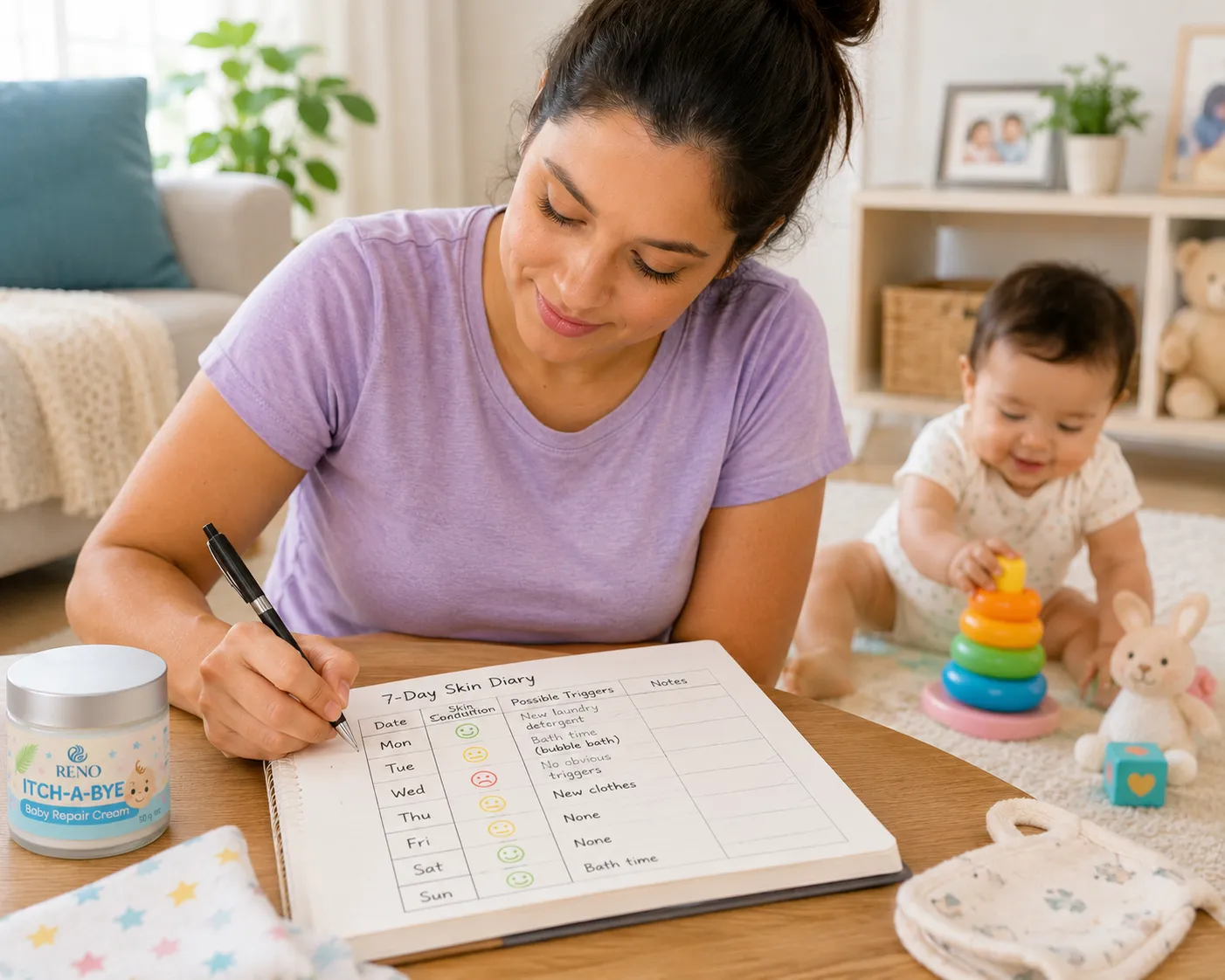
When your baby’s skin is dry, itchy or eczema-prone, it can be surprisingly difficult to work out whether things are actually getting better. One evening the cheeks look calmer, the next morning the legs feel rough again, and by bedtime the scratching has returned. Parents naturally try to remember what changed, but after several days of feeds, baths, washing, sleep disruptions and everyday family life, those details quickly blur together. A simple seven-day skin diary can turn those scattered observations into something far more useful.
Unlike a trigger tracker, which focuses mainly on identifying possible exposures, a 7-Day Baby Dry Skin Diary gives you a broader picture of the skin itself. You record where the dryness appears, how the skin feels, how much your baby scratches, what happened that day and what you did to support the skin. Seven days is long enough to begin seeing patterns without turning skincare into a permanent monitoring exercise. By the end of the week, you should have a much clearer picture of what your baby’s skin is actually doing.
Why Seven Days Can Tell You More Than One Bad Skin Day
Parents understandably react to what they can see today. If the skin suddenly looks redder or feels rougher, the instinct is often to change something immediately. The problem is that baby skin does not always respond instantly to what happened immediately before the change. Yesterday’s swimming, last night’s overheating, several days of drooling or repeated washing may all contribute to what you are seeing now.
Looking across seven days gives you perspective that one isolated day cannot provide. Instead of asking whether the skin looks bad today, you can ask whether the overall direction is improving, worsening or staying roughly the same. You may discover that the cheeks are gradually improving even though there was one difficult evening in the middle of the week. That distinction can stop you abandoning a routine simply because of one temporary setback.
What This Diary Is Designed to Help You Discover
The purpose of the diary is not to diagnose your baby’s skin condition. It is designed to help you observe what is happening more accurately. You are looking for changes in dryness, itching, redness, location and the circumstances surrounding those changes. You are also looking for the things that appear to help.
That last point is important because parents often record only what went wrong. A cooler night, shorter bath, gentler drying routine or consistent application of cream may coincide with a noticeably better morning. Those positive patterns deserve to be recorded too. Knowing what appears to help can be just as valuable as identifying what may be adding pressure to the skin.
Before Day One: Choose the Areas You Want to Watch
Do not try to monitor every centimetre of your baby’s skin. Choose the two or three areas that concern you most, such as the cheeks, arms, legs, tummy, neck or behind the knees. Watching the same areas each day makes comparisons much easier. If another area suddenly becomes important, you can add it to the diary.
Try to check the skin at roughly the same times each day. Morning and evening are usually enough for most families. The morning check shows you how the skin behaved overnight, while the evening check captures the accumulated effects of the day. Consistency is more valuable than repeatedly checking the skin every hour.
Record 1: Where Is the Dry Skin?
Start each entry by recording exactly where you can see or feel dryness. Instead of writing simply “skin dry,” write “both cheeks,” “behind knees,” “lower legs” or “wrists and hands.” Location matters because different areas of the body experience different pressures. The face may be dealing with saliva and food contact while the legs may be experiencing clothing, crawling, grass or swimming.
Also note whether the affected area has changed since yesterday. Has it spread, become smaller or stayed in the same place? Is a previously dry area now feeling smoother? These small details become surprisingly useful when you compare all seven days together.
Record 2: How Dry Does the Skin Feel?
Appearance does not always tell the whole story. Skin can look relatively normal but still feel rough, tight or flaky when you gently touch it. Give the dryness a simple score so that you can compare one day with another. You do not need a complicated medical scale.
You could use 0 for no noticeable dryness, 1 for mild dryness, 2 for clearly dry or rough skin and 3 for very dry, flaky or cracked skin. Use the same scale every day rather than worrying about whether the number is perfect. What matters is whether the scores begin moving consistently up or down. By day seven, that trend can tell you far more than your memory alone.
Record 3: How Much Is Your Baby Scratching?
Dryness and itching do not always move together. Sometimes skin looks much better but the baby is still scratching, while on another day the skin looks dry but does not seem to bother them very much. That is why itching deserves its own entry. Record what your baby actually does rather than trying to guess how itchy the skin feels.
A simple scale works well here too. 0 can mean no noticeable scratching, 1 occasional scratching, 2 frequent scratching and 3 persistent scratching that is difficult to interrupt or disturbs sleep. Also write down where the scratching happens. A repeated pattern involving one particular area may give you another clue about what that skin is experiencing.
Record 4: What Happened Overnight?
Night-time can reveal skin problems that are less obvious during the day. Babies may become warmer under sleepwear and bedding, and there are fewer distractions from itching once they settle. Scratching may also happen during sleep without parents immediately noticing it. Morning scratch marks can therefore tell a story about what happened overnight.
Record whether your baby slept normally, woke more often than usual or scratched during the night. Note whether the room felt particularly warm and whether different pyjamas, bedding or a sleep sack were used. If several difficult mornings follow warm or restless nights, that pattern deserves attention. It may point you toward the sleep environment rather than immediately toward another skincare product.
Record 5: Bathing and Water Exposure
Write down whether your baby had a bath that day and approximately how long it lasted. Record whether the water was warm or particularly hot and whether soap, cleanser, shampoo, bubble bath or bath oil was used. If the routine was exactly the same as usual, a short note is enough. If something changed, make that change clear.
Swimming should also be recorded separately because it combines water exposure with other factors. Chlorinated water, wet swimwear, sunscreen and towel drying may all occur within a relatively short period. Some babies become noticeably drier several hours after leaving the pool rather than immediately afterwards. Without a diary, that delay can make the connection easy to miss.
Record 6: Heat and Sweat
Heat deserves a place in every baby skin diary because it is one of the easiest pressures to overlook. Babies can become warm in car seats, prams, sleep sacks and layered clothing even when the weather itself does not seem particularly hot. Sweat and warmth can make already irritated skin feel considerably itchier. The effect may become especially noticeable around the neck, back, chest and skin folds.
Write down whether the day was hot, whether your baby seemed sweaty or whether they spent a long period bundled in warm clothing. Also note unusually warm nights. You do not need to record exact temperatures unless you want to. A simple entry such as “hot afternoon, sweaty after car trip” may be enough to reveal a repeating pattern later.
Record 7: Drooling, Teething and Face Wiping
For babies who are teething or drooling heavily, the face may experience dozens of small exposures every day. Saliva repeatedly wets the cheeks, chin and neck, while bibs and cloths repeatedly rub those same areas. Food may then add another layer of contact and cleaning. None of these events may seem significant by themselves.
Record heavy drooling days and how often the face seemed to need wiping. Note whether bibs became wet and whether the skin around the mouth, chin or neck looked different afterwards. If facial dryness consistently worsens on heavy drooling days, you have found a useful pattern. That knowledge can help you focus more attention on protecting those particular areas.
Record 8: Food Contact Around the Face
Once solids begin, mealtimes can become an important part of the skin diary. The goal is not to create an exhaustive food journal unless you have a particular reason to do so. Instead, record new foods and especially messy meals where food remained in contact with the cheeks, chin or neck. Also note whether the face needed repeated wiping afterwards.
This helps distinguish between what your baby ate and what physically contacted the skin. Local redness exactly where food and saliva have been sitting can tell a different story from symptoms appearing elsewhere on the body. Looking at the location and timing together gives you much more useful information. It also helps prevent every facial flare from automatically being blamed on a food.
Record 9: Clothing, Bedding and Laundry
Clothing is in contact with your baby’s skin for most of the day, yet it is often forgotten when parents investigate recurring dryness. New clothes may introduce different fabrics, seams, elastic or simply more heat. Bedding and sleepwear can have similar effects overnight. Even an outfit that feels soft in your hand may behave differently after several hours against warm skin.
Record new clothes, unusually heavy layers or anything that seemed to rub a particular area. Also note changes to detergent, fabric softener, laundry sanitiser or other laundry products. If nothing changed, there is no need to write a detailed entry every day. The purpose is to capture differences that may later explain a pattern.
Record 10: What Did You Put on the Skin?
Write down the skincare products used each day and approximately when they were applied. Include moisturisers, creams, cleansers, sunscreen, bath products and anything new. If you are using the same routine every day, this can be as simple as a tick. Consistency makes the diary much easier to interpret.
If you are using Itch-A-Bye Baby Repair Cream, record where you applied it and whether you used it once or more than once that day. Try not to change several other skincare products simultaneously unless there is a clear reason to do so. A stable routine gives you a better baseline for understanding everything else that is happening around the skin. It also makes it easier to judge whether the overall condition is moving in the right direction.
Record 11: What Was Different Today?
This may become the most useful line in the entire diary. Every evening, ask yourself one simple question: What was different today? Perhaps your baby went swimming, spent several hours outdoors, wore new clothes, had a longer bath or started a new food. Maybe the weather suddenly became much hotter.
You may also discover that nothing obvious was different. Record that too. Not every change in the skin has an immediately identifiable explanation. Over seven days, however, apparently unrelated events may begin forming a pattern.
Record 12: Was Today Better, Worse or About the Same?
Finish each daily entry with a simple overall judgement. Compared with yesterday, was the skin better, worse or about the same? Do not overanalyse this answer. It is simply a way to capture your overall impression before the details disappear from memory.
At the end of seven days, these entries create a useful visual trend. You may see three days of improvement, one difficult day and then another three days of progress. Without the diary, that one difficult day may have felt as though everything had failed. The written record shows the larger picture.
Take One Photograph Each Day
A photograph can strengthen the diary enormously because memory is poor at comparing gradual visual changes. Choose one or two areas and photograph them at approximately the same time each day. Try to use similar lighting and distance. You do not need dozens of photographs.
At the end of the week, place the Day 1 and Day 7 photographs side by side. Then look at the photographs in between. Is the affected area smaller, less red, smoother or roughly unchanged? Sometimes improvement becomes much more obvious when the images are viewed together.
Your 7-Day Baby Dry Skin Diary
| What to Record | Your Entry |
|---|---|
| Date | |
| Main areas of dryness | |
| Dryness score: 0–3 | |
| Itching score: 0–3 | |
| Night scratching or disturbed sleep | |
| Bath or swimming today? | |
| Hot weather, sweating or overheating? | |
| Heavy drooling or teething? | |
| New food or significant food contact? | |
| New clothing, bedding or laundry product? | |
| Skincare products used | |
| Where cream was applied | |
| Anything unusual today? | |
| Better, worse or about the same? | |
| Daily photograph taken? |
You can copy this table seven times and label the pages Day 1 through Day 7. Keep each entry short enough that completing it becomes part of the evening routine rather than another burden. Two or three minutes is usually enough. What makes the diary valuable is not the amount you write, but the consistency of the observations.
Day 1: Establish Your Baseline
Day 1 is your starting point. Describe the skin as it is today without trying to explain why it looks that way. Record the affected areas, dryness score and itching score. Take your first photograph.
Also record the routine you are already following. What products are you using, how often are you applying them and what happened during the day? This becomes your baseline against which the next six days can be compared. Resist the temptation to make several changes immediately unless something clearly needs attention.
Day 2: Look for Changes, Not Conclusions
On Day 2, compare the skin with yesterday but do not start drawing conclusions. One day is rarely enough to establish a meaningful pattern. Record whether the dryness and itching scores moved up, down or stayed the same. Pay particular attention to whether the same areas remain affected.
Write down anything that changed during the previous twenty-four hours. If the baby had a bath, went swimming or experienced a particularly warm night, record it. You are collecting clues rather than deciding what they mean. The interpretation comes later.
Day 3: Pay Attention to Timing
By Day 3, start noting when scratching seems most noticeable. Is it after meals, after bathing, during the afternoon or mainly at bedtime? Timing can reveal patterns that photographs alone cannot show. It may also help explain why the skin looks different at particular times.
Continue using the same dryness and itching scales. Avoid changing your scoring system because the skin looks slightly different from what you expected. Consistency is what allows you to compare the seven days. The numbers do not have to be medically precise to be useful.
Day 4: Look at the Environment
Day 4 is a good point to examine what surrounds your baby. Think about temperature, clothing, bedding, time outdoors, car seats, prams, crawling surfaces and anything else repeatedly touching the skin. These ordinary environmental pressures are easy to miss when the search is focused entirely on skincare products. Record anything that stands out.
Also compare your Day 1 and Day 4 photographs. Do not expect dramatic change. Look for smaller differences in texture, redness and the size of affected areas. You are now beginning to see a trend rather than a snapshot.
Day 5: Look for Repetition
By Day 5, repeated patterns may begin appearing. Perhaps the baby scratched more after both bath days. Maybe facial redness appeared on the two days with heavy drooling. Perhaps the best day followed a cooler night and a particularly simple skincare routine.
Do not treat repetition as absolute proof of a trigger. Instead, mark it as something worth watching. A pattern that repeats again becomes more meaningful. This is where the diary starts replacing vague suspicion with useful observation.
Day 6: Notice What Is Helping
Day 6 is deliberately focused on improvement. Ask yourself what was happening on the baby’s best skin days. Was the routine simpler, the weather cooler or the bath shorter? Was cream applied more consistently?
Parents can become so focused on avoiding triggers that they overlook the conditions under which the skin seems happiest. Those positive patterns can guide the routine just as strongly as negative ones. Record them clearly. What helps your baby’s skin deserves a place in the diary too.
Day 7: Compare the Whole Week
On Day 7, complete the diary normally before reviewing anything. Then compare the first and last photographs, dryness scores, itching scores and affected areas. Look at the entire week rather than allowing the worst day to dominate your judgement. Ask whether the overall direction was better, worse or unchanged.
Next, circle any exposure that appeared repeatedly before difficult days. Mark anything that appeared repeatedly before better days as well. You now have a seven-day picture of the skin rather than seven separate memories. That is the real purpose of the diary.
The Skin Threshold Model Can Help You Read the Diary
One reason skin diaries are so useful is that there may not be one single trigger behind every difficult day. In Beyond the Skin Barrier, we explain this through what we call the Skin Threshold Model. Think of the skin as having a threshold for the pressures it encounters. Individual pressures may be tolerated until enough of them accumulate.
A long bath may not create a problem by itself, and neither may a warm afternoon. Add swimming, sweat, friction, drooling and repeated wiping within the same twenty-four hours, however, and the total load may become much greater. The skin may then cross its threshold and become noticeably drier, itchier or more irritated. Your seven-day diary helps you see those combinations.
Do Not Search Only for One Villain
This is one of the biggest lessons the diary can teach. Parents often begin with the assumption that one thing must be responsible. They search for the wrong moisturiser, wrong detergent, wrong food or wrong fabric. Sometimes one exposure really does stand out, but frequently the picture is more complicated.
The diary may show that the difficult days were not associated with one repeated product at all. Instead, they may have been the days when several pressures occurred together. That changes the question from “What is causing my baby’s skin?” to “What is adding to the total pressure on my baby’s skin?” That can be a far more productive way to think.
Repair, Nourish and Defend
Once you begin identifying the pressures surrounding the skin, the next part of the strategy is supporting the skin itself. Our approach is built around three principles: Repair, Nourish and Defend. Repair means supporting the barrier so the skin can hold moisture more effectively and perform its protective role. Nourish means giving the skin more than water alone by providing ingredients that contribute moisturising, soothing, conditioning and antioxidant support.
Defend recognises that baby skin exists in a living environment. It encounters bacteria, fungus, other microbes, sweat, water, friction and environmental pressures every day. The objective is therefore not simply to make dry skin temporarily feel softer. It is to support the skin more comprehensively while also reducing unnecessary pressures around it.
Where Itch-A-Bye Fits Into the Diary
Itch-A-Bye Baby Repair Cream was developed around this broader Repair, Nourish and Defend approach for dry, itchy and eczema-prone baby and young children’s skin. Rather than relying on one fashionable ingredient, the formulation combines ingredients that perform complementary roles. Glycerin and Hyaluronic Acid support hydration, while Black Seed Oil provides emollient support and naturally occurring bioactive compounds. MSM and Allantoin contribute soothing, conditioning and skin-supportive properties.
Vitamin C and Vitamin E add antioxidant support. The formulation also contains carefully selected plant extracts including Centella asiatica, Chamomile, Licorice, Scutellaria baicalensis, Green Tea, Rosemary, Polygonum cuspidatum and Ginger. These botanicals contain compounds investigated for properties including antioxidant, soothing and anti-inflammatory activity. It is the synergy of the formulation that matters rather than expecting one ingredient to do everything.
Why the Diary Makes Your Skincare Routine More Meaningful
Without a diary, parents may use a cream for several days and then decide it is not working because the baby had one bad night. But perhaps that night followed swimming, unusually hot weather and heavy drooling. The topical routine did not suddenly exist in isolation from everything else happening to the skin. Context matters.
Recording both skincare and daily exposures gives you that context. You can see whether the overall trend improves while the routine remains consistent. You can also see whether particular environmental pressures repeatedly overwhelm otherwise calmer skin. This is a much more useful way to evaluate what you are doing than judging the entire routine from one difficult evening.
What to Do After the Seven Days
At the end of the week, do not immediately eliminate everything that appeared before a difficult day. Start with the patterns that repeated most clearly. If swimming was followed by increased dryness three times, your post-swim routine deserves closer attention. If hot nights repeatedly matched increased scratching, the sleep environment may deserve adjustment.
Make one sensible change at a time whenever possible. Then continue observing the skin. Changing the detergent, moisturiser, bath routine, clothing, bedding and diet all at once may leave you with no idea which change actually mattered. The diary should make your decisions more deliberate, not create a new round of guessing.
When Your Seven-Day Diary Can Help a Health Professional
If your baby’s skin remains persistently troublesome, the diary can also help you explain what has been happening. Instead of trying to remember several weeks during an appointment, you can show when the symptoms appeared, which areas were affected and whether scratching disturbed sleep. Photographs can provide additional context. You can also show which products and routines you have already tried.
This does not mean you need to arrive with pages of complicated data. A clear seven-day record is often enough to make the conversation more specific. It can highlight whether symptoms are localised or widespread and whether they are changing over time. Most importantly, it gives you a clearer history than memory alone.
When Not to Wait for Day Seven
The diary is designed for observing familiar dry, itchy and eczema-prone skin, not for watching significant deterioration while waiting for the week to finish. Increasing warmth, swelling, pain, significant weeping, blistering, heavy crusting or substantial skin breakdown deserve closer attention. Repeated bleeding or deep cracks should also be assessed rather than simply scored in the diary. Your baby’s overall wellbeing matters as much as the appearance of the skin.
Fever, unusual tiredness or a baby who appears generally unwell should not be treated as another diary entry to review later. Sudden widespread symptoms, facial swelling or breathing difficulty after an exposure require prompt medical attention. The diary is there to help you recognise patterns in everyday skin behaviour. It should never stop you responding when something clearly falls outside that pattern.
Frequently Asked Questions
Is Seven Days Really Long Enough?
Seven days is a useful starting period because it captures weekdays, different activities and enough repetition for some patterns to emerge. It will not answer every question, especially if a suspected exposure happens only occasionally. If the diary is useful and not becoming burdensome, you can continue it for another week. The first seven days give you a structured place to begin.
Should I Change My Baby’s Cream During the Diary?
If your baby is comfortably tolerating the current routine, keeping it stable can make the diary easier to interpret. Introducing several new products at once adds more variables. If you decide to change something, record exactly when you changed it. That allows you to compare the days before and after.
Should I Record Every Meal?
Usually that is unnecessary unless food is a particular concern. Record new foods, unusually messy meals and occasions where food spent significant time against the skin. Pay attention to where any skin change appears. A seven-day skin diary should remain manageable rather than becoming a complete record of everything your baby does.
What If My Baby Has One Very Bad Day?
Record it carefully but compare it with the rest of the week. Ask what was different during that day and the previous twenty-four hours. One bad day does not necessarily mean the whole routine has failed. The week-long trend provides the context needed to interpret it.
Should I Take Photos Every Day?
One photograph each day can be extremely useful, especially if you photograph the same area under similar conditions. This makes gradual improvement or deterioration easier to see. Avoid obsessively photographing the skin throughout the day. The purpose is comparison, not constant surveillance.
Can I Use the Diary While Using Itch-A-Bye?
Yes. Record where and when you apply Itch-A-Bye Baby Repair Cream and try to keep the application routine reasonably consistent. This allows you to evaluate the skin in the context of the whole week. It can also show whether certain environmental pressures repeatedly coincide with more difficult days.
What If I Find Several Possible Triggers?
That is not unusual and may actually be the most useful discovery. The Skin Threshold Model suggests that several smaller pressures may accumulate rather than one factor acting alone. Look for combinations that repeatedly occur before difficult days. Then consider which pressures can reasonably be reduced without unnecessarily restricting your baby’s life.
What If I Find No Pattern at All?
That is still useful information. It tells you that there may not be one obvious everyday exposure explaining the changes. Continue the diary for another week if appropriate or take the information with you if you seek further assessment. A lack of an obvious pattern is better than inventing one from guesswork.
Seven Days Can Change the Questions You Ask
At the beginning of the week, you may be asking, “Why is my baby’s skin dry again?” By the end of seven days, you may be asking much more useful questions. Does scratching increase after warm nights? Are the cheeks worse on heavy drooling days? Does swimming consistently precede a drier evening, and does the skin settle when the after-swim routine is more consistent?
Those questions matter because recurring baby skin problems rarely exist in a vacuum. The developing skin barrier is constantly interacting with water, temperature, clothing, saliva, food, microbes, friction, products and the wider environment. This broader way of understanding dry, itchy and eczema-prone skin is explored throughout Beyond the Skin Barrier. It is also why we believe parents benefit from looking beyond what they can see on the surface.
The diary gives you one practical way to do that. Repair, Nourish and Defend gives you a framework for supporting the skin while you learn what pressures surround it. Itch-A-Bye Baby Repair Cream provides the topical part of that approach through a formulation designed around complementary moisturising, soothing, conditioning, antioxidant and botanical ingredients. The diary provides the other half: understanding what is happening around your baby’s skin from one day to the next.
Seven days will not answer every question. But seven days of consistent observation can be far more useful than seven days of changing products, blaming ingredients and wondering what happened. Do not just remember the bad days. Record the pattern. That simple shift can give parents a much clearer picture of what their baby’s skin is experiencing.