
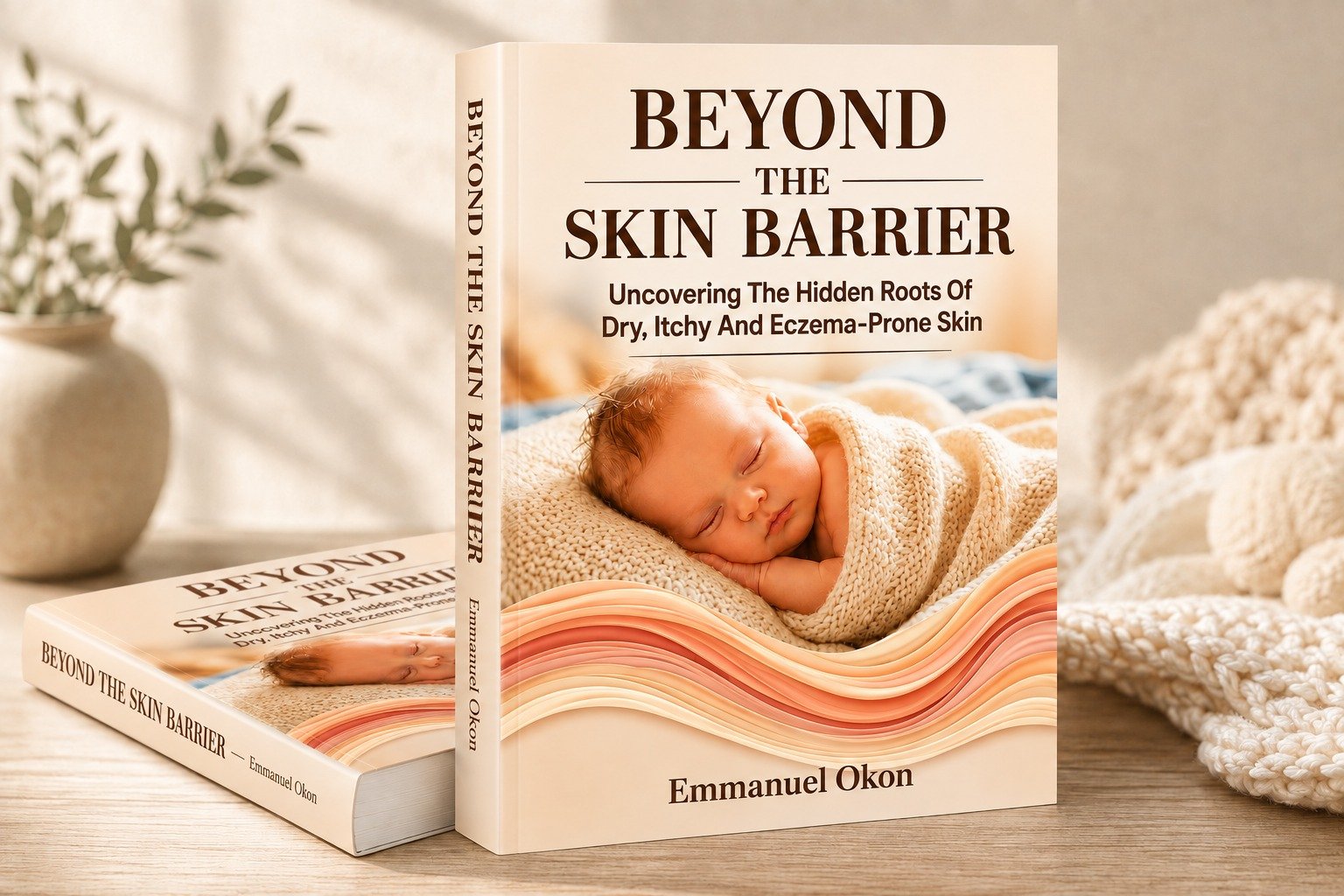
Beyond the Skin Barrier: Why Is My Baby So Itchy… And Why Does the Eczema Keep Coming Back?

A free guide for parents who want to understand what may be happening beneath the surface of dry, itchy, sensitive and eczema-prone baby skin.

Maybe you have found yourself awake at night watching your baby scratch. You pull their little hand away. A few moments later, it goes straight back to the same irritated patch.

You moisturise. You change the washing powder. You try another cream. You wonder whether they are getting too hot. You start thinking about food, allergies, bedding, bath products and almost everything else they come into contact with.
Sometimes the skin settles. Then, just when you think you are getting somewhere, the itching starts again. And eventually you find yourself asking a much bigger question.

Why does this keep happening?

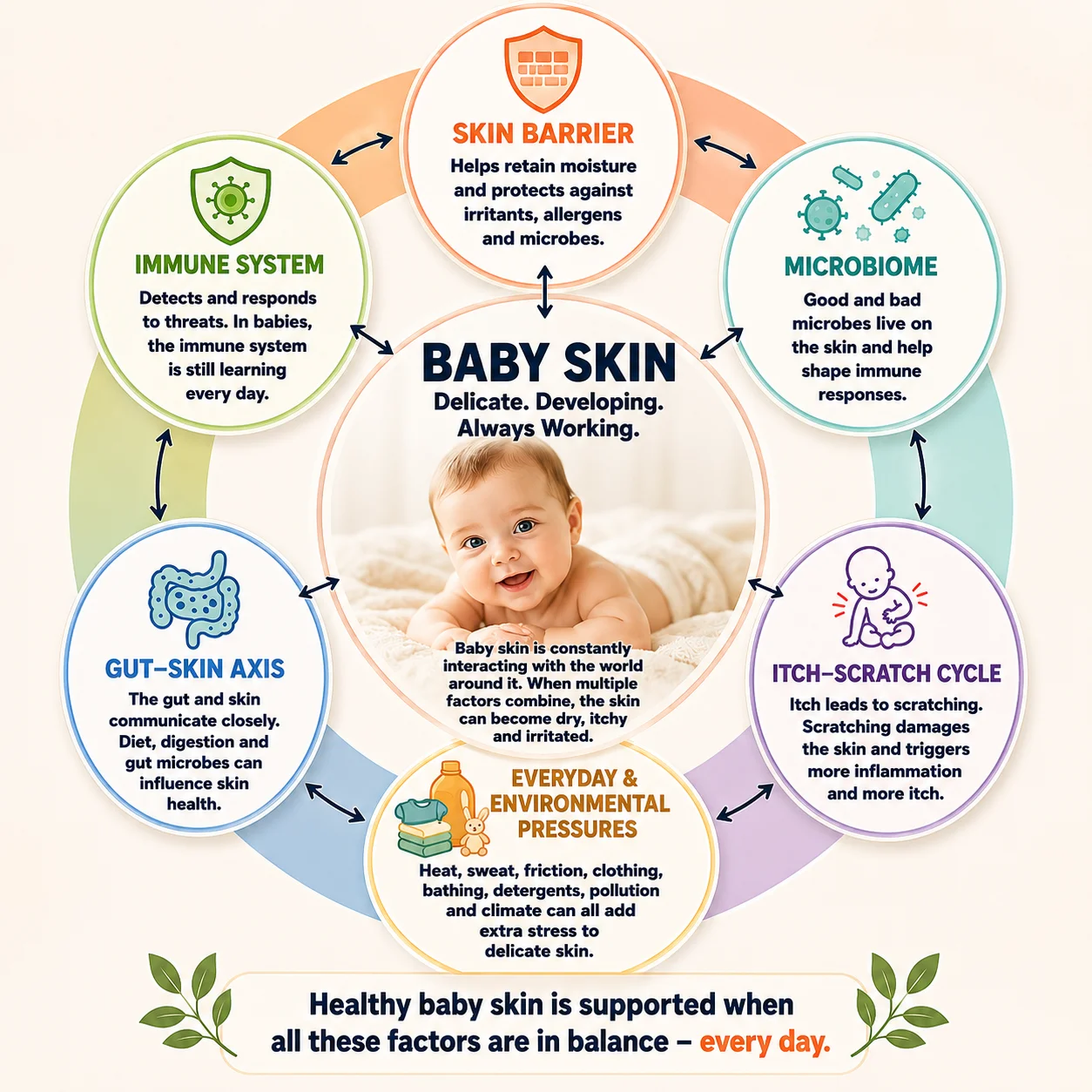
That question is at the heart of Beyond the Skin Barrier. This free ebook was written to help parents understand some of the interconnected factors that may influence dry, itchy, sensitive and eczema-prone baby skin. It explores the skin barrier, the itch-scratch cycle, immune signalling, the gut-skin axis, microbiome, food and allergy, environmental pressures and why several seemingly small factors may sometimes combine to contribute to a flare.
Most importantly, it offers a simpler way to bring that bigger picture together.

Repair. Nourish. Defend.

You Have Been Looking at the Skin. But What If There Is More To Understand?

There is a reason parents can become frustrated by recurring baby eczema. The symptoms are visible. You can see the dryness. You can see the redness. You can see your baby scratching. So naturally, most of your attention goes to the surface of the skin.

And supporting the skin barrier is extremely important. But eventually many parents start asking questions that go beyond moisturising.

Why is my baby so itchy? Why does the eczema disappear and then return? Why is it worse some nights than others? Could food have something to do with it? What about allergies? Does gut health matter? Why does my baby seem fine one day and flare the next? Could several things be happening at once?

These are good questions. And science is increasingly showing us just how interconnected the skin is with the rest of the body and the world around it. That does not mean there is one hidden cause behind every case of baby eczema. There isn’t.

But it does mean there may be value in looking beyond what we can immediately see. That is where this book begins.

Why Is My Baby So Itchy?

Itch changes everything. An adult can understand that scratching irritated skin may make things worse. A baby cannot.

When something itches, the natural response is to scratch it, rub it or move against whatever brings temporary relief. But that relief can come at a cost.

Scratching can further disturb an already vulnerable skin barrier. When the barrier is compromised, the skin may lose moisture more readily. Dryness and irritation can increase. Vulnerable skin may become increasingly exposed to irritants and other environmental pressures.

And then something frustrating happens. The skin itches again. The baby scratches again. And the cycle continues.

The Itch-Scratch Cycle

This simple cycle helps explain why dealing with the visible irritation alone may sometimes feel like you are constantly returning to the beginning.

The question is no longer simply: How do I stop the itch? It also becomes: What is keeping the cycle going?

And that leads us to another question parents ask all the time.

Why Does My Baby’s Eczema Keep Coming Back?

If you have been dealing with recurring eczema for a while, you may have started searching for the trigger.

Maybe it is dairy. Maybe it is detergent. Maybe it is heat. Maybe it is the bath. Maybe it is dust. Maybe it is a cream. Maybe it is something in the environment.

Sometimes there may indeed be an identifiable trigger. But what if, in other situations, there isn’t just one? What if several smaller pressures are accumulating at the same time?

This idea became one of the most useful ways of thinking about recurring eczema in Beyond the Skin Barrier.

The Eczema Threshold

Imagine for a moment that your baby’s body and skin have a certain capacity to cope with different pressures.

One day there might be some dryness. But everything else is relatively calm. No major flare.

Another day there might be dryness plus heat. Still manageable. Then add sweating. A little friction. More scratching. An environmental irritant. Perhaps an allergen or another individual influence.

At some point, the combined pressure may become greater than the child’s individual capacity. The threshold is crossed. And that is when the flare becomes visible.

The Interconnected System

This model does not claim that every flare can be explained this way. Instead, it gives us another way to think.

Rather than endlessly asking: “What is the one thing causing this?” we can also ask: “What combination of pressures might be affecting my baby’s skin right now?”

That is a very different question. And sometimes a much more useful one.

What If the Skin Is Only Where We Can See the Problem?

Your baby’s skin is remarkable. It is not simply a covering. It is an active protective organ constantly interacting with the world around it.

It helps retain moisture. It provides a physical barrier. It encounters microorganisms. It interacts with allergens and irritants. And it communicates with the immune system.

During infancy, many of these systems are still developing. The skin barrier is maturing. The immune system is learning how to respond to the outside world. The gut microbiome is developing rapidly. New foods are introduced. New environments are encountered.

This is where our understanding of eczema begins to become much more interesting. Because the skin may be where we see the symptoms. But it does not exist independently from everything else.

Different systems. One interconnected child.

What Happens When the Baby’s Skin Barrier Is Damaged?

Think of the skin barrier as the protective outer wall between your baby’s body and the world.

When that barrier is functioning effectively, it helps retain moisture while providing protection from outside pressures. When it becomes compromised, moisture may escape more easily.

The skin becomes drier. Dry skin can become increasingly vulnerable to irritation. Scratching can create further disruption. And the cycle can continue.

This is why the skin barrier remains so important in Beyond the Skin Barrier. Looking beyond the barrier does not mean ignoring it. Quite the opposite. It means understanding why supporting it is so fundamental while also recognising that other factors may be influencing what happens there.

But What Does the Gut Have to Do With the Skin?

At first, this sounds like an unusual connection. Your baby’s gut and skin are in completely different parts of the body. What could one possibly have to do with the other?

Quite a lot of scientific interest now surrounds this question. The gut contains enormous communities of microorganisms collectively known as the gut microbiome. These microorganisms and their products interact with the developing immune system. The immune system, in turn, has important relationships with the skin.

Researchers use the term gut-skin axis to describe some of the communication and relationships occurring between these systems. This is a fascinating and evolving area of research. But it is important not to turn an emerging area of science into an oversimplified claim.

Not every baby’s eczema comes from the gut. Beyond the Skin Barrier does not make that claim. Instead, the book asks a more responsible question: Could understanding the gut, microbiome and immune system help us understand the wider biological environment in which eczema develops?

That is a question worth exploring.

And What About Food?

This is where things can become particularly confusing for parents. You notice a flare. You remember something your baby ate. You search online. Suddenly you are reading about dairy, eggs, wheat, peanuts, intolerances, allergies and elimination diets.

Before long, food can start to feel frightening. It shouldn’t.

Food allergy and eczema can occur together. But eczema does not automatically mean that your baby has a food allergy. And the appearance of a flare after eating does not necessarily prove that the food caused it.

There are situations where proper allergy investigation is important. There are also situations where unnecessarily removing foods may create additional problems.

The goal should not be to fear food. The goal is to understand when food may matter and when professional investigation is appropriate. Beyond the Skin Barrier explores food within the wider eczema picture rather than treating diet as the universal explanation.

What About the Microbiome on the Skin?

Your baby’s gut is not the only place where microorganisms live. The skin itself supports communities of microorganisms. This is normal. Healthy skin is not sterile skin.

But when the physical environment of the skin changes, including through dryness, scratching and barrier disruption, the microbial environment may change too. Researchers continue to investigate how these relationships interact with eczema.

This leads to an important distinction. The objective is not to wage war on every microorganism living on the skin. The objective is to support vulnerable skin while helping it defend against bacteria, fungus and other microbes without harshly stripping the very barrier we are trying to protect.

And now the pieces begin to come together.

So What Are We Actually Trying to Do?

After reading about barriers, microbes, immunity, food, itching and environmental pressures, it would be easy to make baby skincare sound impossibly complicated. That is not the purpose of this book.

Understanding more should ultimately help us simplify. And that is why all these ideas eventually came together into three words.

Repair. Nourish. Defend.

The Skin Trifecta

R

Repair

Start with the physical barrier. Support vulnerable skin. Help it retain moisture. Reduce unnecessary irritation. Create better conditions for recovery.

N

Nourish

Skin needs supportive conditions in which to recover. Nourish considers those conditions rather than simply chasing temporary surface symptoms. It recognises that skin exists within a much wider biological system.

D

Defend

Vulnerable skin still has to interact with the outside world. Defend means reducing unnecessary environmental and microbial pressures while helping the skin defend against bacteria, fungus and other microbes without harsh stripping.

Microbial Defence on Compromised Skin

When the skin barrier becomes weakened, the skin surface can become more vulnerable to microbial imbalance. Certain components of the formulation contribute to helping the skin defend against microbes during the recovery phase. Supporting the skin in this way helps prevent prolonged irritation and allows the barrier to stabilise more effectively.

Together, these mechanisms form the foundation of the Skin Trifecta Method™, which guides the design of the formulation.

Botanical and Skin-Compatible Ingredients

Itch-A-Bye Baby Repair Cream is formulated with all-natural ingredients and plant botanicals selected for their compatibility with sensitive and developing skin.

Botanical extracts such as chamomile, centella asiatica, green tea, and licorice root have been widely studied for their calming and skin-supportive properties. When combined with moisture-supportive ingredients and skin-conditioning compounds, they help create a supportive environment for fragile skin.

The goal of the formulation is not to overload delicate skin with aggressive actives, but to provide consistent biological support for the skin barrier while it recovers.

Skin, Immunity, and the Developing Microbiome

During early life, the skin is closely connected to the developing immune system and microbiome. Many parents observe that their child’s skin condition can fluctuate over time as these systems mature.

While internal immune balance and gut microbiome development can influence skin behaviour, the visible symptoms appear on the skin barrier itself. Supporting the barrier where these symptoms occur helps maintain skin comfort and resilience.

Itch-A-Bye is therefore designed to support the skin barrier directly, helping delicate skin remain nourished, protected, and better able to recover from irritation.

What We Leave Out

Because infant skin is highly sensitive, unnecessary additives can sometimes worsen irritation rather than support recovery. For this reason, Itch-A-Bye is formulated without unnecessary fillers or harsh stripping agents that may destabilise delicate skin.

The formulation focuses only on ingredients that contribute to barrier support, nourishment, and defence of compromised skin.

Important Note

Itch-A-Bye Baby Repair Cream is a cosmetic skincare product. Individual responses may vary depending on skin sensitivity, condition, and consistency of use.

If your child has known sensitivities, we recommend performing a small patch test before full application.

The formulation of Itch-A-Bye follows a structured dermocosmetic architecture designed to support three essential functions of compromised skin.

Barrier Support and Moisture Retention

Infant skin that is dry or irritated often shows increased transepidermal water loss. Ingredients in the formulation help reinforce the moisture barrier and improve hydration within the outer layers of the skin. This helps reduce dryness, supports elasticity of the skin surface, and creates an environment where fragile skin can recover more effectively.

Modulation of Inflammatory Stress

Inflammatory signalling is commonly present in irritated or eczema-prone skin. Botanical extracts and skin-supportive compounds in the formulation help calm visible irritation and support the skin’s natural regulatory processes. When inflammatory stress is reduced, itching, redness, and discomfort can gradually subside.

Microbial Defence on Compromised Skin

When the skin barrier becomes weakened, the skin surface can become more vulnerable to microbial imbalance. Certain components of the formulation contribute to helping the skin defend against microbes during the recovery phase. Supporting the skin in this way helps prevent prolonged irritation and allows the barrier to stabilise more effectively.

Together, these mechanisms form the foundation of the Skin Trifecta Method™, which guides the design of the formulation.

Botanical and Skin-Compatible Ingredients

Itch-A-Bye Baby Repair Cream is formulated with all-natural ingredients and plant botanicals selected for their compatibility with sensitive and developing skin.

Botanical extracts such as chamomile, centella asiatica, green tea, and licorice root have been widely studied for their calming and skin-supportive properties. When combined with moisture-supportive ingredients and skin-conditioning compounds, they help create a supportive environment for fragile skin.

The goal of the formulation is not to overload delicate skin with aggressive actives, but to provide consistent biological support for the skin barrier while it recovers.

Skin, Immunity, and the Developing Microbiome

During early life, the skin is closely connected to the developing immune system and microbiome. Many parents observe that their child’s skin condition can fluctuate over time as these systems mature.

While internal immune balance and gut microbiome development can influence skin behaviour, the visible symptoms appear on the skin barrier itself. Supporting the barrier where these symptoms occur helps maintain skin comfort and resilience.

Itch-A-Bye is therefore designed to support the skin barrier directly, helping delicate skin remain nourished, protected, and better able to recover from irritation.

What We Leave Out

Because infant skin is highly sensitive, unnecessary additives can sometimes worsen irritation rather than support recovery. For this reason, Itch-A-Bye is formulated without unnecessary fillers or harsh stripping agents that may destabilise delicate skin.

The formulation focuses only on ingredients that contribute to barrier support, nourishment, and defence of compromised skin.

Important Note

Itch-A-Bye Baby Repair Cream is a cosmetic skincare product. Individual responses may vary depending on skin sensitivity, condition, and consistency of use.

If your child has known sensitivities, we recommend performing a small patch test before full application.