
Are More Ingredients Better in a Baby Cream?
When parents compare baby creams, one of the first things they often notice is the ingredient list. One product has seven ingredients, another has fifteen, and another seems to have half a pharmacy printed on the back of the jar. It is easy to assume that fewer ingredients must be gentler, or that more ingredients must mean a more advanced formulation. Neither assumption is automatically correct.
The real question is not how many ingredients a baby cream contains. The more useful question is whether each ingredient has a clear purpose and whether the formulation works as a coherent whole. A short ingredient list can be excellent, while a longer one can also be excellent if the ingredients complement one another rather than simply adding complexity. In baby skincare, quality matters far more than the final ingredient count.
Why Parents Often Prefer Short Ingredient Lists
There is a natural appeal to simplicity. When you are caring for a baby with dry, itchy or eczema-prone skin, the last thing you want is to make the problem more complicated. A short ingredient list feels easier to understand and can seem less likely to contain something unnecessary. That instinct is understandable.
There can also be practical advantages to simpler formulations. Fewer ingredients can mean fewer variables when you are trying to work out whether your baby is reacting to something. It can also make the product easier to assess if the skin is already irritated. But simple does not automatically mean complete.
A Very Simple Cream Can Still Be Useful
Some creams are intentionally basic. They may contain a small number of ingredients designed primarily to hydrate, soften or reduce water loss. For mild dryness or normal baby skin, that may be perfectly adequate. There is nothing inherently wrong with a formulation that chooses to do one job well.
The problem comes when a simple product is expected to solve a much broader skin problem than it was designed for. If the skin is persistently dry, itchy or repeatedly irritated, basic moisturisation may not address every pressure involved. A simple formulation can be good while still being too limited for a particular baby’s needs.
More Ingredients Do Not Automatically Mean Better
The opposite mistake is assuming that a longer ingredient list must be more advanced. A product can contain thirty ingredients and still be poorly designed. Some ingredients may be included in tiny amounts, some may duplicate one another, and others may be there for texture, fragrance or marketing appeal rather than meaningful skin support. More ingredients only help when they have a reason for being there.
A long ingredient list can also make it more difficult to identify what is causing a problem if the skin reacts. This is why formulation design matters more than sheer quantity. The goal should not be to fit as many impressive names as possible onto the label. The goal should be purposeful synergy.
The Better Question Is: What Does Each Ingredient Do?
This is where ingredient lists become more useful. Instead of counting ingredients, start grouping them by function. Which ingredients support hydration? Which ones help condition the skin? Are there soothing ingredients, antioxidants, oils or other components with specific roles? That tells you far more than whether there are twelve ingredients or twenty-two.
A well-designed baby cream may include humectants, emollients, oils, vitamins, skin-conditioning ingredients, soothing ingredients and botanical extracts. Those categories can work together rather than compete with one another. The important thing is whether the combination makes sense. A formulation should behave like a team, not like a crowded room.
What Is Ingredient Synergy?
Ingredient synergy means combining ingredients that contribute different strengths to the same overall goal. One ingredient may help attract water, another may help condition the skin, while another may contribute soothing or antioxidant support. None of them needs to do everything. Their value comes from how they complement one another.
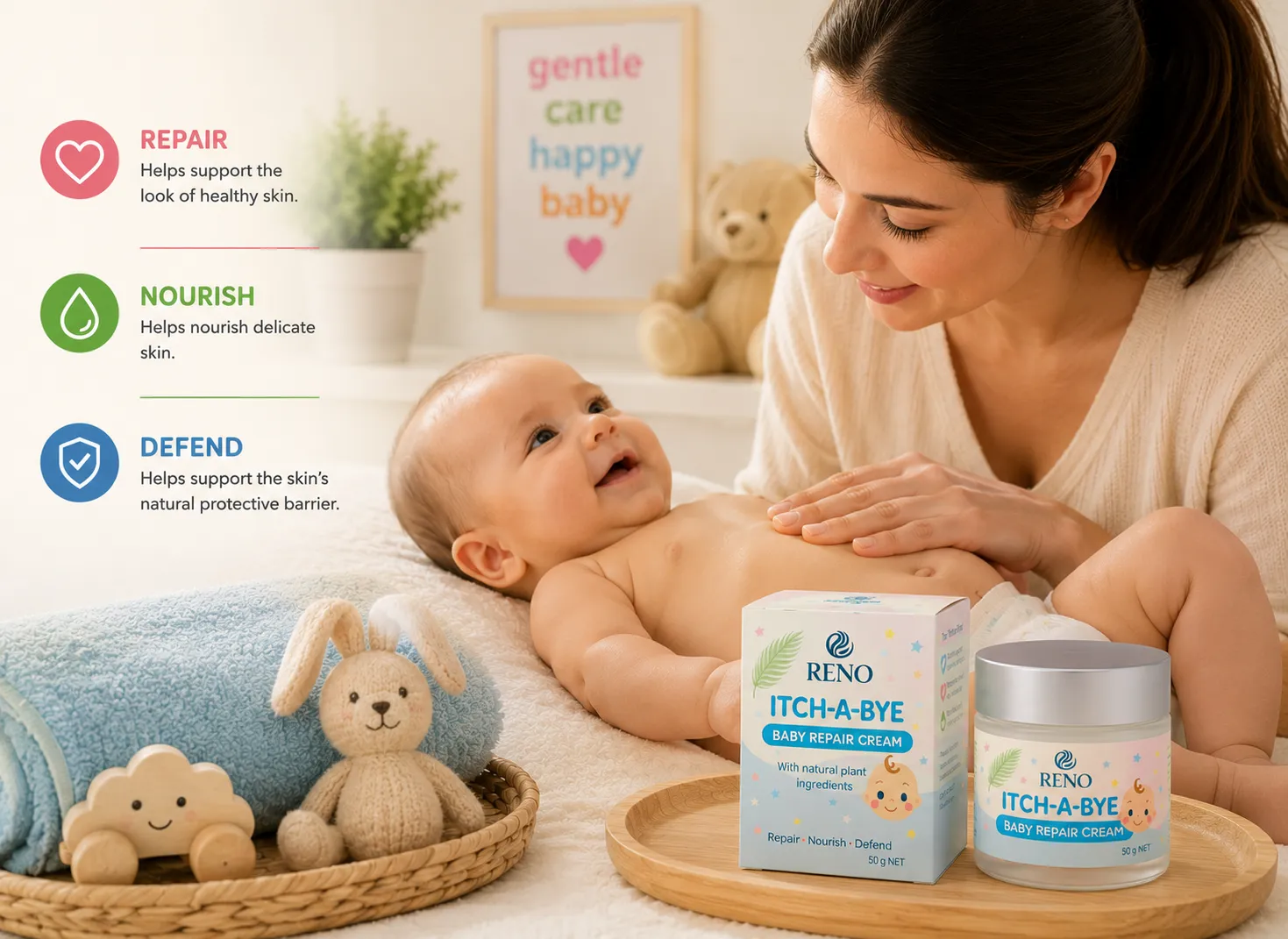
This is the philosophy behind Itch-A-Bye Baby Repair Cream. We did not want one so-called hero ingredient carrying the entire formulation story. We wanted several carefully selected ingredients contributing different forms of support. That is why our approach focuses on Repair, Nourish and Defend rather than on one fashionable ingredient.
REPAIR: Supporting the Skin Barrier
The first part of our philosophy is Repair. Dry and eczema-prone skin can lose water more easily, leaving the surface rough, tight and uncomfortable. Scratching can then add physical pressure to an already vulnerable barrier. Supporting hydration and conditioning becomes important.
This is where ingredients such as Glycerin and Hyaluronic Acid play a role by supporting water retention. Emollient components help improve the feel and flexibility of the skin, while Allantoin adds soothing and skin-conditioning support. These ingredients perform different jobs, but they are directed towards the same broader goal. Repair is about supporting the barrier as a system rather than relying on one single mechanism.
NOURISH: More Than Just Hydration
For us, NourISH does not simply mean adding water. A baby cream can hydrate and still be limited in the type of support it provides. Nourish means combining ingredients that condition, soothe, support hydration and contribute other useful properties. That is why formulation design matters.
Our formulation includes Black Seed Oil, MSM, Allantoin, Hyaluronic Acid, Glycerin, Vitamin C, Vitamin E and a carefully selected botanical complex. These ingredients do not all do the same thing, and that is exactly the point. Their different roles create a broader support system for vulnerable skin. Nourish is about complementary function, not ingredient quantity.
Why Black Seed Oil Is Included
Black Seed Oil, Nigella sativa, is one of the central ingredients in Itch-A-Bye. It contains naturally occurring compounds including thymoquinone that have been investigated for anti-inflammatory, antioxidant and antimicrobial properties. The oil also contributes emollient and conditioning qualities. That gives it a different role from a simple humectant.
It does not replace Glycerin, Hyaluronic Acid or Allantoin. Instead, it sits alongside them as part of the wider formulation. This is a good example of why several ingredients can make sense when they are selected for different reasons. The value is in the relationship between the ingredients, not just the number printed on the label.
Why MSM Is Included
MSM, or methylsulfonylmethane, has been investigated in relation to inflammatory and oxidative processes. That gives it another distinct role within the formula. It does not do the same job as an oil or a humectant. Its inclusion adds another layer of topical support.
This is what a good multi-ingredient formulation should look like. Each ingredient should earn its place. If several ingredients are present, they should expand the range of support rather than simply make the formulation look more impressive. More ingredients are only worthwhile when they add useful function.
Why Allantoin Is Included
Allantoin has a long history of use in skincare for soothing and skin-conditioning support. That makes it particularly relevant when a baby is uncomfortable or repeatedly scratching. Supporting comfort matters because scratching can place additional physical pressure on vulnerable skin. A soothing ingredient therefore has a clear purpose.
Again, Allantoin does not need to replace the role of Glycerin or Black Seed Oil. Its value comes from being different. A good formulation does not need every ingredient to behave the same way.
What About Vitamins?
Vitamins can also contribute to formulation quality when they are included for a clear reason. Vitamin E is widely used for antioxidant and conditioning support, while Vitamin C derivatives are commonly included for antioxidant roles. These functions are different from hydration. That diversity can be useful in a broader formulation.
But the presence of vitamins does not automatically make a cream superior. Concentration, stability and the rest of the formulation still matter. The important thing is that they form part of a coherent system rather than being added purely because consumers recognise the names. Ingredients should be there because they contribute something, not because they look impressive on the packaging.
What About Botanical Extracts?
Itch-A-Bye also contains a selected botanical complex including Centella asiatica, Chamomile, Licorice, Green Tea, Scutellaria baicalensis, Rosemary, Ginger and Polygonum cuspidatum. These plants have different phytochemical profiles and have been researched across areas including soothing, antioxidant, anti-inflammatory and antimicrobial activity. We do not assume that every botanical performs every function. Their differences are part of their value.
Centella does not need to do the same job as Chamomile, and Green Tea does not need to behave like Licorice. The point of the complex is to bring together different forms of support within one formulation. This is another example of synergy rather than ingredient accumulation.
DEFEND: Thinking Beyond Moisture
The third part of our philosophy is Defend. Healthy skin is constantly interacting with bacteria, fungi, environmental irritants and physical contact. Vulnerable skin may need support that goes beyond simply replacing lost moisture. The protective role of the skin matters too.
Black Seed Oil and several botanical ingredients contain compounds that have been investigated for antimicrobial properties. That research informed part of our ingredient-selection approach. This does not mean the finished cream should be used as treatment for an established infection. Defend means supporting vulnerable skin against everyday microbial and environmental pressures.
So, Is a Cream With Five Ingredients Better Than One With Fifteen?
Not automatically. A five-ingredient cream might be beautifully designed for a very simple purpose. A fifteen-ingredient cream might provide a broader range of complementary functions. Either one can be good or poor depending on how the formulation is built. Ingredient count does not tell you formulation quality.
Think of it like cooking. A simple dish with five ingredients can be excellent, while a more complex dish with twenty ingredients can also be excellent if the flavours work together. The number does not determine quality. The combination, balance and purpose do.
Can Too Many Ingredients Be a Problem?
Yes, they can be. Every additional ingredient introduces another variable. A complex formulation can be harder to troubleshoot if the skin reacts, and unnecessary fragrance or poorly chosen botanicals can add complexity without meaningful benefit. More is not always better.
This is why purpose matters. A well-designed formulation should resist the temptation to add ingredients simply because they are fashionable. Each component should have a clear role. The goal is not maximum complexity; it is useful complexity.
Could a Short Ingredient List Be Better for a Baby With Very Reactive Skin?
Sometimes. If a baby appears to react to several products, a simpler formulation can make it easier to reduce variables. This can be useful while you work out what the skin tolerates. The simpler the formulation, the easier it may be to isolate potential problems. That can be particularly useful during periods of uncertainty.
But once again, simple does not automatically mean complete. If the skin remains very dry or itchy, the formulation may not be offering enough support. The right balance depends on what the skin needs and what it tolerates.
What Does “Clean Beauty” Have to Do With This?
Clean beauty has made ingredient counting even more popular. Consumers are often encouraged to avoid long ingredient lists or anything that sounds unfamiliar. But the length or complexity of an ingredient name is not the same thing as risk. A long scientific name is not automatically bad, and a short plant name is not automatically good.
The better approach is to understand purpose and evidence. Some ingredients sound technical because cosmetic labels use standardised names. Others sound natural but may still be unsuitable for a particular baby. Ingredient literacy is more useful than ingredient fear.
Preservatives Still Matter
One category that often gets unfairly criticised is preservatives. Water-based creams need protection against microbial contamination during their intended shelf life and use. A product that becomes contaminated is not safer simply because the manufacturer tried to avoid a preservative that sounded unfamiliar. Preservation is part of formulation safety.
Different products achieve preservation in different ways. Packaging, formulation design and preservatives all play roles. The objective should be to keep the cream stable and safe while maintaining good skin tolerance. Removing important ingredients simply to shorten the label can create its own problems.
Texture Ingredients Can Matter Too
Not every ingredient in a cream is there because it has a direct skin benefit. Some ingredients help keep water and oil mixed together, improve texture, control viscosity or maintain product stability. These may not sound exciting, but they can be essential to how the formulation behaves. A cream has to remain a cream.
Without appropriate emulsifiers and stabilisers, the product could separate or become inconsistent. That means functional formulation ingredients deserve a place even if they are not marketed as hero actives. An ingredient can be important without being glamorous.
Ingredient Quality Matters as Much as Ingredient Number
Two creams can use the same named ingredient and still be very different products. Concentration, purity, extraction method, delivery system and the surrounding formulation can all affect how that ingredient behaves. Seeing a familiar ingredient on a label does not tell you everything about its role.
This is another reason counting ingredients is too simplistic. A carefully formulated product with moderate concentrations of several complementary ingredients may make more sense than a long list containing tiny amounts of fashionable actives. What matters is how the formulation has been built, not how impressive the ingredient list looks.
Ingredient Evidence and Finished-Product Evidence Are Different
This distinction is especially important when discussing multi-ingredient formulas. Research on Black Seed Oil, MSM, Allantoin or botanical extracts tells us something about those individual ingredients. It does not automatically prove that the finished cream produces every outcome reported in those studies. Ingredient evidence and finished-product evidence are not the same thing.
The final formulation contains combinations, concentrations and interactions that are different from isolated ingredients in research. That does not make ingredient studies irrelevant. It means they should be used to explain formulation rationale rather than to make claims the finished product itself has not demonstrated. Good skincare communication keeps those levels of evidence separate.
The Skin Threshold Model Helps Explain Why One Cream May Not Be Enough
Our Skin Threshold Model suggests that vulnerable skin can be influenced by several pressures at the same time. Dryness may add pressure, while heat, sweat, saliva, friction, scratching and environmental exposure add more. A good cream may reduce some of those pressures without removing all of them. The total still matters.
This is why parents can use a well-formulated cream and still see the skin change from one week to the next. The formulation may be doing exactly what it was designed to do while the environment around the skin has become more challenging. Sometimes the answer is not a cream with more ingredients; it is understanding the wider pressures surrounding the skin.
What Should Parents Look for Instead of Ingredient Count?
Look for purpose. Does the formulation contain ingredients that support hydration, conditioning and comfort? Are there emollients, humectants, soothing ingredients or other components that make sense for the skin you are trying to care for? Ask what each group of ingredients contributes.
Then look at the baby’s response. Does the skin remain comfortable for longer after application? Does dryness return quickly? Does scratching continue? The best formulation is the one that makes sense on paper and works well for the individual child.
Where Itch-A-Bye Fits
Itch-A-Bye Baby Repair Cream was created around the idea that more ingredients are only useful when they provide complementary forms of support. That is why we combine Black Seed Oil, MSM, Allantoin, Hyaluronic Acid, Glycerin, vitamins and a carefully selected botanical complex within our Repair, Nourish and Defend framework. We do not add ingredients simply to make the list longer. Each group has a reason for being there.
You can explore Itch-A-Bye Baby Repair Cream here and see how the formulation is built. Our emphasis is not on quantity, but on synergy between hydration, conditioning, soothing, antioxidant and other supportive properties. A thoughtful formulation is more important than either a very short or very long ingredient list.
Go Beyond the Ingredient Count
This is also one of the themes we explore in Beyond the Skin Barrier. Parents are often encouraged to search for one perfect ingredient, one hidden trigger or one universally best cream. In reality, dry, itchy and eczema-prone skin can involve the developing barrier, scratching, environmental pressures, immune signalling, the microbiome and other interacting factors. The skin is more complicated than a number on an ingredient list.
Our Skin Threshold Model helps explain why several small pressures can add up and why one skincare change may only solve part of the problem. You can read Beyond the Skin Barrier here if you want to explore that broader picture. Understanding the skin makes it much easier to judge what a formulation is actually trying to achieve.
So, Are More Ingredients Better in a Baby Cream?
Not automatically. More ingredients can be useful when they are carefully selected for different, complementary roles, but unnecessary ingredients can add complexity without adding value. A short formulation can be excellent, and a longer formulation can also be excellent. Ingredient count alone is a poor way to judge quality.
For parents of babies with dry, itchy or eczema-prone skin, the better question is simple: Does every important ingredient have a purpose, and does the complete formulation give the skin the kind of support it needs? That is the principle behind our approach to Itch-A-Bye. Because the goal is not more ingredients. The goal is the right ingredients working together to help vulnerable skin Repair, Nourish and Defend.