
Baby Body Wash vs Soap: Which Is Gentler for Dry Skin?
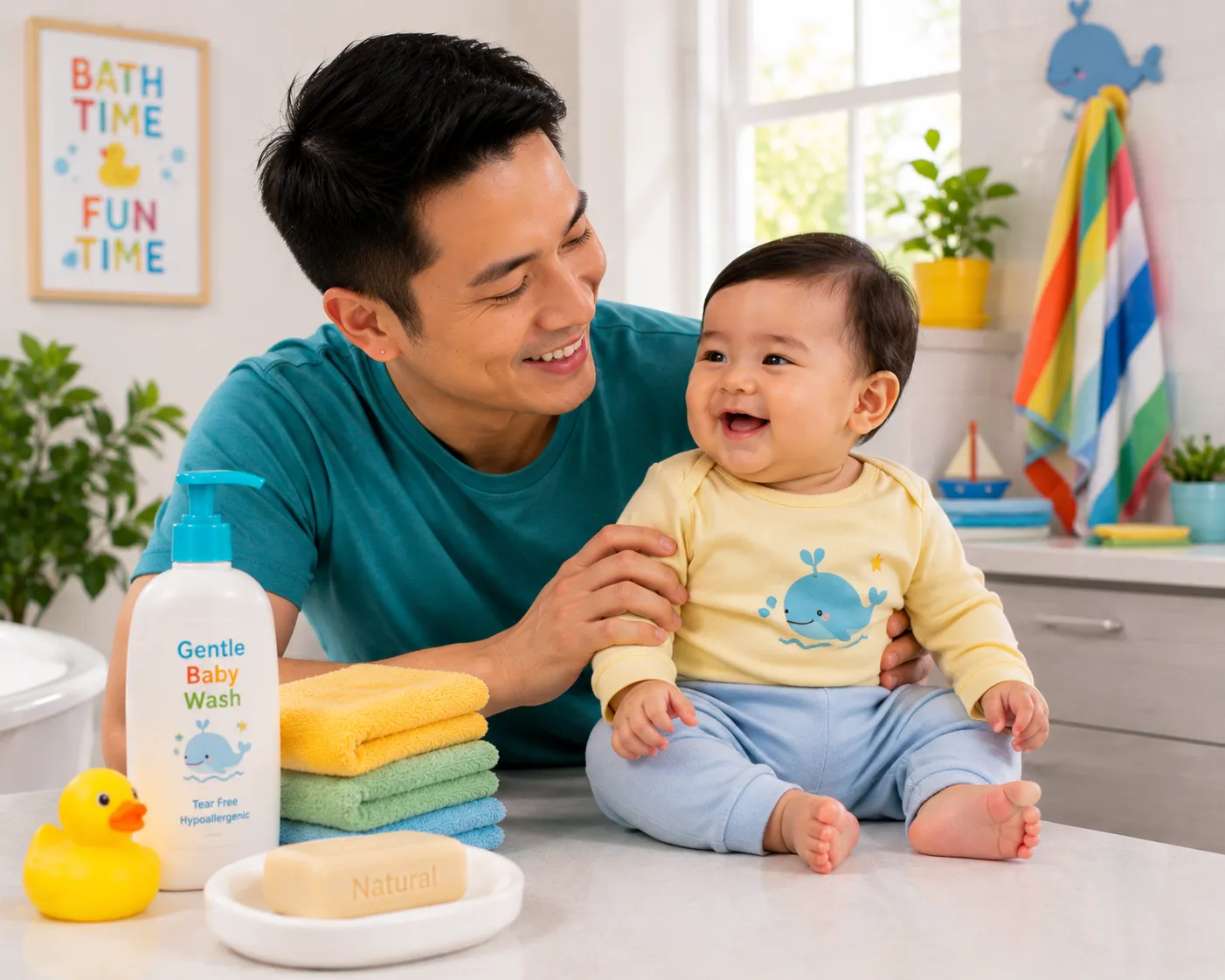
Bath time should be one of the easier parts of looking after your baby. But when your baby has dry, itchy or eczema-prone skin, even choosing something to wash them with can become another decision you worry about. You stand in the baby aisle surrounded by bottles labelled gentle, mild, natural, soap-free and for sensitive skin, and somehow none of it makes the choice any clearer. You simply want something that will get your baby clean without leaving their skin feeling drier, tighter or itchier afterwards.
So, is baby body wash actually gentler than soap for dry skin? In most cases, a mild, soap-free and fragrance-free baby body wash is likely to be a better choice than traditional soap for a baby whose skin is already dry or eczema-prone. But there is an important catch: the words baby body wash on the bottle do not automatically make a product gentle. What matters is how it is formulated, how much you use, how you bathe your baby and what you do to support the skin afterwards.
Why Does the Difference Between Soap and Body Wash Matter?
Traditional soap is very good at what it was designed to do. It removes dirt and oils from the skin, which is useful when something genuinely needs cleaning. The difficulty is that your baby’s protective skin barrier also depends on surface lipids and a carefully maintained environment to help retain moisture. If the skin is already dry and vulnerable, repeatedly removing too much of those surface oils can leave it feeling even tighter and less comfortable.
Traditional soaps also tend to be alkaline, while healthy skin normally maintains a mildly acidic surface environment. That slightly acidic environment helps support important functions within the outer layers of the skin. Repeatedly exposing already vulnerable skin to a strongly alkaline cleanser may therefore add another pressure the skin has to recover from. This does not mean one wash with soap will automatically cause an eczema flare, but it does explain why gentler cleansing can make sense when the barrier is already struggling.
So What Makes Baby Body Wash Different?
Many modern baby body washes do not use traditional soap as their cleansing system. Instead, they use surfactants that can be formulated to clean effectively while being gentler on the skin and closer to its natural pH. A well-designed cleanser can therefore remove sweat, saliva, food and everyday grime without stripping the skin as aggressively. For babies with persistent dryness, that can be an important advantage.
But this is where parents need to look beyond the front of the bottle. Some baby body washes are heavily fragranced, some produce enormous amounts of foam, and some still leave dry skin feeling tight afterwards. A beautiful label and the word gentle do not tell you how your baby’s individual skin will respond. The formulation matters more than the marketing.
“Soap-Free” Doesn’t Mean Your Baby Isn’t Getting Clean
The phrase soap-free can sound strange at first. If there is no soap, you may wonder what is actually cleaning your baby. Soap-free simply means the product does not rely on traditional soap as its primary cleansing system. Other cleansing agents can still lift sweat, oils and dirt from the skin so they can be rinsed away.
For dry baby skin, this can be useful because the goal is not to remove every trace of oil from the body. You want enough cleansing to remove what genuinely needs to come off while leaving the protective barrier as undisturbed as reasonably possible. Your baby should feel clean and comfortable afterwards, not squeaky, tight and stripped. Clean skin does not have to mean aggressively cleansed skin.
Your Baby Probably Doesn’t Need Body Wash Everywhere
Think about where your baby actually becomes dirty during an ordinary day. There may be food around the mouth, milk in the neck folds, sweat around the hairline, contamination around the nappy area and whatever their little hands have collected while exploring. Those areas obviously need appropriate cleaning. But that does not necessarily mean every centimetre of your baby’s arms, legs, back and tummy needs to be heavily lathered every night.
For much of the body, lukewarm water may sometimes be enough during routine bathing. A small amount of mild cleanser can then be concentrated where cleansing is genuinely needed. This reduces unnecessary exposure while still keeping your baby properly clean. For a child whose skin becomes dry very easily, that simple change may make bath time considerably gentler.
More Bubbles Do Not Mean a Cleaner Baby
There is something psychologically satisfying about bubbles. We have been conditioned to associate lots of foam with powerful cleaning, so it is easy to squeeze more body wash into the bath until everything is covered in lather. But the amount of foam tells you very little about whether a cleanser is suitable for your baby’s dry skin. A product does not need to create a mountain of bubbles to clean effectively.
In fact, using more cleanser than necessary simply increases the amount of cleansing agents coming into contact with the skin. If your baby is already prone to dryness, there is rarely any advantage in doing that. Use enough to clean the areas that need attention, rinse it away thoroughly and stop there. Bath time is not a competition to see how much foam you can create.
Fragrance Is Another Thing Worth Thinking About
A beautifully scented baby wash can make your baby smell wonderful after a bath. But fragrance does not actually make the skin cleaner, and for babies whose skin is easily irritated, it is another ingredient worth considering. This does not mean every fragranced body wash will automatically cause a problem. It simply means fragrance provides no essential cleansing benefit when you are trying to keep the routine as gentle as possible.
If you are choosing between two otherwise similar cleansers for a baby with dry or eczema-prone skin, the fragrance-free option is often the more sensible starting point. You are removing something the skin does not actually need. That fits with a broader principle we use throughout our approach to vulnerable baby skin: reduce unnecessary pressures wherever you reasonably can. Sometimes the simplest formulation is exactly what you want from the cleansing stage.
What About Natural Baby Body Wash?
The word natural can be reassuring when you are shopping for your baby. But natural does not automatically mean gentle, just as synthetic does not automatically mean harsh. Some essential oils, fragrances and botanical ingredients can be irritating to particular children. A long list of plant extracts therefore does not automatically make a cleanser suitable for eczema-prone skin.
This is an important distinction because there is a difference between choosing botanicals for a carefully considered function and adding them because they make a product sound wholesome. Look at the purpose of the formulation rather than counting plant names on the label. Is the cleanser mild, soap-free and fragrance-free, and does your baby’s skin remain comfortable after using it? Those questions tell you considerably more than the word natural ever could.
What Should You Look for in a Baby Body Wash for Dry Skin?
A sensible starting point is a mild, soap-free and fragrance-free cleanser designed for babies or dry and eczema-prone skin. You do not need an aggressive antibacterial wash for routine bathing, and you do not need exfoliating acids, scrubs or complicated active ingredients. The cleanser has a relatively simple job: remove what needs removing without unnecessarily challenging the skin barrier. Save the more sophisticated ingredient philosophy for what you put back onto the skin afterwards.
Then watch your baby rather than relying entirely on the label. Does their skin remain comfortable after bathing, or does it become tight, rough or noticeably itchy? Do they begin scratching soon after getting dressed, or do certain areas repeatedly become redder after washing? Your baby’s response can sometimes tell you more about a cleanser than the marketing copy on the bottle.
Don’t Forget About the Water
Even the gentlest body wash cannot completely compensate for a bath that is too hot or unnecessarily long. Very warm water can feel comforting, particularly during winter, but babies do not need hot baths to become clean. For skin that already struggles with dryness, comfortably lukewarm water is usually the more sensible choice. You want the bath to clean and soothe rather than become another source of heat and moisture loss.
The same principle applies to time spent in the bath. Your baby does not need to soak for half an hour every evening for the bath to have done its job. Keep it reasonably short, clean what needs cleaning and enjoy the interaction without turning it into a prolonged soaking session. Then move on to the part of the routine that is often just as important as what happened in the water.
And Please Don’t Undo Everything With the Towel
You can choose a beautifully gentle cleanser, use lukewarm water and keep the bath short, then undo some of that gentleness by vigorously rubbing your baby dry. Towel friction is easy to overlook because drying feels like such an ordinary part of bath time. But when the skin is already dry, itchy or eczema-prone, repeated rubbing is another physical pressure. A baby who is already itchy may then start rubbing and scratching even more.
Instead, use the towel to gently pat away excess water. You do not need to leave the skin soaking wet, but neither do you need to polish it completely dry. Think of the skin as something you are trying to protect rather than scrub. Then, while the skin is still comfortable after bathing, move into your after-bath skincare routine.
This Is Where the Bigger Question Begins
Choosing between soap and body wash is really about reducing what you take away from the skin. But once your baby is out of the bath, another question becomes just as important: what are you putting back? Hydration matters enormously for dry skin, but hydration is only one type of support vulnerable skin may need. This is where our thinking begins to move beyond simply finding a moisturiser.
Dry, itchy and eczema-prone skin may also be dealing with barrier vulnerability, irritation, scratching, heat, friction and environmental pressures. So when we developed Itch-A-Bye Baby Repair Cream, we wanted the formulation to reflect that broader picture. We did not want ten fashionable ingredients added simply so we could list them on the packaging. We wanted different ingredients chosen for different reasons and brought together in a formulation designed around Repair, Nourish and Defend.
REPAIR: What Does the Skin Need After Cleansing?
Even gentle cleansing is still cleansing. Sweat, dirt, saliva and unwanted residue have been removed, but now you want to help the skin return to a comfortable, supported state. For dry skin, restoring hydration is an obvious part of that process. This is why Hyaluronic Acid and Glycerin have important roles within Itch-A-Bye.
Hyaluronic Acid helps attract and retain water, while Glycerin is an effective humectant that also supports hydration. But our Repair philosophy does not end with water because vulnerable skin may also need soothing and conditioning support. This is where ingredients such as Allantoin and Centella asiatica become particularly interesting to us. They bring properties to the formulation that are different from those of a straightforward humectant.
Why We Included Allantoin
Allantoin is not necessarily the ingredient that receives the most attention on social media, but that was never our criterion for choosing ingredients. It is widely used for its soothing and skin-conditioning properties and has also been investigated in skin-recovery contexts. For skin that may already be dry, uncomfortable or repeatedly subjected to rubbing and scratching, those properties made sense within the formulation we wanted to build. It complements hydration rather than simply duplicating it.
This is an important part of our ingredient philosophy. We do not need Allantoin to do what Hyaluronic Acid does, because we already have ingredients selected for hydration. We want Allantoin to contribute its own strengths while working alongside the rest of the formulation. Different ingredients should have reasons for being there.
Why Centella Adds Another Dimension
Centella asiatica gives us another type of support again. Its naturally occurring compounds, including asiaticoside and madecassoside, have been studied in relation to skin recovery, inflammatory pathways, antioxidant activity and processes associated with maintaining skin structure. That makes Centella particularly interesting when you are thinking about vulnerable skin as something more complex than a dry surface. It adds another layer to the formulation philosophy.
Again, we are not suggesting that one botanical somehow fixes eczema on its own. That would be the opposite of what we are trying to achieve. We deliberately do not build the Itch-A-Bye story around one miracle ingredient. The formulation is designed as a system, and Centella is one part of that system.
NOURISH: This Means Much More Than Moisturising
When we say Nourish, we are not using it as a prettier word for hydration. Nourish means supplying vulnerable skin with a deliberately selected combination of topical ingredients that provide different forms of support. Some help attract and retain water, some condition and soothe the skin, some provide antioxidant support, and others contain constituents that have been studied for anti-inflammatory or antimicrobial activity. That is why our Nourish philosophy includes oils, humectants, vitamins, skin-conditioning ingredients and botanicals rather than relying on moisture alone.
This distinction matters because dry, itchy skin may be experiencing several pressures at once. A baby can be dry and hot, dry and scratching, or dry while also experiencing friction and environmental exposure. Simply adding water addresses one part of that picture. Our ingredient philosophy asks what else we can intelligently contribute to the formulation.
Black Seed Oil Is Central to That Thinking
One of the ingredients we particularly value is Black Seed Oil, Nigella sativa. It is not included simply because oils can help a cream feel rich or luxurious. Black Seed Oil contains biologically active constituents, most notably thymoquinone, and has been extensively studied for anti-inflammatory, antioxidant and antimicrobial properties. That gives it a much broader profile than an ingredient included solely for moisturisation.
This is exactly the kind of ingredient that fits our Nourish philosophy. Hyaluronic Acid can concentrate on what it does particularly well, while Black Seed Oil contributes a different set of properties. Neither ingredient needs to replace the other. They become more interesting to us because they are different.
MSM Brings Something Different Again
MSM, methylsulfonylmethane, is another ingredient we deliberately selected because it contributes a different profile. It has been studied particularly in relation to anti-inflammatory and antioxidant activity. That gives us another form of topical support to combine with hydration, conditioning oils and the botanical complex. Once again, we are not asking MSM to perform every job in the formulation.
Think of the difference between MSM and Hyaluronic Acid. One is included partly because of its research around inflammatory and oxidative processes, while the other is particularly useful for hydration and water retention. Black Seed Oil adds another profile, and Allantoin contributes another. Different ingredients. Different strengths. One formulation.
Vitamin C and Vitamin E Have Roles Too
Vitamins were not included simply because consumers recognise their names. Vitamin C has an important role in skin biology and is associated with antioxidant and collagen-related processes, while Vitamin E provides complementary antioxidant support. Our formulation uses a Vitamin C derivative, which is incorporated as part of the broader ingredient system rather than positioned as a miracle active. Again, the value lies in what it contributes alongside everything else.
Antioxidant support is different from hydration, and hydration is different from skin conditioning. Those functions do not have to compete with one another. We can deliberately formulate them together. That is the difference between building an ingredient list and building an ingredient philosophy.
Our Botanical Complex Was Chosen for a Reason
We could have added one fashionable botanical, put it on the front of the packaging and built the entire story around it. Instead, we selected a group of botanicals with different phytochemical profiles and complementary properties. Chamomile has research around soothing and anti-inflammatory activity, while Green Tea provides polyphenols widely studied for antioxidant and anti-inflammatory properties. Licorice contains constituents investigated for anti-inflammatory, antimicrobial and other supportive activities.
Scutellaria baicalensis brings flavonoids including baicalin and baicalein that have been investigated for antioxidant, anti-inflammatory and antimicrobial properties. Rosemary, Ginger and Polygonum cuspidatum contribute still more diverse plant compounds and areas of scientific interest. We are not suggesting that every botanical does exactly the same thing, because that would miss the point entirely. We chose different botanicals precisely because their properties overlap in some places and complement one another in others.
Synergy Is More Important Than a Hero Ingredient
Skincare marketing loves the idea of discovering one extraordinary ingredient. But skin itself does not work through one ingredient, one pathway or one function. Dry, itchy and eczema-prone skin may be simultaneously dealing with hydration loss, barrier vulnerability, scratching, inflammatory pressure, friction and environmental exposure. A formulation designed for that kind of skin should, in our view, think more broadly.
Imagine a football team containing eleven goalkeepers. You may have eleven excellent players, but you do not have a particularly functional team. You need different players performing different jobs and supporting one another. That is how we think about the ingredients in Itch-A-Bye: the formulation, rather than one hero ingredient, is the strategy.
DEFEND: Because Clean Skin Immediately Returns to the Real World
Your baby leaves the bath clean, but they do not enter a sterile environment. Their skin immediately encounters a towel, your hands, pyjamas, bedding, saliva, sweat, food, dust and the microorganisms naturally present throughout everyday life. Healthy skin itself also lives alongside enormous communities of bacteria, fungi and other microorganisms. That is normal and part of being human.
But when skin is dry, irritated or repeatedly scratched, we believe it makes sense to consider that protective environment when choosing ingredients. This is where Defend fits into our formulation philosophy. We are not trying to sterilise your baby’s skin. We are recognising that the barrier exists at the boundary between your child and everything around them.
Why Black Seed Oil and Our Botanicals Matter Here Too
Several ingredients within Itch-A-Bye contain constituents that have been investigated for antimicrobial activity. Black Seed Oil has research relating to antibacterial and antifungal activity in addition to its anti-inflammatory and antioxidant properties. Scutellaria, Licorice, Rosemary and Ginger also contain compounds that have attracted research interest for different antimicrobial properties. That makes them relevant to our broader Defend philosophy.
This does not turn Itch-A-Bye into an antibiotic or an antifungal medicine, nor is it a substitute for appropriate treatment of an established skin infection. It means that when we selected ingredients for vulnerable skin, we deliberately considered more than moisturisation. Repair, Nourish and Defend are therefore connected through the ingredients themselves rather than simply being three words placed on the packaging. That connection is central to the formulation philosophy.
So Which Is Gentler: Baby Body Wash or Soap?
For a baby with dry or eczema-prone skin, a mild, soap-free and fragrance-free baby body wash is generally the more sensible choice over traditional soap for routine cleansing. But remember that body wash is a category, not a guarantee. Look for a genuinely mild formulation and use only as much as you need. Then watch how your baby’s skin responds.
If the skin repeatedly feels tight, dry or itchy after bathing, do not assume you simply need to moisturise more heavily afterwards. Look at the whole routine. The cleanser may be too aggressive, the water may be too warm, the bath may be too long or the towel may be adding friction. Sometimes several small things are pushing the skin in the same direction.
This Is Where the Skin Threshold Model Helps
Imagine your baby’s skin already begins bath time slightly dry. Warm water adds one pressure, cleanser adds another and towel friction adds another. Then you put on warm pyjamas, your baby becomes hot and a little scratching begins before bedtime. None of those events necessarily creates an obvious problem on its own.
But several relatively small pressures can accumulate. For skin that is already vulnerable, eventually the combination may be enough to push it beyond its comfortable threshold. That is why we think about the entire routine rather than endlessly searching for one guilty product. Sometimes reducing several small pressures is more useful than trying to identify one perfect culprit.
A Gentler Bath Doesn’t Need to Be Complicated
Use comfortably lukewarm water and keep bath time reasonably short. Use a mild soap-free cleanser where cleansing is actually needed rather than automatically covering the entire body in foam. Avoid unnecessary fragrance, rinse the cleanser away properly and gently pat rather than rub your baby dry. Then move promptly into the after-bath skincare routine.
This is one of the times when Itch-A-Bye Baby Repair Cream fits particularly naturally into the day. The cleanser has just done its job by removing what needed to come off the skin. Now the focus changes from taking away to putting supportive ingredients back onto vulnerable skin. That is where Repair, Nourish and Defend begin.
Clean Gently. Then Support Properly.
Perhaps that is the simplest answer to the entire soap-versus-body-wash question. For dry and eczema-prone baby skin, we generally favour a mild soap-free body wash over traditional soap because the objective should be to clean effectively without unnecessarily stripping the barrier. But choosing the gentlest cleanser is only half of the story. What happens after the bath deserves just as much thought.
Your baby’s skin still has to retain moisture, maintain its barrier, recover from everyday rubbing and scratching, tolerate heat and friction, and interact with the environment around it. That is why our philosophy goes beyond simply applying another moisturiser after washing. We developed Itch-A-Bye around ingredients selected to contribute different but complementary forms of support through Repair, Nourish and Defend. The aim is to support vulnerable skin as a system rather than treating hydration as the only consideration.
Because the goal is not merely to find the gentlest way to wash dry baby skin. The goal is to clean it gently, avoid taking away more than necessary, and then give vulnerable skin thoughtful support for everything it has to do next. Clean gently, then Repair, Nourish and Defend. That is the approach we believe makes the most sense for dry, itchy and eczema-prone baby skin.