
Baby Dry Skin vs Eczema: How Can Parents Tell the Difference?
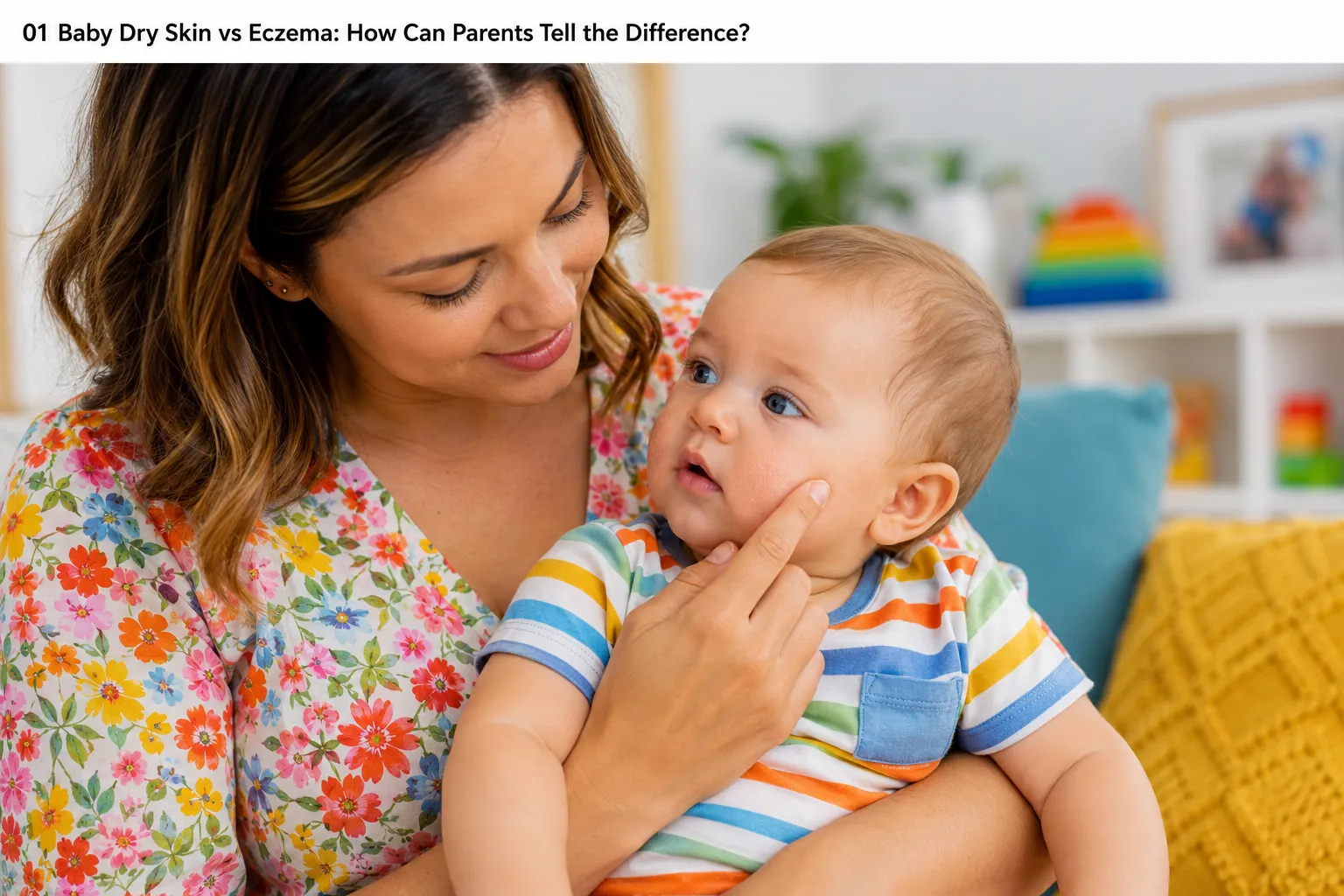
A baby’s skin can change surprisingly quickly. Cheeks that felt soft yesterday may suddenly look rough, flaky or red, while a dry patch on the arms or legs may appear almost overnight. For parents, one of the hardest questions is whether they are looking at ordinary baby dry skin or the beginning of eczema. The two can look remarkably similar because eczema itself commonly involves dry skin, yet persistent itching, inflammation and recurring flare-ups can suggest that something more is happening. Dermatologists describe atopic dermatitis, the most common form of eczema, as a condition associated with itchy, dry and inflamed skin. The simplest distinction is that dry skin describes the condition of the skin, while eczema is an inflammatory skin condition that often includes dryness as one of its features.
That means a baby can have dry skin without having eczema, but a baby with eczema will very often have skin that is unusually dry. The difficulty is that there isn’t always a sharp visual line separating the two, particularly at the beginning of a flare. Instead of trying to diagnose your baby from one dry patch, it is usually more useful to watch how the skin behaves over time. Itching, recurrence, inflammation, location, spreading and the way the skin responds to ordinary moisturising can provide much more useful clues. This guide will help you understand those clues without pretending that an online article can diagnose your child.
The Quick Difference: Baby Dry Skin vs Eczema
If your baby’s skin is simply dry, you may notice roughness, fine flaking, mild scaling or areas that feel less soft than the surrounding skin. These changes may follow cold weather, low humidity, bathing, swimming, air conditioning, heating, frequent washing or exposure to products that remove moisture from the skin. Simple dryness may improve when those pressures are reduced and the skin is moisturised consistently. The baby may barely notice it, particularly when the dryness is mild. Most importantly, persistent itching is not necessarily the dominant feature of ordinary dry skin.
Eczema tends to behave differently because itching and inflammation become much more central to the picture. A baby may rub their cheeks against your clothing, mattress or bedding, scratch accessible areas, become restless during sleep or repeatedly return to the same itchy places. Babies may rub against blankets and other objects because they cannot deliberately scratch every affected area. The skin may also move through periods when it looks considerably better and periods when it flares again. That itch scratch flare pattern is one of the most useful differences for parents to notice.
A Parent Friendly Comparison
| What you notice | Simple dry skin | Possible eczema |
|---|---|---|
| Dryness | Common | Very common |
| Fine flaking | Common | Can occur |
| Rough texture | Common | Common |
| Persistent itching | Usually less prominent | Often a major feature |
| Repeated scratching or rubbing | Less typical | Common |
| Inflammation | Usually limited | More likely |
| Recurring in the same areas | Possible | More suggestive |
| Flares that improve then return | Less characteristic | Characteristic |
| Sleep disturbed by itching | Less typical | Can occur |
| Oozing or crusting | Not typical | Needs medical assessment |
| Improves with basic moisturising | Often | May improve but repeatedly return |
This table is a guide rather than a diagnostic test. Babies can have both dry skin and eczema, and eczema itself can vary considerably in appearance and severity. Other conditions can also resemble either of them, including contact dermatitis, cradle cap, heat rash and skin infections. Skin tone matters as well because inflammation does not always appear bright red; eczema can produce grey, purple, brown, lighter or darker changes depending on the child’s skin tone. That is one reason photographs on the internet should never be treated as a definitive diagnostic tool.
Start With the Itch, Not Just the Rash
Parents naturally look at what they can see, but what your baby is doing may tell you just as much as what the skin looks like. A patch may appear only mildly dry while causing considerable itching underneath the surface. Babies cannot tell us that their cheek, neck or scalp feels itchy, so they communicate through behaviour instead. You may notice face rubbing, head scratching, ear scratching, repeated movement against bedding or increased restlessness when your baby becomes hot or tired. Repeated itching and subsequent scratching can contribute to visible skin changes.
That distinction becomes particularly important when a baby’s skin looks relatively clear but the scratching continues. Parents can understandably assume that if the rash has disappeared, the problem must have disappeared too. In reality, itch and visible inflammation do not always rise and fall at exactly the same time. Repeated rubbing and scratching can then damage vulnerable skin and contribute to another cycle of irritation. Our guide to why a baby’s scratching may keep coming back explores the wider pattern in more detail.
Does the Skin Keep Coming Back to the Same Problem?
Another useful clue is recurrence. Ordinary dryness caused by a temporary environmental change may settle once the cause is removed and moisture is restored. Eczema is more characteristically associated with periods of improvement followed by flare ups. Parents may therefore notice that the cheeks clear and become rough again, or that the same areas around the wrists, ankles, elbows, knees or neck repeatedly become troublesome. That history can be more revealing than how severe the skin looks on any particular morning.
Try mentally changing the question from “What does this patch look like?” to “What has this patch been doing for the last two weeks?” Has it disappeared completely, or merely faded before returning? Does your baby repeatedly scratch it? Does heat, bathing, swimming, clothing, drooling or bedtime seem to precede deterioration? Those patterns can help you have a much more productive conversation with your doctor or other qualified healthcare professional if assessment becomes necessary.
Where Does Baby Eczema Usually Appear?
Location can provide clues, although location alone cannot diagnose eczema. In babies and young children, atopic dermatitis commonly appears on areas including the cheeks, forehead and scalp, and it can also occur on the trunk, arms and legs. As children get older, eczema commonly affects areas such as the elbows, knees, wrists, ankles and neck. That is why persistent rough or itchy cheeks in a baby often attract attention from parents long before eczema appears elsewhere. Location should be treated as one clue among several rather than a diagnosis.
Simple dry skin, by contrast, can appear almost anywhere the skin is losing moisture or encountering environmental pressure. Exposed cheeks may become dry in cold weather, while frequent hand washing, bathing or swimming can affect other areas. Skin folds create their own conditions involving heat, sweat and friction, while drooling can repeatedly wet the chin, mouth and neck. Rather than assuming every dry location means eczema, consider what that particular part of the baby’s skin encounters during an ordinary day. Our guide to baby dry skin on the face explores facial dryness specifically.
Why Are the Cheeks Such a Difficult Area?
Baby cheeks are almost a perfect meeting place for several sources of irritation. They are exposed to air, touched frequently, rubbed against clothing and bedding, and repeatedly exposed to saliva, milk and food. During teething, a baby’s face can move through repeated cycles of becoming wet with drool, being wiped and then drying again. Cold wind or dry indoor air can add another pressure at exactly the same time. It is therefore entirely possible for a baby to develop rough, dry cheeks without every episode representing eczema.
Persistent itching and recurring inflammation make the picture more interesting. Atopic dermatitis commonly affects babies’ faces, particularly their cheeks, so a pattern of repeatedly itchy, inflamed cheeks deserves closer attention. This is why location specific guides can be useful alongside a broader comparison such as this one. The purpose here is to help parents understand the overall distinction between dryness and eczema rather than diagnose a facial rash from appearance alone. The behaviour and history of the skin remain central.
What About Redness?
Redness can be useful information, but it is an unreliable test by itself. Dry skin can become mildly irritated and appear red, especially after rubbing, bathing, heat exposure or contact with saliva. Eczema can produce much more obvious inflammation, but it does not necessarily appear as the classic bright red rash many parents expect. On darker skin tones, affected areas may appear darker brown, purple, grey, lighter than the surrounding skin or as clusters of small rough bumps. Texture, itch and recurrence can therefore matter as much as colour.
That means searching Google Images for “baby eczema” and comparing photographs can easily mislead parents. Skin conditions change with severity, age, body location and skin tone, and photographs capture only one moment. Texture, itch, recurrence and behaviour can provide information that a photograph cannot show. If something looks unusual or your instincts tell you that the skin is getting worse, professional assessment is more reliable than trying to match the appearance to an online picture. This becomes particularly important when the skin changes rapidly or your baby appears unwell.
Does Moisturiser Help Tell the Difference?
How the skin responds to moisturising can provide another clue, although it still isn’t a diagnostic test. Straightforward dryness will often become softer and more comfortable when irritating pressures are reduced and an appropriate moisturiser is used consistently. Eczema prone skin also benefits greatly from moisturising, and moisturising is an important part of eczema skincare. The difference is that eczema may continue to itch, flare or become inflamed despite good moisturising because moisture loss is only part of what is happening. A temporary improvement after moisturising therefore does not prove that the problem is simple dryness.
This explains why parents sometimes say, “I moisturise my baby constantly, but the dry patches keep coming back.” That observation is worth paying attention to rather than automatically responding by applying larger quantities of the same product. Consider whether scratching, heat, sweat, bathing, saliva, fabrics, fragrance or another recurring exposure is placing pressure on the skin. Our guide on how to moisturise dry skin properly explains the practical side of moisturising in more detail. Persistent symptoms may also require medical treatment rather than skincare alone.
The Skin Barrier Connects Dry Skin and Eczema
To understand why the two conditions can look so similar, it helps to understand the skin barrier. Your baby’s outer skin is not simply a covering; it helps retain water while limiting entry by irritants and other external substances. When that barrier is struggling, water can escape more readily and the surface can become dry, rough and vulnerable. Moisturising can help support that environment, which is why it matters in both ordinary dryness and eczema prone skin. But eczema involves more than a skin surface that simply needs additional moisture.
Atopic dermatitis is a chronic inflammatory skin disease involving interactions between skin barrier function, immune activity and environmental influences. Current dermatology guidance therefore treats eczema as a condition requiring appropriate management rather than simply describing it as “very dry skin.” This distinction matters because repeatedly treating significant eczema as nothing more than dryness can delay appropriate assessment and treatment. It also explains why the same moisturising routine may work beautifully for one child and be insufficient for another. Understanding the difference helps parents know when everyday skincare has reached its limits.
Why Scratching Changes Everything
Itching can create a self reinforcing problem. The skin itches, the baby scratches or rubs it, and that mechanical damage places additional pressure on an already vulnerable surface. The damaged skin can then become more uncomfortable, encouraging further scratching. Over time, what started as a relatively small irritated area can become raw, inflamed or broken. This is the itch scratch cycle, and interrupting it is an important part of caring for persistently itchy skin.
Babies make this particularly challenging because telling them not to scratch obviously isn’t realistic. Keeping fingernails short can reduce damage, and appropriate clothing or mittens may sometimes help protect the skin while the underlying cause of the itch is addressed. However, preventing scratching is not the same as resolving why the baby is itchy. Persistent scratching deserves investigation rather than simply being physically prevented. Our article on the itch scratch cycle and damaging scratching examines this problem more closely.
Look for Patterns Before You Keep Changing Products
When a baby’s skin isn’t improving, the natural response is often to buy something else. Parents can end up moving from lotion to cream to balm to oil while simultaneously changing shampoo, body wash, laundry detergent and wipes. The problem is that changing several things at once makes it almost impossible to determine what helped or what made things worse. A simpler approach is to observe the baby’s skin systematically and change one unnecessary exposure at a time where practical. This is particularly useful when symptoms are mild and there are no warning signs requiring medical attention.
Consider keeping a short record of where the dryness occurs, when scratching happens, what touched the skin, whether the baby was hot or sweaty, what products were used and whether anything changed in the previous 24 hours. Patterns that seem invisible from one day to the next can become obvious when written down. This is the thinking behind the Baby Skin Trigger Tracker and 7 Day Baby Dry Skin Diary later in this series. Those resources are intended to help parents observe rather than guess. Good observation is especially useful when you eventually need to explain the problem to a healthcare professional.
Bathing Can Help or Add More Pressure
Bathing itself is not automatically bad for dry or eczema prone skin. What matters is how the baby is bathed and what happens afterwards. Very hot water, long baths, harsh cleansers and vigorous rubbing can leave vulnerable skin feeling drier, while gentle bathing followed by prompt moisturising can form part of good eczema skincare. Lukewarm water, short baths, gentle cleansing where needed and avoiding vigorous scrubbing are sensible principles for vulnerable skin. Applying an appropriate moisturiser afterwards can help reduce moisture loss.
This is another area where generic advice such as “bathe less” can become too simplistic. A baby covered in sweat, saliva, food residue or another irritant may benefit from gentle cleansing, while repeated unnecessary washing can create its own problems. Our detailed guide on how to bathe a child with dry, itchy or eczema prone skin explores the routine step by step. The important principle is to make bathing part of skin support rather than another source of friction. What you do during the few minutes after the bath can matter as much as the bath itself.
Dry Skin Can Become Itchy Without Automatically Being Eczema
There is an important nuance here. Saying that itching is one of the strongest clues for eczema does not mean that every itchy patch is eczema. Very dry skin itself can become uncomfortable and itchy, while heat, sweat, fabrics, soaps, saliva and environmental exposures can cause irritation without necessarily representing atopic dermatitis. Other skin conditions can itch too. This is why no single symptom should be used as a home diagnostic test.
Instead, think in combinations. Dryness plus persistent itch plus recurring inflammation plus repeated flare ups creates a different picture from mild temporary dryness following a cold week or several long baths. Add a characteristic distribution, repeated scratching and sleep disruption, and eczema becomes increasingly reasonable to discuss with a healthcare professional. Remove those features and simple environmental dryness may be more plausible. The goal is not for parents to diagnose eczema themselves but to recognise when ordinary skincare may no longer be the whole answer.
What If Your Baby’s Skin Looks Better but They Still Scratch?
This situation confuses many parents because we naturally judge improvement visually. A rash fades, the redness settles and the skin looks almost normal, so continued scratching can seem inexplicable. But eczema can be intensely itchy, and babies often express that itch through rubbing rather than obvious deliberate scratching. Heat, tiredness, bedding, clothing and established scratching behaviour may also influence what happens when the baby settles down to sleep. The visible skin therefore provides only one part of the story.
Watch what happens during transitions: feeding, getting dressed, becoming tired, entering a warm car seat, going to bed or waking in the morning. Those everyday circumstances can reveal patterns that are easy to miss when you focus only on the appearance of a rash. Our article Baby Scratching All Night? looks specifically at bedtime itching and scratching. Each guide in this knowledge library investigates a distinct circumstance rather than treating every episode of itching as the same problem. That helps parents build a more complete picture of what their child’s skin is doing.
Could Something Else Look Like Eczema?
Absolutely. Babies develop many different rashes and skin changes, and several can resemble eczema at first glance. Contact dermatitis, heat rash, cradle cap, irritation from saliva and other conditions can produce redness, roughness, scaling or discomfort. Even eczema itself is an umbrella term for several conditions; atopic dermatitis is one type rather than the definition of every possible eczema like rash. That is another reason this article should be treated as a guide to recognising patterns rather than a diagnostic checklist.
This series will examine those look alikes separately, including baby eczema vs heat rash, eczema vs contact dermatitis and eczema vs cradle cap. Separating them allows us to explain the distinguishing features properly instead of reducing complex skin conditions to a superficial comparison table. If your baby’s rash is persistent, unusual, worsening or difficult to identify, a qualified healthcare professional can examine details that an article cannot. There is no advantage in confidently putting the wrong label on a baby’s skin. Careful observation should lead to better questions, not overconfident self diagnosis.
When Should You Stop Treating It as “Just Dry Skin”?
If the skin remains persistently itchy, repeatedly becomes inflamed, keeps returning to the same places or starts interfering with sleep and comfort, it is reasonable to seek professional advice. The same applies when ordinary gentle skincare isn’t producing the improvement you would expect. You do not need to wait until the skin becomes severe before asking someone qualified to look at it. A clinician can distinguish between eczema and other conditions that may require different management. Early advice can also help prevent a manageable problem from becoming much more uncomfortable.
Medical assessment becomes more urgent if the skin becomes painful, swollen, warm, blistered, weeping, rapidly worsening or crusted, particularly when your baby seems unwell or develops a fever. These can be signs of infection or another condition requiring treatment. Children with eczema can be more susceptible to skin infections because damaged skin can make it easier for microorganisms to enter. A moisturiser is not an appropriate substitute for medical assessment when infection is suspected. Seek prompt medical advice if you are concerned about your baby’s condition.
A Better Way to Think About Baby Skin
Parents are often encouraged to search for one culprit: one soap, one food, one ingredient, one fabric or one mysterious trigger responsible for everything. Sometimes there really is a clear trigger, but baby skin can also be influenced by several small pressures occurring at the same time. A developing skin barrier may be dealing with dry air, saliva, heat, friction, frequent wiping and scratching all within the same day. Removing one pressure may help without completely resolving the problem. Thinking in patterns therefore gives parents a more realistic framework than endlessly searching for a single villain.
This broader way of looking at dry, itchy and eczema prone skin is explored in our Beyond the Skin Barrier guide. It does not suggest that every baby’s eczema has one hidden internal cause, nor that ordinary skincare is unimportant. Instead, it encourages parents to consider the skin as part of an interconnected biological system while remaining cautious about drawing medical conclusions from individual symptoms. That perspective becomes particularly valuable when the same flare keeps returning despite apparently sensible skincare. Understanding complexity should make decision making clearer, not more frightening.
Where the Skin Trifecta Fits
At Itch A Bye, our skincare philosophy is built around three ideas: Repair, Nourish and Defend. Repair means supporting a vulnerable skin barrier rather than concentrating only on how soft the surface feels. Nourish means supplying moisture and supportive skincare to skin that is struggling with dryness and everyday environmental pressure. Defend means supporting vulnerable skin against bacteria, fungus and other microbes while reducing unnecessary exposures that may aggravate already uncomfortable skin. We refer to these three principles together as the Skin Trifecta.
This framework is particularly relevant to dry and eczema prone skin because moisturising matters enormously, but persistent skin problems can involve more than moisture alone. Itch A Bye Baby Repair Cream was developed as a gentle, non medicated skincare option for dry, itchy and eczema prone baby skin using the same Repair, Nourish and Defend philosophy. It is intended to support skincare, not diagnose eczema or replace medication prescribed by a doctor. If your baby has diagnosed eczema, follow the treatment plan provided by the healthcare professional caring for your child. Good skincare and appropriate medical care should complement each other rather than compete.
Seven Questions Parents Can Ask
When you are unsure whether you’re seeing ordinary dryness or something that deserves closer investigation, ask yourself seven simple questions. Is my baby persistently itchy? Does the same area repeatedly flare? Is the skin becoming inflamed rather than merely dry? Does my baby rub or scratch even when the skin looks better? Is sleep being disturbed? Does basic moisturising help only temporarily? Are there patterns involving heat, bathing, saliva, clothing or other exposures? None of these questions diagnoses eczema, but together they create a much more useful picture than simply asking whether the skin looks red.
If most answers are no and the dryness is mild, temporary and responding well to simple skincare, ordinary dryness may be the more likely explanation. If several answers are yes, particularly persistent itching, recurrence and inflammation, eczema becomes more reasonable to discuss with your baby’s healthcare professional. If there are signs of infection, rapidly worsening symptoms or your baby seems unwell, seek medical advice promptly. This approach gives parents something practical to observe without pretending that an internet article can replace examination. It also creates a record of useful information if professional assessment is needed.
The Most Important Difference Isn’t What You See Today
The most useful distinction between baby dry skin and eczema may not be the appearance of one patch at one moment. It is the pattern the skin creates over time. Ordinary dryness often has an understandable environmental explanation and settles when the skin is gently supported and the pressure is removed. Eczema is more likely to involve persistent or recurring itch, inflammation, repeated flares and a cycle in which rubbing or scratching contributes to further skin damage. Watching that pattern gives parents considerably more information than trying to diagnose a condition from redness alone.
So when you notice another rough patch, don’t immediately assume the worst, and don’t automatically dismiss it as “just dry skin” either. Observe where it appears, whether it itches, what happened beforehand, how long it lasts and whether it keeps returning. Support the skin gently, reduce unnecessary irritation and seek professional advice when the pattern suggests something more persistent. Across the rest of this series, we will break those individual clues down one by one so parents can understand them without being overwhelmed. The aim is not to turn parents into dermatologists; it is to help them become better observers of their own child’s skin.
This article is for general educational information and does not provide a diagnosis or replace advice from your baby’s doctor, pharmacist or other qualified healthcare professional.