
Could My Baby Have an Eczema Trigger I Haven’t Found Yet? Why Looking for One Trigger May Be the Wrong Approach
There comes a point in the eczema journey when many mothers become convinced there must be something they have missed. You have changed the washing powder, stopped using fragranced products, switched the baby wash, bought cotton clothes and wondered whether the dog, the carpet, the weather or the bath water could be responsible. Then you start looking at food, because perhaps it is dairy, eggs, wheat, tomatoes or something you ate while breastfeeding. Before long, caring for your baby’s skin can start to feel less like parenting and more like investigating a crime scene.
And yet the eczema still comes back. One week your baby’s cheeks look beautiful, and you begin to think you have finally solved it. Then the scratching starts again, the skin becomes rough, a familiar patch returns behind the knees or around the neck, and suddenly you are questioning everything. You start replaying the previous few days in your head, desperately trying to identify the thing that caused it.
But what if there isn’t always one thing? What if one of the reasons eczema can be so confusing is that several relatively ordinary pressures can be affecting vulnerable skin at the same time? Dryness, heat, sweat, saliva, friction, scratching, clothing, bathing and environmental exposures can all matter. Instead of endlessly asking, “What is my baby’s eczema trigger?”, sometimes a more useful question may be: “What combination of pressures is my baby’s skin dealing with right now?”
The Search for the Hidden Trigger Can Become Exhausting
You probably did not begin this journey intending to analyse every detail of your baby’s life. You simply wanted their skin to stop itching. But when something keeps returning despite your best efforts, searching for an explanation is completely understandable. Every flare starts to look like evidence.
Perhaps the eczema worsened after swimming, so chlorine becomes the suspect. Then it happens during a week without swimming, and suddenly you are looking somewhere else. Perhaps you eliminate a particular food and the skin improves, only for the eczema to return three weeks later despite that food still being absent. You can spend months chasing one explanation after another without ever feeling that you truly understand what is happening.
That is partly because eczema does not behave like a simple equation where one exposure always produces one predictable reaction. Dry skin, sweat, saliva, clothing, temperature changes and environmental exposures can all become relevant in different children and at different times. Avoiding aggravating factors can help, but the underlying condition of the skin still matters. That is why the search for one perfect answer can become so frustrating.
Maybe You Haven’t Failed to Find the Trigger
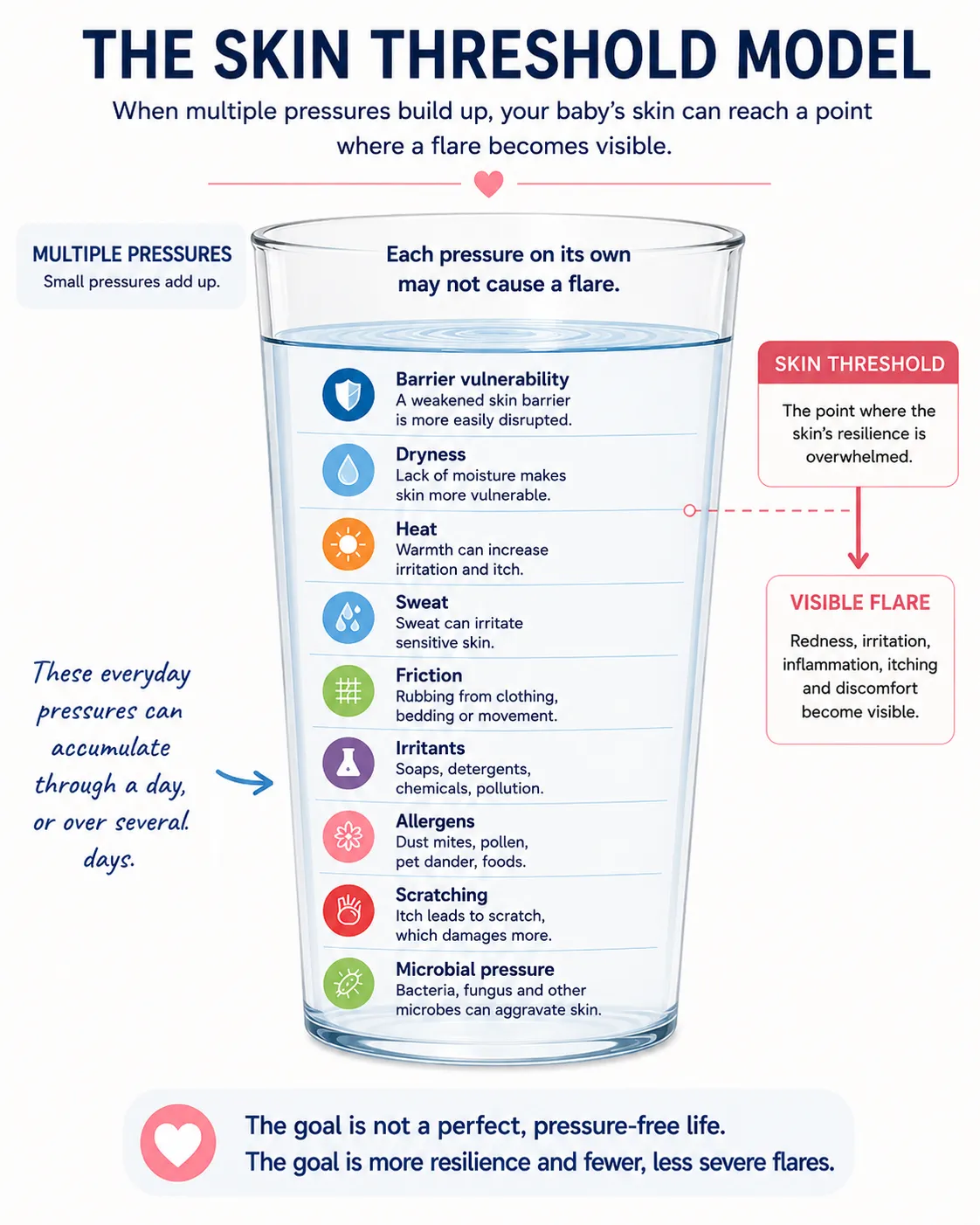
Imagine that your baby’s skin has a certain amount of pressure it can tolerate before it becomes visibly uncomfortable. On a relatively good day, the barrier is reasonably supported, your baby stays cool, there is little friction and they sleep without scratching very much. A small amount of saliva or warmth might make almost no noticeable difference. The skin remains below its threshold.
Now imagine a different day. The weather is warmer, your baby sweats during a nap, teething means more saliva around the cheeks and chin, and the skin was already slightly dry after yesterday’s bath. That evening your baby becomes itchy and begins scratching, adding another source of physical stress to an already vulnerable barrier. Suddenly the same skin that seemed perfectly manageable two days earlier crosses its threshold.
This is the thinking behind what we call the Skin Threshold Model. The model does not suggest that every child has the same triggers or that every flare can be neatly explained. Instead, it gives parents another way of thinking about eczema-prone skin. Rather than searching endlessly for one culprit, we can consider whether several smaller pressures may have accumulated until the skin could no longer comfortably manage them.
Think of Your Baby’s Skin Like a Bucket
Imagine an empty bucket representing the amount of pressure your baby’s skin can currently tolerate. Dryness adds some water to the bucket, then heat adds a little more. Sweat, saliva and friction add more again, while a difficult night of scratching pushes the level higher. None of those things necessarily fills the bucket by itself.
But eventually one small additional pressure causes it to overflow, and that is when the flare becomes obvious. The last thing added to the bucket may get blamed even though it was only the final part of a much bigger picture. This may help explain why your baby can apparently tolerate something perfectly well one week and then flare after encountering the same thing the following week. Instead of assuming the trigger somehow disappeared and returned, consider whether the starting condition of the skin was different.
This Could Explain Why Eczema Feels So Unpredictable
Suppose your baby goes swimming on Saturday and their skin is completely fine afterwards. The following Saturday they swim again, but this time they scratch badly that evening. It would be easy to conclude that chlorine cannot be involved because the previous swim caused no obvious problem. But perhaps the second Saturday was hotter.
Perhaps your baby’s skin was already drier, they stayed in wet swimwear longer, the towel was rubbed rather than patted across the skin and they became warm in the car on the way home. Swimming may have been only one pressure among several. This is why context matters. The question is not always simply “Did swimming cause the eczema?” but “What condition was the skin in when swimming was added to everything else?”
The Same Thing Can Happen With Teething
Teething gets blamed for an enormous number of mysterious baby problems, but there is a very practical skin issue that can accompany it. A teething baby may drool considerably more, leaving saliva repeatedly sitting around the mouth, cheeks, chin and neck. Parents naturally wipe it away, which can add repeated friction to already sensitive skin. Now add warmer weather, slightly dry cheeks and a baby rubbing their face against bedding during sleep.
Several ordinary things may suddenly be occurring in the same small area of skin. That is very different from saying, “Teething causes eczema.” The more useful observation may be that teething changes the environment around your baby’s skin. Once you see it that way, you can begin looking at the actual pressures rather than simply attaching a label to the flare.
Heat May Be One of the Most Underestimated Pressures
A baby does not need to be visibly drenched in sweat before heat becomes relevant. Warm bedrooms, thick sleepwear, car seats, prams, blankets and cuddling can all trap heat against the body. Some children seem particularly likely to become itchy when they are hot. Sweat left on the skin can also interact with friction and already compromised skin.
Try noticing what happens before the scratching begins. Feel the back of your baby’s neck, check the hairline and look beneath folds and sleepwear. If scratching repeatedly appears after your baby becomes warm, that pattern may be far more informative than waiting until the rash becomes obvious. Small observations like this can gradually help you understand your child’s individual threshold.
Then Scratching Adds Pressure of Its Own
This is where things can become particularly frustrating. Your baby’s skin becomes uncomfortable because several pressures have accumulated, so your baby scratches. The scratching may briefly change the sensation, but fingernails are now repeatedly dragging across a barrier that may already be compromised. The skin becomes more irritated and physically damaged, creating another reason for it to feel uncomfortable.
Your baby scratches again, and the cycle begins feeding itself. By morning, the scratching may appear to have been caused by the flare when in reality scratching has also become part of the flare. Once scratching becomes established, simply identifying the original pressure may no longer be enough. You also have to think about the additional damage being created by the child’s response to the itch.
What About Food?
Food is often where frightened and exhausted parents eventually end up. You begin reading online discussions and suddenly almost every food in your kitchen appears capable of causing eczema. Milk goes first, then eggs, wheat, soy or nuts, and before long feeding your child can become another source of anxiety. Food allergy and eczema can certainly coexist, particularly in some children with more significant atopic dermatitis.
But broad food elimination simply because a child has eczema can create unnecessary nutritional problems. If your child repeatedly develops an immediate reaction after a particular food, or you have other reasons to suspect allergy, that deserves appropriate medical assessment. But if you are removing food after food because you desperately need something to blame, the search itself may be taking you further away from understanding the complete picture. Sometimes the skin is responding to several pressures rather than one hidden ingredient in dinner.
Stop Asking Only “What Changed Today?”
When eczema suddenly appears, parents naturally look at what happened immediately beforehand. What did the baby eat today? What soap did we use? Where did we go? What touched their skin?
Those are sensible questions, but expand the window. Think about the previous twenty-four or forty-eight hours as well. Was your baby warmer than usual, did they sleep badly, scratch overnight, swim, spend more time outside, wear different clothing, have several baths or experience increased drooling? You may discover that the supposedly mysterious flare actually has a sequence.
One small pressure may have followed another until the skin eventually became visibly uncomfortable. The last event may have attracted your attention simply because it happened immediately before the bucket overflowed. Looking backwards over the whole sequence can sometimes reveal a pattern that was invisible when you focused only on the final event. That is often where the Skin Threshold Model becomes most useful.
Your Baby’s Eczema Diary Does Not Need to Become Another Job
You do not need a complicated spreadsheet documenting every mouthful of food and every minute of your baby’s life. When you are already exhausted, the last thing you need is another task that makes you feel as though you are conducting a clinical trial in your own home. A simple note on your phone can be enough. Record only the things that appear genuinely relevant.
For example, write down whether the day was particularly hot, whether swimming or bathing occurred, whether teething and saliva were significant, whether your baby scratched badly overnight and where the flare appeared. After several weeks, patterns may become easier to see. You are not trying to prove causation; you are trying to understand your child’s skin story. Sometimes what appears random when viewed one day at a time becomes surprisingly consistent when viewed over several weeks.
You may discover that heat repeatedly precedes scratching, that cheek flares cluster around heavy drooling or that swimming causes more trouble when the skin was already dry. Those observations can give you something far more useful than a growing list of things your baby is forbidden to encounter. They help you anticipate pressure rather than simply react after a flare becomes obvious. And that can make everyday skin care feel far less like detective work.
There Is Another Important Question: What Condition Was the Skin Already In?
This may be one of the most overlooked parts of the entire trigger conversation. We concentrate so heavily on what is attacking the skin that we sometimes forget to ask how prepared the skin is to handle ordinary life. The same environmental exposure may be easier to tolerate when the barrier is comfortable and well supported than when it is already dry, scratched and irritated. The starting condition matters.
Think about a brick wall protecting a house. If the bricks and mortar are intact, ordinary wind and rain are manageable. If cracks have already developed, the same weather can penetrate much more easily and cause additional problems. Your baby’s skin barrier performs a far more sophisticated job than a brick wall, but the principle helps illustrate why barrier condition matters.
It is one reason eczema care cannot be reduced to avoiding every possible trigger. Your child still has to live in the real world, and the skin still needs ongoing support while doing that. The question therefore becomes not only what pressures can be reduced, but also how vulnerable the skin is when those pressures arrive. That shift in thinking can make the entire trigger conversation more useful.
This Is Where Our Thinking About Itch-A-Bye Begins
When we developed Itch-A-Bye, we did not want our entire formulation philosophy to begin and end with moisture. Hydration is extremely important, but we were interested in the broader environment surrounding dry, itchy and eczema-prone skin. If vulnerable skin is simultaneously dealing with dryness, irritation, scratching and environmental pressure, then we wanted a formulation designed with more than one supportive function in mind. That eventually became Repair, Nourish and Defend.
These are not three unrelated marketing words, but three parts of the same idea. Support the physical barrier, provide carefully selected topical ingredients with complementary supportive properties, and consider the fact that vulnerable skin remains an interface between the child and bacteria, fungi and the wider environment. The skin does not perform only one job, so we did not want the formulation to think about only one job either. That is the philosophy behind Itch-A-Bye.
REPAIR: Strengthen the Starting Point
If the barrier is repeatedly drying, cracking or being damaged by scratching, simply removing one suspected trigger does not automatically restore it. The skin still needs appropriate ongoing care while it recovers. That is why Repair forms the first pillar of our formulation philosophy. The starting condition of the barrier influences how vulnerable the skin may be to the next pressure that arrives.
Ingredients such as Allantoin and Centella asiatica interested us because their supportive roles extend beyond simple hydration. Allantoin is widely used for soothing and skin conditioning, while Centella and its compounds have been studied in relation to inflammatory pathways and skin-recovery processes. These ingredients sit alongside the hydrating components of the formulation rather than replacing them. The aim is to formulate intelligently for the condition of the skin we are trying to support.
NOURISH: Give the Skin More Than Water
Nourish is sometimes misunderstood because skincare language often uses nourishment as another word for moisturisation. That is not what we mean. Nourish means supplying vulnerable skin with a deliberately selected combination of topical ingredients that perform different supportive roles. Hydration remains part of that system, but it is not the entire system.
Hyaluronic Acid and Glycerin help attract and retain water. Black Seed Oil contains constituents that have been researched for anti-inflammatory, antioxidant and antimicrobial properties, while MSM has been studied for anti-inflammatory and antioxidant activity. Allantoin, vitamins and carefully selected botanicals bring additional soothing, conditioning and antioxidant-related support. The point is not that one ingredient magically fixes eczema, but that different ingredients can contribute different properties within one formulation.
Our Botanical Complex Has a Purpose
We did not want botanicals in Itch-A-Bye simply so that we could put attractive plant names on the ingredient list. Chamomile has research around soothing and anti-inflammatory activity, while Scutellaria contains flavonoids investigated for antioxidant, anti-inflammatory and antimicrobial properties. Licorice, Green Tea, Rosemary, Ginger and Polygonum cuspidatum each bring different phytochemical profiles to the formulation. There is overlap between them, and that is intentional.
Some ingredients contribute antioxidant activity, some have been studied in inflammatory pathways, and several have constituents with antimicrobial properties. Their presence does not mean the finished cream is a medicine or that each botanical has been clinically proven to treat childhood eczema. It means we deliberately chose ingredients whose known properties make sense within the broader formulation we wanted to build. The synergy matters more to us than any single hero ingredient.
DEFEND: Because Skin Still Has to Live in the Real World
Even if you discovered every trigger affecting your child tomorrow, their skin would still have to encounter the outside world. It would still meet clothing, bedding, bath water, sweat, saliva, dust, bacteria, fungi and countless environmental exposures. The purpose of healthy skin is not to live inside a sterile bubble. This is why our third pillar is Defend.
Several ingredients within the formulation contain constituents studied for antibacterial, antifungal or broader antimicrobial activity, including Black Seed Oil and several of the botanical extracts. We see these properties as complementary to the barrier and nourishment components of the formula. The aim is not to sterilise your baby’s skin or replace medical treatment for infection. It is to support vulnerable skin’s protective environment while recognising that microbial pressure is one part of the world skin continually has to manage.
Maybe the Goal Is Not to Eliminate Your Baby’s Entire World
This is where the search for eczema triggers can sometimes become heartbreaking. You start removing bubble bath, fragrances and obvious irritants, which can be sensible. Then you remove foods, swimming, grass, pets, playgroups, particular clothes and anything else that happened near the last flare. Slowly, eczema begins determining more and more of family life.
Of course, when something consistently and clearly aggravates your child’s skin, reducing that exposure can make sense. But childhood should not become an impossible attempt to create a world containing no heat, sweat, grass, water, food, friction, microorganisms or unpredictability. The more realistic goal may be to reduce unnecessary pressure while helping vulnerable skin cope better with ordinary life. That is a very different goal from trying to eliminate the world around your child.
This Is the Question We Want You to Take Away
The next time your baby’s eczema suddenly worsens, you can still ask what triggered it. Sometimes there really is a clear answer, and recognising that pattern can be extremely useful. But do not stop there. Also ask: What was happening to the skin before this happened?
Was it already dry? Had your baby been scratching? Were they hot or sweaty? Had saliva been sitting around the cheeks, was there more friction than usual, or had they been swimming, bathing more frequently or sleeping badly?
Then ask one final question: Could several of these things have added up? That question can completely change the investigation. Instead of looking for one guilty culprit, you begin looking at the whole environment around the skin. And sometimes that broader view is where the pattern finally becomes visible.
You May Not Be Missing One Secret Answer
If you have spent months searching for the one hidden trigger, this may be the most important idea in this entire series. The reason you cannot find the single answer may sometimes be because there isn’t a single answer to find. Your baby’s skin exists inside a constantly changing system, and the pressures surrounding it change from day to day. Sometimes the breakthrough is not discovering one mysterious culprit.
It is learning how your child’s individual pressures interact, recognising when their skin appears to be approaching its threshold and supporting the barrier before the cycle gathers momentum. That turns eczema care from endless detective work into something closer to pattern recognition. You have not necessarily overlooked some obvious answer that every other mother somehow knows. You may simply have been trying to solve a multi-factor problem as though it had only one cause.
The Bigger Picture Behind This Entire Series
Across these eight articles, we have looked at the questions exhausted parents tend to ask when the standard answers stop feeling sufficient. Why does the eczema keep coming back? Why is my baby still scratching when the skin looks better? Why am I following the routine and still seeing flares? Why does moisturiser sometimes seem insufficient, and why can nighttime change everything?
We have looked at scratching, barrier vulnerability, heat, sweat, friction, saliva, environmental pressure and the possibility that several relatively small factors can accumulate. None of this means established eczema treatment should be abandoned or that every flare can be explained by our Skin Threshold Model. It means there may be value in seeing your child’s skin as an interconnected protective system rather than simply chasing whichever symptom is most visible today. That is also the central idea behind our book, Beyond the Skin Barrier.
We wanted to give parents a framework for understanding the skin barrier, immune signalling, the microbiome, the itch-scratch cycle and the many pressures that can interact around eczema-prone skin. Sometimes having a better model of the problem is what finally allows all those confusing pieces to begin fitting together. It does not promise one simple answer. It gives you a better way to ask the questions.
And That Is Why We Created Itch-A-Bye
Itch-A-Bye Baby Repair Cream was created from the same philosophy. We did not want another formula whose entire story could be reduced to “dry skin needs moisture.” We wanted to think about vulnerable skin more broadly and deliberately select ingredients capable of contributing different forms of topical support. That became Repair. Nourish. Defend.
Repair the vulnerable barrier. Nourish it with hydration plus a complementary mixture of oils, humectants, vitamins, skin-conditioning ingredients and botanicals. Defend the skin as it continues interacting with bacteria, fungi and the environmental pressures of everyday childhood. Your baby’s skin does not live in a laboratory where one variable changes at a time.
It lives in the real world, where teething can happen during a heatwave, swimming can happen when the skin is already dry, and scratching can turn yesterday’s mild irritation into tomorrow morning’s flare. Perhaps the answer is not always finding the one thing you need to remove. Sometimes the better question is how many pressures you can reduce while giving vulnerable skin the support it needs to Repair, Nourish and Defend. And that may be a much more useful place to begin.