
Baby Eczema Trigger Checklist: A 7-Day Skin Threshold Tracker for Parents
When your baby’s skin suddenly becomes drier, itchier, redder or more unsettled, it is natural to start looking for a reason. You may wonder whether it was the bath, something they ate, the weather, a new washing powder or the clothes they were wearing. Sometimes the answer is obvious, but very often it is not. That uncertainty can be frustrating, especially when the skin seemed relatively calm only a day or two earlier.
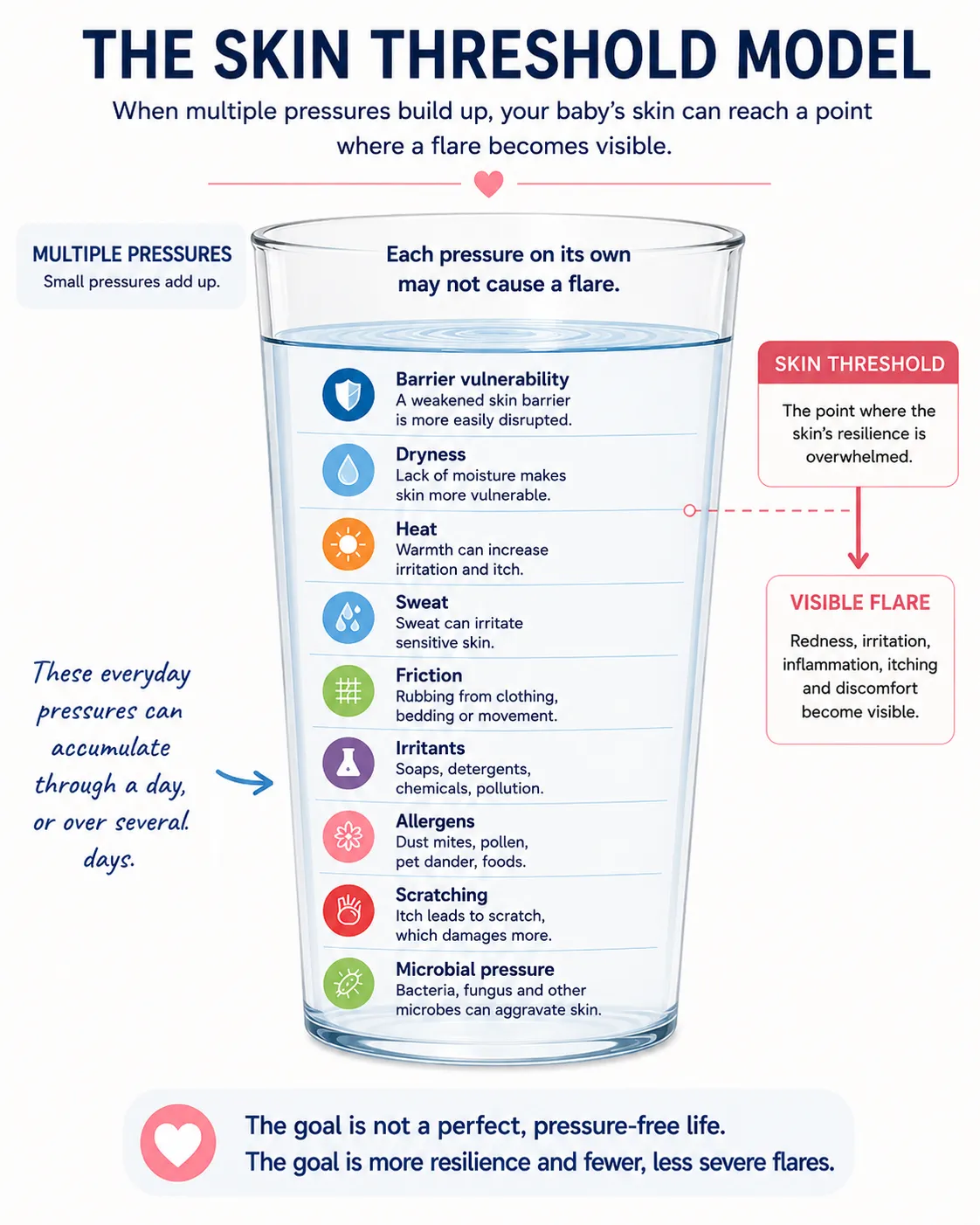
The truth is that baby skin does not always react to one single trigger. Several small pressures may build up over the course of a day or even several days before the skin becomes noticeably uncomfortable. Heat, sweat, saliva, clothing, bathing, swimming, dryness and scratching can all add pressure in different ways. When enough of those pressures come together, the skin may suddenly appear to flare even though nothing dramatic seemed to happen.
That is why a simple skin diary can be so useful. Instead of trying to remember everything that happened before a flare, you can write down a few observations each day and then look back for patterns. You may begin to notice that itching is worse after hot days, that redness around the mouth follows heavy drooling, or that swimming seems to leave the skin drier by bedtime. These are the kinds of patterns that are very easy to miss when you are dealing with them in the moment.
Why Baby Skin Can Seem Fine One Day and Flare the Next
A baby’s skin is still developing, and its protective barrier is not as mature as adult skin. This means moisture can escape more easily, while irritants and environmental stresses may have a greater effect. At the same time, babies are constantly being exposed to new foods, fabrics, temperatures, surfaces and routines. Their skin is therefore doing a great deal of adapting during the first few years of life.
Imagine a warm day when your baby becomes sweaty during play and then spends time in a car seat wearing several layers of clothing. Their skin may already be a little dry, and sweat can sit in folds around the neck, elbows or knees. Later, they may have a warm bath that removes some of the skin’s natural surface oils, followed by repeated scratching at bedtime. By the end of the day, the skin may look much worse even though no single event seemed severe enough to explain it.
This is often why parents describe a flare as happening “out of nowhere.” In reality, the skin may have been dealing with several small stresses that gradually added up. Each one on its own may have been manageable, but together they may have pushed the skin beyond what it could comfortably tolerate. Looking at the full day, rather than one isolated event, can therefore provide a much clearer picture.
The Skin Threshold Idea
One way to understand this is through what we call the Skin Threshold Model. Imagine that your baby’s skin has a certain amount of everyday stress it can cope with before dryness, itching or irritation becomes obvious. When the skin is well supported, it may tolerate several small challenges without much trouble. But when the barrier is already dry, scratched or weakened, it may take much less to push the skin past that threshold.
This changes the question parents can ask themselves when a flare appears. Instead of only asking, “What single thing caused this?”, it can be more useful to ask, “What combination of pressures may have affected my baby’s skin today?” That small change in thinking can make patterns much easier to recognise. It also helps explain why something that seemed harmless last week may appear to be a problem this week.
A skin tracker is useful because it helps you see those combinations more clearly. You are not trying to prove that one thing caused the flare, and you are not expected to become a detective every time the skin changes. You are simply creating a picture of what was happening around the time the skin became better or worse. Over several days, that picture often becomes much more useful than memory alone.
Your 7-Day Baby Skin Threshold Tracker
For the next seven days, make a few simple notes about your baby’s skin and daily routine. There is no need to record every tiny detail or turn it into a complicated project. The purpose is to notice what was happening before, during and after changes in the skin. Even a few minutes at the end of each day can be enough to reveal useful patterns.
1. Start With How the Skin Looks
Begin by recording what your baby’s skin looked like that day. Was it clear, slightly dry, rough, flaky, red, irritated or very itchy? Did it look better than the previous day, or did it seem to be getting worse? Keeping the description simple makes it much easier to compare one day with another.
It is also helpful to record where the change appeared. The cheeks, around the mouth, behind the ears, neck folds, scalp, elbows, knees, ankles and hands are all common areas where parents notice problems. Location matters because different parts of the body are exposed to different pressures. Redness around the mouth, for example, may have a very different explanation from dryness behind the knees.
2. Pay Attention to Itching and Scratching
Try to notice how much your baby scratches, rubs or seems bothered by their skin. You can use a simple score from zero to four, with zero meaning no scratching and four meaning scratching that interrupts sleep or damages the skin. The exact number is less important than using the same scale each day. That makes it easier to see whether the itching is changing over time.
The timing of the scratching can be just as useful as the amount. Some babies become itchier after a bath, after playing outside, after eating or when they become hot. Others scratch much more at bedtime or during the night, even when their skin appears relatively calm during the day. Writing down when the scratching happens can sometimes reveal the first useful clue.
3. Look at Heat and Sweat
Heat is one of the most common pressures on already dry or sensitive skin. Babies can become warm very quickly, especially when they are sleeping, sitting in car seats, crawling, running around or wearing several layers of clothing. Sweat can then collect in skin folds and areas covered by tight clothing. For some children, the itching becomes noticeably worse once they become hot.
During the week, make a note of unusually warm days or times when your baby sweated heavily. Think about whether they were overdressed, whether the bedroom was warm or whether they woke from sleep feeling hot. You may also notice that certain areas become irritated repeatedly, such as the neck, elbows or behind the knees. If the same pattern appears several times, heat may be one of the pressures worth addressing.
4. Notice Clothing and Friction
Clothing touches your baby’s skin for many hours every day, yet it is easy to overlook it when searching for possible triggers. Rough fabrics, tight cuffs, seams, labels and warm synthetic materials can all increase friction against already dry skin. Even a fabric your baby normally tolerates may become uncomfortable when the skin is already irritated. This is why it helps to record what they were wearing when the itching became noticeably worse.
Pay attention to whether your baby was wearing cotton, bamboo, polyester, wool or several warm layers. Also notice whether the irritation appeared exactly where elastic, seams or fabric were rubbing. A patch around the waist, ankle or wrist can sometimes provide an important clue. The pattern matters more than any single day.
5. Record Bathing Habits
Bathing can be soothing, but it can also leave already dry skin feeling tighter if the water is too hot or the bath lasts too long. Strong cleansers, bubble baths and frequent shampooing may also remove some of the oils that help protect the skin. That does not mean bathing is bad for eczema-prone skin. It simply means the way the bath is done can make a difference.
Write down how long your baby stayed in the bath, whether the water was warm or hot and which products were used. Notice whether the skin looked calm immediately afterwards but became dry or itchy later in the evening. Also record how soon moisturiser or skin cream was applied once the bath was finished. These small details can become surprisingly useful when comparing several days.
6. Do Not Forget Swimming and Chlorine
Swimming is another activity worth recording, particularly if your child already has dry or eczema-prone skin. Chlorinated water can leave some children feeling dry, tight or itchy, especially after longer swimming sessions. The skin may look fine when they first leave the pool and become uncomfortable several hours later. This delay is one reason parents do not always connect swimming with the flare.
Record how long your child spent in the pool and whether it was chlorinated or saltwater. Note whether you rinsed the skin afterwards and whether you applied cream soon after swimming. Then watch what happens later that day and during the night. If the same pattern repeats after several swimming sessions, you have found something useful to work with.
7. Think About Outdoor Exposure
Outdoor play exposes the skin to grass, sand, pollen, wind, sun, dust and changing temperatures. None of these automatically causes a skin problem, but they can add pressure when the skin is already dry or irritated. Sweat and friction from outdoor play may also make itching more noticeable. What matters is whether you see the same reaction more than once.
Write down whether your baby spent a long time outside and what the environment was like. If irritation appears mainly on exposed arms and legs, that may suggest a different pattern from irritation underneath clothing. You may also notice that problems appear after grass contact or very hot, windy days. Those repeated patterns are far more useful than guessing after one isolated event.
8. Watch Saliva and Food Contact Around the Mouth
The skin around a baby’s mouth can go through a lot during the day. Drooling, teething, food, wiping and constant moisture can repeatedly irritate an area that may already be dry. As saliva dries on the skin, the area can become rough or red, particularly around the lips, chin and cheeks. Frequent wiping can add even more friction.
Make a note of heavy drooling, teething days or foods that were smeared around the mouth. Acidic foods such as tomato and citrus can sometimes sting irritated skin simply because they are making direct contact with it. This does not automatically mean your baby has a food allergy. Sometimes the problem is happening on the surface of the skin rather than inside the body.
9. Note New Laundry and Household Products
When a flare appears, think back to anything new that may have been introduced recently. A different washing powder, fabric softener, baby wipe, shampoo, bubble bath or household cleaning product can easily be forgotten. New bedding or clothing may also have been washed in products your baby’s skin has not encountered before. Recording these changes helps you avoid relying on memory several days later.
You do not need to assume that every new product is causing a problem. Simply write it down and see whether the same pattern continues. If the skin improves after the product is removed and worsens again when it is reintroduced, the connection becomes more interesting. One observation is a possibility, while a repeated pattern is far more useful.
10. Keep an Eye on Sleep
Night-time can reveal patterns that are less obvious during the day. Some babies scratch much more when they are warm in bed or when there are fewer distractions from the sensation of itching. Bedding can create friction, and sweating during sleep can make already irritated skin feel more uncomfortable. Scratching can then disturb sleep and create even more irritation by morning.
Record whether your baby slept well, woke frequently or seemed to scratch in their sleep. Notice whether their hair or clothing felt sweaty when they woke and whether their skin looked worse first thing in the morning. You may also find that reducing bedroom heat or changing sleepwear makes a noticeable difference. Again, it is the repeated pattern over several nights that matters most.
A Simple 7-Day Tracker
You can use the same short list at the end of each day. Keeping it simple makes it much more likely that you will actually use it for the full seven days. You can write the answers in a notebook, save them on your phone or print a copy and keep it somewhere easy to reach. The goal is consistency, not perfection.
Skin today:
Clear / Dry / Rough / Red / Very itchy / Broken
Main areas affected:
_________________________
Itch score, 0–4:
_________________________
Heat or sweating:
Yes / No
Bath:
Yes / No
Swimming:
Yes / No
Outdoor play:
Yes / No
Heavy drooling or food contact:
Yes / No
New food:
_________________________
New product or detergent:
_________________________
Clothing or fabric changes:
_________________________
Sleep quality:
Good / Interrupted / Poor
Anything unusual today:
_________________________
Repeat the same observations for seven days and try not to judge the results too quickly. A single bad day may not tell you very much, but three or four similar days can begin to reveal a pattern. You may also discover that several things seem to happen together before the skin becomes worse. That is often where the most useful information is found.
What Should You Look for After Seven Days?
At the end of the week, look back over your notes without trying to force an answer. You are not looking for a perfect explanation for every flare. You are looking for repeated combinations, such as heat followed by scratching, swimming followed by dryness, or heavy drooling followed by redness around the mouth. Even one clear pattern can help you make better decisions about your baby’s routine.
You may find that the skin is consistently itchier after warm days or that redness appears after long baths. Perhaps sleep is worse whenever the bedroom is hot, or the skin becomes dry several hours after swimming. You may also find that there is no single trigger at all, but several pressures appearing together. That is exactly what the Skin Threshold Model is designed to help explain.
Do Not Change Everything at Once
Once you notice possible triggers, it can be tempting to change everything immediately. The problem with doing that is that you may never know which change actually helped. It is usually more useful to adjust one or two things at a time and then keep watching the skin. Small, steady changes are much easier to evaluate.
For example, you might shorten bath time for several days and keep everything else the same. If that seems to help, you have learned something useful before moving on to the next change. You could then look at bedtime clothing, bedroom temperature or what happens after swimming. This slower approach often gives parents far more confidence in the patterns they are seeing.
Why Supporting the Skin Matters Between Flares
Tracking triggers is only one part of caring for dry, itchy and eczema-prone skin. The other part is making sure the skin is supported every day, not only when it is visibly irritated. A stronger, better-supported skin barrier is generally more able to cope with the normal pressures of bathing, clothing, weather, saliva and play. That is why daily skin care matters just as much as identifying possible triggers.
This is also why we believe care should go beyond simple surface moisturisation. Dry, irritated skin needs hydration, but it also needs ingredients that can help support repair and provide a more resilient environment for the skin. Scratching and barrier damage can also leave the skin more vulnerable to bacteria and fungus. Our approach therefore focuses on three connected needs: Repair, Nourish and Defend.
How Itch-A-Bye Fits Into the Routine
Itch-A-Bye Baby Repair Cream was developed specifically for babies and children with dry, itchy and eczema-prone skin. The formulation was built around the idea that vulnerable skin often needs more than moisture alone. It combines hydrating, soothing and skin-supportive ingredients designed to work together rather than relying on one headline ingredient. This is the foundation of the Itch-A-Bye Repair • Nourish • Defend approach.
Black Seed Oil is included for its soothing, anti-inflammatory and antimicrobial properties. MSM helps support calm, comfortable skin, while Allantoin is widely valued for its soothing and skin-repair supporting properties. Hyaluronic Acid and Glycerin help attract and hold moisture in the skin, supporting hydration when the barrier is prone to dryness. Vitamin C and Vitamin E derivatives provide additional antioxidant and skin-supportive benefits within the formulation.
The cream also contains a carefully selected blend of botanical extracts chosen to complement those core ingredients. These botanicals help support the formulation’s calming, protective and skin-conditioning effects. Together, the ingredients are designed to help nourish skin that is dealing with repeated everyday pressures such as dryness, scratching, heat, bathing and environmental exposure. The aim is not simply to coat the skin, but to support it so it can better cope with those pressures.
A Better Question to Ask
When your baby’s skin flares, it is completely understandable to want one clear answer. Sometimes there will be one obvious cause, but sometimes the better question is, “What happened over the last 24 to 48 hours that may have added pressure to the skin?” That might include heat, sweating, a bath, swimming, saliva, clothing friction, scratching or a combination of several things. Looking at the whole picture often makes more sense than blaming the last thing that happened.
A seven-day skin diary gives you something memory alone cannot always provide. It allows you to compare days, notice repeated patterns and see which pressures tend to appear before the skin becomes worse. Once you can see those patterns, you can start making more informed decisions about what to change and what may not matter at all. Sometimes the pattern is the missing piece parents have been looking for.
Frequently Asked Questions
What are the most common baby eczema triggers?
There is no single list that applies to every baby, because eczema-prone skin can respond differently from one child to another. Heat, sweating, dry air, saliva, bathing, chlorine, rough fabrics, friction and certain products are common pressures parents often notice. Some babies seem to react strongly to one of these, while others only develop problems when several occur together. A diary can help you identify which patterns appear most often for your child.
Why does my baby’s eczema flare for no obvious reason?
A flare can sometimes seem random because the skin is reacting to several small pressures rather than one dramatic trigger. Dryness, heat, sweating, friction and scratching may all occur during the same day and gradually increase irritation. By the time the skin looks noticeably worse, the event that started the process may have happened many hours earlier. Looking back over the previous day or two can therefore be much more helpful than focusing only on the moment the flare appeared.
How long should I keep an eczema diary?
Seven days is a good place to begin because it is long enough to notice simple patterns without becoming overwhelming. If the suspected trigger does not happen very often, keeping the diary for two to four weeks can give you a clearer picture. Try to use the same simple observations each day so comparisons remain useful. You do not need to record every detail for the diary to be valuable.
Can food cause baby eczema to flare?
Food allergy can be associated with eczema in some children, but not every skin change after eating is caused by an allergy. Saliva, food contact around the mouth and repeated wiping can also irritate already sensitive skin. This is why the location of the reaction and the timing of other symptoms are important. If you suspect a genuine food allergy, particularly where there is swelling, hives, vomiting or breathing difficulty, seek medical assessment promptly.
Why does my baby itch more at night?
Night-time itching may be influenced by warmth, sweating, bedding friction and dryness. Babies also have fewer distractions during sleep, which can make scratching more noticeable. Once scratching starts, it can further irritate the skin and disturb sleep, creating a difficult cycle. Recording bedroom temperature, sleepwear and scratching patterns can help you see whether there is a repeatable connection.
Can chlorine make baby eczema worse?
Chlorinated water can leave some children with dry or eczema-prone skin feeling tighter and more uncomfortable. The reaction may not appear immediately and can become more noticeable later in the day. Rinsing the skin after swimming and supporting it with appropriate skin care afterwards may help reduce some of that dryness. Keeping a note of swimming days can quickly show whether the same pattern keeps returning.
Should I remove every suspected trigger?
Usually, changing everything at once makes it harder to understand what is really affecting the skin. A better approach is to identify one or two likely pressures, make a small change and then continue observing. If the skin consistently improves, that information becomes much more meaningful. Gradual changes also make the routine easier for families to maintain.
Related Reading
If you are trying to understand why your baby’s skin changes from one day to another, several related guides may help build the bigger picture. These include Why Is My Baby So Itchy?, Why Does My Baby Itch More When Hot?, Baby Itching After Being Outside: Heat, Grass, Pollen or Sweat? and Baby Itching After Changing Clothes: Fabric and Friction Explained. You may also find Why Does My Baby Scratch Even When Their Skin Looks Clear? and What Happens to Baby Skin Overnight? Why Bedtime Can Change Itching especially useful. Together, these articles help explain how everyday pressures can interact with already dry or eczema-prone skin.
For practical routines, read The Baby Bedtime Skin Routine: 15 Minutes Before Sleep, How to Moisturise Your Child’s Dry Skin Properly and How to Bathe a Child With Dry, Itchy or Eczema-Prone Skin. The deeper explanation behind this article can be found in The Skin Threshold Model: Why Baby Skin Can Suddenly Flare. These pieces are designed to work together rather than treating every flare as an isolated event. The more patterns you understand, the easier it becomes to build a routine around your baby’s actual skin rather than guesswork.
7-Day Baby Skin Threshold Tracker
Keep this article bookmarked, save the tracker on your phone or print a copy and use it for seven consecutive days. Try to fill it in at roughly the same time each evening while the day is still fresh in your mind. After the first week, look for combinations that appeared repeatedly before itching, redness or dryness increased. Sometimes the answer becomes much clearer when you stop looking at each flare in isolation and begin looking at the days leading up to it.