
Baby Itching After Being Outside: Heat, Grass, Pollen or Sweat?
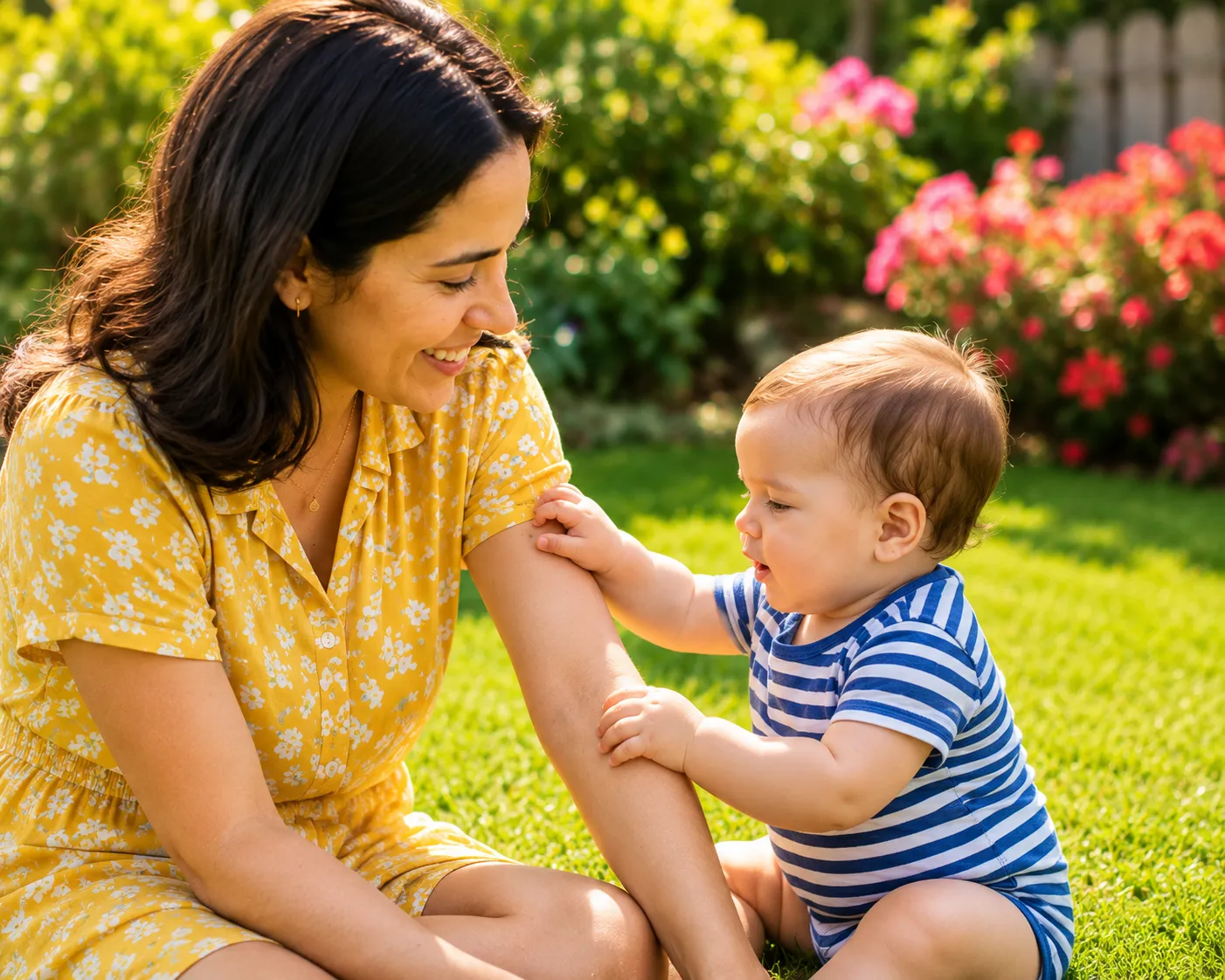
You take your baby outside for what should be one of the easiest parts of the day. Perhaps you sit together in the garden, go for a walk, visit the park or let your baby crawl on a picnic rug while an older sibling plays nearby. Their skin looked comfortable when you left home, and nothing particularly unusual seemed to happen while you were out. Then you get home and notice the scratching, rubbing or restlessness beginning. Their cheeks may look redder, the skin around their neck may feel damp, or previously quiet dry patches suddenly seem much more noticeable.
When this happens repeatedly, it is natural to start looking for one explanation. Was it the grass? Could pollen be irritating the skin? Was your baby simply too hot, or did sweat sit against already-dry areas for too long? The frustrating answer is that any of these things may contribute, and sometimes several of them may be acting together. Dermatologists recognise heat, sweating, pollen and other outdoor exposures as potential triggers for children with eczema-prone skin, but the pattern varies considerably from one child to another.
The First Clue Is Often Timing
One of the most useful things a parent can do is pay attention to when the itching actually begins. If your baby becomes uncomfortable within minutes of getting warm, heat and sweat move higher on the list of possibilities. If the problem seems to happen after crawling on grass or sitting somewhere freshly mown, direct contact deserves more attention. If symptoms seem worse on particular spring days regardless of whether your baby actually touched the lawn, pollen may be worth considering. The timing will not give you a diagnosis, but it can help you stop treating every outdoor episode as though it has the same cause.
It can also reveal patterns that are easy to miss when you are concentrating only on the skin. Perhaps the itching happens after long afternoons outside but rarely after a ten-minute walk. Maybe it appears around the neck and back rather than on the hands and knees that touched the ground. Or perhaps you notice that your baby scratches more after sitting warmly strapped into the pram on the journey home. Those details can help distinguish direct contact from overheating, sweat and friction.
Heat May Be the Simplest Explanation
Babies can become warm surprisingly quickly, particularly when they are dressed for what feels comfortable to an adult. Add a pram liner, hat, blanket, carrier or warm car journey and their skin may spend considerably more time hot and damp than we realise. Heat, humidity, sweating and overheating are commonly recognised as potential triggers for eczema-prone skin. Loose-fitting clothing and avoiding unnecessary overheating can therefore be useful practical measures. The important thing is to watch how your own baby’s skin behaves rather than assuming heat affects every child in the same way.
This does not mean heat itself is damaging your baby’s skin every time they become warm. The more useful observation is whether warmth consistently seems to precede itching. Check the back of the neck, chest and upper back when your baby becomes restless outside. If those areas feel very warm or damp, overheating may be contributing even when there is no obvious rash. Sometimes the simplest intervention is not another skincare product but removing a layer, finding some shade and helping the child cool comfortably.
Sweat Can Make Already-Itchy Skin Feel Much Worse
Sweat deserves separate attention because babies do not need to be visibly dripping with perspiration for it to matter. Moisture can collect in the neck folds, behind the knees, inside the elbows, around the hairline and underneath clothing. If those areas are already dry, scratched or easily irritated, sweat may make them feel increasingly uncomfortable. Keeping children comfortably cool and choosing loose, breathable clothing can help reduce this pressure. The aim is not to prevent normal sweating altogether, but to avoid prolonged heat and dampness where possible.
This can create a frustrating cycle. The baby becomes warm, begins sweating and starts rubbing or scratching. Scratching then places additional mechanical stress on skin that was already uncomfortable, which can encourage even more scratching. By the time you notice the problem, what began as simple overheating may look like a much larger skin episode. This is one reason preventing excessive warmth can sometimes be easier than trying to calm the scratching afterwards.
Grass Is More Complicated Than It Looks
If your baby’s itching seems to begin after sitting or crawling on grass, it is tempting to conclude that they are “allergic to grass.” That conclusion may be premature. Grass exposure can involve direct physical contact, friction, plant material, pollen, soil, insects, moisture and whatever products may have been used on the lawn. A baby’s knees, ankles, wrists and hands may also be repeatedly rubbing against relatively coarse vegetation while crawling. The outdoor environment is rarely a single exposure.
Grass and plant pollens can nevertheless be environmental triggers for some children with eczema-prone skin. If you suspect grass, look for consistency before making dramatic changes. Does your baby become itchy every time bare skin touches grass, or only occasionally? Are the affected areas actually the areas that contacted the ground? Does the same thing happen when your baby plays outside on a blanket rather than directly on the lawn? A repeated pattern is far more informative than one difficult afternoon.
Pollen Can Be Harder to Spot
Pollen is particularly confusing because your baby does not have to visibly touch a flower for exposure to occur. Pollen can be airborne and can settle on hair, skin, clothing, blankets and prams. This means a parent may see itching after a walk and have no obvious event to connect it with. If the pattern appears seasonally or seems noticeably worse when pollen levels are high, that information may be worth recording. Looking for a repeated relationship between outdoor conditions and subsequent skin discomfort can be more useful than assuming pollen is responsible after one episode.
That still does not mean pollen should automatically be blamed whenever your baby scratches outdoors. Parents are better served by identifying a convincing individual pattern than by trying to remove their child from ordinary outdoor life. If you suspect a genuine allergy or notice other symptoms such as significant swelling, breathing difficulty or a more generalised reaction, that moves beyond routine dry-skin care and deserves prompt medical attention. Skin symptoms that are persistent or difficult to interpret should also be discussed with an appropriate healthcare professional.
Sometimes It Is Not Heat, Grass or Pollen — It Is Friction
There is another possibility that can easily hide behind all three: friction. Think about everything touching your baby’s skin during an ordinary trip outside. There may be clothing seams, a nappy waistband, a baby carrier, pram straps, a car-seat harness, socks, shoes and perhaps a hat rubbing against the forehead. Add warmth and sweat, and surfaces that were perfectly comfortable at home may begin feeling very different against vulnerable skin. The resulting itching may be blamed on “something outside” even though the immediate problem is happening underneath the clothing.
Location can give you useful clues. Irritation underneath straps or around clothing edges points in a different direction from exposed cheeks becoming uncomfortable on a high-pollen day. Scratching concentrated behind the knees or around a sweaty neckline suggests something different again. Paying attention to where clothing, seams and straps touch the skin can therefore be surprisingly informative. It may also reveal simple adjustments that make outdoor time more comfortable.
Sunscreen Can Enter the Picture Too
On sunny days there may be another variable: sunscreen. Sun protection is extremely important, particularly here in Australia, so the answer is certainly not to abandon sunscreen because a child has sensitive skin. However, individual skincare products can sometimes irritate eczema-prone skin, which means a new sunscreen can complicate the detective work if it was introduced at roughly the same time as the outdoor itching. Children with sensitive or eczema-prone skin may need carefully selected sun-protection products. It helps to introduce new products thoughtfully so you can recognise a pattern if one develops.
If the itching appears mainly where sunscreen was applied, take note of that pattern. Do not assume that sunscreen is responsible after a single episode, because heat, sweat and sunlight may have changed at the same time. If one particular product repeatedly seems to cause trouble, discuss suitable alternatives with your pharmacist, doctor or dermatologist. For young babies, follow Australian sun-protection guidance and professional advice about appropriate protection rather than simply applying products intended for adults.
The Real Trigger May Be the Combination
This is where outdoor itching becomes particularly interesting. Imagine a baby whose skin is already slightly dry before leaving home. They spend an hour outside on a warm afternoon, become sweaty around the neck, crawl briefly on grass, have pollen settling on their clothes and then spend twenty minutes strapped into a warm car seat. None of those exposures necessarily needs to be dramatic by itself. Together, however, they may create enough pressure for previously comfortable skin to start feeling itchy.
This is very close to the way we encourage parents to think about troublesome skin in our Beyond the Skin Barrier approach. Instead of repeatedly asking, “What is the one thing causing this?”, sometimes a better question is, “What combination of things changed before the itching started?” Skin exists within an environment, and that environment can change several times within a single afternoon. Looking at combinations can help parents identify manageable patterns without turning everyday life into an endless search for one mysterious culprit.
Try the Five-Minute Outdoor Check
When your baby starts scratching after being outside, resist the temptation to immediately change everything. Instead, take five minutes to reconstruct what happened. Think about how warm the day was, what your baby was wearing, whether they were sweating, what surfaces touched their skin and whether they spent time directly on grass. Consider pollen, sunscreen, wet clothing and the journey home as well. Then look at where the itching or redness appeared.
Writing those observations down can be surprisingly useful. You do not need a complicated spreadsheet or medical diary. Something as simple as “warm afternoon, 45 minutes outside, sweaty neck, played on grass, scratching neck and knees afterwards” may be enough. If the same combination appears three or four times, you have learned something much more useful than you could from one isolated episode. Repeated observations can also be helpful if you later discuss the problem with a healthcare professional.
What to Do When You Come Back Inside
For many babies, the first step is simply to remove whatever may still be sitting against the skin. Change sweaty or damp clothing, gently clean exposed areas when necessary and allow your baby to cool down comfortably. Avoid vigorously rubbing the skin with a towel or washcloth, particularly if scratching has already started. If the skin is dry, follow with the moisturising routine that normally works for your child. The goal is to make the transition back indoors gentle rather than adding more friction.
A full bath is not automatically necessary after every trip outdoors. If bathing is useful because the child is sweaty, dirty or covered in pollen or grass residue, keep the water lukewarm and the bath relatively short. Avoid unnecessary scrubbing and follow with moisturiser afterwards. The objective is to remove potential irritants without turning the clean-up itself into another source of irritation. Simple and gentle is usually a good place to start.
Where Itch-A-Bye Can Fit Into the Routine
This is one of the situations in which Itch-A-Bye Baby Repair Cream can fit naturally into everyday skincare. We developed the cream specifically for dry, itchy and eczema-prone baby skin, rather than as a treatment for pollen allergy, heat rash or another medical condition. After an outdoor day, the role we see for Itch-A-Bye is straightforward: once the skin has been cooled and obvious environmental residue has been gently removed, the cream can be used as part of the child’s normal moisturising and skin-support routine. It should complement sensible trigger management rather than replace it. That distinction keeps the focus where it belongs: on the child’s overall comfort and routine.
The formulation reflects our Repair, Nourish and Defend philosophy. It combines Black Seed Oil, MSM and Allantoin with hydration-supporting ingredients including Glycerin and Hyaluronic Acid, alongside Vitamin E, Ascorbyl Palmitate, Caprylic Acid and our broader botanical complex. That complex includes Centella asiatica, Chamomile, Licorice, Scutellaria baicalensis, Rosemary, Polygonum cuspidatum, Green Tea and Ginger. We prefer this multi-ingredient approach because outdoor discomfort can involve dryness, warmth, friction and scratching rather than one isolated problem. The formulation is designed as supportive skincare, not as a substitute for diagnosing an underlying trigger.
But Don’t Use the Cream to Hide the Pattern
This point is important. If your baby’s skin repeatedly becomes uncomfortable every time you visit the same park, sit on the same lawn or go outside on very hot days, we would rather you investigate that pattern than simply apply more cream each time. Skincare can support dry and uncomfortable skin, but it should not prevent parents from asking why a problem keeps returning. Sometimes changing the environment is easier than continually responding afterwards. A repeated pattern is useful information.
Perhaps the answer is lighter clothing. Perhaps it is using a picnic blanket rather than letting bare legs remain directly against grass. Maybe your baby needs more frequent shade breaks, or perhaps changing sweaty clothes quickly makes the biggest difference. Good skincare and sensible trigger management are not competing ideas. They work best together.
Should You Keep Your Baby Indoors on Hot or High-Pollen Days?
Usually, the goal should not be to make ordinary childhood smaller. Babies benefit from being outdoors, and families should not feel that dry or eczema-prone skin means avoiding parks, gardens and family outings altogether. If you identify a strong relationship between very hot weather and itching, however, choosing a cooler part of the day can be sensible. Likewise, if a child has a convincing pollen-related pattern, reducing exposure when pollen levels are particularly high may be worth discussing with a healthcare professional. The aim is thoughtful adjustment rather than fear of the outdoors.
The important word is consistently. One itchy afternoon does not prove an allergy, just as one comfortable afternoon does not rule out an environmental trigger. Look for repetition and context. Your goal is not to create a perfectly controlled environment around your baby. It is to understand their skin well enough to make ordinary life more comfortable.
When Outdoor Itching Needs More Than Skincare
Most mild episodes of dry or itchy skin after outdoor play can be approached with cooling, gentle cleansing when needed, moisturising and watching for patterns. There are situations, however, where the picture changes. Rapid swelling, difficulty breathing, widespread hives, vomiting, unusual lethargy or another sudden systemic reaction requires urgent medical attention rather than a skincare response. Persistent or severe eczema, extensively broken skin, weeping, pus-filled areas or yellow-orange crusting should also be professionally assessed. Signs that suggest infection or a significant allergic reaction should not be managed as ordinary dry skin.
Parents should also seek advice when itching keeps returning despite sensible skincare and trigger management. A doctor or dermatologist can help distinguish ordinary dry-skin irritation from eczema, contact reactions, allergies and other conditions that may look similar at home. Photographs and a simple trigger diary can be extremely helpful at that appointment. Instead of trying to remember what happened three weeks ago, you can show the pattern. That can make the conversation much more productive.
A Better Question to Ask After the Next Outdoor Day
If your baby starts scratching after the next trip to the park, try not to begin with “What are they allergic to?” Start with something broader. What changed between comfortable skin at home and itchy skin now? Was your baby hot, sweaty or overdressed? Did bare skin touch grass, was pollen particularly noticeable, did clothing rub somewhere, or did several of those things happen together?
That small change in the question can completely change the way you investigate the problem. Instead of fearing everything outside, you begin learning which circumstances actually matter to your child’s skin. Over several outings, patterns may emerge, and once you can see the pattern, you can often make surprisingly small adjustments. Outdoor life does not need to become the enemy. The objective is understanding rather than avoidance.
Let Them Enjoy Being Outside
A baby should be able to crawl across a picnic rug, watch leaves moving in the wind, visit the park and discover the strange feeling of grass underneath tiny feet. Dry, itchy or eczema-prone skin can make those experiences more complicated, but it does not have to take them away. Keep your baby comfortably cool, choose soft breathable clothing, watch for sweating and pay attention to repeated patterns. When necessary, gently remove sweat or environmental residue and follow with the moisturising routine that works for their skin. Small practical adjustments can often preserve the experience while making it more comfortable.
For families using Itch-A-Bye, that is where we believe the cream belongs: not as a reason to stop investigating triggers and not as a promise to make every outdoor reaction disappear, but as part of a thoughtful routine for supporting dry, itchy and easily irritated skin. Observe first, make the simple changes you can, and support the skin afterwards. If something continues to concern you, bring the pattern to a healthcare professional. The goal isn’t to protect your baby from the outdoors; it’s to help their skin become a smaller part of the adventure. That is a much more sustainable way to approach everyday family life.
This article provides general educational information and does not replace medical advice. Itch-A-Bye is a cosmetic skincare product for dry, itchy and eczema-prone skin and is not presented as a medicine or treatment for eczema, allergy, infection, heat rash or another medical condition. Individual experiences vary. Seek appropriate professional advice for severe, persistent, rapidly worsening, infected-looking or otherwise concerning skin.