
Before Your Child’s Next Swim, Put This Cream in Their Bag: Why We Believe Itch-A-Bye Could Change Their After-Swim Skin Routine
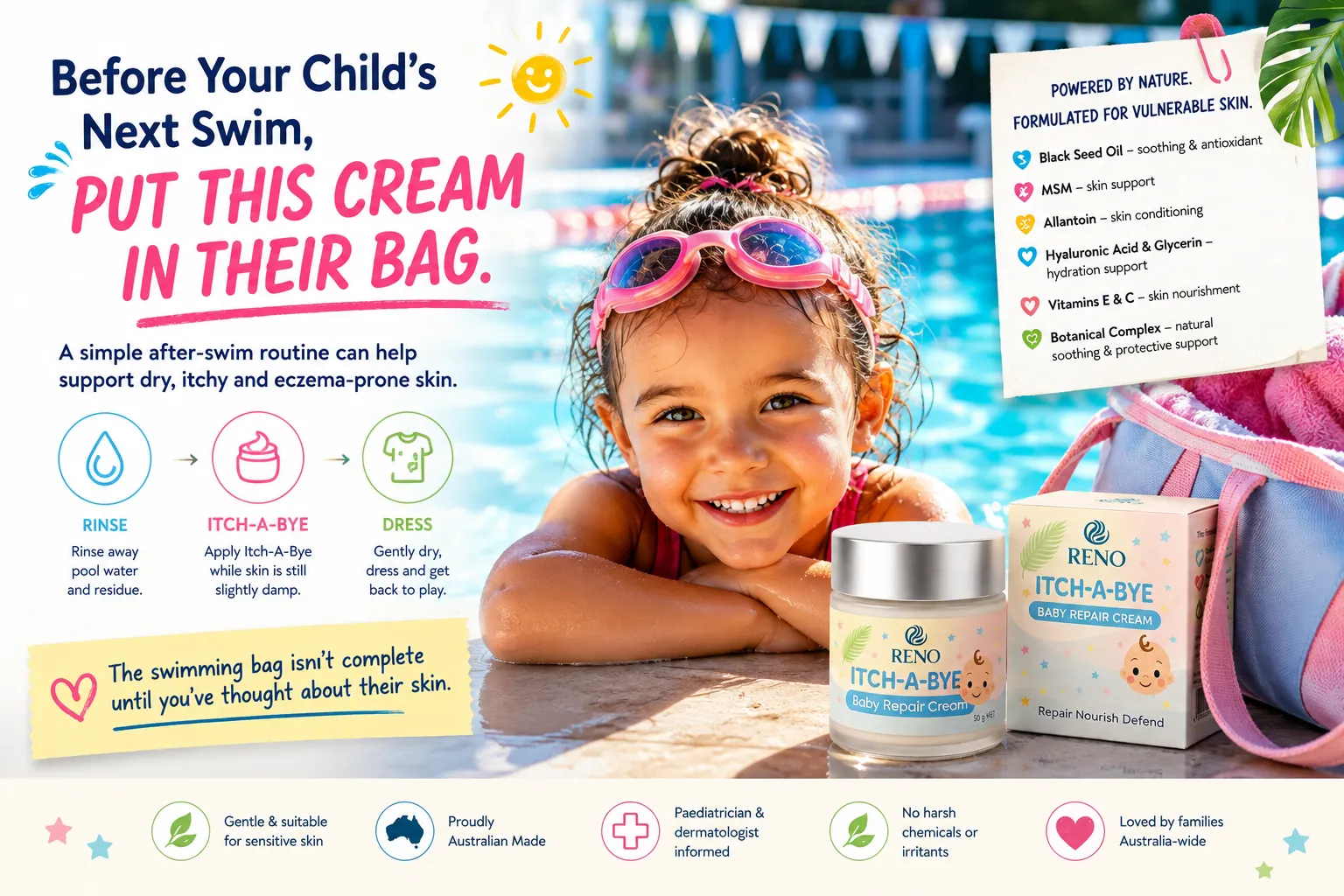
Your child’s swimming bag probably contains a swimsuit, towel, goggles and dry clothes. If swimming often leaves their skin dry, itchy or uncomfortable, there may be one more thing worth packing: their usual skincare.
Many parents know the pattern. A child has a wonderful time in the pool, then starts scratching in the changing room, on the way home or later that evening. The skin may feel tight, rough or simply less comfortable than it did before the swim.
That does not necessarily mean swimming has to stop. A more useful question is what happens in the first few minutes after your child leaves the water.
Think About the Skin Before You Leave Home
Parents are usually very good at packing for swimming. We remember the towel, goggles, dry clothes, water bottle and snack because we know they will be needed. Yet moisturiser is often still sitting in the bathroom at home, even when a child regularly develops dry or itchy skin after swimming.
For children whose skin tends to struggle after pool or beach exposure, skincare can simply become another part of the swimming kit. It does not need to feel like treatment or an emergency measure. It is just preparation.
For families who already use Itch-A-Bye Baby Repair Cream, that may mean keeping the jar in the swimming bag rather than waiting until the skin becomes uncomfortable.
Why the First Few Minutes Matter
It is easy to think, “I’ll moisturise them when we get home.” But home may be twenty or forty minutes away. There may be traffic, another child to collect or groceries to pick up. By then, the skin may already feel dry and the scratching may have started.
Professional guidance for eczema-prone skin commonly recommends rinsing after swimming, drying gently and moisturising promptly. The practical lesson is simple: after-swim skincare is often easier when the moisturiser is actually at the pool with you.
You do not need a complicated routine. You just need something you can remember when everyone is wet, hungry and looking for a missing sock.
Rinse → Moisturise → Dress
Rinse the skin with fresh water, remove wet swimwear and pat the skin gently rather than rubbing hard. Apply an appropriate moisturiser while the skin is still slightly damp, then put on clean, dry clothes.
For families using Itch-A-Bye, it can be as simple as Rinse → Itch-A-Bye → Dress.
Why Swimming Can Leave Some Skin Feeling Uncomfortable
It is tempting to blame everything on chlorine, but swimming involves more than one exposure. A child may spend an hour in treated water, become warm while playing, sit in wet swimwear and then have their skin rubbed with a towel. If the skin was already a little dry before the lesson, all of those small pressures can add up.
The beach has its own combination. Salt, sand, wind, sun, sunscreen and wet clothing can all be part of the experience. Some children tolerate these things without difficulty. Others seem to become dry or itchy quite quickly.
Looking at the whole experience is more useful than treating chlorine as the villain. Chlorine has an important public-health purpose in swimming pools, and many children tolerate it perfectly well.
Where Itch-A-Bye Fits
We did not originally create Itch-A-Bye as a swimming product. It was developed for babies and young children with dry, itchy and eczema-prone skin. Over time, however, swimming became one of the everyday situations in which the formulation seemed particularly relevant.
That made sense when we looked at what the skin may need after swimming. Moisture matters, but so does gentle conditioning and support for skin that feels stressed or uncomfortable.
Itch-A-Bye contains Black Seed Oil, MSM and Allantoin, supported by Glycerin, Hyaluronic Acid, Tocopherol (Vitamin E), Ascorbyl Palmitate and Caprylic Acid. It also contains a botanical complex including Centella asiatica, Chamomile, Licorice, Scutellaria baicalensis, Rosemary, Polygonum cuspidatum, Green Tea and Ginger.
We do not think one ingredient needs to carry the entire story. The useful part is how the formulation works as a whole.
Hydration Is an Important Part of After-Swim Care
Glycerin and Hyaluronic Acid are included for their hydration-supporting properties. That is particularly relevant after swimming because the skin can feel surprisingly dry once the water evaporates and the child has been towelled off.
But parents often describe more than dryness. The skin may feel rough, itchy or easily irritated. That is why the formulation also includes ingredients such as Allantoin, which is widely used for its soothing and skin-conditioning properties.
The aim is not to make the routine more complicated. It is to give dry, uncomfortable skin sensible support at a time when it may need it.
Why We Use Black Seed Oil
Black Seed Oil comes from Nigella sativa, a plant whose naturally occurring compounds have attracted considerable scientific interest. Research has explored compounds such as thymoquinone in relation to antioxidant, anti-inflammatory and antimicrobial activity.
That research helps explain our interest in Black Seed Oil as an ingredient, but it is important not to overstate what it means. Research on an individual ingredient is not the same as a clinical trial of the finished Itch-A-Bye cream, and we do not present it that way.
For us, Black Seed Oil is one part of a broader formulation. MSM, Allantoin, humectants, vitamins and botanicals all contribute different properties. The formulation matters more than turning any single ingredient into a miracle story.
A Broader Way of Thinking About the Formula
This is where our Repair, Nourish and Defend philosophy becomes useful. Repair reflects our focus on supporting skin that has become dry or stressed. Nourish describes the moisturising and conditioning side of the formula. Defend reflects our broader approach to supporting vulnerable skin and its natural protective role against everyday environmental and microbial pressures.
Swimming is a good example because several things can happen to the skin within a short period. There is water exposure, warmth, friction, drying and sometimes scratching. It makes sense to us that after-swim skincare should take a similarly broad view.
These are formulation principles rather than promises that every child will respond in the same way. Children are different, and skincare should always be judged by how well it suits the individual child.
Do Not Wait for Scratching to Be the Reminder
This may be the most useful change parents can make. Most of us remember moisturiser when we notice dry skin or see a child scratching. In other words, the discomfort becomes the reminder.
If you already know swimming tends to leave your child dry or itchy, the swimming lesson itself can become the reminder instead. When the swim ends, rinse the skin, remove the wet clothes, dry gently and moisturise.
That turns after-swim skincare from a reaction into an ordinary habit.
Keep the Routine Easy
If your child swims regularly, it can help to keep a swimming bag partly packed between lessons. Goggles, a soft towel and other swimming essentials can stay together. Their skincare can live there too.
A dedicated jar of Itch-A-Bye in the swimming bag may be useful for families who use it regularly. The point is not to use more product. It is simply to have it available at the time you are most likely to need it.
Small practical changes like this are often what make routines stick.
What About Before Swimming?
Some dermatology guidance also recommends applying an appropriate moisturiser before swimming for children with eczema-prone skin, followed by rinsing and moisturising again afterwards. For children who regularly become very dry, a before-and-after approach may be worth considering.
The exact routine should suit the child, the products being used and any professional advice the family has received. What works beautifully for one child may not suit another.
The broader principle is useful: prepare the skin before a predictable exposure and support it afterwards rather than waiting for discomfort to develop.
Wet Swimwear Can Matter Too
Pool water is not the only thing touching the skin. Wet fabric can sit against the body for quite a while after a lesson, and elastic around the waist, shoulders or legs can rub areas that are already vulnerable.
Changing out of wet swimwear promptly is therefore a simple part of good after-swim care. Rinse, pat dry, moisturise and change into comfortable dry clothing.
It is a small detail, but sometimes several small details make the biggest difference.
The Same Principle Works at the Beach
Seawater is not automatically better or worse for every child. Some children find it comfortable, while salt can sting skin that is scratched, cracked or very dry.
A beach day also adds sand, wind, heat, sunscreen and wet clothing. Rinsing with fresh water when practical, removing sandy or wet clothes and moisturising afterwards can therefore make sense there too.
The environment changes, but the basic idea remains the same: be gentle with the skin after exposure.
When Swimming May Need to Wait
If your child’s skin is extensively raw, open, weeping, crusted, painful or looks infected, ordinary cosmetic skincare may not be enough. A severe flare or rapidly worsening skin deserves appropriate professional assessment.
Itch-A-Bye is a cosmetic skincare product. It is not a substitute for medical diagnosis, prescribed treatment or treatment of an infection.
Knowing that boundary is part of sensible skincare.
Beyond the Skin Barrier
Swimming also illustrates an idea we explore in our book, Beyond the Skin Barrier: Uncovering the Hidden Roots of Dry, Itchy and Eczema-Prone Skin. Parents naturally look for one cause when their child’s skin becomes uncomfortable. Sometimes several smaller pressures may be acting together.
A child might enter the pool with slightly dry skin, spend an hour in treated water, remain in wet clothing, be rubbed with a towel and then start scratching. None of those factors has to explain everything on its own.
That interconnected way of thinking runs throughout the book. The complete digital edition is available free at www.itchabye.com/free-book.
A Simple Habit for the Next Swim
The main idea is not complicated. If swimming repeatedly leaves your child’s skin dry or itchy, think about their skin before you leave home rather than after the scratching begins.
Pack the usual swimming essentials. Add the skincare product that already works for your child. When the swim is over, rinse the skin, remove wet clothing, dry gently and moisturise promptly.
For families who use Itch-A-Bye Baby Repair Cream, the routine is easy to remember:
RINSE → ITCH-A-BYE → DRESS
Then get on with the rest of the day.
This article provides general educational information and does not replace medical advice. Itch-A-Bye is a cosmetic skincare product for dry, itchy and eczema-prone skin and is not presented as a medicine or treatment for eczema, infection, allergy or another medical condition. Individual experiences vary. Seek appropriate professional advice for severe, persistent, infected-looking, weeping, extensively broken or otherwise concerning skin.