
My Child Is Scratching Until They Bleed. How Do We Break the Itch-Scratch Cycle?
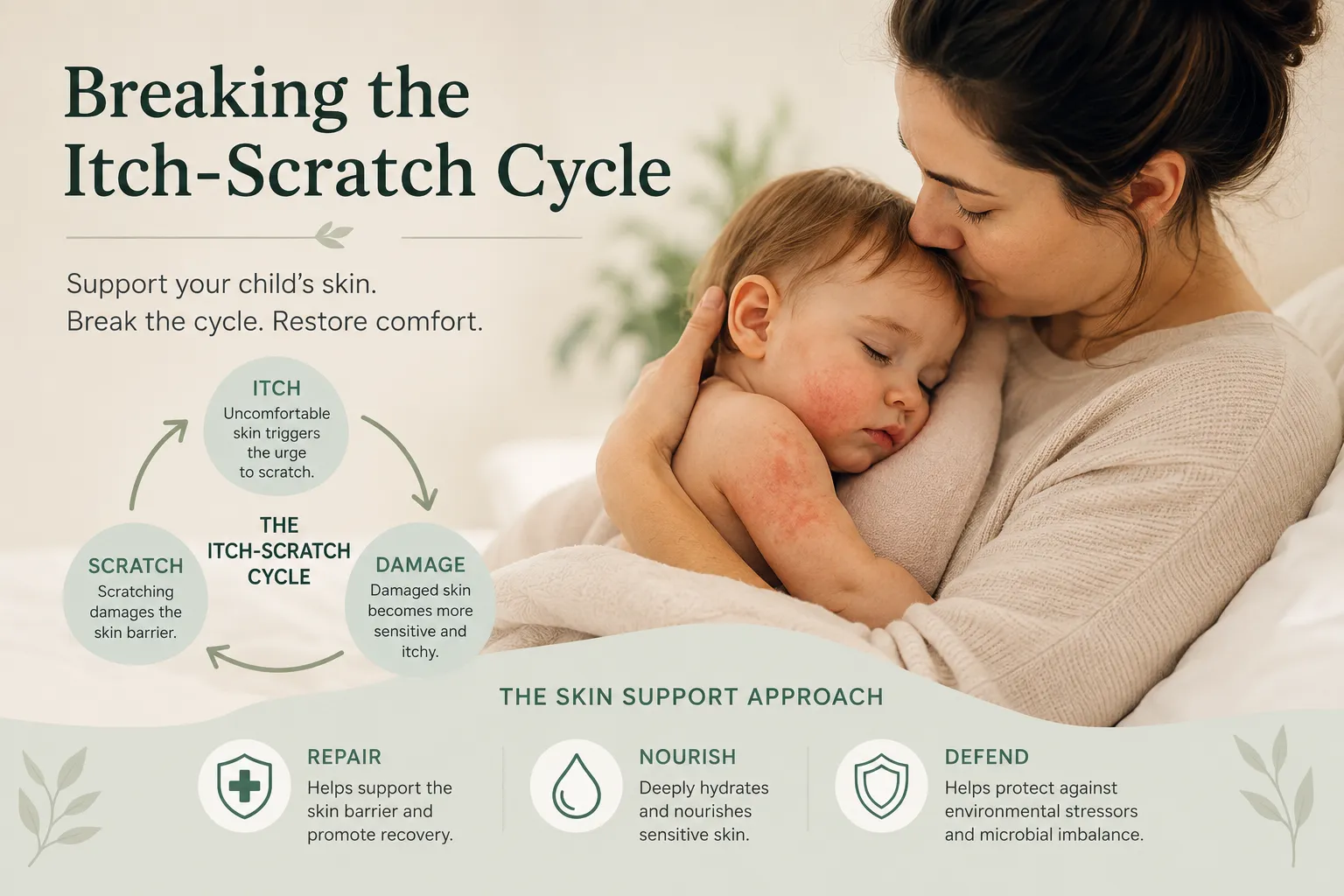
There is a particular kind of exhaustion that comes from being woken by the sound of your child scratching. You hear the rustling through the baby monitor, walk into the room and gently move their hands away from their skin. You settle them, straighten their pyjamas, apply some cream and hope that this time they will stay comfortable. Then twenty minutes later, the scratching begins again.
By morning there may be fresh marks behind the knees, around the neck, across the cheeks or wherever your child tends to scratch most. Sometimes there is a little blood on the pyjamas or sheets, and the patch that finally seemed to be healing yesterday looks raw again. You may have trimmed their nails, changed the detergent, bought cotton clothing and moisturised faithfully, yet somehow you are back in exactly the same place. Eventually you start asking the question so many exhausted parents ask: What am I missing?
The answer may begin with understanding that your child is not “just scratching.” They are responding to a real sensation coming from uncomfortable skin, and young children cannot simply reason themselves out of that urge. Scratching may temporarily change the sensation and provide a few moments of relief. Unfortunately, those few moments can also help create the conditions for even more itching later.
The Problem Is Not Just the Scratching
When parents see their child scratching, the natural reaction is to concentrate on the hands. You move the hands away, put on mittens, trim the nails and repeatedly tell an older child not to scratch. Those things can help reduce damage, but they do not necessarily answer the most important question. Why is the skin giving your child such a powerful reason to scratch in the first place?
Itch can be associated with several things happening within and around eczema-prone skin. The barrier may be dry or compromised, inflammation may be contributing to discomfort, or heat and sweat may be making the skin feel worse. Clothing, bedding, saliva and repeated wiping can add friction, while previous scratching may already have damaged the surface. What looks like one simple behaviour can therefore be the visible end of a much more complicated process.
This Is How the Itch-Scratch Cycle Begins
Imagine your child’s skin becomes uncomfortable and starts to itch. Your child scratches because scratching briefly changes that uncomfortable sensation, but their fingernails are now dragging across a protective surface that may already be vulnerable. Repeated scratching can create tiny breaks, increase irritation and eventually leave visible scratches, raw patches or bleeding. The skin that was originally itchy is now itchy and physically damaged.
That damage can make the skin more vulnerable to further irritation and moisture loss. The area may become increasingly uncomfortable, which creates another reason to scratch it. Your child scratches again, the surface experiences more mechanical stress and the cycle continues. This is why it is called the itch-scratch cycle: itch leads to scratching, scratching contributes to damage, and damaged irritated skin can contribute to more itch.
This Is Why “Stop Scratching” Rarely Solves It
Imagine having an intensely itchy mosquito bite and being told that you are simply not allowed to touch it. An adult may understand why resisting the urge is sensible, yet even adults know how difficult that can become when itching is intense. A baby or toddler does not have that level of understanding or self-control. They simply know that their skin feels uncomfortable and scratching seems to provide immediate relief.
This is why repeatedly moving your child’s hands away may feel like an endless battle. You are trying to stop the behaviour while the sensation driving the behaviour is still there. The hands return because the itch returns, and the cycle can become especially difficult once scratching itself has begun damaging the skin. Breaking the cycle therefore means working on both the urge to scratch and the damage scratching creates.
Dryness May Be Only One Part of What Is Happening
Dry skin is usually the easiest part of the problem to see. You notice rough cheeks, flaky legs, dry folds or patches that look dull and uncomfortable, so naturally you reach for a moisturiser. Hydration is important for eczema-prone skin, and a good moisturiser can help reduce dryness and water loss. But a child who is scratching until they bleed may be dealing with considerably more than a shortage of moisture.
There may also be inflammation, barrier vulnerability, heat, sweat, friction and repeated mechanical damage from scratching. The compromised surface is still interacting with bacteria, fungi and other microorganisms naturally present on the skin and in the environment. These pressures can overlap rather than occurring separately. This is why we think it is more useful to see eczema-prone skin as a vulnerable protective system under pressure, rather than simply a dry surface that needs another layer of moisture.
You Can Moisturise the Skin and Still Have an Itchy Child
This can be incredibly confusing for parents because sometimes the moisturiser appears to be working. The skin feels softer, looks smoother and may even appear less red, so you finally begin to think things are settling down. Then bedtime arrives and your child’s hands go straight back to the same areas. By morning, some of yesterday’s progress appears to have disappeared.
The important distinction is that moisturised skin is not necessarily fully recovered skin. Hydration may have improved while inflammation, barrier vulnerability, heat or the itch-scratch cycle continues. An area that looks almost normal may still be more sensitive than surrounding skin and easier to push back into irritation. This is why visible improvement does not always mean the underlying vulnerability has completely disappeared.
Nighttime Can Change Everything
Many parents tell us their child’s scratching becomes dramatically worse at night. During the day there are toys, meals, movement, people and countless distractions, but nighttime removes many of those distractions. Body temperature can also change, heat may accumulate beneath sleepwear and bedding, and sweat can collect around the neck, knees, elbows and other folds. A child may then scratch repeatedly while sleepy or even while remaining largely asleep.
This creates an especially difficult problem because you cannot reason with a sleeping child. Several hours of repeated scratching can challenge skin that you carefully supported throughout the day. That is why a patch can look reasonably good at bedtime and appear significantly worse the following morning. Sometimes the battle you think you are losing during the day is actually being fought for several hours overnight.
Start by Checking the Simplest Things
If nighttime scratching suddenly becomes intense, feel the back of your child’s neck, chest or upper back. Check whether they feel unusually warm, whether their hairline is damp or whether sweat has collected beneath clothing. Think about the room temperature, sleepwear, blankets and whether your child may simply be getting too hot. For some eczema-prone children, heat and sweating can make itching considerably harder to tolerate.
Then check the fingernails carefully, even if you trimmed them recently. A nail can be short and still have one surprisingly sharp edge capable of repeatedly scraping vulnerable skin. Keeping nails short and gently smoothing rough corners cannot remove the underlying itch, but it can reduce some of the physical damage when scratching occurs. That distinction matters because sometimes the first goal is not eliminating every scratch but preventing each scratch from doing as much harm.
Your Child’s Hands May Be Giving You Clues
Pay attention to where your child’s hands repeatedly go. Scratching behind warm knees or inside elbows may make you think about heat, sweat and friction, while scratching around the cheeks and chin during teething may point toward saliva and repeated wiping as additional pressures. A child constantly reaching for the scalp may require a different explanation from one scratching around the waistband. The location does not automatically reveal the cause, but patterns can provide useful clues.
Also notice when the scratching begins rather than looking only at the skin after the flare appears. Perhaps your child becomes hot in the afternoon, begins rubbing behind one knee, scratches more during the evening and then has an extremely difficult night. By morning the area is red and raw, making it look as though the eczema suddenly appeared overnight. In reality, the skin may have been giving you warning signs for hours.
Scratching Can Sometimes Be an Early Warning Signal
Parents naturally watch for visible redness because that is easy to recognise. But behaviour can sometimes change before the skin looks dramatically different, and your baby may begin rubbing their face or scratching a familiar area while the skin still appears relatively calm. Nighttime scratching may suddenly increase for a couple of nights before the visible flare becomes obvious. These patterns can be worth paying attention to.
Instead of waiting until the skin looks significantly worse, increased scratching can become a signal to look more closely at what has changed. Was the weather warmer, did your child sweat more, were they swimming, are they teething or has sleep been unusually unsettled? Perhaps several of those things happened together. That is where our Skin Threshold Model becomes particularly useful.
Think About a Threshold Rather Than One Trigger
Imagine your child’s skin has a tolerance threshold. Below that threshold, the skin may cope reasonably well even though several small pressures are present. Then dryness increases slightly, the weather becomes warmer, your child sweats more, teething increases saliva and scratching begins during the night. None of those pressures necessarily has to be enormous on its own.
Together, however, they may push vulnerable skin beyond what it can comfortably tolerate. The resulting flare can look sudden even though the pressure was accumulating gradually. This helps explain why the same swimming lesson, clothing or warm day can cause trouble on one occasion and appear harmless on another. The individual trigger may be the same, but the condition of the skin and the total pressure surrounding it may be different.
Do Not Automatically Blame the Last Thing That Happened
This is an easy trap to fall into when you are desperate for answers. Your child eats something new on Tuesday and scratches badly on Wednesday, so the food immediately becomes the suspect. They use a different shampoo, visit somebody’s house or go swimming, and the next flare gets blamed on that event. Sometimes that connection is real, but sometimes the final event was only one additional pressure added to skin that was already struggling.
Looking at the previous twenty-four to forty-eight hours can sometimes reveal a much richer picture. Perhaps your child had already been sleeping poorly, scratching more, sweating at night and developing drier skin before the supposedly new trigger appeared. The last event may simply have coincided with the point at which the skin crossed its threshold. Looking for combinations can therefore be more useful than endlessly eliminating one thing after another.
What About Bacteria When the Skin Has Been Scratched Open?
Healthy skin is not sterile, and we should not want it to be. It naturally lives alongside an enormous community of bacteria, fungi and other microorganisms that form part of the skin’s normal biological environment. However, eczema-prone skin can have an altered relationship with that microbial community, particularly when the barrier is compromised. Repeated scratching adds another layer because the physical surface is being disrupted again and again.
This does not mean that every scratch is infected or that parents should try to disinfect eczema-prone skin. It means that barrier integrity and the skin’s microbial environment belong in the broader conversation about repeatedly damaged skin. Staphylococcus aureus, for example, has been extensively studied in atopic dermatitis because of its relationship with barrier dysfunction and inflammatory processes. This is one reason our formulation philosophy considers Defend alongside Repair and Nourish.
This Is Where We Started Thinking Differently About Cream
When we developed Itch-A-Bye, we did not want to create another product whose entire strategy was simply to make dry skin feel softer. There were already many moisturisers capable of doing that very well. We wanted to ask what vulnerable skin might need when dryness, irritation, scratching, barrier damage and environmental pressure are occurring together. That question eventually became the foundation of our Repair, Nourish and Defend approach.
The formulation was therefore built around complementary ingredients rather than one fashionable hero ingredient. Some ingredients primarily support hydration, while others have been studied for soothing, skin-conditioning, antioxidant, anti-inflammatory or antimicrobial properties. We wanted those different properties working alongside one another because the skin itself is performing several jobs simultaneously. The formulation is the strategy, and ingredient synergy is what brings those different functions together.
REPAIR: Because Scratched Skin Has a Barrier Problem
Every time your child repeatedly scratches the same patch, that physical barrier is being challenged. The skin may begin recovering during the day only to be scratched again during the night, creating the frustrating experience of an area that never seems to stay settled for long. Supporting hydration remains important because a well-hydrated barrier is better able to remain flexible and comfortable. But our Repair philosophy looks beyond hydration alone.
This is one reason ingredients such as Allantoin and Centella asiatica are particularly interesting within the formulation. Allantoin is widely used for soothing and skin-conditioning support and has also been investigated in skin-recovery contexts. Centella contains compounds including asiaticoside and madecassoside that have been studied in relation to fibroblast activity, collagen-related processes, re-epithelialisation, antioxidant activity and inflammatory pathways. We selected them because their properties complement the broader objective of supporting vulnerable skin rather than simply making the surface feel moisturised.
NOURISH: Because Nourishing Skin Means More Than Adding Water
For us, Nourish has never simply meant moisturise. Hyaluronic Acid and Glycerin are important because hydration and water retention matter enormously, particularly when the barrier is dry. But if those were the only types of ingredients in Itch-A-Bye, we would still consider the formulation too narrow for what we wanted to create. Vulnerable skin may benefit from several different forms of topical support working together.
That is why Nourish also includes ingredients selected for complementary properties. Black Seed Oil, MSM, Allantoin, Vitamin C, Vitamin E and our botanical complex bring different types of support alongside hydration. Some have been researched for anti-inflammatory activity, others for antioxidant, soothing, skin-conditioning or antimicrobial properties. Nourish therefore means giving vulnerable skin a deliberately selected combination of ingredients rather than simply replacing lost moisture.
Why Black Seed Oil Matters to Us
Black Seed Oil, Nigella sativa, sits at the heart of this philosophy because it brings something very different from a conventional humectant. It contains numerous biologically active constituents, including thymoquinone, and has attracted substantial research interest for anti-inflammatory, antioxidant and antimicrobial properties. Those properties interested us because itchy, repeatedly scratched skin may be dealing with irritation and environmental pressure at the same time. We wanted an ingredient capable of contributing to more than one part of the formulation philosophy.
That does not mean Black Seed Oil is expected to solve eczema by itself. In fact, expecting one ingredient to do everything would contradict the entire way we formulated Itch-A-Bye. Black Seed Oil performs a different role from Hyaluronic Acid, just as Hyaluronic Acid performs a different role from Allantoin or MSM. The value comes from putting complementary ingredients together rather than searching for one miracle ingredient.
MSM and Allantoin Bring Different Types of Support
MSM is another ingredient we selected because it has been studied for anti-inflammatory and antioxidant properties. That gives it a different supportive role from an ingredient whose primary function is hydration. When inflammation and oxidative pressure can coexist with dryness, we think it makes sense to consider those pressures when building the formulation. MSM therefore becomes another piece of the wider Nourish system.
Allantoin brings soothing and skin-conditioning support and has been investigated in skin-recovery contexts. For a child repeatedly returning their fingernails to the same uncomfortable patch, soothing and conditioning are meaningful parts of the bigger picture. Again, Allantoin is not expected to perform every job required by vulnerable skin. It works alongside the other ingredients, and that complementary relationship is exactly what we mean by synergy.
The Botanical Complex Was Not Added Just to Look Natural
We wanted our botanical ingredients to have a reason for being there. Chamomile has a long history of topical use and research around soothing and anti-inflammatory activity, while Scutellaria baicalensis contains flavonoids studied for anti-inflammatory, antioxidant and antimicrobial properties. Licorice contains constituents researched for soothing and inflammatory pathways, while Green Tea provides polyphenols including EGCG with extensive antioxidant and anti-inflammatory research. Each botanical brings its own profile rather than simply contributing another plant name to the label.
Rosemary contains compounds including rosmarinic acid and carnosic acid and has research around antioxidant, inflammatory and antimicrobial properties. Ginger contains gingerols and shogaols that have been investigated for antioxidant and anti-inflammatory activity, while Polygonum cuspidatum provides polyphenols including resveratrol. These ingredients overlap in some areas and differ in others, which is precisely what we wanted. The objective is a formulation in which several ingredients contribute different kinds of support to the same vulnerable skin environment.
DEFEND: Because Damaged Skin Still Has to Face the Outside World
The patch your child scratched last night does not get to hide away while it recovers. It still encounters clothing, bedding, sweat, saliva, bath water, environmental particles and the microorganisms naturally living around us. When the physical barrier is compromised, that protective relationship becomes even more important. This is why Defend forms the third part of our approach.
Several ingredients within Itch-A-Bye have constituents that have demonstrated antibacterial, antifungal or broader antimicrobial properties in experimental research. Black Seed Oil, Scutellaria, Rosemary, Ginger and Licorice are among the ingredients that bring this additional dimension to the formulation. The aim is not to sterilise the skin, and Itch-A-Bye should not be confused with an antibiotic treatment for an established infection. Our philosophy is to support vulnerable skin’s protective environment while recognising that bacteria, fungi and other microbial pressures are part of the world that skin has to face.
Repair, Nourish and Defend Work Together
Think again about what happens during the itch-scratch cycle. The barrier becomes uncomfortable, the child scratches, the scratching creates more physical damage and that vulnerable surface must then try to recover while remaining exposed to the outside environment. Hydration matters throughout that process, but hydration is not the only biological consideration. This is why our three pillars were designed to complement one another rather than exist as separate marketing ideas.
Repair focuses on supporting the vulnerable physical barrier. Nourish provides hydration together with carefully selected ingredients offering complementary soothing, conditioning, antioxidant and other supportive properties. Defend recognises that the skin remains a protective interface with bacteria, fungi and the environment even while it is compromised. Together, those three functions describe the broader support structure we wanted Itch-A-Bye to provide.
What Can You Do Tonight?
Start with the things you can actually control. Keep your child’s nails short and smooth, check whether they are overheating and pay attention to sweat around the neck, knees, elbows and other folds. Choose soft clothing and bedding that minimise unnecessary friction, and continue the skincare plan that has been recommended for your child’s eczema. Most importantly, begin watching for patterns rather than concentrating only on the visible rash.
If the scratching begins, ask what happened during the previous several hours. Think about heat, sweat, saliva, bathing, swimming, clothing, tiredness and whether the skin was already becoming drier. Notice where your child’s hands repeatedly go and whether scratching tends to begin at a particular time. You may start seeing a sequence that was previously hidden inside what looked like a completely unpredictable flare.
When Your Child Scratches Until They Bleed, Watch the Skin Carefully
A superficial scratch can happen surprisingly easily, particularly when tiny fingernails repeatedly move across the same area. But persistent broken skin, repeated bleeding or significant discomfort deserves closer attention. Watch for increasing pain, warmth, swelling, rapidly spreading redness, unusual weeping, pus or significant crusting. Those changes can indicate that the situation needs professional assessment rather than simply another application of moisturiser.
Seek prompt medical assessment if your child develops fever, appears generally unwell or develops rapidly spreading painful blisters or sores. Broken skin does not automatically mean infection, but once the protective surface has been compromised, changes deserve to be taken seriously. If your child’s eczema is repeatedly destroying their sleep or they are regularly scratching until they bleed despite an appropriate care plan, tell the healthcare professional managing their eczema exactly what is happening. The severity of childhood eczema cannot always be judged from how the skin happens to look during a daytime appointment.
Show Them What Happens at 2AM
Sometimes the skin looks relatively calm by the time you finally get to an appointment. The doctor sees a few dry patches, but they do not see what happened the previous night when your child scratched for two hours. They do not see you changing blood-spotted pyjamas or holding tiny hands away from raw skin. They do not automatically know that everybody in the house is exhausted.
Take photographs when the skin is significantly worse and, where appropriate, keep a simple record of nighttime scratching and waking. Explain whether your child scratches while asleep, whether particular areas repeatedly break open and whether heat seems to make things worse. Those details provide a much fuller picture than a single examination on a relatively good morning. What happens at home matters, and what happens overnight matters.
And There Is Another Person in This Story
There is someone else whose exhaustion can disappear from the conversation when everybody is concentrating on the child’s skin. It is the mother sitting beside the cot at two in the morning, applying cream again and wondering whether she has missed something obvious. It is the parent changing sheets, Googling answers, checking food labels and replaying the previous twenty-four hours in their head. Then morning arrives and ordinary life expects them to function as though they slept all night.
That is why simplistic advice can become so frustrating when you are already doing everything you have been told to do. You do not necessarily need another person telling you to “just moisturise more.” You need to understand why the skin keeps becoming uncomfortable and what combination of pressures may be contributing. Once you start seeing the problem as a system rather than a single symptom, the situation can begin to make more sense.
Look for Progress Rather Than Perfection
Breaking an established itch-scratch cycle may take time. A child who has repeatedly scratched the same areas may continue returning to them, particularly around bedtime and sleep. Instead of judging progress only by whether scratching disappears completely, watch for smaller changes. Fewer new scratch marks, longer periods of uninterrupted sleep and previously raw areas remaining closed are all meaningful signs.
You may also notice that scratching becomes less intense or that your child tolerates warm days better than before. Perhaps you catch the beginning of a flare earlier because you recognise increased scratching as a warning signal. These are useful improvements even if the skin is not perfect. The goal is gradually reducing the pressures that keep feeding the cycle while supporting the skin as it recovers.
Your Child Is Not Choosing to Do This
When you have moved the same little hand away from the same patch for the twentieth time, frustration is understandable. But your child is not trying to damage their skin, and they are not choosing to make the night harder. Something is making their skin uncomfortable enough that scratching feels like the most immediate solution available to them. The scratching is the behaviour you can see, but the real problem lies beneath it.
That problem may involve barrier vulnerability, inflammation, dryness, heat, sweat, friction and the physical consequences of previous scratching. Several of those pressures may be happening simultaneously and feeding into one another. This is why simply stopping the hands is rarely the complete answer. The deeper goal is to give the skin fewer reasons to keep asking your child to scratch.
If You Are Reading This in the Middle of the Night
Maybe this article found you because your child has finally fallen asleep and you are sitting beside the cot afraid to move. Perhaps you searched for something like “my baby won’t stop scratching eczema until bleeding” because you are exhausted and need an answer that goes beyond being told to apply more moisturiser. If that is where you are tonight, remember that the scratching itself is giving you information. Something is keeping that skin uncomfortable.
Look beyond the hands and begin looking at the whole environment around the skin. Think about the barrier, inflammation, heat, sweat, friction, scratching, hydration and the pressures that may have accumulated during the day. Look for combinations instead of desperately searching for one mysterious trigger. That broader way of thinking is the foundation of our Skin Threshold Model and the approach we explore throughout Beyond the Skin Barrier.
Why We Created Itch-A-Bye
Itch-A-Bye Baby Repair Cream grew from the belief that dry, itchy and eczema-prone skin can need broader support than moisture alone. We wanted hydration, but we also wanted carefully selected ingredients with complementary soothing, conditioning, antioxidant, anti-inflammatory and antimicrobial-related properties. We wanted ingredients that made sense together rather than a formula built around one fashionable hero ingredient. That became our approach to ingredient synergy.
And it became the reason behind three simple words: Repair. Nourish. Defend. Repair the vulnerable barrier, Nourish it with a deliberately selected combination of supportive ingredients, and Defend the skin as it continues facing bacteria, fungi and environmental pressure. Because when your child is scratching until they bleed, you do not simply want something that temporarily makes the surface feel softer. You want to give their skin broader support while you work on breaking the cycle that keeps bringing the scratching back.