
Cream vs Lotion for Baby Dry Skin: Which Should You Choose?
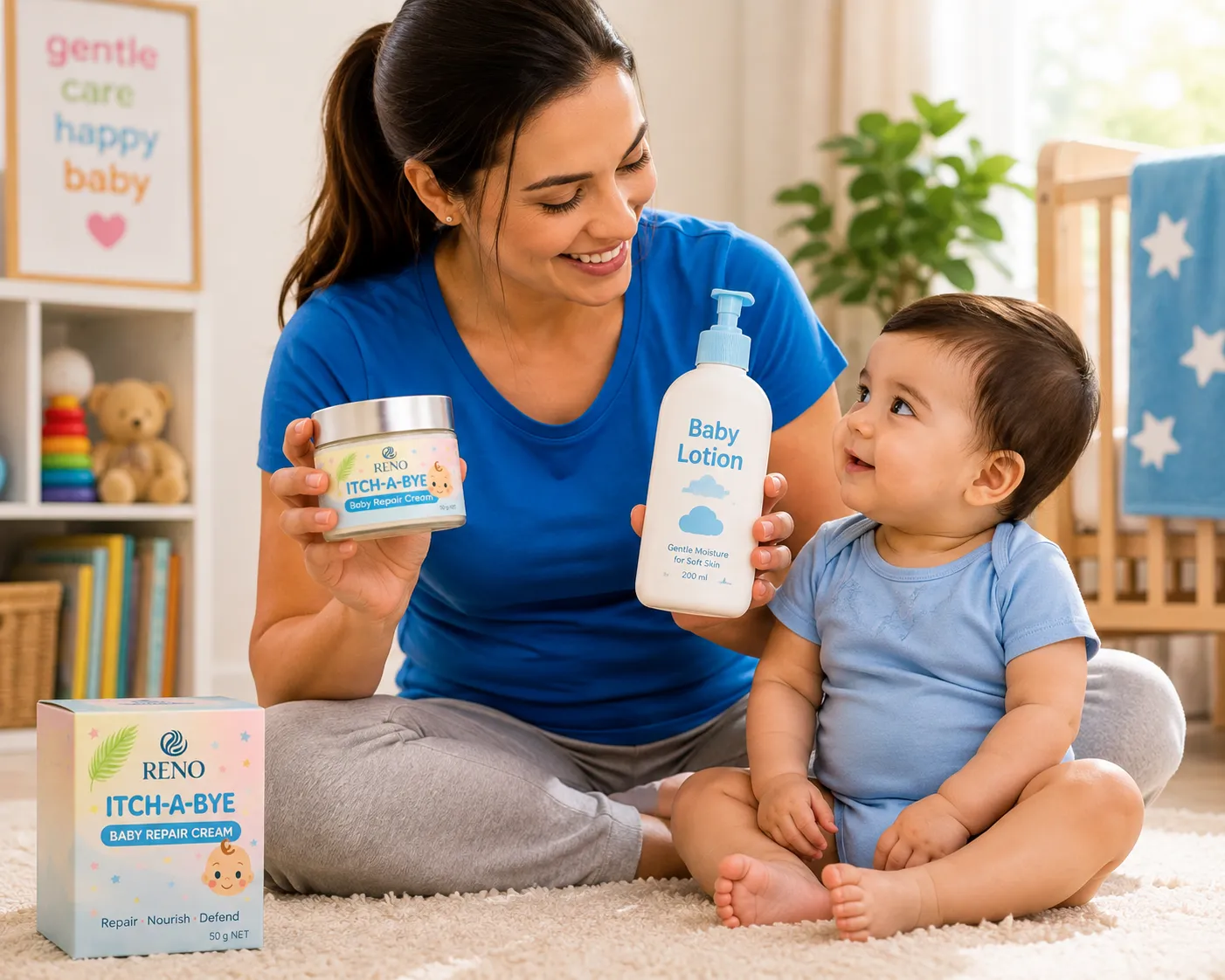
You are standing in front of the baby skincare shelf, and almost every product seems to promise the same thing. Some are called lotions, some creams, some balms and some moisturisers, yet the labels rarely explain why you might choose one over another. If your baby has dry, itchy or eczema-prone skin, that difference can matter more than the packaging suggests. The real question is not which product feels nicest in your hand, but which type of formulation gives your baby’s skin the support it actually needs.
For mild dryness, a lightweight lotion may be perfectly adequate. But when dryness is persistent, roughness keeps returning or your baby is frequently itchy, a richer cream will often be the better starting point because creams generally provide more substantial moisturising and emollient support. Even then, texture is only part of the decision. What is inside the formulation matters just as much as whether the product is called a cream or a lotion.
What Is the Difference Between a Cream and a Lotion?
Both creams and lotions are usually emulsions containing water and oil-based ingredients. Lotions are generally lighter, spread quickly and usually contain a higher proportion of water, while creams tend to be thicker and richer. That affects how they feel on the skin and how much material remains on the surface after application. A lotion can feel refreshing and easy to use, while a cream usually provides a more substantial layer.
Neither format is automatically better simply because of its name. A well-formulated lotion can be excellent, while a poorly formulated cream may not suit your baby’s skin at all. The important question is what you are trying to achieve. For persistent dryness, you generally want something with enough staying power to support the skin between applications.
When a Lotion May Be Enough
Imagine your baby’s skin is usually comfortable but becomes a little dry after bathing or during colder weather. You apply a gentle lotion once or twice and the skin stays soft until the next day. Your baby is not scratching excessively, the dryness is not returning within hours and the skin otherwise looks settled. In that situation, there may be no reason to make the routine heavier than necessary.
Lotions can also be useful during warm weather because they spread easily and often feel lighter under clothing. Some babies simply tolerate that texture better, particularly when they dislike thick products. If a lotion is keeping the skin comfortable, that is the important outcome. There is no benefit in using a heavier cream simply because it sounds more powerful.
When a Cream May Make More Sense
The decision changes when the dryness keeps returning. You may apply lotion after the bath, the skin initially feels beautifully soft, and then a few hours later the cheeks are rough again or your baby is scratching their legs in bed. You start applying the lotion more frequently, but the improvement still seems temporary. At that point, the problem may not be how often you are moisturising.
The formulation may simply be too lightweight for what the skin currently needs. A richer cream can provide more substantial emollient support and help reduce water loss from the skin surface. For dry or eczema-prone skin, that greater staying power can be useful. Sometimes the answer is not another application of the same lightweight lotion, but a formulation better matched to vulnerable skin.
Why Does Dry Baby Skin Lose Moisture So Quickly?
The outer layer of the skin acts as a barrier. It helps hold water inside while protecting the body from friction, irritants and the surrounding environment. When that barrier becomes vulnerable, water can escape more easily and dryness becomes more visible. This is why some babies seem to become dry again remarkably quickly after moisturising.
Parents naturally respond by applying more product. Sometimes that works, but sometimes the repeating dryness is telling you that the skin needs stronger barrier support rather than simply more frequent applications. The skin may also be dealing with heat, sweat, friction, scratching and environmental pressures at the same time. Dryness may be the most visible sign, but it may not be the only thing happening.
Why Lotion Can Feel Great and Still Not Last
Lotions often contain a relatively high proportion of water, which is one reason they feel so fresh when first applied. That can make dry skin feel better almost immediately. But some of that water will eventually evaporate, particularly if the skin barrier is already vulnerable. The rest of the formulation therefore has to help maintain hydration and condition the skin.
This is why texture and ingredient composition both matter. A well-designed lotion may work beautifully for mild dryness, while persistent dryness may benefit from a richer emulsion with greater staying power. That does not mean every cream automatically beats every lotion. The better question is whether the product keeps your baby’s skin comfortable for a meaningful period after application.
Look Beyond the Front of the Bottle
Words such as baby, natural, gentle and dermatologically tested can sound reassuring, but they do not tell you much about what the formulation is actually designed to do. Look at the ingredients and think about their functions. Humectants such as Glycerin and Hyaluronic Acid help support hydration, while emollient ingredients and oils can improve softness and reduce that dry, tight feeling. For easily irritated skin, fragrance-free formulations may also be worth considering.
Then ask another question that parents are not always encouraged to ask: what is this product doing besides moisturising? If your baby’s skin is persistently dry, itchy or eczema-prone, you may want a formulation built around more than hydration alone. That broader question is central to the philosophy behind Itch-A-Bye Baby Repair Cream. You can explore Itch-A-Bye Baby Repair Cream and its formulation here.
Moisturising Is Important, but It May Be Only the Beginning
If the only problem is occasional dryness, a straightforward moisturiser may be perfectly adequate. But when parents tell us they are moisturising repeatedly and the skin is still becoming dry and itchy, we think the conversation should go further. The skin is not simply a container that needs more water. It is a living protective organ dealing with multiple pressures at the same time.
That is why we developed Itch-A-Bye Baby Repair Cream around three connected ideas: Repair, Nourish and Defend. Repair focuses on supporting the physical barrier, Nourish provides a wider range of complementary topical ingredients, and Defend recognises the skin’s constant interaction with bacteria, fungi and environmental pressure. The cream format matters, but the ingredient philosophy inside the cream matters even more. This broader formulation approach is what separates the product from a simple hydration-only lotion.
REPAIR: Support the Barrier, Not Just the Surface
Dry skin can often be made to feel softer temporarily simply by adding water or a lightweight moisturiser. But if the barrier remains vulnerable, that improvement may not last long. Our Repair philosophy therefore begins with hydration but does not stop there. We want to support the conditions in which the outer skin barrier performs its protective role.
Hyaluronic Acid and Glycerin are important because they help attract and retain water. Allantoin adds soothing and skin-conditioning properties, while Centella asiatica contributes a different profile through compounds investigated in relation to skin recovery, inflammatory pathways and antioxidant activity. These ingredients are not all trying to do the same job. Repair, for us, means combining different forms of support around a vulnerable barrier.
NOURISH: More Than Simply Adding Water
When we say Nourish, we mean much more than moisturising. We mean supplying vulnerable skin with a deliberately selected combination of humectants, oils, vitamins, soothing ingredients and botanicals that bring different supportive properties. Hydration remains important, but it sits inside a broader system. This is why the formulation is designed around synergy rather than one fashionable hero ingredient.
Think about the demands placed on your baby’s skin during an ordinary day. It has to hold onto water, tolerate clothing, cope with heat, friction and scratching, and continue interacting with the outside world. One ingredient cannot intelligently perform all of those functions. Nourish means giving vulnerable skin a broader range of topical support than hydration alone can provide.
Why Black Seed Oil Matters to the Formula
Black Seed Oil, Nigella sativa, sits at the heart of our formulation philosophy because its role extends well beyond simply making the cream feel rich. It contains bioactive compounds including thymoquinone, and the ingredient has been investigated for anti-inflammatory, antioxidant and antimicrobial properties. That gives it a very different profile from a conventional humectant. We deliberately wanted that difference.
Hyaluronic Acid can concentrate on hydration, while Black Seed Oil brings another set of properties. Allantoin contributes another form of support, and MSM adds another again. The formulation is stronger because the ingredients complement one another rather than all performing the same task. This is the core of what we mean by ingredient synergy.
Why We Included MSM
MSM, or methylsulfonylmethane, brings another dimension to the formulation. Research has explored MSM in relation to inflammatory and oxidative processes, which interested us when considering skin repeatedly exposed to dryness, irritation and scratching. Its role is therefore different from that of a basic moisturising ingredient. It contributes another layer to the overall formulation strategy.
A formulation becomes more useful when its ingredients have complementary functions. Hydration can address one need while conditioning, soothing, antioxidant and anti-inflammatory support address others. This is why we do not build the entire Itch-A-Bye story around one ingredient. The formulation itself is the strategy.
Our Botanical Complex Adds More Layers of Support
We also selected a group of botanicals because different plants bring different phytochemical profiles. Chamomile has research around soothing and anti-inflammatory activity, while Green Tea contains polyphenols widely studied for antioxidant and anti-inflammatory properties. Licorice contains constituents investigated across anti-inflammatory and antimicrobial areas, while Scutellaria baicalensis provides flavonoids that have attracted considerable scientific interest. Each contributes something slightly different.
Other botanicals in the formulation, including Rosemary, Ginger and Polygonum cuspidatum, bring additional compounds and overlapping areas of research. We do not claim that every botanical performs every possible function. Their value is in how their different properties can work alongside one another. That is what makes the botanical complex part of our Nourish philosophy rather than simply decoration on an ingredient list.
DEFEND: Skin Has Another Job Besides Holding Water
Your baby’s skin is constantly interacting with the outside world. Clothing touches it, hands touch it, saliva reaches the face and neck, sweat accumulates in folds and microorganisms naturally live on the skin surface. Healthy skin is not sterile and should not be treated as though it needs to be. But the skin still has an important protective role.
This is where Defend completes our framework. Black Seed Oil and several botanicals within Itch-A-Bye contain constituents that have been studied for antimicrobial properties alongside their other functions. That research helped guide our ingredient choices. Defend means supporting vulnerable skin as it performs its everyday protective role in constant contact with microbial and environmental pressures.
Defend Does Not Mean Treating an Infection
There is an important distinction here. Itch-A-Bye is not an antibiotic or antifungal medicine, and ingredient research should not be confused with proof that the finished cream treats established infection. If your baby’s skin becomes increasingly painful, hot, swollen, weeping or crusted, appropriate medical assessment matters. A cosmetic cream has a different role from medical treatment.
Our Defend philosophy is about everyday support for vulnerable skin. It helps explain why we were interested in ingredients with antimicrobial-related research as part of a broader formulation. The same ingredient may also bring antioxidant, soothing or anti-inflammatory properties. Again, the value lies in the combination rather than one isolated claim.
Cream vs Lotion Is Really a Question About What the Skin Needs
Imagine two babies whose skin looks slightly dry after bathing. The first baby’s skin becomes comfortable after one application of a lightweight lotion and stays that way until the next day. The second baby’s skin initially improves but becomes rough again within a few hours and the baby begins scratching later that night. It would make little sense to assume both babies need exactly the same skincare approach.
The second baby may benefit from a richer cream with greater staying power. But even then, texture is only part of the answer. You still need to consider the formulation, the ingredients and everything else happening around the skin. Choose for the skin you are actually looking at rather than for the product category printed on the bottle.
What About Ointments?
Ointments are generally richer again and usually contain much less water than creams or lotions. Their more occlusive nature can be helpful when the main goal is reducing moisture loss from very dry skin. They can also feel greasier, which some families find useful for specific dry areas and others dislike for daytime use. Different textures can therefore have different practical roles.
There is no rule saying one family must use only one texture for every body area and every season. A lotion may be useful in one situation, a cream in another and an ointment for particularly dry patches. Your baby’s needs can change over time as well. Skincare categories should be tools rather than rigid rules.
What About Hot Australian Weather?
This is particularly relevant when the weather becomes warm. A rich cream that feels perfect in winter may feel heavier during a hot summer day, especially if your baby is sweating. Heat and sweat can themselves increase discomfort and itching in vulnerable skin. Applying more product is not automatically better.
You can adjust the amount according to how the skin behaves. A richer cream can still be used on dry areas without unnecessarily coating the entire body. Breathable clothing and temperature management matter alongside skincare. The best cream in the world cannot completely compensate for a baby who is consistently becoming hot and sweaty underneath too many layers.
Could You Use Lotion During the Day and Cream at Night?
For some families, yes. A lighter lotion may feel convenient during the day when dryness is mild, while a richer cream after the evening bath can provide more substantial support before bedtime. Other babies may do better with a cream throughout the day. There is no universal rule.
Nighttime can be particularly difficult for eczema-prone skin because some babies scratch more once they become warm and tired. Moisture matters, but heat, bedding, friction and the itch-scratch cycle may also contribute. That means the answer is not simply to apply the thickest possible product before bed. Look at the whole bedtime environment as well as the product texture.
Does a Thicker Cream Automatically Mean a Better Product?
No. Thickness alone tells you very little about ingredient quality or how your baby’s skin will respond. A cream can be thick and still contain fragrance or other ingredients that do not suit a particular child. A carefully formulated lotion can sometimes outperform an unsuitable cream. Texture is only one clue.
Watch what happens over time. Does the skin remain comfortable between applications? Does dryness return quickly? Does scratching increase after the product is applied? The best product is the one whose texture and formulation work for your baby’s skin, not the one that happens to be the thickest.
What If You Are Moisturising Constantly and Nothing Seems to Last?
This is where many parents become frustrated. You apply moisturiser several times a day, yet the skin still becomes dry and itchy. It can feel as though you are doing everything right and getting nowhere. Sometimes that is because dryness is only one part of the problem.
Heat, sweat, saliva, shampoo, cleanser, clothing, friction and scratching can all add pressure at the same time. A parent can therefore be moisturising perfectly while several other factors continue pushing the skin in the opposite direction. This is one reason persistent dry and itchy skin can be so confusing. Looking at those pressures together can reveal patterns that are easy to miss when the focus stays on moisturiser alone.
The Skin Threshold Model Helps Explain Why
Our Skin Threshold Model asks you to imagine that your baby’s skin can comfortably tolerate a certain amount of combined pressure. A little dryness may be manageable on one day. Add heat, sweat, friction and scratching, and the picture can change. Several relatively small pressures can sometimes accumulate until the skin crosses its threshold.
This is one of the central ideas explored in our book Beyond the Skin Barrier. The book looks at the developing skin barrier, immune signalling, scratching, environmental pressure, the microbiome and the gut-skin axis. If you want to understand why your baby’s dry or eczema-prone skin may keep changing even when the skincare routine stays the same, continue reading with Beyond the Skin Barrier here. It provides the wider framework behind many of the practical ideas discussed throughout this article.
When Should You Apply a Cream?
After bathing is one particularly useful time. Gently pat away excess water, dry the folds properly and apply your chosen cream while the broader skin remains slightly damp. You do not need to race against a stopwatch, but avoiding a long delay can help support hydration before the skin becomes completely dry. Bathing, drying and skincare can then become one continuous routine.
Cream can also be reapplied when the skin becomes noticeably dry or uncomfortable, depending on the product and your baby’s needs. Pay attention to predictable areas such as the cheeks, arms, legs or places exposed to repeated rubbing. More product is not automatically better. Consistency and the quality of the formulation matter more than simply applying the largest possible amount.
Where Itch-A-Bye Fits Into the Routine
If your baby’s skin is persistently dry, itchy or eczema-prone and you are looking for something richer than a basic lotion, this is the type of situation we had in mind when we created Itch-A-Bye Baby Repair Cream. We wanted a cream with enough richness to support vulnerable skin while also incorporating ingredients selected for complementary functions. That is why the formulation contains Black Seed Oil, MSM, Allantoin, Hyaluronic Acid, vitamins and our botanical complex. The aim was broader topical support rather than simply creating another light moisturiser.
You can explore Itch-A-Bye Baby Repair Cream here. The product page explains how Itch-A-Bye fits into our Repair, Nourish and Defend approach. Rather than being simply another moisturiser, it was designed around the idea that vulnerable skin may benefit from hydration plus broader topical support. That formulation philosophy is the reason we chose a cream format in the first place.
A Simple Way to Decide Between Cream and Lotion
Start with your baby’s actual skin. If the dryness is mild and a gentle lotion keeps it comfortable, there may be no reason to change anything. If the skin repeatedly becomes dry again, feels rough or tight, or your baby stays itchy despite frequent lightweight moisturising, a richer cream may be worth considering. Then look carefully at the formulation.
Ask what the ingredients are actually there to do. Look for hydration, conditioning and broader support rather than relying entirely on marketing language. Try to change one variable at a time so you can see how the skin responds. The goal is not to find the thickest product but to find the right level and type of support.
So, Cream or Lotion for Baby Dry Skin?
For mild, occasional dryness, a gentle lotion may be perfectly adequate. For persistent dry, rough, itchy or eczema-prone skin, a richer cream will often be the more useful starting point because it can provide more substantial moisturising and emollient support. But the words cream and lotion alone do not tell you whether the formulation is right for your child. The ingredients, texture and your baby’s actual response all matter.
And if you find yourself repeatedly moisturising without lasting comfort, ask whether the skin needs broader support rather than simply more water. That is the thinking behind Itch-A-Bye Baby Repair Cream and our Repair, Nourish and Defend formulation philosophy. The aim is to bring together complementary forms of topical support in one formulation. For vulnerable skin, what is inside the cream can matter every bit as much as the fact that it is a cream.
Want to Understand Why Your Baby’s Skin Keeps Becoming Dry and Itchy?
If you are repeatedly treating the surface but still wondering why the dryness and itching keep returning, Beyond the Skin Barrier was written to help parents understand the bigger picture. It explores the developing skin barrier, scratching, environmental pressures, immune signalling, the microbiome, gut-skin interactions and our Skin Threshold Model. The aim is to help you see how several seemingly small pressures can sometimes add up. That wider perspective can make recurring skin problems much easier to understand.
You can continue reading Beyond the Skin Barrier here. And if you want to explore the cream we developed from the same philosophy, discover Itch-A-Bye Baby Repair Cream here. Together, the book and product pages explain both the thinking behind our approach and the formulation we created from it. The book explains the bigger picture; the cream represents how we translated that thinking into everyday skincare.
Don’t Choose the Bottle. Choose for the Skin.
A lotion may be exactly what one baby’s mildly dry skin needs, while another baby’s persistently dry and itchy skin may benefit from something richer. There is no contradiction in that because babies are not skincare categories. Look at how quickly dryness returns, how the skin feels between applications and whether scratching continues despite moisturising. Let those patterns guide the choice.
And if you keep reaching for the lotion again and again without lasting comfort, it may be time to ask a different question. Instead of asking, “How often should I moisturise?”, ask, “Am I giving this skin the right kind of support?” Sometimes that small change in thinking makes the entire skincare aisle much easier to understand. For vulnerable baby skin, the goal is not simply to moisturise more, but to help it Repair, Nourish and Defend.