
Fragrance-Free vs Unscented Baby Cream: What’s the Difference?
When you are choosing a cream for a baby with dry, itchy or eczema-prone skin, two labels can sound almost identical: “fragrance-free” and “unscented.” Most parents would reasonably assume they mean the same thing. After all, if you cannot smell perfume, surely there is no fragrance in the product. Unfortunately, skincare labelling is not always that straightforward.
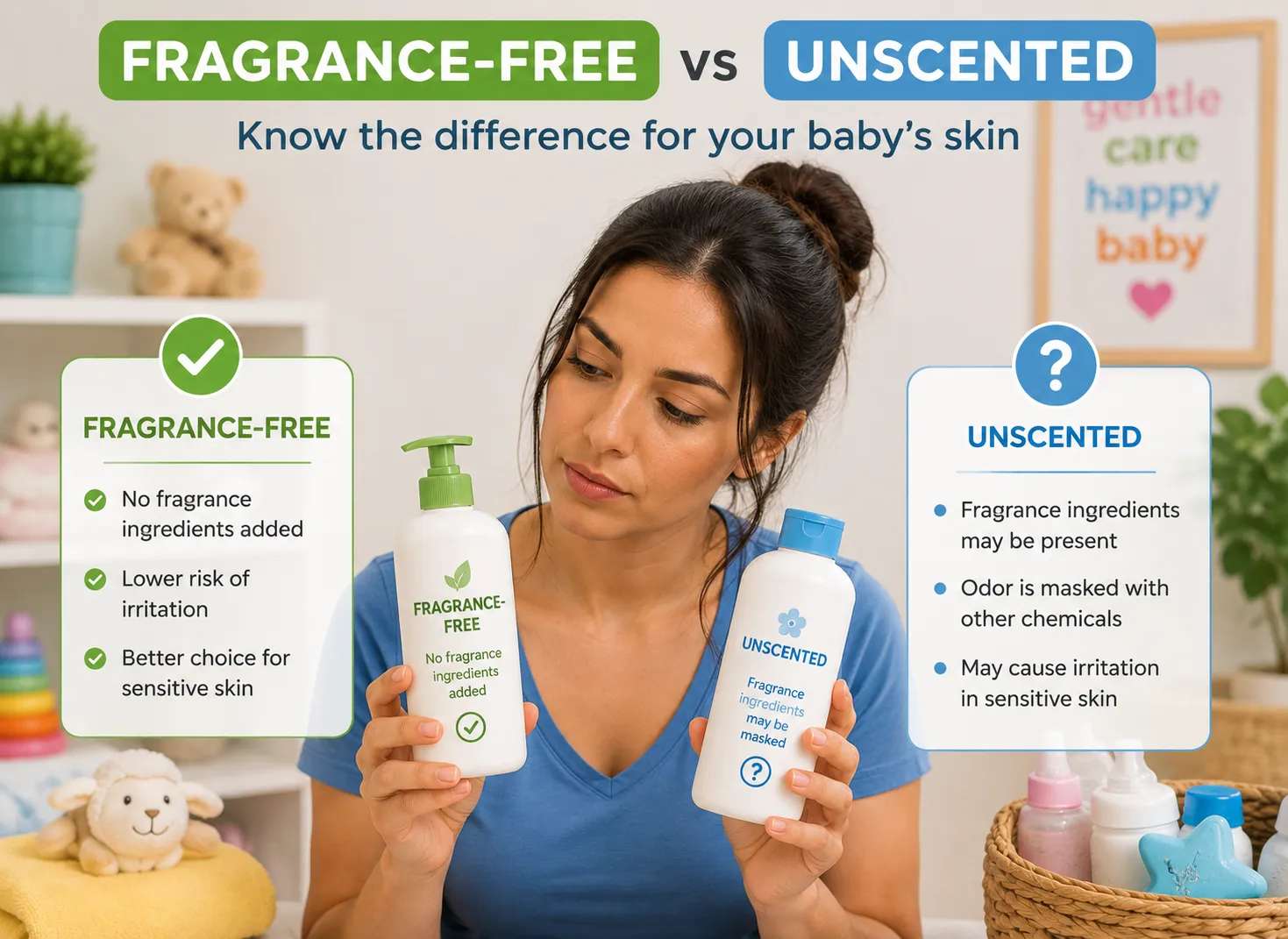
An unscented product may be formulated so that you do not notice a particular smell, while a fragrance-free product is generally intended to contain no ingredients added specifically to fragrance the product. That distinction can matter when you are trying to simplify the routine of a baby whose skin is already easily irritated. For dry, itchy or eczema-prone baby skin, fragrance-free is generally the clearer choice when you want to minimise unnecessary fragrance exposure. But there is more to understand before judging a cream by two words on the front of the jar.
What Does “Fragrance-Free” Actually Mean?
In ordinary skincare language, fragrance-free means that fragrance or perfume has not been intentionally added for the purpose of giving the product a scent. The product itself may still have a natural smell. Oils, botanical extracts and other raw ingredients can all have their own characteristic aromas. Fragrance-free does not necessarily mean completely odourless.
That last point often surprises parents. You might open a fragrance-free cream and notice that it smells faintly botanical, oily or simply like the ingredients from which it was made. That does not automatically mean fragrance has been secretly added. The important distinction is between the natural odour of ingredients and substances deliberately included to perfume the finished product.
What Does “Unscented” Mean?
Unscented usually describes the sensory experience rather than necessarily telling you everything about how that experience was achieved. The finished product has been designed so that the consumer does not notice a strong or distinctive scent. That sounds ideal for sensitive baby skin. But an unscented product can sometimes contain ingredients used to mask or neutralise the natural smell of other ingredients.
This is why “unscented” should not automatically be interpreted as “contains absolutely no fragrance-related ingredients.” Depending on the product and its formulation, masking components may have been used to create a neutral-smelling result. The product may genuinely smell like almost nothing when you open it. But no obvious smell and no added fragrance are not necessarily the same claim.
The Simplest Way to Remember the Difference
Think of it this way. Fragrance-free asks what was added to create fragrance, while unscented describes what your nose experiences when you open the product. A fragrance-free cream may still have a mild smell because its ingredients naturally smell of something. An unscented cream may smell of almost nothing because the formulation was designed to suppress or disguise its underlying odour.
That distinction becomes particularly useful when shopping for a baby with easily irritated skin. The objective is not necessarily to find a cream that smells like absolutely nothing. The more useful objective may be to avoid ingredients included primarily to make the product smell attractive. For vulnerable baby skin, function should usually take priority over fragrance.
Why Is Fragrance Added to Skincare in the First Place?
There is nothing mysterious about why manufacturers use fragrance. People enjoy products that smell pleasant, and scent can make applying skincare feel more luxurious, clean or comforting. Baby products have historically been particularly associated with distinctive “baby” fragrances. For many families using those products causes no obvious problem at all.
The difficulty is that fragrance is largely a sensory addition rather than something the baby’s skin needs to function. When skin is already dry, itchy or eczema-prone, it can make sense to remove unnecessary variables from the routine. This does not mean every fragrance will irritate every child. It means fragrance may be an avoidable exposure when the primary objective is supporting vulnerable skin.
Why Can Fragrance Matter for Eczema-Prone Skin?
Eczema-prone skin often has a more vulnerable barrier. When the barrier is struggling, substances from the surrounding environment can interact with the skin differently from how they might interact with stronger, more comfortable skin. Fragrance compounds are among the ingredients commonly considered when investigating contact irritation or allergic contact dermatitis. This does not mean fragrance is responsible for every baby’s flare.
The important word is susceptibility. One child may tolerate a fragranced product perfectly well while another develops irritation, and another may use it repeatedly before a problem becomes apparent. That individual variation is precisely why simpler formulations are often attractive for vulnerable skin. Removing unnecessary fragrance eliminates one potential variable from an already complicated picture.
“Natural Fragrance” Does Not Automatically Mean Gentler
This is another area where marketing language can create confusion. Words such as natural, botanical and plant-derived often sound inherently gentle. But the fact that a fragrant compound came from a plant does not automatically tell us how an individual’s skin will respond to it. Natural substances can still contain potent aromatic compounds.
Essential oils are a good example. They can contain biologically active compounds and may have interesting properties, but they are also highly concentrated aromatic materials. Their natural origin does not make them universally appropriate for every baby or every compromised skin barrier. When evaluating fragrance exposure, “natural” should not be treated as a synonym for “non-irritating.”
What About Essential Oils in Baby Creams?
Essential oils deserve separate consideration because they are sometimes marketed as alternatives to artificial fragrance. Lavender, citrus, peppermint and other aromatic oils can make a product smell beautiful. But if their primary purpose in a baby cream is to provide fragrance, parents should still recognise that the skin is being exposed to aromatic compounds. Whether those compounds are synthetic or plant-derived does not erase their fragrance function.
This does not mean every essential oil is inherently harmful or that every product containing one will cause irritation. Formulation, concentration and individual susceptibility matter enormously. But for a baby whose skin is persistently dry, itchy or eczema-prone, there is a reasonable question to ask: Does this ingredient need to be here for the job I need this cream to perform? If its main contribution is scent, you may decide that it does not.
A Pleasant Smell Is Not Evidence That a Cream Is Working
Parents understandably use sensory clues when evaluating skincare. A cream that smells fresh, feels silky and disappears quickly can immediately feel like a high-quality product. Those characteristics matter to the user experience, but they tell us surprisingly little about what the formulation is actually doing for the skin. Your nose cannot measure barrier support.
A beautifully fragranced lotion may be perfectly adequate for ordinary skin, while a much less glamorous-smelling formulation may contain the combination of humectants, emollients, oils and skin-conditioning ingredients that dry skin needs. Conversely, simply removing fragrance does not automatically make a poorly designed moisturiser excellent. Fragrance status is one part of formulation quality. It is not the entire test.
Fragrance-Free Does Not Automatically Mean Hypoallergenic
These terms are also frequently confused. A fragrance-free product removes one potential category of exposure, but the formulation still contains many other ingredients. A baby can potentially react to preservatives, botanical ingredients or other components regardless of whether fragrance is present. No cosmetic formulation can sensibly promise that every person will tolerate every ingredient.
This is why labels should be treated as useful information rather than guarantees. “Fragrance-free” tells you something specific about the formulation philosophy, but it does not tell you everything. You still need to consider the complete ingredient list and how your baby’s skin responds. The baby’s actual experience matters more than a reassuring word printed on the packaging.
Should Every Baby Use Fragrance-Free Skincare?
Not necessarily. Many babies have comfortable skin and tolerate fragranced skincare without any obvious difficulty. Parents do not need to become frightened of every scented product in the bathroom. Skincare should remain practical rather than becoming an endless exercise in anxiety.
But the equation changes when a baby has persistent dryness, itching or eczema-prone skin. In that situation, reducing unnecessary variables can make the routine easier to understand. A fragrance-free moisturiser is often a sensible starting point because fragrance is not required to hydrate or condition the skin. If you are already trying to calm a complicated skin routine, simplicity has value.
What If My Baby Has Used a Fragranced Cream for Months Without a Problem?
There is no reason to assume that a product must suddenly be harmful simply because it contains fragrance. If your baby’s skin is comfortable and consistently tolerates the product, that observation is useful information. The purpose of understanding fragrance is not to persuade every parent to throw away everything they already own. It is to make more informed choices when problems arise.
If unexplained irritation develops, however, it can be helpful to examine everything regularly touching the skin. That includes moisturisers, cleansers, shampoos, wipes, laundry products and fragranced household products. Changing ten things simultaneously makes it difficult to identify patterns. A more useful approach is often to simplify the routine and observe carefully.
The Ingredient List Can Tell You More Than the Front Label
Marketing language is designed to be noticed quickly. Ingredient lists require more effort, but they can provide additional information about what you are buying. Terms such as fragrance, parfum or aroma may indicate an intentionally fragranced formulation, although ingredient naming varies between products and markets. Individual fragrance allergens may also appear separately where labelling rules require them.
Botanical ingredients make interpretation more complicated because some plant extracts naturally have an aroma without being included specifically as perfume. This is why reading an ingredient list is not always as simple as searching for anything that sounds botanical. The relevant question is why an ingredient is present. Its role within the formulation matters.
What About Botanical Extracts?
This distinction is particularly important for Itch-A-Bye Baby Repair Cream because our formulation contains a deliberately selected botanical complex. Botanical ingredients and fragrance are not automatically the same thing. A plant extract can be included because of the functional properties associated with its constituents rather than because we want the finished cream to smell like that plant. Purpose matters.
Our botanical ingredients were selected as part of a wider formulation strategy for vulnerable, dry and itchy skin. They sit alongside Black Seed Oil, MSM, Allantoin, Hyaluronic Acid, Glycerin and vitamins rather than functioning as perfume. We want the ingredients to earn their place in the formulation through the support they can provide, not simply through the smell they create. That distinction is central to how we think about formulation.
This Is Where Formulation Philosophy Matters
Imagine two baby creams sitting next to each other. One contains a very short list of ingredients and provides straightforward moisturisation, while another combines several ingredients selected to perform complementary functions. Either formulation may be appropriate depending on what the baby’s skin needs. The number of ingredients alone does not determine quality.
Our approach has always been based on formulation synergy. Instead of asking one ingredient to do everything, we combine ingredients selected for hydration, conditioning, soothing, antioxidant and other supportive properties. This allows us to think beyond the narrow question of whether a cream simply makes skin feel moisturised. The bigger question is what kind of support the complete formulation provides.
REPAIR: Supporting a Vulnerable Barrier
The first part of our Repair, Nourish and Defend philosophy focuses on the physical barrier. Dry skin can lose water more readily, become rough and feel increasingly uncomfortable. Repeated scratching can then place additional mechanical pressure on an already vulnerable surface. Supporting hydration and conditioning therefore becomes fundamental.
Fragrance is not required for any of those jobs. It does not need to be present for Glycerin to support hydration or for oils to condition the skin. When designing skincare specifically for vulnerable baby skin, every unnecessary variable deserves consideration. Repair is about supporting the barrier, not decorating the formulation with a particular smell.
NOURISH: Much More Than Adding Moisture
Our definition of Nourish goes considerably beyond hydration. It means supplying vulnerable skin with a deliberately selected combination of topical ingredients that hydrate, condition, soothe and provide antioxidant and other supportive properties. Humectants such as Glycerin and Hyaluronic Acid contribute one part of that system. Oils, vitamins, Allantoin, MSM and botanicals contribute others.
That distinction matters because a fragrance-free product can still be extremely basic. Removing perfume tells us what the formulation does not contain for scenting purposes, but it does not tell us what useful support has been included instead. For us, Nourish is about what we deliberately give the skin, not simply what we remove from the jar. It is a positive formulation principle rather than merely an exclusion list.
Why Black Seed Oil Is Different From Added Fragrance
Black Seed Oil, Nigella sativa, naturally has its own characteristic aroma. That does not mean its role in a formulation is to act as perfume. Black Seed Oil contains naturally occurring compounds, including thymoquinone, that have been investigated for anti-inflammatory, antioxidant and antimicrobial properties. The oil also contributes emollient and skin-conditioning characteristics.
This is a useful example of why “fragrance-free” should not be confused with “contains nothing that naturally smells.” Functional oils and botanical ingredients can have their own inherent aroma. Masking every trace of that aroma simply to make a product smell like nothing could defeat the purpose of avoiding unnecessary fragrance-related additions. Sometimes the smell of the ingredients is simply the smell of the ingredients.
MSM, Allantoin and the Ingredients You Cannot Smell
Many valuable skincare ingredients contribute little or nothing to the sensory fragrance of a product. MSM has been investigated in relation to inflammatory and oxidative processes, while Allantoin is widely used for its soothing and skin-conditioning properties. Neither needs a perfume surrounding it to perform its role. Their value lies in what they contribute to the formulation.
The same principle applies to humectants such as Glycerin and Hyaluronic Acid. Their job is not to make a cream smell appealing when you open the jar. They are there because hydration matters to vulnerable skin. A functional baby cream should be built around what the skin needs rather than what the parent’s nose expects baby skincare to smell like.
DEFEND: Reducing Pressure While Supporting the Skin
Our Defend principle considers the skin’s protective relationship with the outside world, including everyday microbial and environmental pressures. Black Seed Oil and several of our botanical ingredients contain constituents that have been investigated for antimicrobial properties. This does not mean Itch-A-Bye is intended to treat an established bacterial or fungal infection. The distinction between supporting vulnerable skin and treating infection is important.
Reducing unnecessary irritant exposure also fits naturally into this wider philosophy. If a baby’s skin is already facing dryness, heat, sweat, friction, saliva and scratching, there is little advantage in adding an unnecessary fragrance variable simply to make the product smell pleasant. Defend is partly about understanding the pressures surrounding vulnerable skin and removing the ones we can reasonably remove. It is another reason we focus on function first.
Could Fragrance Be the Hidden Trigger?
Sometimes, but parents should be careful about assuming there must be one hidden culprit. A new fragranced product may coincide with irritation, making it an obvious candidate to investigate. But dry, itchy and eczema-prone skin is often influenced by several pressures acting together. Heat, sweat, saliva, friction, bathing, cleansers, scratching and environmental conditions may all contribute.
This is where our Skin Threshold Model becomes useful. Instead of imagining every flare as the result of one mysterious trigger, imagine multiple small pressures accumulating until vulnerable skin crosses its individual threshold. Fragrance exposure could potentially be one pressure among several rather than the entire explanation. Removing it may lower the overall burden even when it was never the only factor involved.
Watch for Patterns Rather Than Guessing
If you suspect a particular product is making your baby’s skin uncomfortable, observation can be more useful than panic. Think about when the product was introduced, where it is being applied and whether irritation appears repeatedly in those areas. Consider what else changed at the same time, including weather, clothing, bathing products and laundry products. Patterns can reveal information that an ingredient list alone cannot.
This is particularly important because parents of babies with eczema-prone skin are often surrounded by conflicting advice. One person blames food, another blames detergent, another blames heat and another blames moisturiser. Several influences may be present simultaneously. The goal is not to find someone to blame; it is to reduce unnecessary pressure wherever practical.
What About Fragranced Laundry Products?
Your baby’s moisturiser is only one source of fragrance exposure. Laundry detergent, fabric softener, scent boosters, wipes, shampoo, body wash and household sprays can all leave fragranced substances around the child. Clothing and bedding remain against the skin for hours, making laundry products particularly relevant when investigating persistent irritation. Again, this does not mean fragrance is automatically responsible.
If you are simplifying a routine, it can make sense to look at the whole environment rather than changing the moisturiser repeatedly. Choose simple products where practical and introduce changes methodically. This makes it easier to see whether a pattern emerges. The skin does not know which bottle an ingredient came from; it only experiences what reaches its surface.
Fragrance-Free Does Not Mean Ingredient-Free
There is another trap worth avoiding. Once parents become worried about ingredients, it is easy to assume that the shortest possible ingredient list must always be best. Simplicity can be valuable, particularly when investigating a suspected reaction. But vulnerable skin may also benefit from thoughtfully selected ingredients performing different supportive functions.
The objective should not be to reduce a formulation to almost nothing simply for the sake of having fewer words on the label. It should be to remove unnecessary ingredients while retaining useful ones. There is an important difference between formulation simplicity and formulation emptiness. A carefully designed fragrance-free cream can still contain a sophisticated combination of functional ingredients.
What Should You Choose: Fragrance-Free or Unscented?
If your baby has dry, itchy or eczema-prone skin and you are choosing between otherwise suitable products, fragrance-free is generally the more informative label for the goal of avoiding deliberately added fragrance. Unscented tells you primarily that the finished product is not intended to have a noticeable scent. Those two things may overlap, but they should not automatically be treated as identical. Check the ingredient information when you are uncertain.
Then move beyond fragrance and evaluate the rest of the formulation. Does it contain useful humectants, emollients and skin-conditioning ingredients? Is the texture suitable for the level of dryness you are trying to manage? Consider how well your baby’s skin tolerates it over time. The best choice is not merely the product with the least smell; it is the formulation that makes the most sense for your baby’s skin.
Where Itch-A-Bye Fits
Itch-A-Bye Baby Repair Cream was developed for babies and children with dry, itchy and eczema-prone skin around our Repair, Nourish and Defend philosophy. Our formulation combines Black Seed Oil, MSM, Allantoin, Hyaluronic Acid, Glycerin, vitamins and a deliberately selected botanical complex. These ingredients were chosen for functional roles within the formulation rather than to create a perfume experience. We believe vulnerable baby skin deserves ingredients selected for purpose.
This also explains why we talk so much about formulation synergy. Hydration alone is useful, but it is not our entire definition of nourishment. We want complementary ingredients supporting hydration, conditioning, comfort, antioxidant support and the skin’s protective environment. You can explore Itch-A-Bye Baby Repair Cream here and see how Repair, Nourish and Defend come together in one formulation.
Sometimes Less Noise Makes the Skin Easier to Understand
Parents caring for eczema-prone skin can quickly end up with a bathroom full of products. One cream is for redness, another is for dryness, another smells calming before bedtime, another promises “natural” ingredients and another was recommended by someone online. When the skin changes, it becomes almost impossible to know which product helped and which may have added another pressure. A simpler routine can make the skin’s patterns easier to read.
That is one reason fragrance-free skincare can make sense even beyond the question of irritation. It removes something the skin does not require and reduces one variable from the routine. You can then concentrate on the ingredients that are there for a functional reason. For a parent already trying to solve a complicated skin puzzle, fewer unnecessary variables can be genuinely useful.
Go Beyond the Label
This way of thinking is central to our book Beyond the Skin Barrier. Dry, itchy and eczema-prone baby skin rarely makes sense when we look only at the visible surface. The developing barrier, scratching, heat, sweat, environmental exposures, microbial pressures, immune signalling and other influences can interact. Understanding those interactions can help parents stop endlessly chasing one supposed trigger.
Our Skin Threshold Model provides a framework for looking at those pressures together. A fragranced product may be one piece of the picture, but it does not need to become the explanation for everything. You can read Beyond the Skin Barrier here and explore the wider framework behind our approach to vulnerable baby skin. It is about understanding the combined pressures rather than chasing one answer.
The Bottom Line
Fragrance-free and unscented do not necessarily mean exactly the same thing. Fragrance-free generally indicates that ingredients have not been deliberately added for the purpose of fragrancing the product, while unscented primarily indicates that the finished product is intended to have little or no noticeable scent. A fragrance-free cream may therefore still have a mild natural aroma from its functional ingredients. For babies with dry, itchy or eczema-prone skin, that distinction can be worth understanding.
But do not make fragrance the only thing you look for. A good baby cream still needs a formulation capable of supporting hydration, conditioning, comfort and the wider needs of vulnerable skin. Remove unnecessary ingredients where sensible, but pay equal attention to the useful ingredients that remain. Because the best baby cream should not be designed primarily to smell beautiful; it should be designed to help vulnerable skin Repair, Nourish and Defend.