
How Should You Dry a Baby With Eczema-Prone Skin After a Bath?
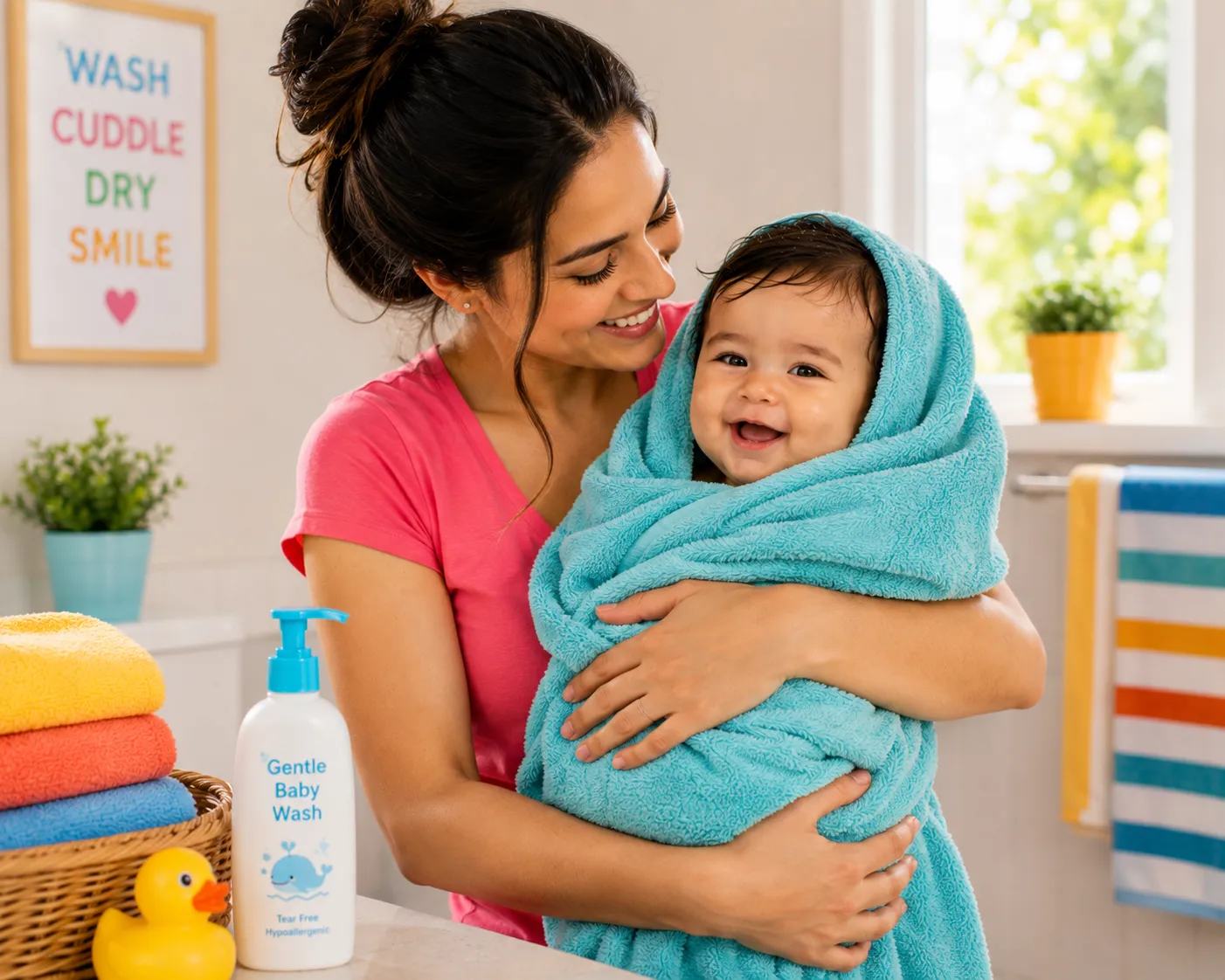
Bath time is over, your baby is warm and relaxed, and you reach for the towel without giving much thought to what happens next. Most parents simply wrap their baby up and rub them dry because that is how we have always dried ourselves. But when your baby has dry, itchy or eczema-prone skin, the way you use that towel can matter more than you might expect. Drying should remove excess water without adding unnecessary friction to skin that may already be vulnerable.
For most babies with eczema-prone skin, the gentler approach is simple: pat rather than rub, leave the skin slightly damp rather than bone dry, and move promptly into the after-bath skincare routine. You do not need a complicated technique or special equipment. What matters is reducing friction, avoiding overheating and supporting the skin before too much moisture evaporates. Those few minutes between leaving the bath and getting dressed can become an important part of the whole skincare routine.
Why Does Drying Matter So Much?
A baby’s skin barrier is not simply a covering. It helps retain moisture, protect underlying tissues and separate your baby’s body from the outside environment. When that barrier is already dry, irritated or eczema-prone, repeated rubbing with a towel can add another source of mechanical stress. A towel that feels wonderfully soft to you can still create substantial friction when it is dragged repeatedly across vulnerable skin.
This is particularly important when your baby has been scratching. Areas around the elbows, knees, cheeks, neck or other commonly scratched places may already have tiny surface disruptions that you cannot easily see. Rubbing those areas firmly after every bath can make them feel more uncomfortable and encourage more scratching afterwards. The goal is not simply to get the skin dry as quickly as possible, but to get your baby comfortably dry without making the skin work harder.
Patting Is Usually Better Than Rubbing
The easiest change you can make is to stop treating the towel like something you need to scrub the skin with. Instead, lay or press the towel gently against the body and allow the fabric to absorb excess water. Lift it, move to the next area and repeat. You can still dry your baby thoroughly enough to get them dressed without dragging the towel back and forth across the skin.
This is what people mean when they recommend patting the skin dry. It sounds almost too simple to matter, but friction is one of the everyday pressures eczema-prone skin may have to deal with repeatedly. The gentler the drying process, the less extra mechanical stress you add after bathing. Small changes like this can become more meaningful when they happen every single day.
You Do Not Need to Dry the Skin Until It Feels Completely Dry
Many parents instinctively continue towelling until every trace of water has disappeared. For dry skin, that may not be necessary. Once most of the visible water has been gently removed, leaving the skin slightly damp can help create a useful window for applying skincare. The important word here is slightly, not soaking wet.
You do not want water sitting trapped inside folds or saturating clothing, but you also do not need to wait until the skin feels completely dry and tight. Applying your baby’s skincare shortly after patting dry can help support hydration before too much water evaporates from the skin surface. Think of bath time and moisturising as one continuous routine rather than two completely separate events. The way you dry the skin can help prepare it for what comes next.
The Few Minutes After the Bath Matter
Once your baby leaves the water, evaporation begins almost immediately. If the skin is already prone to losing moisture, that evaporation can leave it feeling increasingly dry and tight. This is why many eczema-care routines encourage applying moisturising products soon after bathing. The objective is to help retain hydration while the skin is still slightly damp and comfortable.
You do not need to race around the bathroom in a panic, but you also do not need to wait twenty minutes before applying skincare. Pat the skin gently, make sure important folds are appropriately dry and then move directly into your chosen after-bath routine. The bath cleans the skin, while the next few minutes are your opportunity to support it. A calm, continuous routine can make this easier for both parent and baby.
Be Especially Careful Around Skin Folds
There is an important exception to the idea of leaving skin slightly damp. Areas where skin sits against skin should not remain persistently wet. The neck folds, behind the ears, armpits, groin and other creases can trap moisture, particularly in younger babies. Warmth, sweat, saliva and friction may already be present in these areas.
Gently separate the folds where practical and pat away excess water. You do not need to scrub or rub inside them, but you do want to prevent water from sitting there for long periods underneath clothing. This is especially important around the neck, where milk, saliva and sweat may already create a moist environment. Slightly damp exposed skin and persistently wet skin folds are two very different things.
The Neck Deserves Extra Attention
A baby’s neck can be one of the easiest areas to overlook after bathing. Chubby folds can hide moisture surprisingly well, and once pyjamas or a bodysuit are put on, that moisture may remain trapped. Saliva from teething, milk and sweat can also accumulate there during the day. That creates a combination of moisture, warmth and friction before you even consider the baby’s underlying eczema-prone skin.
After the bath, gently lift or separate the folds and pat them dry with a soft towel. Avoid vigorous rubbing because irritated neck skin can become sore very quickly. Then check the area again before dressing your baby, particularly if the folds were already red or irritated. A few extra seconds spent drying the neck carefully can prevent another unnecessary pressure from being added to the skin.
Behind the Ears Can Be Easy to Miss Too
Water often collects behind a baby’s ears during bathing and hair washing. It is a small area, so parents naturally concentrate on the bigger parts of the body and forget about it. But if your baby already has dryness, irritation or scratching around the ears, leaving moisture trapped there can make the area less comfortable. Shampoo residue can sometimes remain there as well.
Use the corner of a soft towel to gently absorb moisture rather than rubbing aggressively behind the ear. Check the crease where the ear meets the head and make sure the area is comfortably dry. If you notice that your baby frequently scratches around the ears after bath time, this is one of the places worth examining more carefully. Sometimes simple details reveal patterns we had not noticed before.
What Kind of Towel Is Best?
You do not necessarily need an expensive specialty towel. What matters most is that the fabric feels soft, absorbent and comfortable against your baby’s skin. Rough or heavily textured towels can create more friction, particularly if you rub vigorously. Soft cotton towels are often a practical choice, although the gentleness of the drying technique matters at least as much as the material itself.
Also pay attention to how the towel is washed. Strong fragrances, fabric softeners or detergent residue can remain in textiles and may bother some children with easily irritated skin. If your baby’s skin seems uncomfortable after drying, it can be worth simplifying the laundry routine as well as changing the towel technique. Sometimes the problem is not the towel itself but what is left on the towel.
Do You Need a Separate Towel for Your Baby?
A separate baby towel is not essential from an eczema perspective, but it can be useful for practical reasons. It allows you to know exactly what detergent has been used and how frequently the towel has been washed. It also means the towel is not being used by adults who may leave hair products, fragrances or other residues on it. For a baby with easily irritated skin, simplifying exposures can sometimes make the routine easier to manage.
What matters most is that the towel is clean, soft and well rinsed. A towel that smells strongly of fragrance is not necessarily cleaner than one with no scent at all. In fact, your baby’s skin does not need perfume from a towel after you have deliberately chosen gentle bath products. The simpler the routine, the easier it can be to understand what your baby’s skin actually tolerates.
Should You Use a Hair Dryer on Baby Skin?
For routine drying of a baby’s body, a hair dryer is unnecessary and can easily introduce heat that dry or itchy skin does not need. Warm moving air may feel pleasant to an adult, but babies can become overheated more quickly. Heat itself can sometimes make eczema-prone skin feel itchier. There is also no reason to use hot air when a soft towel can remove excess water safely and gently.
If you are drying hair, the safest routine is generally to towel it gently and allow the remaining moisture to dry naturally where practical. Avoid directing hot air onto your baby’s face, neck or irritated skin. If heat is one of your baby’s known itch aggravators, this becomes even more important. Drying should calm the skin, not turn bath time into another source of overheating.
Do Not Let Your Baby Get Cold Either
Gentle drying does not mean leaving your baby wet and shivering while you slowly inspect every part of their skin. Babies can lose heat relatively quickly after leaving the bath. Have the towel ready before you lift your baby out and wrap them comfortably straight away. You can then expose one area at a time while patting it dry.
The goal is balance. Avoid overheating, but keep your baby comfortably warm while you dry and apply skincare. If your baby becomes distressed and starts rubbing or scratching because they are uncomfortable, the routine becomes harder for everyone. Good eczema care should fit into normal family life rather than become a stressful ritual.
What About Towelling the Face?
The face deserves particularly gentle treatment because it may already be dealing with saliva, food, wiping and frequent touching throughout the day. After bathing, lightly pat away visible water rather than repeatedly rubbing the cheeks. Around the mouth, use a clean part of the towel and avoid dragging it back and forth across already dry skin. If your baby tends to rub their face into bedding later, reducing unnecessary friction at bath time becomes even more sensible.
This is also a useful moment to look at the skin rather than simply drying it mechanically. Are the cheeks more red after the bath? Is the area around the mouth damp from saliva? Does the skin look comfortable or already tight and rough? Drying time can become a quick daily opportunity to notice what your baby’s skin is telling you.
What If the Skin Looks Redder After Bathing?
A temporary increase in redness after a warm bath does not always mean something has gone seriously wrong. Warm water increases blood flow near the skin surface and can make existing areas look more noticeable for a short period. But if redness is accompanied by increased itching, dryness or discomfort after nearly every bath, it is worth looking at the whole routine. Water temperature, bath duration, cleanser and towel friction could all be contributing.
Try not to change everything at once. You may shorten the bath, lower the water temperature slightly or switch from rubbing to gentle patting and observe what happens. Repeated patterns are usually more informative than one unusual evening. The objective is to gradually make the routine gentler rather than endlessly chase one mysterious trigger.
Drying Can Be Part of the Itch-Scratch Cycle
Imagine your baby’s skin is already itchy before the bath. Warm water increases comfort temporarily, but then vigorous towel rubbing stimulates the same irritated areas. Your baby starts scratching immediately afterwards, creating further mechanical stress on a barrier that was already vulnerable. By bedtime, the area is more irritated than it was before the bath.
The towel did not single-handedly cause the eczema. But it may have added another piece to an existing cycle of itch, scratching and skin damage. That is exactly why seemingly minor details deserve attention. When eczema-prone skin is under pressure, reducing one avoidable source of friction can still be worthwhile.
This Is Where the Skin Threshold Model Helps
Our Skin Threshold Model gives us a useful way to think about after-bath drying. Imagine your baby’s skin has a changing threshold for how much pressure it can comfortably tolerate. Dryness may already be present, then warm water adds heat, cleanser adds another pressure and towel friction adds another. Once pyjamas go on, sweating and nighttime scratching may add still more.
None of those factors necessarily has to be severe enough to create a flare on its own. But when several happen together, the total pressure may become more than vulnerable skin comfortably handles. This is why replacing vigorous towel drying with gentle patting may seem like a small change while still being worthwhile. You are not claiming the towel caused the eczema; you are simply removing one unnecessary pressure from the bucket.
Bathing Should Flow Directly Into Skin Support
Once you have gently dried your baby, the next question is what happens to the skin afterwards. Many parents understandably reach for a moisturiser because dry skin needs hydration. That makes sense, and moisture remains an important part of supporting the skin barrier. But our approach with dry, itchy and eczema-prone skin goes beyond asking only how much water we can put back.
When we developed Itch-A-Bye Baby Repair Cream, we wanted to consider the wider pressures vulnerable skin may be dealing with. That includes hydration loss, barrier vulnerability, scratching, inflammatory pressure and constant environmental exposure. This led us to formulate around three complementary functions: Repair, Nourish and Defend. Importantly, those functions are reflected in our ingredient philosophy rather than being words added after the product was created.
REPAIR: Supporting the Barrier After Bathing
After bathing, hydration is an obvious starting point. Hyaluronic Acid and Glycerin are important parts of the Itch-A-Bye formulation because they support hydration and water retention in the outer skin. Applying skincare while the skin is still slightly damp can help make that part of the routine more meaningful. But Repair, for us, is not limited to adding moisture.
We also use Allantoin because of its soothing and skin-conditioning role and its investigation in skin-recovery contexts. Centella asiatica adds another dimension, with naturally occurring compounds studied in relation to skin recovery, inflammatory pathways and antioxidant activity. These ingredients bring different kinds of support rather than duplicating one another. Repair means supporting the vulnerable barrier with a combination of complementary ingredients rather than relying on hydration alone.
NOURISH: Giving Vulnerable Skin More Than Moisture
This is one of the most important parts of our formulation philosophy. When we say Nourish, we do not simply mean putting water back into the skin. We mean supplying dry, itchy and eczema-prone skin with a deliberately selected mixture of humectants, conditioning oils, vitamins, soothing ingredients and botanicals that bring different supportive properties. Hydration remains important, but it sits inside a broader system.
Think about what your baby’s skin has just experienced during bath time. It has encountered water, perhaps cleanser, temperature changes, drying and then clothing, while it still has to cope with rubbing, scratching, heat and everything else that happens during the rest of the day. The skin does not have only one job, so we did not want the formulation to have only one type of ingredient. Nourish means giving vulnerable skin a broader range of topical support than moisture alone can provide.
Why Black Seed Oil Matters
Black Seed Oil, Nigella sativa, is one of the ingredients at the heart of our formulation philosophy. It contains naturally occurring bioactive compounds, including thymoquinone, and the ingredient has been studied for anti-inflammatory, antioxidant and antimicrobial properties. That is very different from an ingredient whose main purpose is simply attracting water to the skin. We chose Black Seed Oil because its profile fitted the wider type of support we wanted to build.
This does not mean Black Seed Oil has to do everything. In fact, expecting one ingredient to solve every problem would contradict the entire concept behind Itch-A-Bye. Hyaluronic Acid can contribute strongly to hydration while Black Seed Oil brings different properties, and Allantoin brings something different again. The formulation becomes stronger because the ingredients are complementary rather than identical.
MSM Adds Another Type of Support
MSM, methylsulfonylmethane, is another example of that approach. It has been studied particularly for anti-inflammatory and antioxidant activity, which gives it a different role from a humectant. When the skin has been rubbed, scratched or repeatedly irritated, those areas of research make MSM relevant to the formulation philosophy we wanted to develop. It adds another layer without attempting to replace the ingredients around it.
The same principle applies throughout Itch-A-Bye. MSM does not need to behave like Hyaluronic Acid, while Hyaluronic Acid does not need to behave like Black Seed Oil. Allantoin, Centella, vitamins and botanical extracts each bring additional properties. Different ingredients, different strengths, one formulation.
The Botanical Complex Is There for a Reason
Our botanical ingredients were not selected simply because natural-sounding plant names look attractive on a label. Chamomile has research around soothing and anti-inflammatory activity, while Green Tea provides polyphenols widely investigated for antioxidant and anti-inflammatory properties. Licorice contains constituents studied across anti-inflammatory and antimicrobial areas, and Scutellaria baicalensis contains flavonoids that have also attracted substantial scientific interest. These ingredients contribute overlapping but different phytochemical profiles.
Rosemary, Ginger and Polygonum cuspidatum provide still more diverse plant compounds and areas of research interest. We do not expect every extract to perform every function because that would defeat the purpose of using a complementary botanical complex. Some strengths overlap while others differ. The value, for us, lies in the synergy created by the complete formulation.
DEFEND: Skin Still Has to Face the Outside World
Once your baby is dry and dressed, their skin immediately returns to normal life. Clothing touches it, hands touch it, saliva reaches the face and neck, sweat accumulates and the skin continues interacting with microorganisms naturally present throughout the environment. Healthy skin is not sterile and should not be treated as though it needs to be. But maintaining a comfortable, intact protective surface still matters.
This is why Defend forms the third part of our approach. Several ingredients within Itch-A-Bye contain constituents that have been studied for antimicrobial properties alongside their other supportive functions. Black Seed Oil is one example, while botanicals including Scutellaria, Licorice, Rosemary and Ginger also contain compounds with antimicrobial research behind them. Defend reflects our belief that vulnerable skin should be supported as a protective interface with the outside world.
What Defend Does Not Mean
Itch-A-Bye is not an antibiotic or an antifungal medicine, and it should not be treated as a substitute for appropriate care when a genuine infection is present. When we discuss antimicrobial properties, we are talking about the research surrounding particular ingredients and why those properties interested us when designing the formulation. That is different from claiming the finished cosmetic product treats bacterial or fungal infections. The distinction is important.
The same principle applies throughout our ingredient philosophy. We use research to understand the properties of individual ingredients, then bring them together within a formulation intended to support vulnerable skin. Repair, Nourish and Defend describes the framework behind those decisions rather than promising that one cream performs every medical function. That gives parents a much more realistic way to understand what the ingredients are there to contribute. It also keeps the focus on supportive skincare rather than turning a cosmetic product into something it is not.
A Simple After-Bath Routine
Have the towel ready before your baby leaves the water. Wrap them comfortably, then gently pat the skin rather than rubbing it vigorously. Dry the neck, behind the ears and other skin folds properly while leaving larger exposed areas slightly damp rather than waiting until the skin feels completely dry. Then move promptly into your skincare routine.
If you are using Itch-A-Bye Baby Repair Cream, the minutes after bathing can be a natural time to apply it to dry, itchy and eczema-prone areas. The bath has removed sweat, dirt and residue, while the cream is designed around the next part of the routine: supporting vulnerable skin through Repair, Nourish and Defend. Bathe gently, pat gently, then support the skin while it is still comfortable. Keeping these steps together can also make the routine easier to remember each day.
What If Your Baby Starts Scratching Immediately After Drying?
That pattern is worth paying attention to. Look first at whether the towel was used aggressively, whether the bath was warmer than usual or whether cleanser residue may still be present. Also consider whether your baby becomes hot as soon as pyjamas and bedding go on. Several of these pressures can occur within a very short period of time.
Try making one or two simple changes rather than changing every skincare product immediately. Pat rather than rub, lower the bath temperature slightly and keep the bedroom and clothing comfortably cool. Then observe whether the scratching pattern changes. Sometimes the solution begins with making the routine gentler rather than adding more products.
The Goal Is Not Perfectly Dry Skin
This is probably the easiest way to remember the whole process. Your objective after a bath is not to remove every molecule of water from your baby’s skin. It is to remove excess water, keep skin folds appropriately dry and then support the vulnerable barrier before evaporation leaves the skin feeling tight. That is very different from vigorously rubbing until the entire body feels completely dry.
Think of drying as a transition between bathing and skincare. Done gently, it becomes part of a continuous routine rather than an aggressive step in the middle. Bath, pat and support is a much more useful mindset for eczema-prone skin. Small changes in technique can make the entire evening routine feel calmer.
Want to Understand the Bigger Picture?
Drying technique is only one of many everyday pressures that can influence dry, itchy and eczema-prone baby skin. In Beyond the Skin Barrier, we explore the developing skin barrier, scratching, environmental pressure, the microbiome, immune signalling and our Skin Threshold Model. The aim is to help parents understand why several seemingly small factors can sometimes combine and make the skin more difficult to manage. You can get the book and explore the wider approach at https://itchabye.com/beyond-the-skin-barrier/.
If you want to learn more about the cream we developed around our Repair, Nourish and Defend formulation philosophy, including the ingredient system behind it, you can visit the Itch-A-Bye product page. There you can explore the formulation and product information in more detail. Visit https://itchabye.com/product/itch-a-bye-baby-repair-cream/ to discover Itch-A-Bye Baby Repair Cream. The product page explains the cream and how it can fit into your baby’s skincare routine.
Pat, Don’t Rub
If you remember only one thing from this article, make it this: your baby’s skin does not need to be scrubbed dry. Use a soft towel, gently absorb excess water, pay particular attention to folds and move into your after-bath skincare routine while the larger areas remain slightly damp. The goal is to reduce friction while helping the skin retain as much comfort as possible. It is a simple adjustment that can be repeated after every bath.
For eczema-prone skin, many of the most useful improvements are surprisingly simple. Cooler water, shorter baths, gentler cleansing, less rubbing and better after-bath support can all reduce unnecessary pressure on the skin. When those changes are combined with a formulation built around complementary ingredients, the routine becomes about much more than simply replacing lost moisture. Bathe gently, pat gently, then Repair, Nourish and Defend.