
How to Read a Baby Skincare Ingredient List Without Being a Chemist
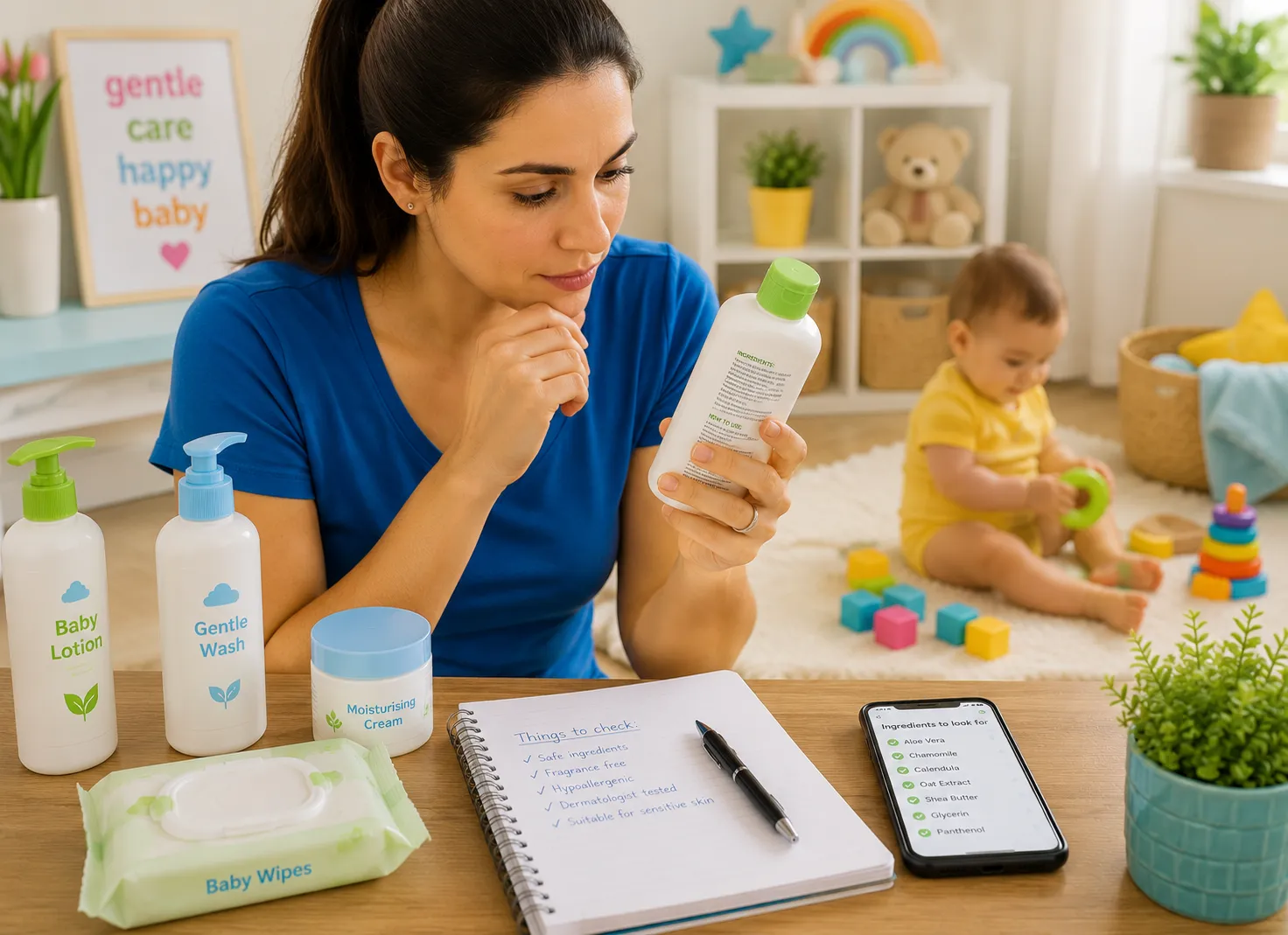
Most parents have stood in a skincare aisle holding a bottle in one hand and staring at an ingredient list that seems designed to confuse rather than inform. The names are long, unfamiliar and sometimes almost impossible to pronounce. Some sound scientific, while others look like Latin words taken from a botany textbook. Yet those names can tell you a great deal about what a product is designed to do. You do not need to become a chemist—you simply need to know where to look and what questions to ask.
Start With What the Product Is Supposed to Do
Before examining individual ingredients, decide what you need the product to accomplish. Are you looking for a basic moisturiser, a protective barrier cream or something more comprehensive for dry, itchy and eczema-prone skin? A long list of fashionable ingredients means very little if the formulation does not address your baby’s actual skin needs. The front label makes the promises, but the ingredient list shows how the product may attempt to fulfil them. Begin by asking whether the formula appears capable of calming irritation, supporting the skin barrier and helping protect vulnerable skin from everyday pressures.
The First Ingredients Usually Tell the Biggest Part of the Story
Cosmetic ingredients are generally listed from the largest amount to the smallest, although ingredients present at concentrations of 1% or less may appear in any order after the higher-concentration ingredients. This means the first several ingredients usually form the main structure of the product. Water often appears first in creams and lotions because it provides the fluid base into which other ingredients are incorporated. Oils, moisturising agents, emulsifiers and texture-building ingredients may follow. Do not assume that an ingredient near the end of the list is useless, however, because some ingredients are effective or necessary in relatively small quantities. Australia’s cosmetic ingredient-labelling rules explain this ordering system more fully through the ACCC Product Safety standard.
A Chemical-Sounding Name Is Not Automatically a Bad Ingredient
One of the easiest mistakes is to judge an ingredient by how frightening or complicated its name sounds. Cosmetic labels commonly use standardised ingredient names so the same substance can be identified across products and countries. Even familiar plant extracts may appear under their Latin botanical names, followed by the everyday plant name in brackets. Tocopherol is vitamin E, for example, while ascorbyl palmitate is a stable, oil-soluble form of vitamin C. The length of a word tells you nothing about whether it is gentle, useful or appropriate for your baby’s skin. What matters is the ingredient’s function, concentration, formulation and how your baby’s skin responds to the finished product.
Learn to Recognise the Main Moisture-Supporting Families
Humectants are ingredients that help attract and retain water within the upper layers of the skin. Glycerin and hyaluronic acid are two recognisable examples, and both can contribute to skin hydration. Emollients help fill the tiny spaces between dry surface cells, making the skin feel softer and smoother. Oils and fatty ingredients commonly perform this role, while more occlusive ingredients help slow the escape of moisture from the skin. A useful baby cream may combine these functions rather than depending on only one form of moisturisation. This matters because skin that repeatedly loses water may need both hydration and support against further moisture loss.
Look Beyond the Word “Moisturising”
Dry, itchy and eczema-prone skin may need more than a cream that simply makes the surface feel soft for an hour. A stronger formulation should be designed to support the skin while it recovers from dryness, irritation and repeated environmental pressure. This is why we look at baby skincare through three connected needs: Repair, Nourish and Defend. Repair means helping calm irritation and supporting the developing skin barrier. Nourish means supplying carefully selected moisturising, conditioning and skin-supporting ingredients. Defend means helping vulnerable skin withstand moisture loss, friction and microbial interference.
Do Not Be Frightened by Every Preservative
Preservatives often receive a great deal of negative attention, but water-containing products require protection from bacteria, yeast and mould. A poorly preserved cream can become contaminated through repeated opening, warm storage or contact with fingers. For a baby skincare product, preservation is therefore part of product safety rather than an unnecessary extra. The better question is not simply, “Does this contain a preservative?” but, “Has the complete formula been designed and preserved appropriately?” Packaging, acidity, ingredient compatibility and manufacturing standards all influence how the preservation system performs.
Pay Attention to Fragrance and Strong Sensory Ingredients
A product can smell wonderful and still be poorly suited to a baby whose skin is already dry, itchy or easily irritated. Added fragrance does not improve the skin barrier or increase hydration; it is primarily included to change the user’s sensory experience. Essential oils are also not automatically gentle merely because they come from plants. Some contain naturally occurring aromatic compounds that may be unsuitable for highly reactive skin. When assessing a product, look beyond words such as “natural,” “pure” and “botanical” and consider whether every ingredient appears to serve a useful purpose. For babies with troublesome skin, a restrained formulation is often more valuable than a heavily perfumed one.
Do Not Judge a Formula by One “Hero Ingredient”
Marketing often encourages parents to search for one celebrated ingredient, but a cream is a complete formulation rather than a collection of isolated names. An excellent ingredient can perform poorly in an unstable or badly balanced formula. Conversely, several carefully selected ingredients can complement one another and support different aspects of the skin at the same time. The final texture, concentration, delivery system and interaction between ingredients all matter. This is why the presence of aloe vera, hyaluronic acid or a botanical oil on the label does not, by itself, prove that a product will be suitable for your baby. Look for a logical combination of ingredients built around a clear purpose.
How We Built the Itch-A-Bye Ingredient Synergy
Itch-A-Bye Baby Repair Cream was formulated around the combined needs of dry, itchy and eczema-prone baby skin. Black Seed Oil was selected for its skin-conditioning, anti-inflammatory and antimicrobial properties, while MSM helps support a calmer skin environment. Allantoin is included for its soothing and skin-recovery support, and hyaluronic acid and glycerin help improve hydration. Vitamin C and vitamin E contribute antioxidant and skin-supporting properties. These ingredients are combined with ten specially selected botanical extracts rather than being scattered through the formula merely to decorate the label.
The formula reflects the Itch-A-Bye Repair, Nourish and Defend approach. Ingredients with calming and soothing properties help address the irritation that can accompany persistent dryness. Humectants, oils, vitamins and conditioning ingredients help supply the moisture and support the skin needs as it repairs itself. Carefully selected botanical ingredients contribute anti-inflammatory, antibacterial, antifungal and antioxidant properties that help support the skin’s natural defences. It is this planned cooperation between ingredients—not one fashionable ingredient in isolation—that gives the formulation its purpose. You can explore the complete thinking behind the formula on our How It Works page.
Use the Ingredient List as a Filter, Not a Guarantee
An ingredient list can help you eliminate products that do not suit your priorities, but it cannot predict every baby’s individual response. Two creams with apparently similar ingredients can behave very differently because their concentrations, manufacturing processes and overall formulations are not the same. Introduce a new product cautiously, particularly when your baby’s skin is already irritated, and observe the area where it is first applied. Stop using a product if it appears to cause increased redness, swelling, discomfort or itching. Persistent, broken, weeping or worsening skin should be assessed by a qualified healthcare professional.
You Are Looking for a Sensible Formula, Not a Perfect Label
You do not need to memorise hundreds of cosmetic ingredients or panic whenever you see an unfamiliar name. Start with the product’s purpose, examine the first several ingredients and identify the main moisturising, soothing, barrier-supporting and protective components. Be cautious of labels that rely heavily on vague words while telling you very little about how the formulation works. Look for purposeful ingredient combinations rather than a single fashionable extract printed in large letters on the front of the jar. Once you learn to read an ingredient list this way, it becomes less like an intimidating chemistry lesson and more like a useful map of what you are putting on your baby’s skin.