
Your Child Loves Swimming. Their Skin May Not. Here’s Why We Created an Itch-A-Bye After-Swim Routine for Dry, Itchy Skin
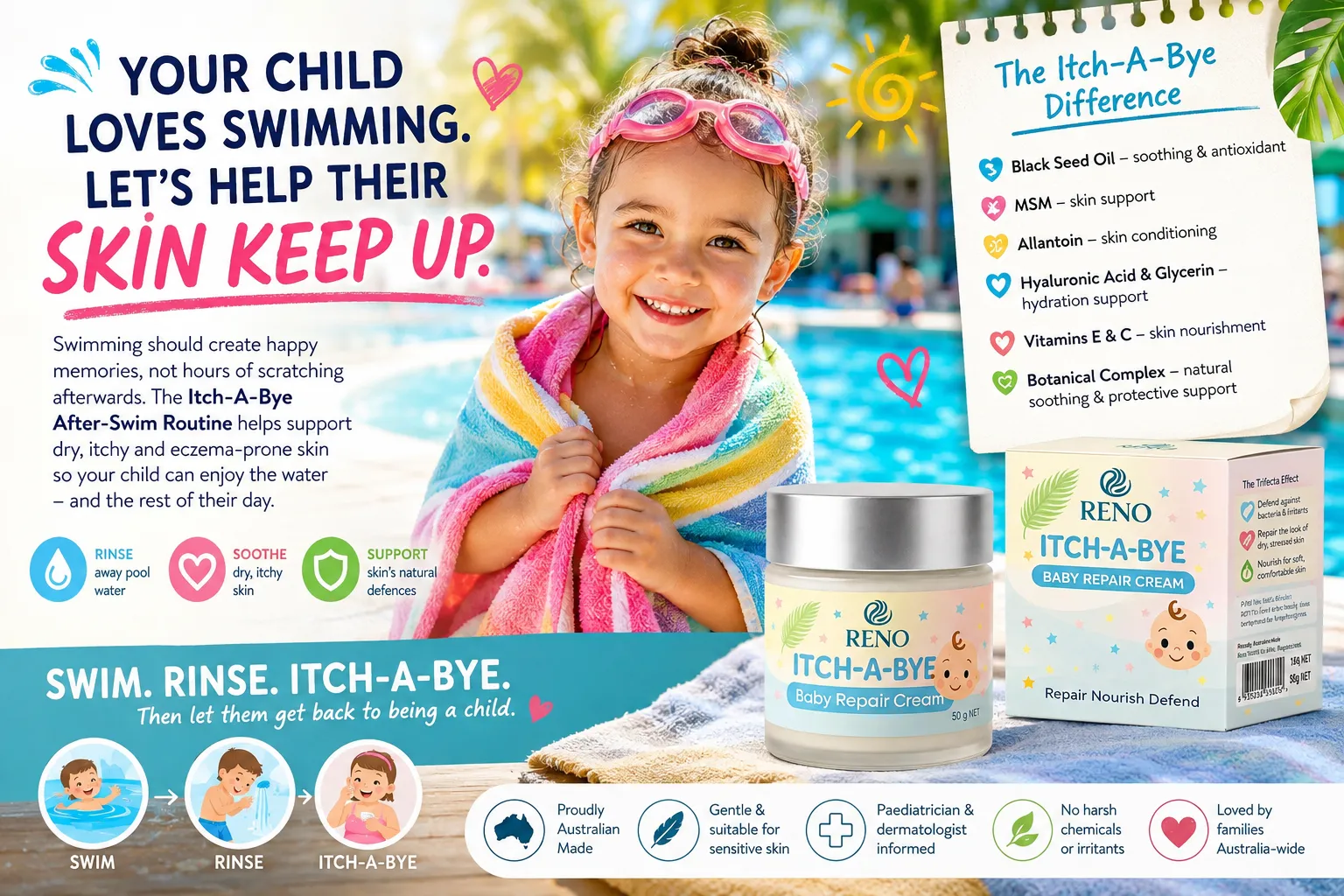
Your child should be thinking about splashing, kicking and having fun in the water, not about how uncomfortable their skin might feel afterwards. For families dealing with dry, itchy or eczema-prone skin, we believe better after-swim care can help keep the focus where it belongs: on childhood.
There is something wonderfully simple about watching a child in a swimming pool. They are not thinking about chlorine, moisturisers, skin barriers or what their skin might feel like later that evening. They are thinking about splashing, floating, kicking their legs and asking for another five minutes when you tell them it is time to get out. For them, swimming is freedom, and for parents it can be one of those lovely moments when you simply watch your child enjoying being a child.
But some parents know there can be another side to that experience. Their child gets out of the water and, before long, the skin begins to feel dry or tight. Perhaps the cheeks become rougher, the creases behind the knees become uncomfortable, or familiar itchy areas begin attracting little fingers again. Sometimes the scratching starts before the family has even left the swimming centre; sometimes it appears later that evening. When this happens repeatedly, parents can understandably begin wondering whether swimming itself is simply incompatible with their child’s skin.
We don’t think it should have to be that way.
The Question Shouldn’t Always Be “Should My Child Stop Swimming?”
When parents repeatedly notice uncomfortable skin after swimming, avoiding the pool can seem like the safest answer. Yet major dermatology and eczema organisations do not generally tell children with eczema-prone skin to stop swimming altogether. Instead, practical guidance commonly focuses on sensible precautions such as moisturising appropriately, rinsing afterwards and restoring moisture promptly.
That changes the question we think parents should be asking. Instead of beginning with, “Should my child stop swimming because of their skin?”, perhaps the better starting point is, “What can I do before and after swimming to make the experience easier on their skin?” This is a much more useful question because it focuses on the things parents can actually control. It also leaves room for children to continue enjoying an activity they love while their parents learn what their particular skin needs.
That idea sits behind what we have come to think of as the Itch-A-Bye After-Swim Routine.
What Actually Happens to Skin Around Swimming?
It is easy to assume that skin surrounded by water must automatically become more moisturised. Unfortunately, the relationship between water and dry or eczema-prone skin is more complicated. Swimming-pool disinfectants are essential for keeping communal water safe, but chlorinated water can feel drying or irritating for some susceptible skin. This is one reason post-swim rinsing and moisturising are commonly recommended for children whose skin tends to become dry or uncomfortable.
Chlorine, however, may only be one part of the story. Think about everything that can happen during a single swimming lesson: prolonged water exposure, warmth, sweating, wet swimwear rubbing against the body, towel drying and perhaps an already-dry patch that was vulnerable before the child entered the pool. At the beach, salt, sand, wind and sun exposure can add still more variables. Once itching begins, scratching can introduce another source of irritation.
This is why we prefer not to reduce the entire problem to “chlorine is bad for the skin.” Chlorine has an important job to do, and many children tolerate swimming pools perfectly well. For a child whose skin repeatedly becomes dry or uncomfortable afterwards, however, the combination of exposures may be enough to matter. Understanding that combination gives parents more options than simply banning swimming.
This Is Where Our Thinking About Itch-A-Bye Changed
We did not originally develop Itch-A-Bye Baby Repair Cream as a specialist swimming product. It was created for babies and young children with dry, itchy and eczema-prone skin, with a formulation designed to provide more than basic moisturisation. But once families began using the cream in everyday life, we started learning things about the product that could never have come from thinking about the formulation in isolation.
One of those lessons came from swimming. Parents told us about using Itch-A-Bye when their children’s skin became dry, itchy or uncomfortable after time in the pool. We began to see after-swim care emerging as a particularly useful real-world application for the cream. Individual experiences naturally vary, and parent feedback should never be confused with controlled clinical evidence, but recurring experiences can still teach a company a great deal about how families actually use its product.
When we looked again at the formulation, the connection made sense. After swimming, vulnerable skin may need hydration, soothing and conditioning support at the same time. Itch-A-Bye had already been formulated around exactly that broader way of thinking about troublesome skin.
That is why we now believe Itch-A-Bye deserves a place in the swimming bag.
We Aren’t Trying to Fight Chlorine
This distinction is important because there is a temptation in skincare marketing to turn ordinary chemicals into villains. Chlorine should not be treated that way. Proper swimming-pool disinfection helps control potentially harmful microorganisms and plays an important public-health role. Children also respond differently to chlorinated water; some tolerate it extremely well, while others with already-vulnerable skin may find it drying or irritating.
We therefore do not claim that Itch-A-Bye “neutralises chlorine,” nor do we claim that it prevents a medical eczema flare caused by swimming. Those would be specific claims requiring appropriate testing of the finished product. What we can say is something much more practical: once the swimming is finished and residual pool water has been rinsed away, Itch-A-Bye provides a multi-ingredient skincare formulation specifically created for dry, itchy and eczema-prone skin.
In other words, let the swimming pool do its job. Let your child enjoy the swimming pool. Then remove what remains on the skin and give vulnerable skin thoughtful support afterwards.
The Difference May Begin in the First Few Minutes After Swimming
Imagine two children leaving the same swimming pool after forty minutes in the water. The first child gets out, is rubbed vigorously with a towel and remains in wet swimwear while everyone packs up. Their already-dry skin receives no particular attention until later that evening, by which time they may already be scratching. Nothing about that routine is unusual; it is probably what countless families do without thinking about it.
Now imagine a slightly different routine. The child leaves the pool and their skin is promptly rinsed with fresh, comfortably warm water. Wet swimwear comes off, and instead of rubbing the skin vigorously, the parent gently pats it dry. Before the skin has had time to become very dry and uncomfortable, an appropriate moisturising product is applied. It only takes a few extra minutes, but the skin has been treated very differently.
This approach closely resembles established dermatological advice: rinse promptly, treat vulnerable skin gently and moisturise soon afterwards. This is one reason we believe the period immediately after swimming represents such an important opportunity.
Our Routine Is Deliberately Simple
Parents already have enough complicated routines to remember, so we do not want this one to require six products and fifteen steps. Our preferred approach can be remembered in three simple actions.
SWIM. RINSE. ITCH-A-BYE.
Let your child enjoy the swim. Afterwards, rinse the skin with clean fresh water to remove residual pool water, salt or other material from the swimming environment. Gently pat rather than aggressively rub the skin, remove wet swimwear and then apply Itch-A-Bye Baby Repair Cream according to the product directions as part of the child’s normal skincare routine.
The simplicity matters because consistency matters. A sophisticated routine that nobody follows is not particularly useful. A parent who knows exactly what to do when their child leaves the pool has a much better chance of turning good after-swim skincare into an ordinary habit.
Why Not Just Use Any Moisturiser?
An appropriate moisturiser can absolutely form part of after-swim care. We are not suggesting that a child’s skin somehow knows the brand name written on the jar. What makes Itch-A-Bye interesting to us is the thinking behind the formulation and how closely that thinking fits the needs of skin that can become dry and uncomfortable after environmental exposure.
When we developed Itch-A-Bye, we did not begin by asking which fashionable ingredient we could place in large letters on the front of the packaging. We asked a broader question: what might dry, itchy and easily irritated skin need from a supportive skincare formulation? That led us towards ingredients with complementary roles rather than expecting one celebrated ingredient to accomplish everything.
At the centre are Black Seed Oil, MSM and Allantoin. Around them sit Hyaluronic Acid and Glycerin, together with Tocopherol (Vitamin E), Ascorbyl Palmitate and Caprylic Acid. The formulation also incorporates botanicals including Centella asiatica, Chamomile, Licorice, Scutellaria baicalensis, Rosemary, Polygonum cuspidatum, Green Tea and Ginger.
The formulation is the hero.
Why Black Seed Oil Became So Important to Us
Black Seed Oil, derived from Nigella sativa, occupies an important place in our formulation philosophy because the plant contains naturally occurring compounds that have attracted considerable scientific interest. Published research has examined Nigella sativa and compounds such as thymoquinone in relation to antioxidant, anti-inflammatory and antimicrobial activity, including research relevant to dermatology. The scientific literature is interesting, although studies of an individual ingredient should never be presented as proof that a finished cosmetic product produces the same therapeutic effects.
That distinction is central to the way we want to communicate about Itch-A-Bye. We would rather explain why we selected an ingredient than turn it into a miracle claim. Black Seed Oil does not have to carry the entire product on its shoulders because it works within a much broader formulation. Its role makes more sense when considered alongside MSM, Allantoin, humectants, vitamins and the botanical ingredients surrounding it.
This is also why we resist the idea of the “hero ingredient.” Black Seed Oil may be one of our most important ingredients, but the real hero is what happens when carefully selected ingredients are brought together for complementary purposes.
MSM and Allantoin Add Another Dimension
Allantoin is widely used in skincare for its skin-conditioning and soothing properties. It is not an ingredient that needs an extravagant story to justify its inclusion. For skin that feels dry, rough or irritated, those straightforward conditioning properties are exactly what make it useful.
MSM provides another complementary component within the formulation. Rather than expecting it to perform the same role as Glycerin or Black Seed Oil, we selected it as part of a system in which different ingredients contribute different forms of support. This is particularly relevant when skin has experienced several pressures at once, as can happen around swimming.
A child leaving a pool may not simply have “dry skin.” There may be dryness alongside warmth, friction, irritation and scratching. That is why our formulation philosophy has always been broader than simply adding moisture.
Hydration Cannot Be an Afterthought
If there is one message that appears consistently in professional guidance about eczema-prone skin and swimming, it is the importance of moisturising. That is why Glycerin and Hyaluronic Acid are particularly relevant when we think about Itch-A-Bye as an after-swim product. These ingredients are incorporated as part of the formulation’s hydration-supporting system.
The timing also matters. Professional recommendations commonly encourage moisturising soon after rinsing rather than waiting until the skin has become very dry later in the day. For a family whose child predictably becomes uncomfortable after swimming, it makes sense to have the skincare product available at the pool rather than sitting at home in the bathroom.
That is why we keep returning to the swimming bag. If you already know the skin tends to struggle after swimming, why wait for the struggle before beginning the after-care?
Our Botanical Complex Is About Breadth, Not Decoration
Itch-A-Bye also contains a broad botanical complex incorporating Centella, Chamomile, Licorice, Scutellaria, Rosemary, Polygonum cuspidatum, Green Tea and Ginger. Different botanical ingredients contain different naturally occurring compounds that have been investigated for antioxidant, soothing and skin-conditioning properties. As with Black Seed Oil, research on individual ingredients does not automatically prove a particular clinical outcome for the finished Itch-A-Bye formulation.
But the selection tells you something about how we formulate. We are interested in creating a network of complementary functions rather than filling a product with multiple versions of the same idea. Hydration has a role. Conditioning has a role. Soothing support has a role. Antioxidant and botanical support have roles too.
Think of it like building a team. A great team is not made by finding one exceptional player and cloning that person eleven times. Different players contribute different strengths, and the result depends on how well those strengths work together. That is what we mean when we talk about ingredient synergy.
Repair. Nourish. Defend. Makes Particular Sense After Swimming
The swimming environment gives us one of the clearest ways to explain our Skin Trifecta philosophy. Repair reflects our focus on supporting skin that has become dry, stressed or uncomfortable. Nourish reflects the moisturising and conditioning support provided by the formulation. Defend reflects our broader philosophy of supporting vulnerable skin and its natural protective role against everyday environmental and microbial pressures.
These are not three unrelated marketing words that we added after creating the cream. They describe the way we think about skincare. Skin rarely exists in a vacuum where it is dealing with only one problem at a time, and swimming makes that particularly obvious.
There can be water exposure, environmental chemicals, warmth, friction, dryness and scratching in the space of an hour. It therefore makes sense to us that the skincare used afterwards should take a broader view as well.
Parents Helped Us Discover the After-Swim Opportunity
Product developers can learn an enormous amount from the people who eventually take a product home. Parents do not use skincare under controlled laboratory conditions. They use it after baths, before bedtime, in the middle of holidays, after daycare and when a tired child has decided that scratching is more interesting than sleeping. They also use it after swimming.
The positive experiences families have shared with us about Itch-A-Bye following swimming helped us recognise an application for the cream that has become increasingly important to us. We should be clear that these experiences are real-world parent feedback, not controlled clinical evidence, and we would never present them as anything else. Individual children can also respond differently to the same product.
But customer experience still matters. When families independently discover that a product fits particularly well into a recurring part of their lives, it is worth paying attention. In our case, that recurring moment is increasingly the period immediately after swimming.
Perhaps Itch-A-Bye Belongs in the Swimming Bag
Think about what parents routinely pack before leaving for swimming lessons. There is the swimsuit, towel, goggles, fresh clothing, water bottle, perhaps sunscreen where appropriate and inevitably a snack. These things become automatic because experience has taught us that we will need them.
For a child whose skin repeatedly becomes dry or itchy after swimming, perhaps skincare should become just as automatic. Not hidden in the bathroom cupboard waiting for the scratching to begin several hours later. Not remembered only when the skin is already uncomfortable. Put it in the bag before leaving home.
That is the behaviour we would love families to associate with Itch-A-Bye. If swimming tends to leave your child’s skin dry and itchy, pack the Itch-A-Bye.
There May Also Be a Role for Moisturising Before Swimming
Professional guidance also provides an interesting lesson about what happens before a child enters the water. Some dermatology guidance recommends applying an appropriate moisturiser before swimming for children with eczema-prone skin, as well as rinsing and moisturising again afterwards. This reinforces the idea that good swimming skincare is about preparation as well as recovery.
Parents whose children repeatedly experience substantial irritation after swimming may therefore want to discuss an appropriate before-and-after routine with their doctor, dermatologist or pharmacist. The child’s individual history matters, particularly if eczema is severe or there are open areas of skin.
For our purposes, however, the after-swim opportunity remains beautifully simple. Once swimming is finished, remove the residue, treat the skin gently and restore moisture promptly.
Don’t Forget About Wet Swimwear
It is surprisingly easy to blame every post-swimming reaction on chlorine when the water may only be one part of the problem. Wet fabric can remain pressed against the body for quite some time after a swimming lesson, while elastic around the waist, legs or shoulders can rub repeatedly against vulnerable areas. If the child is warm as well, discomfort may become even more noticeable.
This is another reason we prefer to think about the whole swimming experience rather than searching for one villain. Get the wet swimsuit off. Rinse the skin. Pat gently. Then provide the skin support your child normally needs.
Salt Water Is Not Automatically Better
Parents sometimes assume that if chlorinated pools cause difficulty, seawater must automatically be gentle. Children’s experiences are more variable than that. Salt water may feel comfortable for some, while it can sting dry, scratched or cracked skin in others.
A beach day also brings sand, wind, sunshine and wet salty swimwear into the picture. Rubbing sandy skin aggressively with a towel can create additional friction, while salt remaining on already-dry skin may feel uncomfortable as the skin dries. Once again, the sensible response is not necessarily to eliminate the activity.
Enjoy the beach, rinse the skin when practical, remove sandy or wet clothing, dry gently and support the skin afterwards. The location changes. The philosophy doesn’t.
There Are Times When Swimming Should Wait
There is an important limit to everything we are saying. If your child’s skin is significantly raw, open, weeping, crusted, infected-looking or experiencing a severe flare, this is not the moment to rely on an after-swim cream and hope for the best. In situations like these, swimming may need to wait until the problem has been appropriately assessed and controlled.
Itch-A-Bye is skincare. It should not replace appropriate medical assessment or prescribed treatment when those are required. If the skin is rapidly worsening, painful, extensively broken or showing signs of possible infection, seek advice from an appropriately qualified healthcare professional.
Responsible skincare sometimes means knowing when not to sell another application of skincare.
We Want Parents to Remember One Very Simple Idea
There are hundreds of baby moisturisers competing for attention. There are thousands of articles about eczema, dry skin and itching. We do not want Itch-A-Bye to become another jar sitting anonymously on a bathroom shelf making vague promises.
We want parents to remember something much more specific.
If swimming leaves your child’s skin dry and itchy, think Itch-A-Bye.
And then remember the routine:
SWIM. RINSE. ITCH-A-BYE.
Enjoy the water. Remove what remains on the skin. Then support it.
Because the Real Product Isn’t the Jar
Parents do not wake up in the morning hoping to buy another moisturiser. They do not dream about owning a more impressive skincare collection. What they actually want is for their child to be comfortable enough that skin problems stop dominating ordinary family life.
They want bath time without drama. They want bedtime without endless scratching. They want to dress their child without worrying about every rough patch. And when Saturday morning swimming lessons arrive, they want to sit beside the pool and enjoy watching their child rather than spending the entire lesson wondering what the skin will look like that evening.
That is the outcome that interests us.
The jar is simply the tool. The goal is helping a child get on with childhood.
Beyond the Skin Barrier
Swimming also illustrates one of the central ideas behind our book Beyond the Skin Barrier: Uncovering the Hidden Roots of Dry, Itchy and Eczema-Prone Skin. Parents understandably search for the one thing responsible whenever their child’s skin becomes uncomfortable. Sometimes, however, looking for one culprit can prevent us from seeing several smaller pressures occurring together.
After swimming there may be treated water, but there may also be existing dryness, prolonged wetting, warmth, friction, wet clothing, towel rubbing and scratching. At the beach, salt, wind and sand may join that list. Looking at the combination can give parents a much richer understanding of why one swimming session seems fine while another is followed by hours of discomfort.
That interconnected way of thinking runs throughout Beyond the Skin Barrier. The complete digital edition is available free at www.itchabye.com/free-book for parents who want to explore the subject in much greater depth.
Your Child Loves Swimming. Let’s Help Their Skin Keep Up.
Maybe your child is the one standing cautiously at the edge of the pool before finally jumping. Maybe they are the child you practically have to negotiate with to get out of the water. Perhaps swimming lessons have only just begun, or Saturday morning at the pool has already become part of your family’s routine. Whatever the situation, dry, itchy or eczema-prone skin should not automatically be allowed to write the ending to that story.
Professional guidance tells us that many children with eczema-prone skin can continue swimming and that sensible skincare around swimming can help. Rinsing promptly, treating the skin gently and restoring moisture afterwards are simple measures commonly recommended. It is within that established after-swim principle that we believe Itch-A-Bye Baby Repair Cream has found a particularly natural home.
It was created specifically with dry, itchy and eczema-prone skin in mind. It combines Black Seed Oil, MSM and Allantoin with Glycerin, Hyaluronic Acid, Vitamin E, Ascorbyl Palmitate and our broader botanical complex. It reflects our philosophy of Repair, Nourish and Defend, while positive experiences shared by families have helped us recognise how useful the formulation can be around swimming.
We don’t claim that Itch-A-Bye neutralises chlorine. We don’t claim that it makes eczema disappear, and we don’t claim that every child’s skin will respond identically. We believe something simpler and, we think, much more useful: when swimming leaves vulnerable skin needing moisture, soothing and support, this is exactly the kind of moment Itch-A-Bye was designed for.
So pack the towel. Pack the goggles. Pack the dry clothes. And if your child is one of those children whose skin doesn’t love swimming quite as much as they do, pack the Itch-A-Bye.
SWIM. RINSE. ITCH-A-BYE.
Then let them get back to being a child.
This article provides general educational information and does not replace medical advice. Itch-A-Bye is a cosmetic skincare product for dry, itchy and eczema-prone skin and is not presented as a medicine or treatment for eczema, infection, allergy or other medical conditions. Parent experiences are individual experiences rather than controlled clinical evidence, and results can vary. Seek professional medical advice for severe, persistent, infected-looking, weeping, extensively broken or otherwise concerning skin.