
Lotion vs Balm vs Cream: A Parent’s Guide to Baby Moisturisers
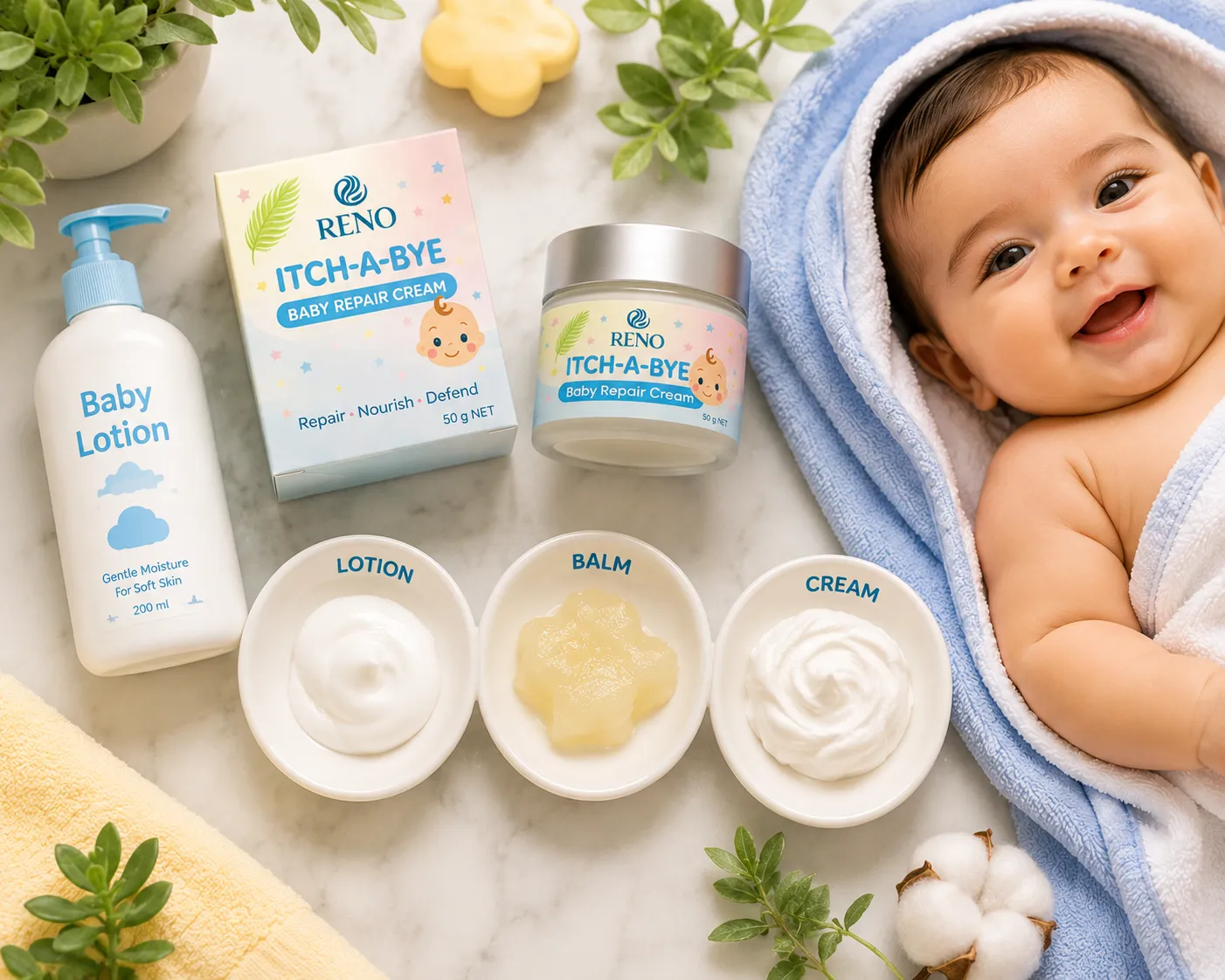
Walk into the baby skincare aisle and something that should be simple can quickly become confusing. There are lotions, creams, balms, butters, ointments, oils and products described as “intensive,” “barrier,” “soothing” or “repairing.” When your baby already has dry, itchy or eczema-prone skin, the last thing you need is another decision that feels impossible. So which should you actually choose: a lotion, a balm or a cream?
The answer is not that one category is automatically better than all the others. Lotions, balms and creams are different delivery systems, and each can be useful depending on what your baby’s skin needs. What matters is how much hydration and occlusion the product provides, how comfortable it is to use, and most importantly, what is actually inside the formulation. The name on the front of the container tells you about texture, but it does not tell you the whole story about what the product can do.
The Simple Difference Between Lotion, Cream and Balm
Think of these products as sitting on a spectrum. Lotions generally contain more water and have a lighter consistency, creams tend to sit somewhere in the middle, and balms are usually richer and contain a higher proportion of oils, waxes or other occlusive ingredients. As you move from lotion towards balm, products commonly become thicker and more protective on the skin. But thickness alone should never be confused with formulation quality.
A beautifully formulated cream may provide more useful support for a particular baby than a very basic balm, while another baby with extremely dry patches may benefit enormously from the stronger occlusion a balm provides. A lotion may be ideal for quick whole-body application in warm weather but inadequate when skin becomes intensely dry. Different formats solve different practical problems. The question is not simply which product is thickest. The question is what job you need the product to perform.
What Is a Baby Lotion?
Lotions are generally the lightest of the three options. Because they contain a relatively high proportion of water, they spread quickly over large areas and usually absorb without leaving much residue. This can make them convenient after bathing or when moisturising an active baby who has little patience for a lengthy skincare routine. In warm weather, that lighter feel can also be appealing.
The disadvantage is that some lotions may not provide enough lasting support for persistently dry or eczema-prone skin. A product can make the skin feel beautifully moisturised immediately after application but leave it feeling dry again relatively quickly. This does not mean lotions are bad products. It simply means that a light formulation may sometimes be asked to do a job that requires something more substantial.
When Can a Lotion Be Useful?
A lotion can make sense when your baby has relatively mild dryness and you mainly want an easy everyday moisturiser. It can also be useful when covering large areas of skin because the lighter texture usually spreads quickly. During hot Australian weather, some families may find lotions more comfortable than very heavy products. Convenience matters because a product that never gets used cannot help the skin.
However, watch what happens several hours after application rather than judging the product only by how silky the skin feels immediately afterwards. Does your baby’s skin remain comfortable, or does the dryness quickly return? Does scratching increase again later in the day? Your baby’s skin response is more informative than the word “lotion” printed on the bottle.
What Is a Baby Balm?
Balms usually sit towards the richer end of baby skincare. Many contain oils, butters or waxes and relatively little water, although formulations vary considerably between brands. Their richness can create a stronger layer over the skin surface and help reduce moisture loss. This can make them particularly appealing for stubborn dry patches.
A balm can be especially useful on smaller areas such as dry cheeks, wrists, ankles or other places that repeatedly become rough. The thicker texture may remain on the skin longer than a light lotion. However, a rich balm covering the entire body can sometimes feel heavy, particularly during warm weather or underneath clothing. More occlusion can be useful, but more is not automatically better in every situation.
When Can a Balm Be Useful?
Think of a balm as a potentially useful tool when additional sealing and protection are priorities. If a particular area repeatedly loses moisture despite regular moisturising, a richer balm may help reduce that water loss. It can also provide a physical layer between vulnerable skin and some forms of friction. That can be particularly useful on exposed or persistently dry areas.
But the environment still matters. A baby covered in a thick balm and then dressed warmly may become hot and sweaty, and heat and sweat can themselves contribute to itching in some children. A product that works beautifully during winter may feel completely different during summer. Baby skincare should respond to the child, the skin and the environment rather than following one rigid rule throughout the year.
What Is a Baby Cream?
Creams usually sit between lotions and balms. They generally contain both water and oil phases, allowing them to provide hydration while carrying oils, emollients and a broader variety of other ingredients. A well-designed cream can therefore offer substantial moisturising without necessarily feeling as heavy as a balm. This balance makes creams particularly practical for everyday use.
The cream format also gives formulators considerable flexibility. Humectants, oils, vitamins, soothing ingredients, antioxidants and botanical extracts can potentially be incorporated into the same formulation. Of course, simply calling something a cream does not mean it contains any of those ingredients. The advantage is not the word “cream” itself, but what a thoughtful formulator can build within that format.
So Which Is Most Moisturising?
This is where product labels can become misleading. It would be tempting to say lotion is light, cream is medium and balm is strongest, but moisturisation involves more than simply putting the thickest substance possible onto the skin. Hydration, emollience and occlusion are related but different functions. A good moisturising strategy can involve all three.
Humectants help attract and retain water, emollients help soften and condition the skin, and more occlusive ingredients can reduce the amount of water escaping from the surface. Different formulations combine these functions in different proportions. A thicker texture can therefore be useful without automatically making the complete formulation superior. A thicker product may provide stronger occlusion without necessarily offering the broadest range of supportive ingredients.
Why This Matters for Dry, Itchy and Eczema-Prone Baby Skin
When a baby has eczema-prone skin, dryness is often only one part of what the family is experiencing. The skin barrier may be vulnerable, scratching can create additional physical damage, and heat, sweat, saliva, friction and irritants may add further pressure. The microorganisms naturally living on the skin are part of that environment too. Several of these influences can occur at the same time.
That helps explain one of the most frustrating experiences parents describe: moisturising repeatedly while their baby remains itchy. The moisturiser may actually be doing its moisturising job, yet other pressures can continue affecting the skin. The skin may need support in more than one area at the same time. Moisture is essential, but moisture alone does not explain everything happening in eczema-prone skin.
The Biggest Mistake Is Choosing Only by Texture
Parents understandably associate thickness with strength. A balm looks substantial, a cream looks reassuringly rich and a lotion can appear almost too light. But appearance tells us very little about the quality of the complete formulation. Two creams sitting beside one another can contain completely different ingredient systems.
One may be primarily designed to hydrate and soften, while another may combine humectants, oils, vitamins, soothing ingredients, antioxidants and botanicals. The same principle applies to lotions and balms. Reading beyond the product category can therefore tell you much more. Instead of asking only “How thick is this?”, start asking “What has this formulation actually been designed to provide?”
Why We Chose a Cream for Itch-A-Bye
When we developed Itch-A-Bye Baby Repair Cream, we wanted something richer and more substantial than a basic lightweight lotion but practical enough for regular application across vulnerable baby skin. We also wanted the formulation to carry several different groups of ingredients rather than relying on one moisturising mechanism. A cream provided the flexibility we needed. That decision ultimately became part of our Repair, Nourish and Defend philosophy.
We wanted humectants for hydration, oils for conditioning, soothing ingredients, vitamins, antioxidants and a deliberately selected botanical complex working within one formulation. We did not want “Nourish” to mean simply adding water to the skin. We wanted the formulation itself to provide multiple forms of topical support. The cream is therefore the delivery system, while the ingredient synergy is the more important story.
REPAIR: Supporting the Barrier That Keeps Losing Moisture
Healthy skin performs an extraordinary balancing act. It helps keep water inside while creating a physical boundary between the body and the surrounding environment. When that barrier becomes vulnerable, water can escape more easily and the skin can become dry, rough and uncomfortable. Scratching can then place even more physical pressure on the surface.
Our Repair principle focuses on supporting that vulnerable outer barrier and the environment it needs to function effectively. Hyaluronic Acid and Glycerin contribute hydration, while Allantoin brings soothing and skin-conditioning support to the formulation. Other ingredients contribute complementary functions rather than asking one ingredient to do everything. Repair is therefore broader than simply making dry skin temporarily feel softer.
NOURISH: Much More Than Adding Moisture
This is one of the most important distinctions in our approach. When we say Nourish, we do not mean hydration alone. We mean supplying vulnerable skin with a deliberately selected combination of topical ingredients that hydrate, condition, soothe and provide antioxidant and other supportive properties. Hydration is one part of that system.
Humectants, oils, vitamins, skin-conditioning ingredients and botanicals can each contribute something different. A carefully designed formulation allows these ingredients to complement rather than merely duplicate one another. This is why we do not build the Itch-A-Bye story around one fashionable hero ingredient. Nourish is about formulation synergy.
Why Black Seed Oil Matters
Black Seed Oil, Nigella sativa, sits at the heart of the Itch-A-Bye formulation. It contains naturally occurring constituents including thymoquinone and has been studied for anti-inflammatory, antioxidant and antimicrobial properties. It also provides oil-based conditioning within the formulation. Those characteristics give it a very different role from a simple humectant.
That difference is important. Hyaluronic Acid does not need to perform the same function as Black Seed Oil, and Black Seed Oil does not need to replace Allantoin or Glycerin. Each ingredient can contribute something different to the complete formulation. The strength of the approach comes from bringing complementary ingredients together.
Why We Included MSM
MSM, or methylsulfonylmethane, adds another dimension to the formula. Research has explored MSM in relation to inflammatory and oxidative processes, which made it interesting when considering skin repeatedly exposed to dryness, irritation and scratching. It was not included merely to make the ingredient list longer. It forms part of the broader supportive architecture of the cream.
This illustrates why comparing products purely according to whether they are lotions, creams or balms can miss something important. Texture tells you how a product may spread and feel, but formulation tells you why its ingredients were selected. Two creams can therefore be very different products despite looking almost identical. What is inside matters more than the category printed outside.
Allantoin Has a Different Job Again
Allantoin has a long history of use in skincare as a soothing and skin-conditioning ingredient. When skin has been dry, irritated or repeatedly scratched, comfort becomes an important part of everyday care. Allantoin therefore complements rather than duplicates the hydrating ingredients in the formula. This is precisely the kind of ingredient diversity we wanted.
The same logic runs throughout the formulation. Some ingredients primarily contribute hydration, others conditioning, while others have been investigated for soothing, antioxidant or other supportive properties. No single ingredient needs to carry the entire formula. A skincare system becomes more interesting when the ingredients are selected for complementary roles.
The Botanical Complex Adds Another Layer
Itch-A-Bye also contains a deliberately selected group of botanical extracts, including Centella asiatica, Chamomile, Licorice, Scutellaria baicalensis, Green Tea, Rosemary, Ginger and Polygonum cuspidatum. These plants have different phytochemical profiles and have been researched across areas including soothing, antioxidant, anti-inflammatory and antimicrobial activity. We do not assume every plant provides every property. Their differences are part of the reason they were selected.
Centella does not need to behave like Green Tea, and Chamomile does not need to perform the same function as Licorice. They sit alongside Black Seed Oil, MSM, Allantoin, Hyaluronic Acid, vitamins and the other components of the formulation. Together they create a wider ingredient architecture than hydration alone could provide. That is what we mean when we talk about nourishing skin through ingredient synergy rather than hydration alone.
DEFEND: Remembering What the Skin Barrier Is Actually For
The skin barrier is not simply a lid that stops water escaping. It is the body’s interface with the outside world and is constantly encountering microorganisms and environmental pressures. Bacteria and fungi are normal parts of our surroundings, and many microorganisms naturally coexist with healthy skin. The objective is not to sterilise a baby’s skin.
Our Defend principle recognises this broader protective role. Black Seed Oil and several botanical ingredients contain constituents that have been investigated for antimicrobial properties, alongside their other characteristics. That research helped inform our ingredient-selection philosophy. Defend means supporting vulnerable skin as it interacts with everyday microbial and environmental pressures.
Lotion vs Balm vs Cream After Bathing
Immediately after bathing is one of the most useful times to think about moisturising. Water can temporarily hydrate the outer skin, but evaporation begins soon after the baby leaves the bath. Applying an appropriate moisturiser while the skin remains slightly damp can help retain some of that hydration. The product you choose should still suit the skin and circumstances.
A lotion may spread extremely quickly, a cream may provide a useful balance of hydration and richness, while a balm may offer stronger sealing on particularly dry areas. You do not necessarily have to choose one product for every part of the body. A simple routine can still use different textures selectively when there is a clear reason. The goal is not to follow a skincare rule perfectly; it is to support your baby’s skin effectively.
Lotion vs Balm vs Cream in Hot Weather
Warm weather changes the equation. Babies can become hot quickly, particularly underneath clothing, blankets and heavy skincare products. Sweat can collect around the neck, elbows, knees and other folds, and some eczema-prone children become noticeably itchier when overheated. In that environment, extremely heavy whole-body application may not always feel comfortable.
A lighter lotion or well-tolerated cream may be easier across larger areas, while a balm could be reserved for stubborn dry patches. Clothing and room temperature matter as well, because changing moisturiser cannot compensate for constant overheating. Watch your baby rather than blindly following the same routine throughout the year. Skincare should change when the pressures surrounding the skin change.
Lotion vs Balm vs Cream During Winter
Winter can produce almost the opposite problem. Cooler air, heating and lower humidity can contribute to increasing dryness, and skin that tolerated a lightweight lotion during summer may suddenly need more support. A richer cream may become useful for everyday application. Particularly dry patches may benefit from additional occlusion.
This is why declaring one moisturiser texture “best” for eczema-prone skin can be misleading. The same baby can have different requirements in January and July. Skin needs can also change during and between flares. A flexible routine is often more sensible than remaining loyal to one texture regardless of what the skin is telling you.
What About a Baby Who Hates Being Moisturised?
This matters more than skincare discussions sometimes acknowledge. A theoretically perfect moisturiser becomes much less useful if applying it turns every morning and bedtime into a wrestling match. Thick balms can take longer to spread, while lighter lotions generally cover large areas faster. Creams often provide a practical compromise between richness and spreadability.
Try warming a small amount between your hands before application and use calm, smooth strokes rather than repeatedly rubbing the same area. Keep the routine simple and have everything ready before you begin. For an older baby, distraction can sometimes make the process considerably easier. Practical skincare has to work in a real family, not just on an ingredient chart.
What If the Lotion Seems to Disappear Immediately?
That may simply reflect the lighter formulation. A lotion can absorb quickly and still provide useful hydration, so rapid absorption does not automatically mean it has failed. The more important question is what the skin feels like later. If dryness repeatedly returns soon after application, your baby may need a richer or more occlusive formulation.
You could consider moving from lotion to cream rather than immediately choosing the heaviest balm available. Alternatively, a richer product might only be necessary on particular areas. Observe patterns for several days instead of constantly changing products after one application. Your baby’s skin can tell you far more than the marketing language on the bottle.
What If a Balm Feels Too Greasy?
Then it may simply be too heavy for the way you are currently using it. That does not mean the balm is poor quality or unsuitable for every situation. It might work beautifully on a stubborn dry patch while feeling unnecessary across the chest, back and legs. Products can be used strategically.
The same idea applies to cream. You may prefer cream across most of the body and use something more occlusive only where additional sealing is needed. There is no prize for using exactly the same texture everywhere. Different areas of a baby’s skin can have different needs at the same time.
What If My Baby Is Still Scratching Despite Moisturising?
This is where the conversation needs to become broader than lotion versus balm versus cream. Dryness can contribute substantially to itching, but itch is not always a simple measurement of how moisturised the surface appears. Heat, sweat, friction, saliva, clothing and the itch-scratch cycle may continue adding pressure. The skin can also remain uncomfortable after it begins looking better.
Repeatedly applying more and more moisturiser may therefore miss part of the picture. Look at when the scratching occurs, where it happens and what was happening beforehand. Nighttime scratching may suggest a different pattern from scratching after swimming, eating, sweating or changing clothes. Sometimes the timing of the itch provides the clue that the appearance of the skin does not.
The Skin Threshold Model Makes This Easier to Understand
Our Skin Threshold Model provides a simple way to think about these overlapping pressures. Imagine that your baby’s skin can tolerate a certain amount of combined pressure before visible redness, dryness or increased discomfort appears. Dryness adds some pressure, heat adds more, sweat may contribute further, and friction, saliva, scratching, irritants and microbial pressures can add to the total. Eventually, the combined load may push vulnerable skin beyond its threshold.
A moisturiser can help reduce important parts of that pressure, particularly those associated with hydration, conditioning and water loss. But no lotion, cream or balm can control every environmental and biological influence surrounding the skin. This explains why a product can appear to “work” one week and seem less effective during another. The product may not have changed at all; the total pressure surrounding the skin may have changed.
Should You Own More Than One Type of Moisturiser?
You can, but you do not necessarily need to. Some families find one well-formulated cream handles most everyday situations, while others prefer a lighter product for some occasions and a richer balm for stubborn patches. The objective should be simplicity rather than accumulating an entire cupboard of baby skincare. More products do not automatically produce better skin.
Every additional formulation also introduces another set of ingredients that your baby’s skin has to encounter. If a simple routine works well, there is little reason to make it complicated. If something clearly is not providing enough support, then changing texture or formulation can be reasonable. Build the routine around what the skin actually needs rather than around how many products the skincare industry tells you to buy.
When the Problem Is More Than Dryness
Sometimes the most important decision is not which moisturiser to choose. Skin that becomes increasingly painful, hot, swollen, weeping, crusted or rapidly worse may need professional assessment. Persistent scratching that repeatedly breaks the skin also deserves attention. Simply moving from lotion to balm is not an adequate response to every skin problem.
Itch-A-Bye is an everyday skincare product, not an antibiotic or antifungal medicine. Research into the antimicrobial or anti-inflammatory properties of individual ingredients should not be confused with evidence that the finished cream treats established infection or eczema as a disease. Our Repair, Nourish and Defend framework describes our formulation philosophy and how we think about supporting vulnerable skin. Knowing when routine skincare is no longer enough remains important.
How to Read the Label More Intelligently
Instead of immediately turning the bottle around looking for the longest ingredient list, first ask what the formulation appears designed to accomplish. Look for hydration-supporting ingredients, emollients or oils, and consider whether the product contains additional soothing or skin-conditioning ingredients. Fragrance and other unnecessary additions may also matter when choosing products for eczema-prone skin. Then consider whether the texture suits how and where you intend to use it.
A sophisticated ingredient list does not automatically guarantee that a product will suit every baby. Likewise, a simple formulation is not automatically inferior. The best formulation is ultimately one that provides the support required and is well tolerated by that particular child. Ingredients, formulation, texture and the individual skin response all matter together.
A Simple Parent’s Guide
If your baby has mild dryness and you want something extremely quick and lightweight, a lotion may be enough. If you want richer everyday moisturising with the flexibility for a broader ingredient system, a cream may offer a useful middle ground. If the main problem is extremely dry patches and stronger sealing is needed, a balm can be particularly useful. None of these choices has to be permanent.
You may move between them as your baby grows, the weather changes or the skin behaves differently. You may even use a cream generally and a balm selectively without turning the routine into something complicated. What matters is understanding why you are choosing each product. Choose according to function rather than simply choosing according to thickness.
Why Itch-A-Bye Sits in the Middle
We chose the cream format for Itch-A-Bye Baby Repair Cream because we wanted a balance. We wanted something substantial enough for persistently dry, itchy and eczema-prone skin but practical enough to spread as part of an everyday routine. Most importantly, we wanted a formulation capable of bringing together Black Seed Oil, MSM, Allantoin, Hyaluronic Acid, vitamins and our specially selected botanical complex. The format allowed us to build the ingredient system we wanted.
That system sits behind Repair, Nourish and Defend. Repair focuses on supporting the vulnerable barrier, Nourish provides hydration plus oils, humectants, vitamins, skin-conditioning ingredients and botanicals, and Defend recognises the skin’s interaction with microbial and environmental pressures. These functions overlap and complement one another rather than operating as three isolated steps. You can discover Itch-A-Bye Baby Repair Cream and explore the formulation in more detail.
Go Beyond the Moisturiser Aisle
One of the central ideas behind our book Beyond the Skin Barrier is that parents deserve a better explanation than simply being told to moisturise more. Moisturising matters enormously, but dry, itchy and eczema-prone skin can involve the developing barrier, scratching, environmental pressures, immune signalling, the microbiome and other interacting influences. Understanding those relationships can change the questions you ask. Instead of constantly wondering which product you have not tried yet, you can begin looking for patterns.
That is particularly important when your baby’s skin seems unpredictable. A routine can appear successful for several weeks before suddenly seeming inadequate, even though nothing in the jar has changed. The Skin Threshold Model helps explain how changing combinations of pressure can produce that experience. You can continue with Beyond the Skin Barrier here.
Lotion vs Balm vs Cream: The Bottom Line
Choose lotion when lightweight hydration and fast application are the priorities. Choose balm when stronger occlusion and sealing are particularly useful. Choose cream when you want a balance between moisturising, richness, spreadability and the flexibility to deliver a broader ingredient system. Then look beyond the product category and examine what the formulation has actually been designed to provide. The best choice is the one that matches the skin in front of you.
For babies with persistently dry, itchy or eczema-prone skin, the smartest approach is rarely to chase whichever product feels thickest. Look at the skin, watch the patterns, consider heat, sweat, friction and other pressures, and choose a formulation that fits the job you are asking it to perform. The moisturiser format matters, but the formulation inside it matters even more. And ultimately, the goal is not simply moisturised skin, but vulnerable skin that is better supported to Repair, Nourish and Defend.