
Natural Baby Cream: What Does “Natural” Actually Mean?
“Natural” is one of the most reassuring words a parent can see on a baby cream. When your baby has dry, itchy or eczema-prone skin, it is understandable to look for something that sounds simple, gentle and close to nature. A jar covered with words such as natural, botanical or plant-based can immediately feel safer than something that looks more clinical. But the word “natural” on its own tells you surprisingly little about how a baby cream will actually behave on your child’s skin.
Natural does not automatically mean gentle, reaction-free or better for eczema-prone skin. It also does not tell you whether the formulation provides enough hydration, conditioning or broader support for a vulnerable skin barrier. Some natural ingredients can be extremely useful, while others may be unnecessary in a baby product. The better question is not simply, “Is this cream natural?” but “What ingredients are in it, why are they there, and how do they work together?”
What Does “Natural” Mean on a Baby Cream?
There is no single everyday meaning of “natural” that tells parents exactly how a skincare product has been formulated. Different manufacturers can use the word in different ways depending on their formulation philosophy, ingredient sourcing and the standards they follow. One product may use “natural” because most of its ingredients originate from plants, while another may use the term because particular ingredients have undergone relatively limited processing. That means two creams carrying the same “natural” description can have very different formulations.
Even ingredients that begin in nature often need processing before they can be incorporated safely and consistently into a modern cream. Oils may be filtered or refined, botanical compounds may be extracted, and ingredients may need to be stabilised so that the finished formulation remains usable. Water-containing creams also need to remain microbiologically safe throughout their intended shelf life. Natural skincare is therefore not simply a collection of untouched ingredients scooped from nature and placed into a jar.
Natural Does Not Mean Unprocessed
This is one of the biggest misconceptions surrounding natural skincare. A plant may be natural, but transforming that plant into an ingredient suitable for a stable cream often involves extraction, purification, concentration or other processing. None of those steps automatically makes the resulting ingredient undesirable. In many cases, processing is precisely what allows an ingredient to be used consistently.
The more useful question is whether the processing is appropriate for the ingredient and the finished formulation. Parents do not need to fear an ingredient simply because its name sounds scientific or because some manufacturing has taken place. The origin of an ingredient is only one part of its story. Its purity, concentration, stability and role inside the finished cream matter too.
Does Natural Automatically Mean Safer for Babies?
No. Nature contains extraordinarily useful substances, but it also contains irritants, allergens and toxins. Poison ivy is natural, pollen is natural and many substances capable of irritating human skin originate entirely from nature. Natural origin alone cannot therefore be used as a guarantee of safety.
What matters is the specific ingredient, its concentration, how it has been processed and how it interacts with the rest of the formulation. A thoughtfully formulated botanical ingredient can be valuable, while an inappropriate natural ingredient can be troublesome. The same principle applies to synthetic ingredients. Safety should be judged ingredient by ingredient and formulation by formulation, rather than by dividing everything into “natural good” and “synthetic bad.”
Can a Natural Baby Cream Still Cause a Reaction?
Yes. Babies can react to naturally derived ingredients just as they can react to other ingredients. Plant extracts contain biologically active compounds, and some people can be sensitive or allergic to particular botanical substances. A natural label cannot predict how every individual baby will respond.
This becomes particularly important when the skin barrier is already dry, irritated or repeatedly scratched. Compromised skin may behave differently from comfortable, intact skin, and the surrounding conditions can change from day to day. Individual response still matters regardless of the label. A product being natural does not remove the need to watch how your baby’s own skin responds.
Are Essential Oils Natural?
Many essential oils are derived from plants, so they can certainly fit within some definitions of natural skincare. But that does not automatically make them appropriate for every baby formulation. Essential oils are concentrated mixtures of aromatic compounds, and their properties vary considerably depending on the plant and concentration used. “Natural fragrance” should therefore not automatically be interpreted as “gentler fragrance.”
This is especially relevant when parents are deliberately trying to minimise unnecessary fragrance exposure on dry or eczema-prone skin. A product can smell beautiful and still contain something your baby’s skin does not need. Natural skincare does not have to be strongly scented to be genuinely plant-based. Sometimes the most thoughtful formulation decision is knowing which natural ingredients not to include.
Natural and Fragrance-Free Are Not the Same Thing
A cream can be natural and fragranced, or largely naturally derived and fragrance-free. These descriptions answer different questions. “Natural” refers broadly to ingredient origin or formulation philosophy, while “fragrance-free” generally tells you that fragrance has not intentionally been added simply to perfume the product. Neither claim automatically guarantees the other.
This distinction matters for babies with persistently dry or itchy skin. Parents can easily see flowers and botanical imagery on a package and assume that the product must be particularly gentle. Packaging can create powerful impressions before the ingredient list is read. The ingredient list is far more informative than the leaves, flowers and green colours printed on the front of the jar.
Does Natural Mean Hypoallergenic?
No. A natural product is not automatically hypoallergenic, and a product described as hypoallergenic does not have to be completely natural. These are separate ideas. A botanical ingredient can still contain compounds to which an individual child may react.
This is why claims need to be interpreted independently rather than bundled together. “Natural,” “hypoallergenic,” “dermatologically tested” and “paediatrician tested” can all appear reassuring, but each tells parents something different. None gives you a complete picture of the formulation. The strongest product choice comes from understanding what is actually inside the cream and what the formulation was designed to do.
Is a Shorter Ingredient List Always More Natural?
Not necessarily. A short ingredient list can be useful when a formulation has been intentionally kept simple, but the number of ingredients does not automatically tell you whether a product is better. A cream containing eight ingredients is not automatically safer or more effective than one containing twenty. Every ingredient needs a purpose.
A more sophisticated formulation may contain humectants, emollients, oils, vitamins, soothing ingredients, botanical extracts and ingredients needed to keep the product stable and safe. That naturally creates a longer ingredient list. The important question is whether those ingredients complement one another rather than merely increasing the number printed on the label. Formulation quality is about purpose and synergy, not winning a competition for the shortest ingredient list.
What About Ingredients With Long Chemical Names?
Long names often frighten parents because they look artificial. But everything in nature is made from chemicals, including water, plant oils and the compounds responsible for the smell of a flower. Cosmetic ingredient lists also use standardised ingredient naming systems, which can make familiar substances appear more technical. A scientific-looking name is not evidence that an ingredient is harsh.
The reverse is equally important. A familiar plant name is not proof that an ingredient is gentle. Parents are better served by asking what the ingredient does and whether it makes sense in the formulation. How a name looks on the label tells you far less than the ingredient’s function, concentration and evidence.
Why “Natural” Can Become a Marketing Shortcut
The word works because it carries emotional meaning. Natural can suggest purity, simplicity, gentleness and trustworthiness before a parent has read a single ingredient. Those associations are powerful, particularly when you are buying something for a baby. But emotional reassurance should not replace formulation science.
A beautiful natural-looking package can contain a basic moisturiser, while another less picturesque formulation may contain a carefully selected combination of useful ingredients. Neither should be judged by packaging alone. Natural ingredients can be excellent, but they still need to earn their place in the formulation. The goal should be intelligent natural skincare rather than natural skincare simply for the sake of the word.
A Natural Cream Can Still Be Too Basic
This is particularly relevant for parents who tell us they have tried several gentle or natural moisturisers but their baby’s skin remains persistently dry or itchy. The product may be perfectly pleasant and may provide useful hydration. The problem may simply be that moisturising is almost the entire job it was designed to perform. For some vulnerable skin, that job may be too narrow.
Dry, itchy and eczema-prone skin can involve more than a shortage of surface moisture. Barrier vulnerability, scratching, heat, sweat, friction and environmental exposures can all add pressure. The broader context therefore matters. That is why we believe the conversation needs to move beyond “natural versus synthetic” and towards what kind of support the formulation actually provides.
This Is Where Formulation Synergy Matters
At Itch-A-Bye, our formulation philosophy is not based on finding one fashionable natural ingredient and building the story around it. We selected ingredients with different but complementary functions and brought them together within one cream. Some help attract and retain water, some condition the skin, while others provide soothing, antioxidant or other supportive properties. The value lies in how those functions complement one another.
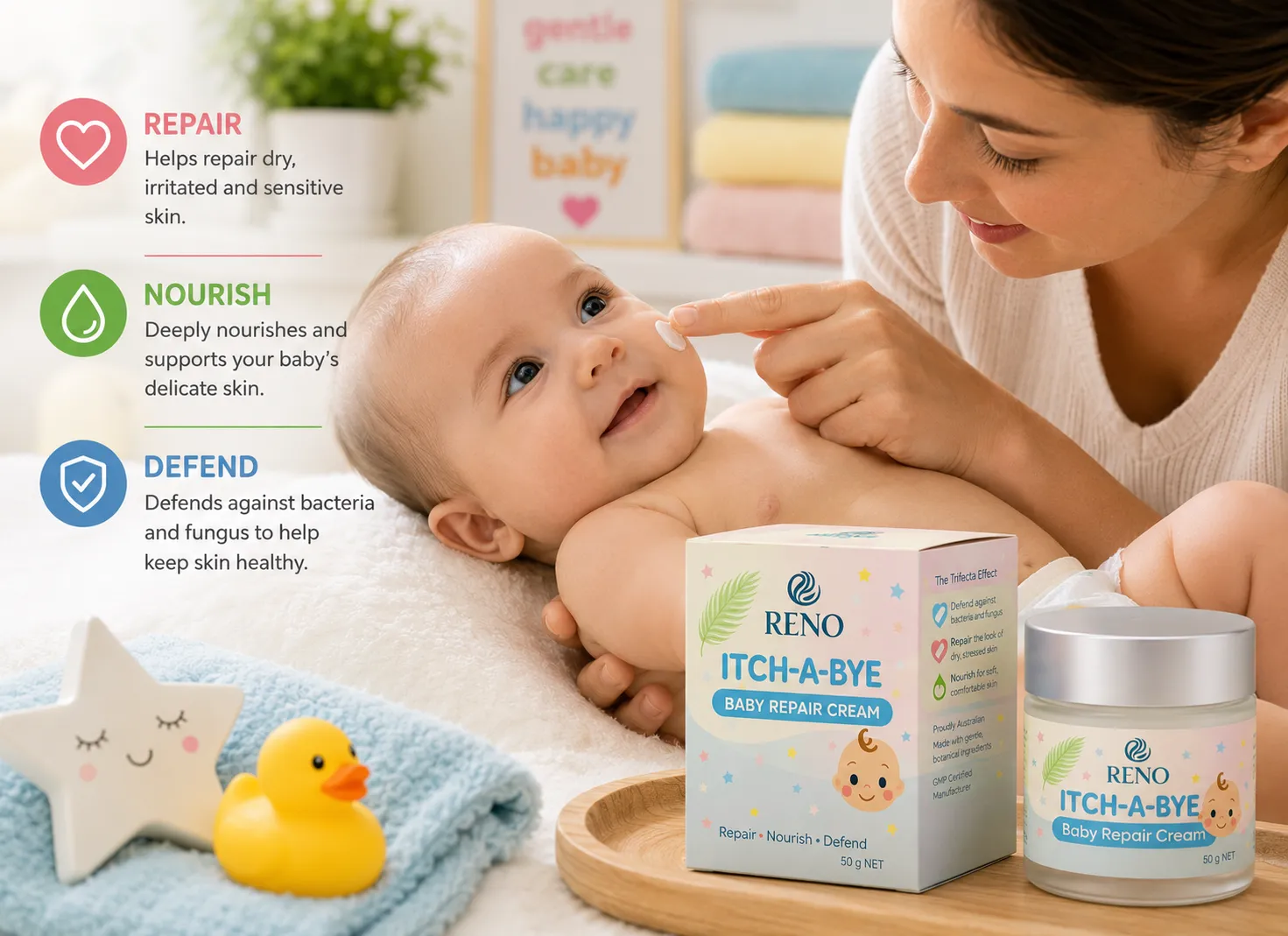
This became our Repair, Nourish and Defend approach. The three parts are connected rather than isolated. Supporting the barrier can help create a better environment for the skin, while nourishing ingredients provide additional forms of topical support and the Defend component considers the pressures vulnerable skin encounters. It is a formulation philosophy rather than a single-ingredient philosophy.
REPAIR: Natural Skin Still Needs Barrier Support
The outer skin barrier helps reduce excessive water loss and protects the tissues beneath it from the outside environment. When that barrier becomes dry or compromised, skin can feel rough, tight and uncomfortable. Babies may then rub or scratch the area, creating further physical pressure. Repair therefore begins with supporting the conditions that help the barrier function effectively.
Itch-A-Bye uses Hyaluronic Acid and Glycerin to support hydration and water retention, alongside emollient and skin-conditioning ingredients. Allantoin contributes additional soothing and conditioning support. These ingredients do not all perform the same job, and that is precisely the point. Repair is about supporting the barrier as a system rather than simply making the surface feel wet for a few minutes.
NOURISH: Much More Than Moisture
For us, Nourish does not mean hydration alone. Vulnerable skin may benefit from a deliberate combination of oils, humectants, vitamins, skin-conditioning ingredients and botanical compounds. These provide different forms of topical support that complement the Repair and Defend parts of the formulation. Nourish is therefore about what we give the skin, not simply how much water we can hold against it.
This is where ingredients such as Black Seed Oil, MSM, Allantoin, Hyaluronic Acid, Glycerin, Vitamin C, Vitamin E and our botanical complex fit into the wider formulation. Their functions overlap in some places and differ significantly in others. That diversity is deliberate. Instead of asking one ingredient to do everything, we use several ingredients to contribute different strengths.
Why Black Seed Oil Sits at the Heart of Itch-A-Bye
Black Seed Oil, Nigella sativa, is one of the central natural ingredients in Itch-A-Bye. It contains naturally occurring compounds including thymoquinone, which has attracted scientific interest for antioxidant, anti-inflammatory and antimicrobial properties. Black Seed Oil also contributes emollient and skin-conditioning qualities. That combination made it particularly interesting when we were developing a formulation for vulnerable skin.
We do not describe Black Seed Oil as a miracle cure, because that would oversimplify both the ingredient and the skin. Its value comes from what it contributes alongside the other ingredients in the cream. Humectants, soothing ingredients, vitamins and botanical extracts provide additional functions. Black Seed Oil is important to the formulation, but the formulation is more important than Black Seed Oil alone.
Why MSM Is Included
MSM, or methylsulfonylmethane, is another ingredient selected for a different reason. It has been investigated in scientific research in relation to inflammatory and oxidative processes. That gives it a different profile from a simple moisturising ingredient such as Glycerin. Its inclusion helps broaden the type of topical support built into the formulation.
This illustrates what we mean by synergy. We do not need every ingredient to duplicate the same function. In fact, deliberately choosing ingredients with complementary properties is part of the formulation strategy. The objective is not simply more ingredients, but more useful relationships between them.
Why We Use Allantoin
Allantoin is widely used in skincare for its soothing and skin-conditioning properties. For a baby whose skin feels uncomfortable and who repeatedly rubs or scratches, comfort is not a trivial consideration. Scratching can place additional mechanical pressure on an already vulnerable barrier. An ingredient that contributes soothing support therefore has a logical place in the formulation.
Allantoin sits alongside hydration, oils and botanical components rather than replacing them. This is another example of why judging a cream simply as natural or synthetic is too simplistic. What matters is what each ingredient contributes. A well-designed formulation is a team rather than a collection of isolated stars.
What About the Botanical Ingredients?
Itch-A-Bye contains a deliberately selected botanical complex including Centella asiatica, Chamomile, Licorice, Scutellaria baicalensis, Rosemary, Green Tea, Ginger and Polygonum cuspidatum, among others. These plants contain different naturally occurring compounds and have been studied across areas including antioxidant, soothing, anti-inflammatory and antimicrobial activity. We do not claim that every botanical performs every one of those functions. Each plant has its own chemical profile and its own body of evidence.
That is important because “contains botanicals” should never be the end of the conversation. We wanted botanical ingredients with a reason for being present rather than plants added simply so flowers could appear on the packaging. Their functions should complement the rest of the cream. Their value comes from their individual properties and the way they complement the rest of the formulation.
Natural Ingredients Can Smell Natural
Parents sometimes assume that an unscented-looking cream should have absolutely no smell. But plant oils and botanical ingredients naturally have their own aromas. Black Seed Oil, in particular, has a recognisable natural character. The presence of a natural ingredient aroma is different from adding perfume simply to make a baby cream smell attractive.
For us, fragrance is not the purpose of the formulation. The ingredients are selected for the functions they contribute rather than for perfume. A cream does not need to smell like flowers, fruit or baby powder to feel appropriate for a child. Function should come before fragrance when the goal is supporting dry, itchy and eczema-prone skin.
DEFEND: Nature Has More to Offer Than Moisture
The skin is not simply a waterproof covering. It is a living protective surface that constantly interacts with the environment and with microorganisms including bacteria and fungi. Healthy skin naturally hosts microorganisms, so the goal is not to sterilise the skin. The goal is to support vulnerable skin as it performs its protective role.
Black Seed Oil and several of our botanical ingredients contain compounds that have been investigated for antimicrobial properties. That research informed part of our ingredient-selection philosophy. It does not mean that the finished cosmetic cream should be treated as medication for an established infection. Our Defend philosophy is about supporting vulnerable skin against microbial and environmental pressures, not claiming to treat an infection.
Natural Does Not Mean Antibacterial or Antifungal
This distinction is important. A product can be completely natural and have no meaningful antimicrobial properties whatsoever. Conversely, some naturally derived ingredients contain compounds that have demonstrated activity against particular microorganisms under research conditions. The word “natural” itself tells you neither.
This is another reason ingredient-specific evidence matters. We should not transfer a property from one botanical to every plant simply because they all come from nature. The evidence needs to follow the ingredient. Natural origin is a category; biological function is something that needs to be demonstrated separately.
Ingredient Evidence Is Not Finished-Product Evidence
This principle is especially important when discussing natural ingredients. Research into Nigella sativa, Centella asiatica or another botanical tells us something about those ingredients and their compounds. It does not automatically prove that every cream containing them produces every outcome reported in the research. Ingredient evidence and finished-product evidence are different levels of evidence.
The concentration, extraction method, delivery system and surrounding formulation can all matter. That does not make ingredient research irrelevant; it makes accurate interpretation important. We use published ingredient research to inform our formulation philosophy without pretending that every ingredient study is a clinical trial of Itch-A-Bye. That distinction allows us to talk about natural ingredients without turning them into exaggerated promises.
What About Preservatives in Natural Baby Cream?
Any water-containing cosmetic needs careful protection against microbial contamination during its intended use and shelf life. A contaminated cream is certainly not made safer simply because someone wanted to avoid an ingredient that sounded unfamiliar. Preservation therefore needs to be considered as part of formulation safety. “Preservative-free” should not automatically be interpreted as superior.
Different formulations solve preservation in different ways, and the complete system matters. Packaging, water activity, manufacturing practices and the ingredients themselves can all contribute. Parents do not need to become cosmetic chemists to choose a baby cream. But it is worth remembering that keeping a cream microbiologically safe is a positive formulation objective, not something manufacturers should ignore in pursuit of a cleaner-looking label.
What Does “Plant-Based” Mean?
Plant-based is another term that often appears beside natural. It usually indicates that plant-derived ingredients form an important part of the formulation, but it does not necessarily mean every ingredient came directly from a plant. A modern cream may contain plant oils, botanical extracts, humectants and other functional components. Again, the exact formulation tells you more than the headline phrase.
We believe plant ingredients can contribute enormously to skincare when they are selected intelligently. But being plant-based should not become a reason to reject every useful ingredient that does not fit a romantic idea of nature. Formulation needs to remain the priority. The goal is an effective, coherent and well-tolerated formulation, not ideological purity inside a jar.
What Does “Naturally Derived” Mean?
Naturally derived generally describes ingredients that originate from natural raw materials but may undergo processing before reaching the finished product. That processing can make the ingredient purer, more stable or more suitable for cosmetic formulation. It does not automatically erase the ingredient’s natural origin. This is why “natural” and “naturally derived” are related concepts but are not always used identically.
For parents, the practical lesson is straightforward. Do not become frightened when an ingredient has been processed, and do not automatically trust another ingredient simply because it has a familiar plant name. The purpose of the ingredient still matters. Ask what it does, why it is there and whether the complete formulation makes sense for the skin you are trying to support.
The Skin Threshold Model Changes the Question
Our Skin Threshold Model helps explain why choosing the “most natural” cream does not necessarily solve persistent skin problems. Imagine the skin dealing with dryness, heat, sweat, saliva, friction, scratching and environmental exposures at the same time. Each factor may add pressure until the total exceeds what the skin can comfortably manage. Changing one product can help without necessarily removing every other pressure.
That is why parents sometimes switch to a beautiful natural cream and still see their baby scratching. The cream may not be causing the problem at all. It may simply be addressing only one part of a much larger picture. Understanding the combined pressures on the skin can be more useful than endlessly searching for one supposedly perfect ingredient.
What Should Parents Look for in a Natural Baby Cream?
Start by moving past the word on the front of the packaging. Look at what the formulation is trying to achieve and whether its ingredients have clear roles. Consider hydration, water retention, emollient support, soothing ingredients and whether unnecessary fragrance has been added. Then consider whether the formulation seems appropriate for the level of dryness or itching you are actually dealing with.
A product suitable for normal baby skin may not provide enough support for skin that becomes dry again shortly after application. Likewise, the richest possible formulation is not automatically necessary for every child. Your baby’s response remains important. The right cream is not simply the one with the strongest natural claim; it is the one whose formulation makes sense for your baby’s skin.
Where Itch-A-Bye Fits
Itch-A-Bye Baby Repair Cream was developed around a formulation philosophy rather than a marketing buzzword. We deliberately combine Black Seed Oil, MSM, Allantoin, Hyaluronic Acid, Glycerin, vitamins and a selected botanical complex within our Repair, Nourish and Defend approach. The ingredients were selected to contribute different forms of support rather than to create the longest possible natural ingredient list. Our focus is synergy.
You can explore Itch-A-Bye Baby Repair Cream here and see how those ingredients come together. For us, natural ingredients are valuable because of what they contribute to the formulation, not simply because they allow us to use the word “natural.” The complete system is what matters. Nature gives us remarkable ingredients, but intelligent formulation is what turns those ingredients into a useful cream.
Go Beyond the Label
This same principle runs throughout Beyond the Skin Barrier. Parents are surrounded by labels that appear to simplify difficult skincare decisions: natural, hypoallergenic, fragrance-free, dermatologically tested and paediatrician tested. Each phrase can provide some information, but none explains why one baby’s skin remains comfortable while another continues scratching. The skin itself is far more complex than the front of a skincare package.
Our book explores barrier development, environmental pressures, scratching, immune signalling, the microbiome, the gut-skin axis and the Skin Threshold Model. It gives parents a framework for thinking beyond one ingredient, one trigger or one marketing claim. You can read Beyond the Skin Barrier here if you want to explore that wider picture. Understanding the skin makes it much easier to interpret the products being offered to you.
So, What Does “Natural” Actually Mean on a Baby Cream?
It generally tells you something about where ingredients came from or the formulation philosophy behind the product, but it does not automatically tell you whether the cream is gentle, hypoallergenic, fragrance-free, effective for dry skin or suitable for every baby. Natural ingredients can be exceptionally useful, but they still need to be selected carefully, formulated appropriately and used for a reason. A natural label should therefore be the beginning of your questions rather than the end of them. The complete formulation remains the most useful thing to understand.
For parents caring for dry, itchy or eczema-prone baby skin, the more useful question is not simply “Is it natural?” Ask instead what the cream provides, how its ingredients complement one another and whether it gives vulnerable skin the type of support it needs. Because when natural ingredients are chosen intelligently and brought together with purpose, the real value is not the word on the front of the jar. It is what the complete formulation can contribute to helping vulnerable skin Repair, Nourish and Defend.