
Should You Patch Test a New Baby Skincare Product?
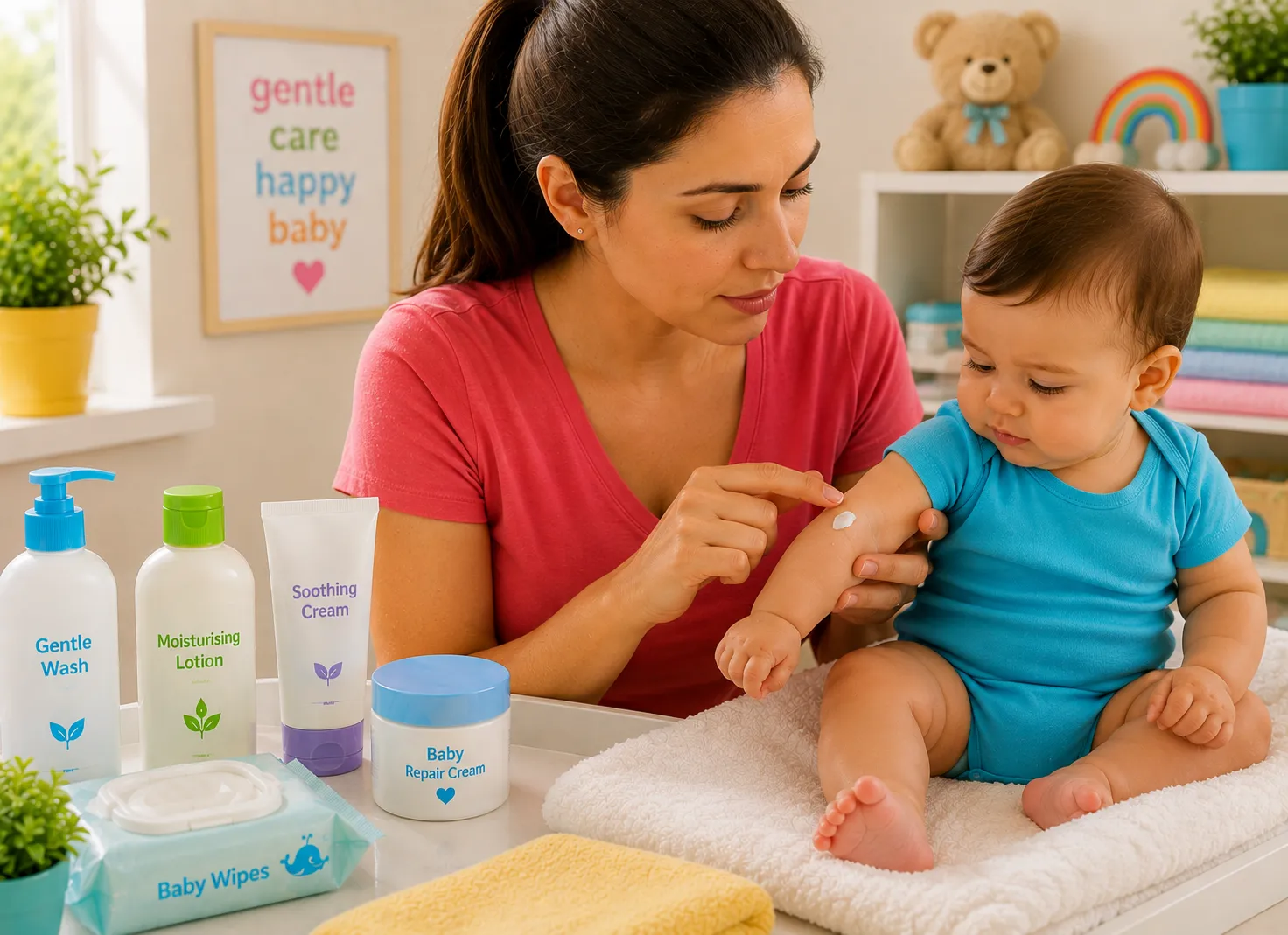
You have bought a new cream, moisturiser, baby wash or other skincare product and you are standing in the bathroom wondering whether you should simply start using it. The label says it is gentle, perhaps it says natural or suitable for babies, and hundreds of other parents may have used it without a problem. But your baby’s skin is individual, and if it is already dry, itchy, irritated or eczema-prone, introducing something new deserves a little more thought.
This is where the idea of a patch test becomes useful. Rather than applying a new leave-on product over a large area immediately, parents can sometimes introduce a small amount to a limited area first and observe what happens. It is a simple precaution, but it is important to understand that a home patch test is not the same thing as medical patch testing performed by a dermatologist.
What Does Patch Testing a Baby Skincare Product Actually Mean?
In everyday skincare language, people often use “patch test” to mean trying a small amount of a new product on a limited area before using it more widely. The idea is straightforward. If the product causes obvious irritation on that small area, you have potentially avoided exposing a much larger area of your baby’s skin.
For a leave-on product such as a moisturiser or cream, this can be particularly useful when a child has a history of reacting to skincare products. However, one comfortable application does not prove that a product can never cause irritation or allergy. Skin responses can depend on repeated exposure, the condition of the barrier and many other factors.
A Home Patch Test Is Not a Medical Allergy Test
This distinction is important. Dermatologists use formal patch testing to investigate allergic contact dermatitis. Specific potential allergens are applied under controlled conditions and the skin is assessed according to a defined testing process.
Trying a small amount of baby moisturiser at home is much simpler. It may help you notice an obvious local reaction before widespread use, but it cannot diagnose contact allergy and it cannot prove that a product is completely allergy-free for your child. Think of it as a cautious introduction rather than a diagnostic test.
Should Every New Baby Product Be Patch Tested?
Not every parent routinely patch tests every shampoo, cleanser or moisturiser they buy. Many babies tolerate appropriately formulated skincare products without difficulty. But there are circumstances where introducing a product cautiously makes particularly good sense.
If your baby already has very dry, itchy, irritated or eczema-prone skin, has reacted to skincare before, or you are introducing a product containing ingredients your child has never encountered, a small-area trial can provide useful information. It can also be sensible when you are changing several parts of a skincare routine and want to know which product the skin tolerates.
The more reactive the skin has been, the stronger the argument for introducing changes one at a time.
Why Baby Skin Deserves a Careful Introduction
Baby skin is not simply adult skin in miniature. During early life, its barrier properties continue to develop, and that barrier plays an important role in controlling water loss and protecting the body from the outside environment. When the barrier becomes very dry or disrupted, skin can become more vulnerable to irritation.
That matters when introducing skincare. The same product can feel perfectly comfortable on intact skin and uncomfortable on skin that has recently been scratched, rubbed or severely dried. The response you see therefore reflects not only what is inside the bottle but also the condition of the skin receiving it.
Where Should You Test a New Baby Cream?
For a leave-on skincare product, choose a small area of intact skin rather than immediately covering the baby’s face or every dry area. Use only a small amount and avoid skin that is broken, bleeding, weeping or severely inflamed. You are trying to see how the skin tolerates the product, not challenge an already damaged area.
Keep the test uncomplicated. Do not apply several new products to the same area because you will not know which one was responsible if something happens. If the skin becomes clearly red, swollen, intensely itchy, blistered or uncomfortable after application, stop using the product.
Why Testing Severely Irritated Skin Can Mislead You
Suppose your baby’s arm has been scratched repeatedly until the surface is raw and then you apply a new moisturiser directly to it. The child cries and the area becomes red. It may be tempting to conclude immediately that the baby is allergic to the moisturiser.
But compromised skin can sting when substances are applied because the protective barrier has already been disrupted. That does not mean the reaction should be ignored, but it does mean that severely damaged skin is not an ideal place for an informal tolerance test. The condition of the test area matters.
How Long Should You Watch the Area?
An immediate reaction is obviously important, but not every skin response appears within minutes. Some irritation can develop gradually, and allergic contact reactions can be delayed. This is one reason a quick ten-minute test followed by widespread application should not be regarded as proof of tolerance.
Observe the area over time and look for changes such as persistent redness, increased itching, swelling, bumps or blistering. When parents know their child has particularly reactive skin, introducing one new leave-on product at a time over several days can make patterns easier to recognise. If you are concerned about a previous allergy or significant reaction, seek professional guidance rather than designing increasingly elaborate home tests.
Don’t Test Five New Products Together
Imagine changing your baby’s body wash, moisturiser, shampoo, wipes and laundry detergent on the same weekend. On Monday the skin becomes red and itchy. You now have five suspects and very little useful information.
Introducing products individually makes it much easier to understand what the skin is telling you. This is especially valuable for children whose skin repeatedly becomes dry or uncomfortable. A simple skincare routine is not only easier to maintain; it can also be easier to investigate when something changes.
What Should You Look for After Applying the Product?
The most obvious things to watch for are persistent redness, swelling, increased itching, bumps, blistering or obvious discomfort. Also pay attention to whether the child begins repeatedly rubbing or scratching the area. Babies cannot tell you that something feels itchy or uncomfortable, so behaviour can sometimes provide useful information.
Do not assume that tingling, redness or burning means a product is “working.” Baby skincare does not need to cause discomfort to be effective. If a product repeatedly makes the skin noticeably worse after application, that deserves attention regardless of how gentle its marketing claims sound.
Does Hypoallergenic Mean You Can Skip the Test?
Not necessarily. Terms such as “hypoallergenic,” “dermatologically tested,” “gentle” or “for sensitive skin” can be useful pieces of product information, but none can guarantee that every individual baby will tolerate every ingredient. Individual biology does not read the front of the packaging.
The ingredient list and formulation matter, but so does your baby’s previous history. If you already know that your child reacts to a particular ingredient, check labels carefully. If reactions keep occurring and you cannot identify the cause, a healthcare professional or dermatologist may be able to investigate further.
What About Products Labelled Natural?
The same principle applies. Natural ingredients can have extremely useful skincare properties, which is one reason plant-derived ingredients form such an important part of our approach to Itch-A-Bye Baby Repair Cream. But natural origin does not make individual sensitivity biologically impossible.
Plants contain complex compounds. That biological activity can be one of the reasons a botanical is interesting in skincare, but it is also why responsible formulation matters. The question should therefore not simply be “Is it natural?” but “Why was this ingredient chosen, how is it being used, and how does my baby’s skin respond to the finished formulation?”
Why Ingredient Choice Matters to Us at Itch-A-Bye
When we developed Itch-A-Bye Baby Repair Cream, we did not want to create another moisturiser whose only function was to temporarily make dry skin feel less dry. We approached the formulation through the broader needs of vulnerable baby and young children’s skin. That thinking eventually became our Repair, Nourish and Defend framework.
Each part addresses a different aspect of the problem. Repair focuses on supporting the skin barrier. Nourish combines hydration with ingredients selected for soothing, conditioning, antioxidant and other skin-supportive properties. Defend recognises the barrier’s protective relationship with environmental and microbial pressures, including bacteria and fungus.
The formulation is therefore deliberately built around ingredient synergy rather than one fashionable hero ingredient.
Why Black Seed Oil Became a Cornerstone Ingredient
Black Seed Oil, derived from Nigella sativa, occupies an important place in our formulation because it offers more than the emollient properties expected from an oil. Its constituents, including thymoquinone, have been investigated for anti-inflammatory, antioxidant and antimicrobial activity. These properties made Black Seed Oil particularly interesting when we were developing a formulation for dry, itchy and easily irritated skin.
The oil also helps condition and soften the skin, so it contributes in several ways rather than having one narrow function. Within our framework, it connects particularly well with both Nourish and Defend. Instead of expecting Black Seed Oil to do everything, however, we combine it with other ingredients whose functions complement it.
Why We Chose MSM
MSM, or methylsulfonylmethane, was selected for another part of the formulation puzzle. It has attracted interest for anti-inflammatory and soothing properties, which made it relevant to our approach to uncomfortable, irritated skin. When dryness leads to itching and itching leads to scratching, simply adding more moisture may not address everything the skin is experiencing.
MSM works alongside rather than instead of the moisturising system. That is an important distinction in the Itch-A-Bye philosophy. We are trying to provide the skin with complementary forms of support rather than asking one ingredient to perform every job.
Why Allantoin Has an Important Role
Allantoin is widely used in skincare for its soothing, conditioning and skin-protective properties. For dry and rough skin, it can help improve the feeling of softness and comfort while supporting the environment in which normal surface recovery takes place. That makes it especially relevant when scratching has added another layer of irritation.
Within Itch-A-Bye, Allantoin fits naturally between Repair and Nourish. It complements the hydration system while adding another form of soothing support. It is not there simply because parents recognise the ingredient name; it has a defined role within the formulation.
Why We Use Both Glycerin and Hyaluronic Acid
Dry skin needs water, but getting water into the outer layers and helping it remain there are different parts of good moisturising formulation. Glycerin and Hyaluronic Acid are humectants, meaning they help attract and retain moisture. Better hydration can help dry skin feel softer, more supple and less tight.
We use them as part of a wider system rather than presenting Hyaluronic Acid as a miracle ingredient. Hydration is important, but dry, itchy and eczema-prone skin can also involve barrier disruption, irritation, scratching and environmental pressures. That is why our Nourish pillar deliberately extends beyond moisturising alone.
Why Vitamins C and E Are Part of the Formula
Vitamin C and Vitamin E derivatives add another dimension through antioxidant and skin-conditioning support. Skin is continually exposed to environmental oxidative stress, so antioxidants have an established place within modern skincare formulation. Vitamin E is also particularly compatible with the oil phase of cosmetic formulations and complements other conditioning ingredients.
Their inclusion again comes back to synergy. We do not expect one vitamin to transform a child’s skin. We want several carefully chosen components supporting different aspects of the skin environment together.
Why We Use a Botanical Complex
Itch-A-Bye also incorporates specially selected plant extracts including Centella asiatica, Chamomile, Licorice, Scutellaria baicalensis, Green Tea, Rosemary, Polygonum cuspidatum and Ginger, among the wider botanical blend. Different plants bring different phytochemicals to the formulation, including flavonoids, polyphenols and other compounds studied for soothing, antioxidant, anti-inflammatory and skin-conditioning properties. We preferred that complementary approach to choosing one fashionable botanical and putting it at the centre of the story.
Centella has a strong reputation in skincare for conditioning and supporting skin recovery, while Chamomile is widely associated with soothing. Licorice contains compounds investigated for calming and anti-inflammatory properties, and Green Tea provides antioxidant polyphenols. Scutellaria, Rosemary, Ginger and Polygonum contribute additional botanical compounds that broaden the overall antioxidant and skin-supporting profile.
This botanical network forms an important part of what we mean by Nourish and Defend. It is also why we take individual tolerance seriously. Biologically interesting plant ingredients should be thoughtfully formulated and introduced with the same observation you would give any other skincare ingredient.
The Formulation Matters More Than Any One Ingredient
Parents increasingly recognise ingredients such as Hyaluronic Acid, Black Seed Oil or Centella, but an ingredient name alone tells you surprisingly little about the quality of a finished product. Concentration matters. Compatibility matters. Stability, preservation, texture and interactions among ingredients matter as well.
A good formulation is an ecosystem. Humectants support hydration, emollient components condition the surface, soothing ingredients help comfort vulnerable skin, antioxidants provide another form of support and carefully selected botanical compounds broaden the formulation. Our intention with Itch-A-Bye is to make these elements work together around Repair, Nourish and Defend.
That is also why patch testing should focus on the finished product, not merely on whether you recognise or approve of every individual ingredient.
Should You Patch Test Itch-A-Bye Baby Repair Cream?
If your baby has particularly reactive skin or a history of reacting to skincare products, cautiously introducing Itch-A-Bye Baby Repair Cream to a small area before broader use is a reasonable approach. Itch-A-Bye was developed for dry, itchy and eczema-prone baby and young children’s skin using all-natural ingredients and carefully selected plant botanicals. But no responsible skincare brand should tell parents that individual reactions are impossible.
Our confidence comes from the formulation philosophy behind the product, not from pretending every baby’s skin is identical. Observe how your child’s skin responds. If the product is well tolerated, you can then incorporate it into the wider routine according to your child’s needs.
Repair, Nourish and Defend Also Helps You Evaluate Products
Patch testing answers one question: Does my baby’s skin appear to tolerate this product on this occasion? The next question should be what the product actually contributes to the routine. That is where Repair, Nourish and Defend becomes a useful way of thinking.
Does the formulation support the dry skin barrier? Does it provide meaningful hydration and other nourishing support? Does it consider the skin’s protective environment rather than repeatedly stripping it? These questions can help parents look beyond advertising phrases such as “ultra gentle” and understand what they actually want a skincare product to accomplish.
The Skin Threshold Model Explains Why a Test Isn’t a Lifetime Guarantee
There is another reason a successful small-area test cannot guarantee that a product will always be tolerated. In Beyond the Skin Barrier, we describe the Skin Threshold Model, which looks at the cumulative pressures acting on vulnerable skin. A child’s skin may tolerate a product comfortably when the overall pressure is low and respond differently when several other pressures have accumulated.
Heat, sweat, swimming, dry weather, saliva, frequent washing, friction and scratching can all change the condition of the barrier. A product tested comfortably today may therefore be applied to very different skin several months later. This does not automatically mean the product suddenly became harmful; the environment receiving it may have changed.
That is why observation should continue after the patch test ends.
Don’t Keep Re-Testing Something That Caused a Significant Reaction
There is an important difference between cautiously introducing a new moisturiser and repeatedly challenging the skin with something that has already caused an obvious reaction. If a product produces substantial swelling, blistering, widespread redness or significant discomfort, do not keep applying it at home simply to confirm your suspicion. Stop using it and seek appropriate advice.
This is particularly important if you suspect an allergy. Formal investigation of allergic contact dermatitis belongs with healthcare professionals who can determine whether medical patch testing is appropriate. A bathroom experiment cannot replace that process.
When Should You Seek Medical Advice?
Seek professional advice when a baby’s skin repeatedly reacts to products and you cannot identify why, when the reaction is persistent or spreading, or when itching and discomfort are substantial. Skin that becomes increasingly painful, hot, swollen, weeping, blistered or crusted also deserves assessment. Those signs can indicate that something more than simple dryness is happening.
Urgent medical attention is appropriate for breathing difficulty, facial or mouth swelling, widespread hives, collapse or a baby who appears seriously unwell. Do not attempt to investigate a potentially serious allergic reaction by applying the suspected product again. Those situations require appropriate medical care.
Frequently Asked Questions
What is the easiest way to patch test a new baby cream?
For an informal tolerance check, apply a small amount to a limited area of intact skin rather than immediately covering a large area. Avoid broken, severely irritated or weeping skin. Observe the area rather than adding several other new products. Remember that this is a cautious introduction, not a medical allergy test.
How long should I wait after patch testing?
Do not assume that ten or twenty minutes without redness guarantees tolerance. Some reactions are delayed, so continue observing the area over the following days when introducing a new leave-on product. If your child has a history of significant reactions, ask a healthcare professional for personalised guidance rather than relying solely on home testing.
Can a product pass a patch test and still cause a reaction later?
Yes. The condition of the skin can change, repeated exposure can matter, and some allergic reactions require previous sensitisation. A small test also does not reproduce every circumstance in which the product may later be used. Passing an informal patch test therefore reduces uncertainty rather than eliminating it.
Should I patch test natural baby products?
You can use the same cautious approach regardless of whether a product is described as natural or synthetic. Natural ingredients can provide valuable skincare functions, but individual sensitivities can still occur. The finished formulation and your baby’s response matter more than a marketing category.
Should I test a new product directly on the eczema-prone area?
If the area is severely inflamed, scratched, broken or weeping, it is not a good location for an informal tolerance test. Compromised skin may sting or react differently because its barrier is already disrupted. Choose intact skin for a cautious introduction and seek professional advice for severe or persistent skin problems.
Does hypoallergenic mean my baby cannot react?
No. No skincare label can guarantee universal tolerance. “Hypoallergenic” does not mean biologically incapable of causing a reaction in every individual. Your baby’s history and actual response remain important.
Can I patch test several creams at the same time?
Introducing multiple products simultaneously can make interpretation difficult, particularly if irritation develops. When you are dealing with reactive skin, simplicity provides better information. Introducing one new product at a time makes it easier to identify patterns.
Why might my baby tolerate a cream during the test but react weeks later?
Skin does not remain in exactly the same condition. Heat, sweat, illness, swimming, weather, scratching and repeated washing can change barrier integrity, while sensitisation to certain substances can develop after previous exposure. The Skin Threshold Model helps explain why tolerance at one moment does not guarantee exactly the same response under every future condition.
Should I patch test Itch-A-Bye?
For a baby with a history of highly reactive skin, introducing Itch-A-Bye to a small area first is a sensible precaution. Our formulation combines Black Seed Oil, MSM, Allantoin, Hyaluronic Acid, Glycerin, vitamins and carefully selected plant botanicals around Repair, Nourish and Defend. Despite that careful ingredient selection, every baby’s skin is individual and should be observed accordingly.
A Patch Test Is a Starting Point, Not the Whole Answer
Patch testing can be a useful way of introducing a new baby skincare product cautiously, particularly when you already know that your child’s skin is reactive. But it should not become a false guarantee. A small-area test cannot diagnose allergy, predict every future reaction or account for every change that may occur in the skin barrier.
The bigger goal is to understand your baby’s skin rather than simply accumulate products. Introduce changes thoughtfully, keep the routine manageable and pay attention to patterns. Then look beyond the front of the jar and ask what the formulation is actually designed to do.
That philosophy is why we created Itch-A-Bye around Repair, Nourish and Defend, and why Beyond the Skin Barrier looks beyond individual triggers to the wider pressures acting on developing skin. Sometimes the most useful skincare decision begins not with applying more, but with observing more carefully.