
Should You Use Soap on a Baby With Dry Skin?
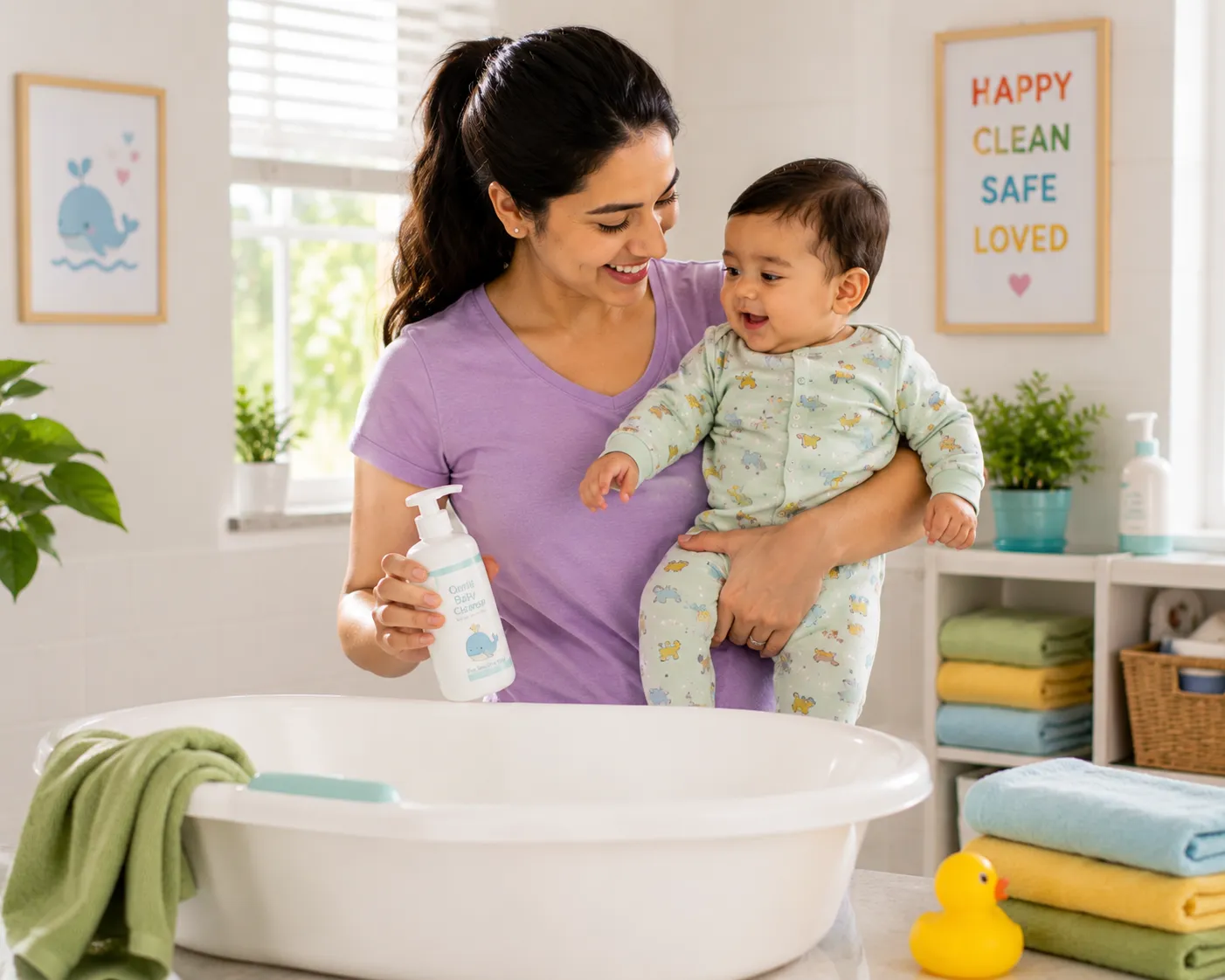
Bath time is supposed to be one of the simplest parts of caring for a baby. Warm water, a little baby wash, a soft towel, clean pyjamas and perhaps a cuddle before bed. But when your baby has dry, itchy or eczema-prone skin, even something as ordinary as washing them can suddenly become another thing you worry about. You may notice their skin looks comfortable before the bath but becomes tighter, rougher or itchier afterwards.
That can leave parents wondering whether they should stop using soap altogether. Others go in the opposite direction and worry that water alone will not properly clean their baby’s skin, particularly around the nappy area, neck folds and anywhere sweat, food or saliva accumulates. Then there are supermarket shelves full of products labelled baby, gentle, natural, sensitive and dermatologically tested, which can make what should be a simple decision even more confusing. So, should you use soap on a baby with dry skin?
The short answer is that traditional soap is usually not the best choice for a baby whose skin is already dry or eczema-prone. Babies still need to be cleaned, but cleaning the skin and repeatedly stripping it are not the same thing. For many babies, the better approach is to use plain lukewarm water for much of the body and, when a cleanser is actually needed, choose a mild soap-free product designed for delicate skin. The bigger question, however, is what happens to your baby’s skin before, during and immediately after the bath.
Why Soap Can Be a Problem for Already-Dry Baby Skin
To understand why, it helps to stop thinking about your baby’s skin as simply a surface that needs washing. The outermost layer of skin is part of an active protective barrier. It helps keep water inside the body while limiting the penetration of irritants and other environmental pressures from outside. Traditional soaps are very good at removing oils and dirt, but when skin is already dry and its barrier is vulnerable, aggressive cleansing can remove some of the surface lipids that help the skin retain moisture.
There is another consideration: pH. Healthy skin normally maintains a mildly acidic surface environment, sometimes called the acid mantle. Traditional soaps tend to be alkaline, and repeated exposure can temporarily raise the skin’s surface pH. That matters because skin pH is connected with several barrier functions, including enzymes involved in maintaining the outer layer of skin.
For a baby whose skin is already dry, repeatedly disrupting that environment may be one pressure the skin simply does not need. The goal is not to avoid cleanliness. It is to clean without unnecessarily stripping an already vulnerable barrier. That distinction becomes particularly important when bathing is part of a daily routine.
But Doesn’t My Baby Need Soap to Get Clean?
This is where the conversation needs some common sense. A baby does not spend the day repairing engines, digging gardens or working on a construction site. Much of what needs removing from a baby’s skin is sweat, saliva, milk, food residue, nappy-area contamination and whatever they collect during ordinary play. You do not necessarily need to lather your baby’s entire body with cleanser every time they have a bath.
There are obviously areas where more thorough cleaning may sometimes be appropriate. The nappy area, hands, skin folds and areas contaminated with food, faeces or other material deserve proper attention. But that does not mean every square centimetre of already-dry skin needs to be repeatedly degreased. Clean what needs cleaning and be gentler with what doesn’t.
“Baby Soap” Does Not Automatically Mean Gentle
This catches many parents out. A product can have a smiling baby on the bottle, pastel packaging and the word gentle written across the front without necessarily being ideal for your particular child’s dry skin. Marketing language and formulation are not the same thing. What matters is what the cleanser actually does when it meets your baby’s skin.
Some products cleanse more aggressively than others. Fragrance can also be unnecessary for babies whose skin is easily irritated, and products producing enormous amounts of foam are not automatically cleaning the skin more appropriately. In fact, the psychological association between bubbles and cleanliness can encourage parents to use considerably more cleanser than is necessary. For dry and eczema-prone skin, more cleansing is not necessarily better cleansing.
What Should You Use Instead?
For routine bathing, lukewarm water may be sufficient for much of your baby’s body. When a cleanser is needed, a mild, soap-free, fragrance-free cleanser designed for delicate or eczema-prone skin is generally a more sensible option than traditional alkaline soap. Use a small amount rather than assuming the baby needs to be covered in foam. Then pay attention to your baby’s skin afterwards.
Does it feel comfortable and supple, or does it suddenly look dull, tight and dry? Does your baby begin rubbing or scratching after the bath? Do particular areas repeatedly become redder? A cleanser that sounds perfect on the label but repeatedly leaves your child’s skin uncomfortable may simply not be the right cleanser for that child.
The Temperature of the Water Matters Too
Sometimes soap gets blamed for everything when the bath itself is adding several pressures at once. Very warm water can feel wonderful to an adult, particularly during winter, but a baby’s bath does not need to be hot. Prolonged exposure to warm water can contribute to dryness, and a baby who becomes hot during or immediately after bathing may also become itchier. A comfortably lukewarm bath is usually a better starting point.
Length matters as well. Bath time does not need to become a twenty or thirty-minute soak every night for a baby whose skin becomes increasingly dry in water. Keep the bath reasonably short, clean what needs cleaning and move on to the part many parents underestimate. What you do after the bath can be just as important as the bath itself.
Please Don’t Rub the Skin Dry
When bath time finishes, there is a temptation to wrap your baby in a towel and give them a good rub. For robust adult skin, that may not matter much. For already-dry, eczema-prone baby skin, vigorous towel drying adds another source of friction. If the skin is already itchy, that friction can also stimulate more rubbing and scratching.
Instead, gently pat the skin. You do not need to leave your baby dripping wet, but neither do you need to polish the skin dry. Treat the towel as something that absorbs excess water rather than something used to scrub the surface. Then move quickly to skincare.
The Few Minutes After the Bath Matter
This is where bath time can either become one isolated event or part of a complete skin-support routine. Once your baby leaves the water, evaporation begins. If the skin is already prone to losing moisture, allowing it to dry completely before applying skincare can leave it feeling increasingly tight. Applying an appropriate moisturising or barrier-supporting product soon after gently patting the skin dry can help retain hydration.
This is sometimes called soak and seal. But for us, this is also where an important distinction begins. If your baby’s skin repeatedly becomes dry, itchy and uncomfortable despite moisturising after every bath, perhaps the question should not simply be, “Do I need a stronger moisturiser?” Perhaps it should be, “Does vulnerable skin need support beyond moisture alone?”
Moisture Is Important. But Dry, Itchy Skin May Need More Than Water.
Most ordinary moisturisers are primarily designed around a straightforward objective: increase hydration and reduce water loss. There is nothing wrong with that, because hydration is fundamental to supporting dry skin. But look at what your baby’s skin may have just experienced during an ordinary day. There may have been dryness, saliva, food, wiping, heat, sweat, clothing friction, crawling, scratching, bathing and exposure to the microorganisms naturally present on skin and throughout the environment.
That is considerably more complicated than simply “the skin needs water.” This is one of the reasons we developed Itch-A-Bye around a broader formulation philosophy. We wanted to think about vulnerable skin as a protective system facing several different pressures rather than treating dryness as the only consideration. That thinking eventually became Repair, Nourish and Defend.
Why We Think About Repair, Nourish and Defend
When we formulated Itch-A-Bye Baby Repair Cream, we did not begin by asking how many fashionable ingredients we could put on the label. We asked a different question: What kinds of topical support make sense for dry, itchy, repeatedly challenged baby skin? That question led us to three complementary functions: Repair, Nourish and Defend. Importantly, the ingredients were selected to work together rather than relying on one so-called miracle ingredient.
This ingredient philosophy becomes particularly relevant after bathing. The bath has just exposed the skin to water, cleansing and drying, and now we have an opportunity to give something back. Some ingredients primarily support hydration, while others bring soothing, conditioning, antioxidant, anti-inflammatory or antimicrobial-related properties. The formulation philosophy is about combining those different roles into one complementary system.
REPAIR: Support the Barrier You Have Just Cleaned
The first objective is straightforward: help support the physical barrier. Dry skin loses water more easily, and repeated scratching, friction and cleansing can add further pressure. This is why hydration and skin-conditioning ingredients remain fundamental to Itch-A-Bye. Hyaluronic Acid helps attract and retain water, while Glycerin acts as an important humectant.
Together they help address one of the most obvious things dry skin needs after bathing: hydration. But we deliberately did not stop there. Allantoin was selected because it is widely valued as a soothing and skin-conditioning ingredient and has also been investigated in skin-recovery contexts. Centella asiatica brings a different dimension, with its naturally occurring compounds extensively researched in relation to skin recovery, inflammatory pathways, antioxidant activity and processes involved in maintaining skin structure.
Each ingredient has a reason for being there. Hydration supports one aspect of the barrier, while soothing and conditioning ingredients contribute different forms of support. We are not looking for one ingredient to perform every job. We are building a formulation in which the ingredients complement one another.
NOURISH: This Is Where Our Philosophy Goes Beyond Moisturising
When we say Nourish, we do not simply mean adding more water to the skin. We mean providing vulnerable skin with a deliberately selected mixture of oils, humectants, vitamins, skin-conditioning ingredients and botanical extracts with different but complementary properties. Some support hydration, some have soothing properties, some provide antioxidant support, and others contain constituents studied for anti-inflammatory or antimicrobial activity. This is where Black Seed Oil, Nigella sativa, becomes particularly important to our formulation philosophy.
Black Seed Oil is not simply another oil added to make the cream feel richer. It contains numerous biologically active compounds, most notably thymoquinone, and has attracted substantial scientific interest for its anti-inflammatory, antioxidant and antimicrobial properties. That makes it fundamentally different from an ingredient whose primary contribution is moisturisation. We selected it because vulnerable skin exists in a complicated environment.
Then There Is MSM
MSM, methylsulfonylmethane, brings another set of properties to the formulation. It has been studied particularly in relation to anti-inflammatory and antioxidant activity. Again, this does not mean we expect MSM to perform every job required by dry or eczema-prone skin. That would defeat the entire purpose of building a synergistic formulation.
Instead, MSM contributes something different from Hyaluronic Acid. Hyaluronic Acid contributes strongly to hydration, MSM brings another form of supportive activity, and Black Seed Oil brings another profile again. Different ingredients. Different strengths. One formulation. That is what we mean by Nourish.
Allantoin Is There for a Reason Too
Allantoin sometimes receives less attention because it is not currently one of the fashionable skincare ingredients dominating social media. But we like it precisely because of what it contributes to the formulation. Allantoin is widely used for its soothing and skin-conditioning properties and has been investigated in contexts involving skin recovery and wound healing. For skin that is dry, uncomfortable or repeatedly subjected to scratching and friction, those characteristics make sense within our broader formulation philosophy.
Again, the important point is not that Allantoin works alone. It works alongside Black Seed Oil, MSM, Hyaluronic Acid, Glycerin, vitamins and the botanical complex. Every ingredient does not need to perform the same function. That complementary relationship is where the formulation becomes more interesting.
Our Botanical Extracts Were Not Added Just So We Could Say “Natural”
There is a tendency in skincare marketing to create a long list of botanical extracts because consumers like seeing plant names. That was not our objective. We selected botanicals because different plants contain different naturally occurring compounds with properties that complement the wider formulation. Chamomile has a long history of topical use and research around soothing and anti-inflammatory activity.
Centella asiatica has attracted significant research interest around skin recovery and inflammatory pathways, while Green Tea provides polyphenols with well-documented antioxidant and anti-inflammatory properties. Licorice contains constituents studied for anti-inflammatory and antimicrobial activity. Scutellaria baicalensis contains flavonoids including baicalin and baicalein that have been investigated for antioxidant, anti-inflammatory and antimicrobial properties. Then we have Rosemary, Ginger and Polygonum cuspidatum, each contributing its own phytochemical profile.
We are not claiming every botanical does exactly the same thing. Quite the opposite. We selected them because they don’t. The purpose is to create complementary support rather than an ingredient list filled with duplicates performing essentially the same job.
Synergy Is the Point
Imagine an orchestra consisting entirely of twenty violinists. They might produce something beautiful, but they cannot create the same range as an orchestra containing strings, brass, woodwind and percussion. Different instruments contribute different things to the finished piece. That is broadly how we think about Itch-A-Bye.
Hyaluronic Acid does not need to do what Black Seed Oil does. Black Seed Oil does not need to do what Allantoin does. MSM does not need to replace Centella, and the botanical extracts do not need to replace the humectants. Their value comes from complementing one another.
This is why we are reluctant to describe Itch-A-Bye as simply another moisturiser. Moisturising is one part of what the formulation is designed to support. The ingredient system is deliberately broader because vulnerable skin itself is dealing with more than one pressure at a time. The formulation, rather than one hero ingredient, is the strategy.
DEFEND: Because Bathing Doesn’t Put Your Baby Into a Sterile World
The moment your baby leaves the bath, their skin goes straight back into the real world. Pyjamas touch it, bedding touches it and tiny hands touch it. Saliva, sweat, food, dust and everything else involved in normal childhood eventually touch it. Importantly, skin itself naturally exists alongside enormous communities of microorganisms.
Healthy skin is not sterile, nor should it be. But when the skin barrier is dry, irritated or repeatedly scratched, we believe it makes sense to consider the skin’s protective environment as part of the formulation philosophy. This is the Defend pillar. It complements Repair and Nourish rather than replacing them.
Why Our Ingredient Choices Matter to Defend
Several ingredients in Itch-A-Bye contain constituents that have been studied for antimicrobial activity. Black Seed Oil has research relating to antibacterial and antifungal activity as well as its anti-inflammatory and antioxidant properties. Scutellaria, Licorice, Rosemary and Ginger also contain compounds investigated for various antimicrobial properties. These ingredient characteristics give the Defend pillar a deliberate formulation basis.
That does not mean Itch-A-Bye is an antibiotic, antifungal medicine or treatment for an established skin infection. It means that when selecting ingredients for vulnerable skin, we deliberately considered more than hydration. Repair addresses the barrier, Nourish provides multiple forms of topical support, and Defend recognises that skin remains the body’s interface with bacteria, fungi and other environmental pressures. We designed the formulation so those three ideas could work together.
So What Should Bath Time Actually Look Like?
It does not need to become complicated. Use comfortably lukewarm water, keep the bath reasonably short and use water alone where that is sufficient. When cleansing is needed, choose a mild soap-free product rather than repeatedly washing dry skin with traditional soap. Clean the areas that genuinely need cleaning rather than assuming your baby’s entire body needs heavy lather every night.
When the bath is finished, gently pat rather than rub the skin. Then apply your baby’s skincare promptly. If you are using Itch-A-Bye Baby Repair Cream, this is one of the times we think its formulation philosophy makes particular sense: after cleansing, when you want to put supportive ingredients back onto skin that has just been exposed to water and washing. Bath time can then become part of the skin-support routine rather than something that repeatedly leaves the skin feeling stripped.
What If My Baby Still Gets Dry After Every Bath?
That is information worth paying attention to. Look first at the obvious things. Is the water too warm, is the bath too long, are you using more cleanser than necessary, or is the product fragranced or leaving the skin feeling tight? Then consider what happens afterwards.
Is skincare being applied promptly, or is the skin allowed to dry completely first? Is your baby immediately dressed in heavy clothing and becoming hot? Are they scratching particular areas after bathing? Sometimes there is no single dramatic mistake, and several small pressures may simply be adding up.
This Is Where the Skin Threshold Model Helps Again
Think of your baby’s skin as having a threshold. Perhaps the skin begins the evening slightly dry. Warm bath water adds some pressure, cleanser adds another, towel friction adds another, then warm pyjamas cause your baby to become hot. None of those things necessarily creates a problem alone.
Together, they may be enough to push already-vulnerable skin beyond its comfortable threshold. That is why changing just one part of bath time can sometimes produce a surprisingly noticeable difference. Shorten the bath, lower the temperature slightly, use less cleanser and pat instead of rub. Apply skincare promptly and keep your baby comfortably cool afterwards.
You are reducing pressure from several directions rather than desperately searching for one villain. This is the practical value of thinking about the whole environment around the skin. Bathing, cleansing, drying and after-bath skincare all become parts of the same system. Small changes can therefore work together just as small pressures can add up.
Should You Stop Bathing a Baby With Dry Skin?
Usually, the better question is not whether bathing itself is good or bad. It is how you are bathing. Bathing removes dirt, sweat, saliva, allergens and other substances from the skin. It can also be calming and an enjoyable part of family life.
The problem arises when bath time repeatedly becomes a combination of hot water, aggressive cleansing, prolonged soaking, vigorous towel drying and delayed moisturising. Change the process before automatically abandoning the bath. Your baby’s skin may tolerate bathing perfectly well when the routine is designed around protecting rather than stripping the barrier. The details of the routine matter.
And Should You Use Soap?
For a baby with persistently dry or eczema-prone skin, traditional soap would not be our first choice for routine whole-body cleansing. Use water where water is sufficient. When cleanser is needed, choose something mild and soap-free, use only what is necessary and pay attention to how your baby’s skin responds. But most importantly, do not think of bath time as ending when your baby leaves the water.
For dry, itchy and eczema-prone skin, the after-bath routine matters enormously. That is when hydration can be replenished, the barrier supported and carefully selected topical ingredients applied. It is also an opportunity to reduce some of the pressures the skin has just experienced. This is why we see cleansing and after-bath skincare as parts of one continuous routine.
Bath. Pat. Repair. Nourish. Defend.
Perhaps that is the easiest way to remember it. Bathe gently with lukewarm water and avoid unnecessary stripping. Pat gently to reduce friction rather than rubbing vulnerable skin dry. Then think beyond simply replacing the water the skin has lost.
Repair. Nourish. Defend. Repair by supporting the vulnerable barrier. Nourish with hydration plus ingredients selected for complementary soothing, conditioning, antioxidant, anti-inflammatory and other supportive properties. Defend by recognising that your baby’s skin immediately returns to a world containing bacteria, fungi and countless other environmental pressures.
That is the philosophy behind Itch-A-Bye Baby Repair Cream. When your baby’s skin is already dry, itchy and easily irritated, the goal should not simply be to wash it clean and put some moisture back. The goal is to clean it gently, reduce unnecessary pressure and then give vulnerable skin broader support for everything it has to do next. And that can make bath time a much more thoughtful part of caring for dry, eczema-prone baby skin.