
The Three-Minute Rule After Baby’s Bath: Does It Matter?
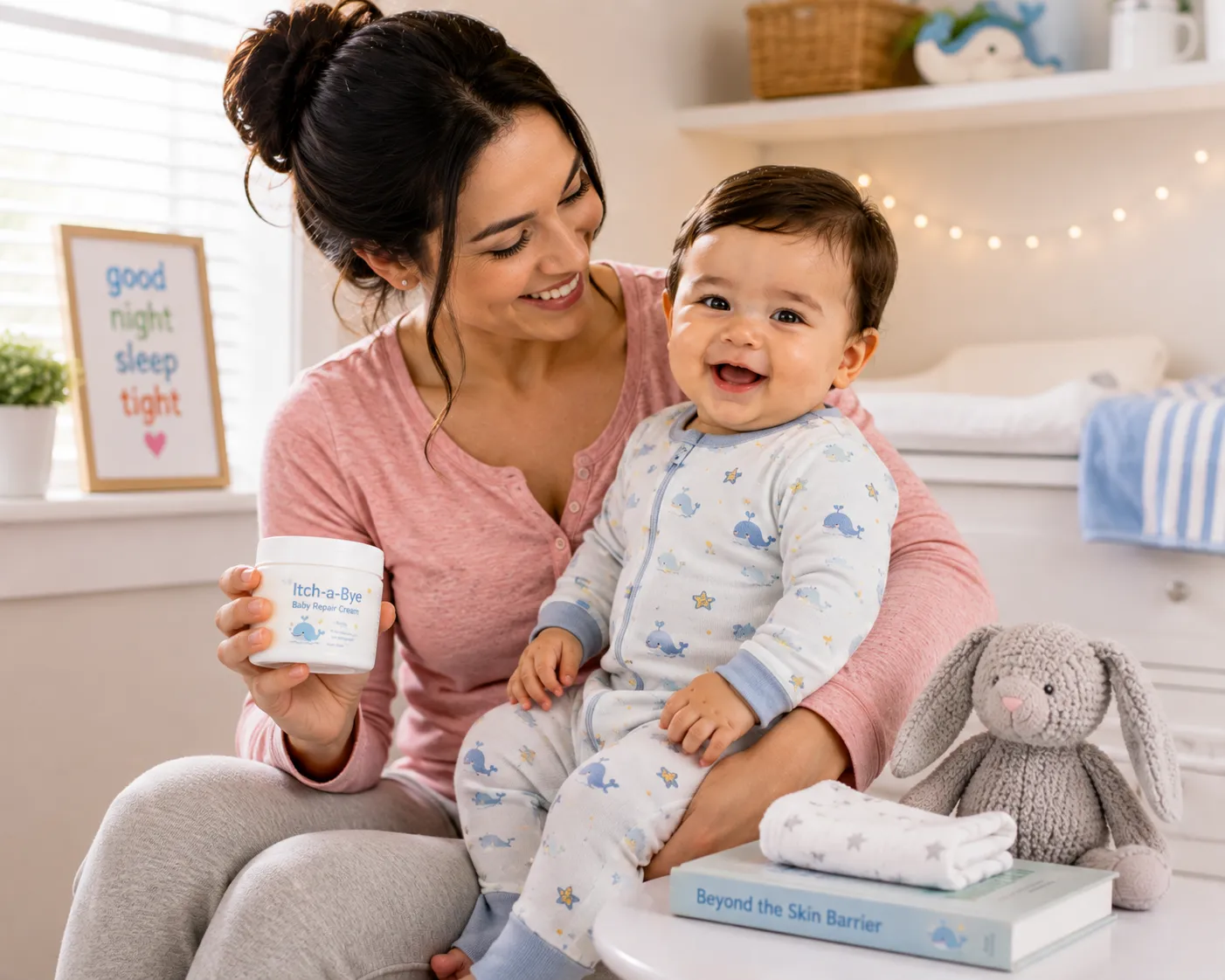
Bath time is finished. Your baby is wrapped in a towel, perhaps already wriggling, crying or trying to escape while you search for a nappy, pyjamas and the cream you thought you had left beside the changing table. In the middle of all this, parents of babies with dry, itchy or eczema-prone skin are sometimes told that they should moisturise their baby within three minutes of leaving the bath. It can sound strangely precise, almost as though minute four means you have missed your opportunity.
So does the three-minute rule really matter? The principle behind it matters more than the stopwatch. Applying an appropriate moisturising or skin-support product soon after bathing, while the skin is still slightly damp, can help reduce the amount of water lost as the skin dries. But if you apply it after four, five or even several minutes, that does not mean the entire routine has suddenly become useless.
What Is the Three-Minute Rule?
The three-minute rule is a simple skincare idea: after bathing, gently pat away excess water and apply moisturiser promptly rather than allowing the skin to become completely dry first. You may also hear this described as “soak and seal.” The bath provides water to the outer skin, and the product applied afterwards helps reduce the loss of that moisture. For skin that struggles to retain water effectively, the logic is easy to understand.
The number three gives parents an easy rule to remember, but it should not become another source of anxiety. Your baby does not have an invisible timer counting down from 180 seconds. What matters is the sequence: bathe gently, pat gently and support the skin reasonably soon afterwards. That is the useful lesson hidden inside the three-minute rule.
Why Can Skin Feel Dry After a Bath?
It seems contradictory that skin can become dry after being surrounded by water. During bathing, the outermost layers of the skin absorb some water and temporarily become more hydrated. Once your baby leaves the bath, however, water begins evaporating from the skin surface. If nothing is applied afterwards, that temporary hydration can disappear relatively quickly.
This can be particularly noticeable when the skin barrier is already vulnerable. Babies with dry or eczema-prone skin may not retain moisture as effectively as comfortable, intact skin. Hot water, prolonged bathing, strong cleansers and vigorous towel drying can add still more pressure. The bath itself is therefore only one half of the routine; what happens immediately afterwards matters too.
Why Slightly Damp Skin Can Be Useful
After the bath, you do not need to rub your baby’s skin until it feels completely dry. Instead, gently pat away the obvious water with a soft towel while leaving larger exposed areas slightly damp. This creates a useful moment to apply the skincare product you normally use. The idea is not to trap pools of water underneath cream, but to work with the residual moisture already present on and within the outer skin.
There is an important distinction here. Areas such as the neck folds, behind the ears, armpits and groin should not remain persistently wet because trapped moisture and friction can create their own problems. Dry those folds carefully while remaining gentle with the surrounding skin. Slightly damp skin can be useful; persistently wet skin folds are something different.
Does It Have to Be Exactly Three Minutes?
No. There is no biological switch that suddenly flips at three minutes and makes moisturising ineffective. The practical message is simply that you should not routinely leave vulnerable skin exposed for a long period after bathing while it progressively dries out. If you can apply your baby’s skincare within a few minutes, that is a sensible routine.
This distinction matters because parents already have enough to worry about. If your baby needs a nappy immediately, is crying, needs feeding or simply refuses to cooperate, deal with your baby rather than staring at the clock. Apply the skincare product when you can and continue with your evening. Consistency over weeks and months is likely to matter far more than whether tonight’s application happened at two minutes and forty seconds or five minutes.
Think “Promptly,” Not “Perfectly”
A better way to remember the rule may simply be: do not unnecessarily delay. Have the towel, nappy, skincare product and clothing ready before the bath whenever possible. Once your baby comes out, wrap them comfortably, gently pat the skin and apply the product before moving on to everything else. That makes the routine easier without turning it into a military operation.
Preparation can make an enormous difference when you are dealing with a tired baby at the end of the day. Put everything within reach before you start the bath so you are not searching through drawers afterwards. You can even leave the cream beside the towel as a visual reminder. The best skincare routine is usually the one that is simple enough to repeat consistently.
The Three-Minute Rule Cannot Fix an Aggressive Bath Routine
Applying moisturiser quickly does not cancel out everything that happened during the bath. If the water was very hot, the bath lasted a long time, a strongly fragranced cleanser was used and the skin was vigorously rubbed with a towel afterwards, applying cream within three minutes does not magically erase those pressures. The whole routine needs to work together. This is especially important when your baby’s skin is already dry, itchy or eczema-prone.
Think of bathing as a sequence rather than a collection of unrelated steps. Use comfortably lukewarm water, keep cleansing gentle, rinse products properly and pat rather than rub when drying. Then apply your chosen skincare product promptly. The three-minute rule works best as part of a gentle routine, not as a rescue operation after a harsh one.
The Towel Matters More Than Many Parents Realise
The few minutes after bathing are not only about moisturising. They are also the moment when many babies experience one of the most vigorous parts of the entire routine: towel drying. Rubbing a rough towel repeatedly across already vulnerable skin creates mechanical friction. If your baby has been scratching, some areas may already be particularly sensitive.
Instead of scrubbing the skin dry, press or pat the towel gently against it and allow the fabric to absorb the water. Move systematically around the body while paying particular attention to folds. Then move directly into the after-bath skincare step. A three-minute moisturising rule makes much more sense when the three minutes themselves are gentle.
What If My Baby Starts Scratching Straight After the Bath?
That pattern deserves attention. Some babies seem comfortable in the water but begin rubbing or scratching their skin shortly after they come out. The immediate assumption may be that they need more moisturiser, but several things could be contributing. Water temperature, cleanser residue, towel friction, rapidly drying skin, clothing and overheating can all occur within the same short period.
Watch what happens rather than looking only at the final rash. Does scratching begin during towel drying or only after pyjamas go on? Does it happen after shampoo nights but not other nights? Does the neck become itchy after hair washing? Patterns can sometimes tell you more than endlessly changing products without understanding what is happening around them.
This Is Where the Skin Threshold Model Becomes Useful
Our Skin Threshold Model provides another way to think about the three-minute rule. Imagine your baby’s skin has a changing threshold for how much pressure it can comfortably tolerate. Dryness may already be present before the bath, while warm water, cleanser, shampoo, friction and evaporation can add further pressures. Clothing, heat and scratching may then arrive immediately afterwards.
One of those factors may not explain everything by itself. The problem may be the cumulative effect when several pressures arrive together and push vulnerable skin beyond its threshold. Prompt after-bath skincare cannot remove every pressure, but it can become one way of supporting the skin during that transition. The objective is not a perfect, pressure-free life; it is greater resilience and fewer unnecessary pressures.
Moisturising Is Important, but We Think the Conversation Should Go Further
If your baby’s skin is dry, hydration matters. That is why humectants and moisturising ingredients remain an important part of skincare for dry and eczema-prone skin. But when we developed Itch-A-Bye Baby Repair Cream, we did not want to think about the skin only as something that needed more water. Vulnerable skin is dealing with much more than dehydration.
It is interacting with scratching, friction, heat, environmental exposures and microorganisms while maintaining a physical protective barrier. That led us to develop Itch-A-Bye around our broader Repair, Nourish and Defend philosophy. The three functions overlap and support one another rather than behaving as three isolated steps. For us, the minutes after bathing are an opportunity not simply to moisturise, but to give vulnerable skin broader topical support.
REPAIR: Supporting the Barrier After Bathing
The first objective is to support a barrier that may already struggle to retain moisture. Hyaluronic Acid and Glycerin contribute to this part of the Itch-A-Bye formulation because of their ability to attract and retain water. Applying the cream while the skin is still slightly damp fits naturally into this hydration-supporting role. But our concept of Repair extends beyond hydration alone.
We also use Allantoin, an ingredient valued for its soothing and skin-conditioning properties and studied in skin-recovery contexts. Centella asiatica brings naturally occurring compounds investigated in relation to skin recovery, inflammatory pathways and antioxidant activity. Different ingredients therefore contribute different forms of support. Repair is about helping create better conditions for a vulnerable physical barrier rather than simply making the skin feel wet.
NOURISH: Much More Than Hydration
When we use the word Nourish, we mean something much broader than moisturising. Vulnerable skin benefits from water, but our formulation philosophy also considers conditioning oils, vitamins, soothing ingredients, antioxidants and botanicals with diverse supportive properties. These ingredients were selected to work together rather than simply repeat the same function. Hydration is one part of Nourish, not its complete definition.
This distinction becomes particularly important after bathing. Your baby’s skin has just experienced water, temperature changes, cleansing and drying and is about to encounter clothing, bedding, friction, heat and perhaps scratching. We wanted the formulation to provide several forms of topical support during that transition. Nourish means giving vulnerable skin a deliberately selected combination of ingredients that hydrate, condition, soothe and provide complementary supportive properties.
Black Seed Oil Brings Something Different
One of the ingredients central to Itch-A-Bye is Black Seed Oil, Nigella sativa. Black Seed Oil contains naturally occurring bioactive compounds including thymoquinone, and research has investigated the ingredient for anti-inflammatory, antioxidant and antimicrobial properties. Those properties make its role very different from an ingredient whose primary purpose is attracting water. This is exactly why ingredient diversity matters within our formulation.
We do not expect Black Seed Oil to do everything by itself. Hyaluronic Acid and Glycerin have particular strengths, while Allantoin, MSM, vitamins and botanical extracts contribute others. The purpose is to bring complementary properties together in one formulation. Itch-A-Bye was designed as a team of ingredients rather than a product built around one fashionable hero ingredient.
Why We Include MSM
MSM, or methylsulfonylmethane, adds another dimension to the formulation. It has been studied for anti-inflammatory and antioxidant activity, which made it particularly interesting to us when thinking about skin repeatedly exposed to irritation and scratching. Its role is therefore different from that of a conventional humectant. That difference is exactly what we want.
A good formulation does not require every ingredient to perform the same task. If every player on a football team were a goalkeeper, the team would not become stronger simply because it had more goalkeepers. In the same way, we selected ingredients that bring different strengths and can complement one another. Synergy, rather than duplication, sits at the centre of our Nourish philosophy.
Our Botanical Complex Adds Another Layer
Itch-A-Bye also contains a deliberately selected complex of botanical extracts. Chamomile has been studied for soothing and anti-inflammatory properties, while Green Tea contains polyphenols widely investigated for antioxidant and anti-inflammatory activity. Licorice contains constituents researched across anti-inflammatory and antimicrobial areas, while Scutellaria baicalensis provides flavonoids that have attracted considerable scientific interest. These plants do not all contribute exactly the same profile.
Other botanicals within the formulation, including Rosemary, Ginger and Polygonum cuspidatum, provide additional plant compounds and overlapping areas of research. We do not claim that every botanical performs every possible function. Their value lies in bringing different properties into the broader formulation. This is what we mean when we talk about nourishing skin through ingredient synergy rather than hydration alone.
DEFEND: Because Skin Does Not Live in Isolation
Your baby’s skin is constantly interacting with the outside world. Clothing rubs against it, hands touch it, saliva reaches the face and neck, sweat collects in folds and microorganisms naturally occupy the skin surface. Healthy skin is not sterile, and our objective is not to make it sterile. But the skin’s role as a protective interface remains enormously important.
This is where Defend completes our framework. Black Seed Oil and several botanical ingredients used within Itch-A-Bye contain constituents studied for antimicrobial properties alongside their other functions. That research helped inform why these ingredients interested us when developing the formulation. Defend means supporting vulnerable skin as it performs its everyday protective role in constant contact with the environment.
Defend Does Not Mean Treating an Infection
There is an important distinction here. Itch-A-Bye is not an antibiotic or antifungal medicine, and the antimicrobial research surrounding individual ingredients should not be confused with proof that the finished cream treats established infections. If a baby’s skin appears infected, appropriate medical assessment remains important. Ingredient research explains our formulation choices; it does not turn a cosmetic skincare product into a medicine.
That distinction also demonstrates why we prefer the broader Repair, Nourish and Defend framework. We are interested in supporting vulnerable skin before every conversation becomes about treating something that has already gone badly wrong. The aim is thoughtful everyday skincare built around complementary ingredient properties. Defend is about supporting the skin’s protective environment, not claiming to sterilise or medically treat it.
So When Should You Apply Itch-A-Bye After a Bath?
The simplest answer is: reasonably soon after gently patting your baby dry. You do not need to stand over your baby with a stopwatch, but there is little reason to deliberately wait until the skin has become completely dry and tight. Have the cream nearby before the bath so that it naturally becomes the next step. That makes the routine easier to repeat.
Gently dry areas that need to be properly dry, particularly folds, while leaving the broader skin slightly damp. Then apply Itch-A-Bye to the dry, itchy or eczema-prone areas you are supporting. Dress your baby in comfortable clothing and pay attention to overheating, particularly around bedtime. Bath, pat, Repair, Nourish and Defend becomes one continuous routine.
What If You Forget and 15 Minutes Have Passed?
Apply the cream anyway. Missing the ideal post-bath window does not mean there is no point doing anything. Skincare should support family life, not create another standard parents feel they have failed to meet. Tomorrow gives you another opportunity to make the routine easier.
You may find that simply placing your baby’s skincare beside the towel solves the problem. After a few evenings, the sequence becomes automatic: baby out, towel, pat dry, cream, nappy and pyjamas. That consistency is more valuable than obsessing over seconds. The three-minute rule should make skincare simpler to remember, not harder to live with.
A Practical After-Bath Routine
Before bathing, place your towel, nappy, clothes and skincare product within easy reach. Keep the bath comfortably lukewarm and avoid unnecessarily long bathing, particularly if you have noticed that longer baths leave your baby’s skin feeling drier. When the bath is finished, wrap your baby immediately and gently pat rather than rub. Carefully dry the neck, behind the ears and other folds where water can become trapped.
Then, while the larger areas of skin remain slightly damp, apply your chosen skincare product. If you use Itch-A-Bye Baby Repair Cream, this is a natural point in the routine to apply it to the areas needing support. Dress your baby in comfortable, breathable clothing and avoid making them excessively warm. The entire routine can be simple enough to become something you do almost without thinking.
The Three-Minute Rule Is Really About the Bigger Picture
The most useful lesson is not that three minutes possesses some special biological power. The lesson is that what happens immediately after bathing can influence how comfortable vulnerable skin feels afterwards. Drying technique, evaporation, moisturising, clothing and temperature all arrive within a very short period. Thinking about them together makes more sense than concentrating on one isolated step.
That is also the philosophy behind our Skin Threshold Model. Dry, itchy and eczema-prone skin may be responding to several pressures at the same time rather than one mysterious trigger. By making bathing gentler, reducing towel friction, applying skincare promptly and avoiding overheating afterwards, you remove or reduce several avoidable pressures. Small improvements can become meaningful when they are repeated every day.
Want to Understand Why Your Baby’s Skin Keeps Reacting?
The three-minute rule is only one small part of the bigger story. In our book Beyond the Skin Barrier, we explore why dry, itchy and eczema-prone skin can be influenced by the developing barrier, immune signalling, scratching, environmental pressures, the microbiome and the gut-skin axis. We also explain the Skin Threshold Model, which provides a practical way of understanding why several apparently small pressures may sometimes combine. The book is designed to help parents move beyond endlessly searching for one hidden trigger.
You can get your copy of Beyond the Skin Barrier and explore the complete approach at https://itchabye.com/beyond-the-skin-barrier/. If you want to learn more about the cream we developed around our Repair, Nourish and Defend formulation philosophy, visit https://itchabye.com/product/itch-a-bye-baby-repair-cream/. There you can explore Itch-A-Bye Baby Repair Cream and the thinking behind its ingredient system. The book explains the bigger picture; the cream represents how we translated that philosophy into everyday skincare.
Three Minutes Is a Reminder, Not a Deadline
So, does the three-minute rule after your baby’s bath matter? Yes, in principle, but you do not need to become obsessed with exactly three minutes. Gently patting dry and applying skincare reasonably soon afterwards is a sensible way to make use of the hydration provided by bathing while reducing unnecessary drying and friction. What matters most is building a gentle routine you can actually maintain.
Have everything ready, keep bath time gentle, pat instead of rubbing and do not unnecessarily leave vulnerable skin drying for a long period afterwards. If it takes two minutes one night and six minutes the next, you have not failed. Keep looking at the whole routine rather than chasing perfection in one tiny part of it. Bathe gently, pat gently, then Repair, Nourish and Defend.