
What Does “Dermatologically Tested” Mean on Baby Cream?
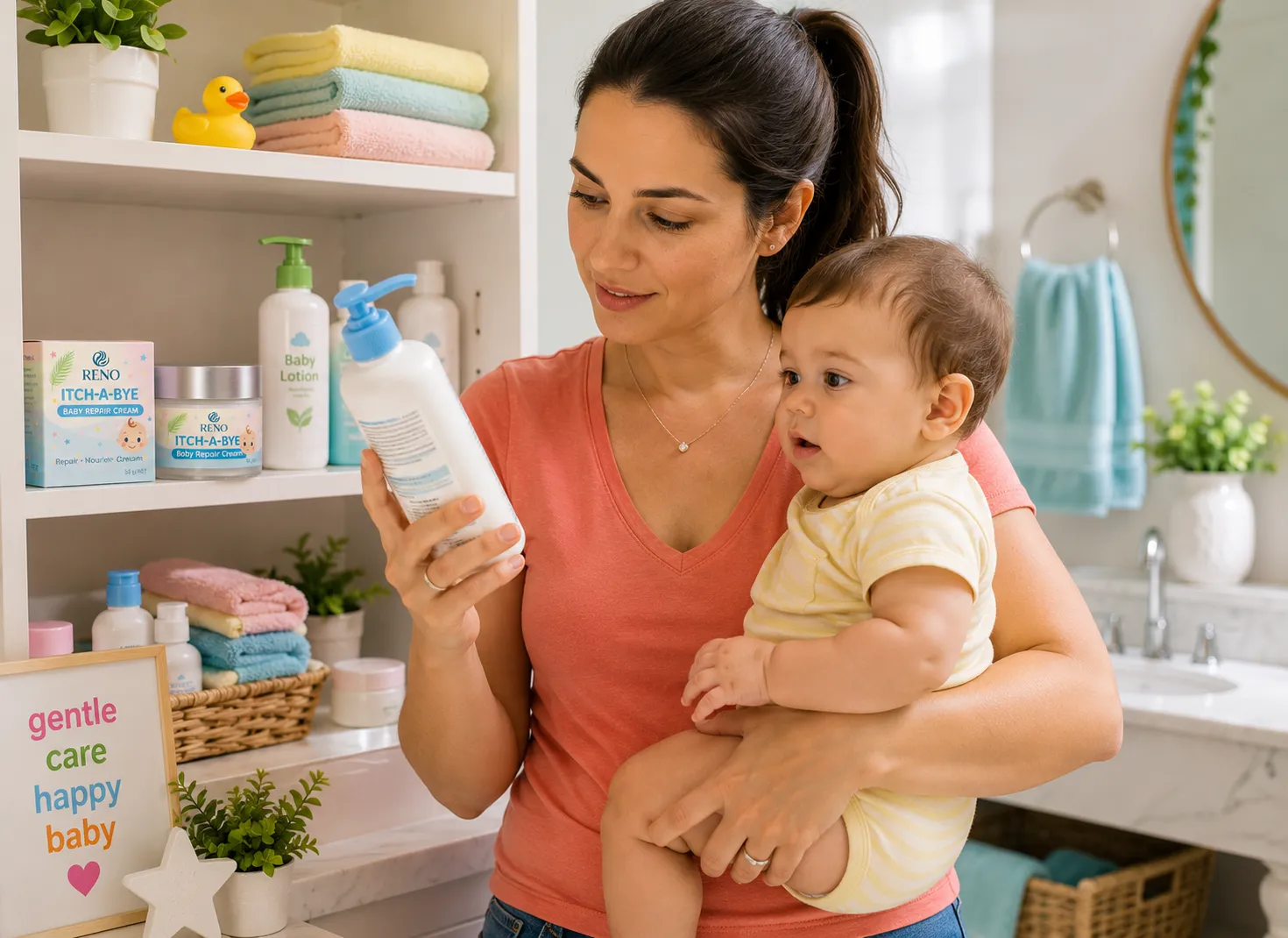
“Dermatologically tested” is one of those phrases parents see everywhere on baby skincare. It appears on creams, lotions, washes and products specifically marketed for sensitive or eczema-prone skin. The words sound reassuring because they seem to suggest that a dermatologist has examined the product and confirmed that it is safe and gentle. But “dermatologically tested” does not automatically mean dermatologist-approved, hypoallergenic or guaranteed not to irritate your baby’s skin.
That distinction becomes especially important when you are choosing skincare for a baby who is already dry, itchy or uncomfortable. A dermatological test can provide useful information about how a formulation was tolerated under particular test conditions, but it cannot predict how every baby will respond. The phrase also tells you surprisingly little about the type, size or design of the testing unless the manufacturer provides those details. So rather than treating “dermatologically tested” as a guarantee, it is better to understand exactly what the claim can and cannot tell you.
What Does “Dermatologically Tested” Usually Mean?
At its simplest, “dermatologically tested” generally means that a skincare product has undergone some form of testing involving the skin, usually under the supervision or oversight of a dermatologist or appropriately qualified professional. The purpose is commonly to assess things such as skin tolerance or the potential for irritation under the conditions of the test. Exactly how that testing was conducted can vary considerably. The words alone do not tell you the complete methodology.
One manufacturer may test a finished cream on a panel of volunteers, while another may use a different protocol, participant group or observation period. The number of participants can vary, as can the amount of product applied and the frequency of application. Some studies may specifically examine people with particular skin characteristics, while others involve a more general population. This is why two products can both say “dermatologically tested” even though the testing behind those words may not have been identical.
Does It Mean a Dermatologist Personally Used the Cream?
Not necessarily. The phrase can easily create an image of a dermatologist personally applying the cream, examining every ingredient and then giving the product a professional seal of approval. That is not necessarily what happened. A dermatologist may instead have supervised, reviewed or participated in a skin-tolerance testing process.
The precise involvement depends on the testing protocol and the company making the claim. This does not make dermatological testing worthless, because properly conducted tolerance testing can provide useful information. It simply means parents should not read more into the phrase than it actually says. “Tested under dermatological control” and “personally recommended by a dermatologist for your baby” are very different statements.
Dermatologically Tested Does Not Mean Dermatologist-Approved
This is one of the easiest misunderstandings to make. Tested describes a process, whereas approved or recommended suggests an endorsement or conclusion. A product can undergo dermatological testing without every dermatologist involved necessarily recommending that product for every baby. Those are separate ideas.
Think of it in the same way you might think about testing almost any product. Testing tells us something about what happened under particular conditions. It does not automatically transform the product into the best option for every possible user. The value of the claim depends partly on what was actually tested, how it was tested and what the results showed.
Does Dermatologically Tested Mean the Product Cannot Cause Irritation?
No. Even a well-formulated and carefully tested baby cream can irritate an individual child’s skin. Human skin varies enormously, and a formulation that is well tolerated by the overwhelming majority of people in a test group may still be unsuitable for one particular person. Babies with already compromised or eczema-prone skin may also respond differently depending on what else is happening to their skin at the time.
Heat, sweat, saliva, friction, bathing, scratching and other skincare products may all influence how the skin behaves. A baby could therefore appear to react after applying a dermatologically tested cream even when the explanation is more complicated than one ingredient or one product. Alternatively, that particular formulation genuinely may not suit that child. Dermatological testing reduces uncertainty; it does not eliminate individual variation.
What Is Actually Being Tested?
This is the question that deserves more attention. When you see “dermatologically tested,” you might reasonably ask: Tested for what? Was the study primarily looking for visible irritation? Was it assessing tolerance after repeated application? How many people participated, and what kind of skin did they have?
Those details can dramatically change how informative a claim is. A test involving healthy adults does not necessarily answer exactly the same question as one involving children with dry or eczema-prone skin. Similarly, a short exposure test tells us something different from repeated use over a longer period. The phrase becomes far more meaningful when a manufacturer explains the evidence behind it.
Does It Mean the Finished Cream Was Tested?
Ideally, when parents see a dermatological-testing claim on a product, they naturally assume the finished formulation is what was evaluated. That distinction matters because ingredients can have individual safety histories without the exact finished combination necessarily having undergone the same testing. A formula is more than a collection of isolated ingredients. Concentrations, combinations, pH, preservatives and the overall formulation can affect skin tolerance.
This is also why ingredient research and finished-product evidence should never be treated as interchangeable. Research showing that an individual ingredient has particular properties does not automatically prove that every cream containing it produces the same outcome. When evaluating a testing claim, evidence on the finished formulation is especially valuable. Parents are using the finished cream, not isolated ingredients from a research paper.
Is Dermatologically Tested the Same as Hypoallergenic?
No. These claims answer different questions. Dermatologically tested generally refers to a product having undergone some form of skin-related testing, while hypoallergenic generally communicates an intention to reduce the likelihood of an allergic reaction. Neither term means that reactions are impossible.
A product can therefore be dermatologically tested without being marketed as hypoallergenic. A hypoallergenic product may also have undergone dermatological testing, but one statement does not automatically prove the other. Understanding this distinction prevents reassuring words from becoming blurred together. Every claim on a skincare label should be interpreted according to what that particular claim actually means.
Is It the Same as Fragrance-Free?
Again, no. Fragrance-free generally tells you something about whether ingredients have been deliberately included to perfume the product. Dermatologically tested tells you something about a testing process. A product can be fragrance-free and dermatologically tested, fragranced and dermatologically tested, or fragrance-free without carrying a dermatological-testing claim.
This is why choosing baby skincare purely from the front of the package can become confusing. Several phrases may appear together, but each describes something different. None of them alone tells you everything about formulation quality. The useful question is not simply how many reassuring claims appear on the jar, but what those claims actually tell you about the product.
What About “Paediatrician Tested”?
“Paediatrician tested” introduces another professional-sounding phrase, but once again the important question is what testing actually took place. A paediatrician may have been involved in a study or evaluation, but the phrase alone does not necessarily mean that paediatricians universally recommend the product. Nor does it tell you that the cream is appropriate for every baby with every type of skin problem. The underlying methodology still matters.
Professional involvement can certainly strengthen a product’s evidence when the testing is relevant and well designed. But a title on the front of a package should not replace the details behind the study. The quality and relevance of the testing remain central. The more specific a manufacturer can be about what was tested and what was found, the more useful the information becomes.
What Does “Clinically Tested” Mean?
“Clinically tested” can sound even stronger, but it also needs context. A clinical test simply means that some form of study or evaluation involving people has been performed under defined conditions. The phrase itself does not tell you whether the study involved 20 people or 2,000, lasted two days or several months, or measured irritation, hydration, itching or something completely different. Those details determine how much the study can actually tell us.
There is also an important distinction between clinically tested and clinically proven. Even “proven” needs to be considered alongside the evidence supporting the specific claim being made. Parents should be wary of mentally upgrading any testing phrase into a guarantee. Good evidence becomes stronger when the methodology and results are transparent.
Why These Claims Matter So Much to Parents
Choosing baby skincare is emotional in a way that buying an ordinary cosmetic often is not. If your baby’s skin is red, dry and itchy, you are not simply looking for a pleasant moisturiser. You are trying to find something you can apply without making an already uncomfortable situation worse. Words such as “dermatologically tested” naturally offer reassurance at precisely the moment you want reassurance most.
That is why these claims should be understood rather than dismissed. Parents deserve to know what the words can reasonably tell them and where their limitations begin. Dermatological testing can be a positive feature of a product. But the claim should be one part of your decision, not the entire reason for making it.
A Dermatologically Tested Cream Can Still Be Too Basic
There is another issue that is often overlooked. A product may demonstrate excellent skin tolerance while providing only relatively simple moisturisation. If that is all your baby’s skin needs, there may be absolutely nothing wrong with that. But a baby with persistent dry, itchy or eczema-prone skin may need you to think beyond tolerance alone.
A cream can be gentle without necessarily being comprehensive. It might cause no obvious irritation yet still leave the skin dry again an hour later. It may provide hydration without the combination of conditioning, soothing and other supportive ingredients you are looking for. “Doesn’t irritate” and “provides the support this skin needs” are related questions, but they are not the same question.
This Is Where Reading the Ingredients Still Matters
Once you move beyond the front label, the ingredient list starts telling a much richer story. Look for ingredients with identifiable roles rather than being impressed by the sheer number of claims printed on the package. Humectants such as Glycerin and Hyaluronic Acid can help attract and retain water. Emollient ingredients can help condition dry, rough skin.
Other ingredients may contribute soothing, antioxidant or additional skin-supportive properties. The value comes from how those functions work together in the finished formulation. A beautifully designed label cannot compensate for a formulation that does too little for the skin you are trying to support. Dermatological testing can tell you something about tolerance, while the formulation tells you what the cream was actually built to do.
What Should Parents Look for in a Baby Cream?
Start with the skin rather than the marketing. Is your baby’s skin occasionally a little dry, or is it repeatedly rough, itchy and uncomfortable? Does the moisturiser seem to last, or does the skin feel dry again shortly after application? Is scratching continuing even though you are moisturising regularly?
Then look at the product. Consider fragrance, texture, humectants, emollients, oils, skin-conditioning ingredients and anything else included for a functional reason. Think about whether the formulation matches the level of support your baby’s skin seems to need. The best label in the world cannot answer those questions for you.
Why Formulation Synergy Matters
At Itch-A-Bye, our formulation philosophy is based on the idea that vulnerable skin may benefit from different ingredients doing different jobs together. We do not expect Glycerin to perform the same role as Black Seed Oil, or Allantoin to perform the same role as Hyaluronic Acid. Their differences are part of the point. The formulation is designed as a system rather than around one fashionable hero ingredient.
We call this ingredient synergy. Hydration, conditioning, soothing, antioxidant support and other properties can complement each other within one formulation. This is also why we do not define Nourish as simply “adding moisture.” A carefully formulated cream should be judged by the combined support its ingredients provide, not merely by the strongest-sounding claim on the front.
REPAIR: Start With the Barrier
The first part of our Repair, Nourish and Defend philosophy is Repair. Dry and eczema-prone skin can have difficulty holding onto water, leaving the surface rough, tight and more vulnerable to everyday pressures. Scratching can then add physical damage and increase discomfort. Supporting the barrier therefore becomes an important part of everyday skincare.
Glycerin and Hyaluronic Acid contribute hydration support, while emollient components help condition the surface. Allantoin adds soothing and skin-conditioning support within the wider formulation. No single ingredient has to carry the whole burden. Repair is about creating conditions that support a vulnerable barrier rather than simply making the skin feel temporarily soft.
NOURISH: More Than Moisturising
Our definition of Nourish goes much further than hydration alone. It means providing vulnerable skin with a deliberately selected combination of topical ingredients that hydrate, condition, soothe and provide antioxidant and other supportive properties. Oils, humectants, vitamins, Allantoin, MSM and botanical ingredients can therefore contribute different pieces of the formulation. Their functions overlap in some areas and complement one another in others.
This distinction becomes particularly useful when comparing products that all describe themselves as gentle or dermatologically tested. Two creams can both be well tolerated while offering very different levels and types of topical support. Nourish asks not only whether the formulation avoids unnecessary problems, but what useful things it deliberately gives the skin. That is a much broader question.
Black Seed Oil Adds Another Dimension
Black Seed Oil, Nigella sativa, sits at the centre of the Itch-A-Bye formulation. Its naturally occurring constituents, including thymoquinone, have been studied for anti-inflammatory, antioxidant and antimicrobial properties. The oil also provides emollient and skin-conditioning characteristics. These functions are quite different from simply attracting water into the outer skin.
That does not mean research on Black Seed Oil proves that every finished product containing it will produce the same results. Ingredient evidence and finished-product evidence need to remain separate. We selected Black Seed Oil because its documented properties fit the broader formulation strategy we wanted to build. Its value in Itch-A-Bye comes from being one component of a synergistic system rather than being presented as a cure-all ingredient.
MSM and Allantoin Bring Different Forms of Support
MSM, or methylsulfonylmethane, has been investigated in relation to inflammatory and oxidative processes. Allantoin is widely used in skincare for soothing and skin-conditioning purposes. Neither ingredient performs exactly the same function as Glycerin, Hyaluronic Acid or Black Seed Oil. That difference is useful.
When several ingredients contribute complementary properties, the formulation can approach vulnerable skin from more than one direction. That is what we mean when we talk about synergy. The objective is not to cram as many fashionable ingredients as possible into a jar, but to give each selected ingredient a reason for being there. The complete formulation is what matters.
What About the Botanical Complex?
Itch-A-Bye also contains a deliberately selected group of botanical ingredients, including Centella asiatica, Chamomile, Licorice, Green Tea, Scutellaria baicalensis, Rosemary, Ginger and Polygonum cuspidatum. These plants contain different phytochemicals and have been investigated across areas including soothing, antioxidant, anti-inflammatory and antimicrobial activity. We do not assume that every botanical performs every function. Different plants have different evidence profiles.
This is an important part of responsible ingredient communication. Research into a botanical ingredient does not automatically prove that the finished Itch-A-Bye formulation treats a medical condition. Instead, the evidence helps explain why particular ingredients were interesting to us when designing the formulation. The wider value comes from how these selected ingredients complement the rest of the formula.
DEFEND: Thinking Beyond Moisture
The third part of our philosophy is Defend. Skin does not exist in isolation; it constantly encounters bacteria, fungi, environmental irritants, clothing, surfaces and other everyday pressures. Healthy skin also naturally hosts microorganisms, so the objective is not to sterilise it. Our interest is in supporting vulnerable skin’s protective environment.
Black Seed Oil and several botanical ingredients contain compounds that have been studied for antimicrobial activity. That evidence helped shape our ingredient-selection philosophy. It does not mean Itch-A-Bye should be used as a substitute for treatment when a child has an established skin infection. Defend means supporting vulnerable skin against everyday microbial and environmental pressures while recognising the limits of cosmetic skincare.
Why Testing and Ingredient Evidence Are Different
This distinction deserves to be made very clearly. An ingredient can have extensive published research behind it while the finished cream containing that ingredient has not been tested for every outcome described in those papers. Conversely, a finished cream can undergo dermatological tolerance testing without proving every theoretical benefit associated with every ingredient. These are different forms of evidence.
Ingredient research helps explain formulation rationale. Finished-product testing tells us something about the actual finished formulation under the conditions studied. Consumer experience can provide another type of information, but it is not the same as a controlled clinical trial. Strong skincare communication keeps these categories separate rather than blending them into one oversized claim.
Does Dermatological Testing Tell You Whether a Cream Works for Eczema?
Not automatically. A skin-tolerance test may establish that a formulation was well tolerated by the people who participated, but that is different from demonstrating effectiveness for eczema. To make conclusions about a specific condition, you would want testing designed to answer that particular question. The study population, outcome measures and methodology would all matter.
This is another reason parents should be careful about interpreting professional-sounding language. “Dermatologically tested” can be valuable without meaning “clinically proven to treat eczema.” Those are very different statements. Understanding the difference allows you to appreciate legitimate testing without asking it to prove something it was never designed to prove.
Could a Tested Product Still Make My Baby Itch?
Yes. If your baby consistently becomes itchier, redder or more uncomfortable after using a particular product, the words on the package should not make you ignore what you are observing. The product may contain something that does not suit your child’s skin. Or another pressure may be coinciding with application.
Look at timing and patterns. Consider whether heat, bathing, clothing, saliva, sweat, shampoo or laundry products changed around the same time. Try not to change ten things simultaneously if you are attempting to understand what is happening. Your baby’s actual skin response remains important regardless of what testing claim appears on the label.
The Skin Threshold Model Helps Put Testing in Perspective
Our Skin Threshold Model gives parents another way to understand why a perfectly reasonable product may appear to “stop working” or coincide with a flare. Imagine several pressures accumulating together: dryness, heat, sweat, friction, saliva, environmental irritants and scratching. Each may add only a little pressure. Together they may push vulnerable skin beyond its threshold.
A dermatologically tested cream can reduce uncertainty about one part of the picture, but it cannot remove every pressure affecting the skin. The same product may appear perfectly adequate during a cool week and insufficient during several hot, sweaty nights. The product did not necessarily change; the total pressure surrounding the skin may have changed.
Dermatologically Tested Does Not Mean “Use as Much as You Want”
Application still matters. Even a gentle cream needs to be used sensibly within the child’s routine. Very thick application under warm clothing may feel uncomfortable in hot weather, while applying too little to very dry areas may provide insufficient coverage. Texture and quantity should make sense for the circumstances.
The same applies to layering products. A lotion, cream, balm or ointment may each have different advantages depending on dryness, weather and the area being treated. Application choices remain part of effective skincare. Dermatological testing does not remove the need to think about how, when and where the product is being used.
When Should Parents Be More Cautious?
If a baby develops significant swelling, increasing pain, widespread redness, weeping, crusting or rapidly worsening skin, the question has moved beyond interpreting a cosmetic label. Broken skin from persistent scratching can also require closer attention. These situations may need professional assessment. A dermatologically tested moisturiser is still a moisturiser.
Likewise, evidence that individual ingredients have antimicrobial properties does not turn the finished cream into an antibiotic or antifungal medicine. Established infection requires appropriate assessment and treatment. Everyday skincare has a different role. Knowing what skincare can do is useful, but knowing its limits is equally important.
Where Itch-A-Bye Fits
Itch-A-Bye Baby Repair Cream was developed for babies and children with dry, itchy and eczema-prone skin around our Repair, Nourish and Defend philosophy. Our formulation combines Black Seed Oil, MSM, Allantoin, Hyaluronic Acid, Glycerin, vitamins and a deliberately selected botanical complex. Each group of ingredients contributes a different part of the wider formulation strategy. We think that complete picture matters more than relying on one reassuring phrase.
When you evaluate any baby cream, including ours, look beyond the front label and ask what the formulation is actually designed to provide. Look at the ingredients, the texture, the intended use and how your child’s skin responds. You can explore Itch-A-Bye Baby Repair Cream here and see how Repair, Nourish and Defend come together in the formulation. The complete formulation tells the fuller story.
Look Beyond One Word on the Jar
This is also one of the central ideas behind Beyond the Skin Barrier. Parents dealing with persistent dry and itchy skin are frequently given very short answers to complicated questions. Choose hypoallergenic products. Use something dermatologically tested. Moisturise more often. Avoid triggers.
Those suggestions can all contain useful ideas, but the skin may be responding to several interacting pressures at once. Our book explores barrier development, scratching, environmental influences, immune signalling, the microbiome, the gut-skin axis and the Skin Threshold Model. You can read Beyond the Skin Barrier here if you want to explore the wider framework behind our approach. It provides context that a short product label cannot.
So, What Does “Dermatologically Tested” Actually Mean?
“Dermatologically tested” generally means that a product has undergone some form of skin-related evaluation under dermatological supervision or control, but the phrase alone does not tell you exactly how the study was designed, who participated, how long it lasted or what was measured. It does not automatically mean dermatologist-approved, hypoallergenic, irritation-proof or clinically proven to treat eczema. The details behind the claim determine how informative it really is. That makes transparency especially valuable.
For parents choosing skincare for dry, itchy or eczema-prone baby skin, dermatological testing can certainly be one positive factor to consider. But look beyond it to the complete formulation, the ingredients, the type of support being provided and, most importantly, how your baby’s skin actually responds. Because the strongest baby skincare decision is not made by finding the most impressive words on the front of the jar. It comes from understanding what those words mean and choosing a formulation that gives vulnerable skin the support it needs to Repair, Nourish and Defend.