
What Does “Hypoallergenic” Actually Mean on Baby Skincare?
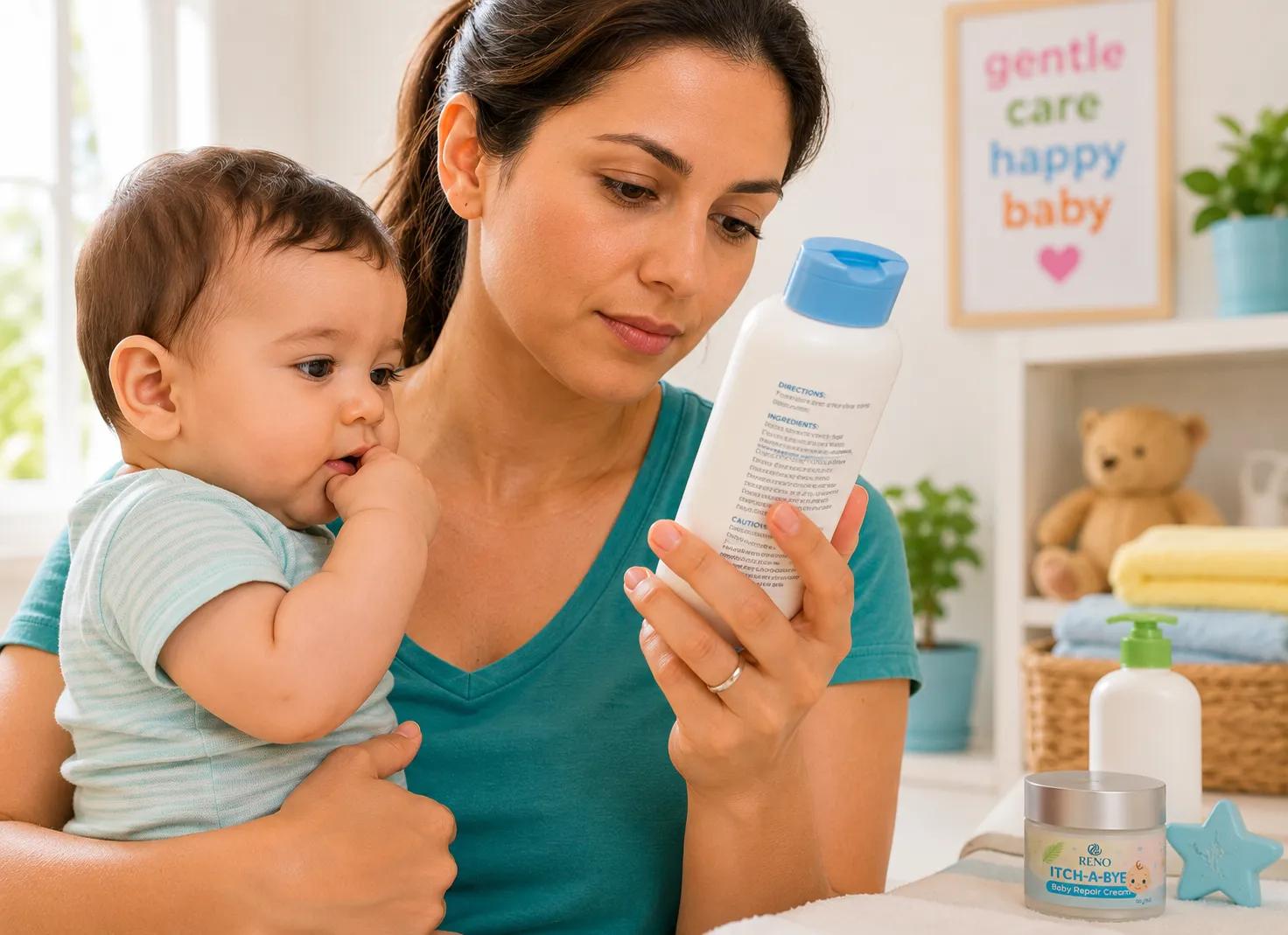
“Hypoallergenic” is one of those words that seems reassuring the moment you see it on a baby skincare label. It sounds as though the product has been designed to be safer, gentler and less likely to cause a reaction than an ordinary cream or lotion. For a parent caring for dry, itchy or eczema-prone skin, that can make the word feel especially important. But “hypoallergenic” does not mean the same thing as “guaranteed not to cause a reaction.”
That distinction matters because babies can respond differently to the same formulation. One child may use a product for months without any difficulty, while another develops redness, itching or irritation after only a few applications. The word can be useful as a clue about how a product has been positioned or formulated, but it should never replace looking at the ingredients and watching how your baby’s skin actually responds. The label may guide you, but the skin still gives the final answer.
What Does “Hypoallergenic” Usually Mean?
In skincare, hypoallergenic generally means that a product is intended to have a lower likelihood of causing an allergic reaction than products that contain more commonly problematic ingredients. That sounds straightforward, but the problem is that there is no universal formulation recipe that every hypoallergenic product must follow. Different manufacturers can use the word based on different internal criteria. This makes the term less absolute than it may first appear.
One brand may remove fragrance, another may avoid a particular preservative system, and another may perform patch testing before using the claim. These approaches are not necessarily identical. The details behind the claim can therefore matter as much as the word itself. The word “hypoallergenic” describes an intention to reduce reaction risk, not a promise that every person will tolerate the product.
Hypoallergenic Does Not Mean Allergy-Proof
This is perhaps the most important point for parents to understand. A hypoallergenic cream can still contain ingredients that a particular child does not tolerate. Babies can react to preservatives, botanical extracts, fragrances, essential oils or other components depending on their individual susceptibility. No cosmetic product can realistically promise zero risk for every person.
Even ingredients that are widely considered gentle can occasionally cause problems in susceptible individuals. The human immune system is too variable for any skincare label to eliminate that possibility completely. Individual tolerance always remains part of the equation. Hypoallergenic should therefore be interpreted as “designed to reduce the likelihood of reaction,” not “impossible to react to.”
Why the Word Feels More Powerful Than It Really Is
Marketing language can influence how parents think about products. Terms such as gentle, natural, dermatologist-tested, sensitive, fragrance-free and hypoallergenic all sound reassuring because they appear to simplify a complicated decision. But none of these words tells you everything about the finished formulation. A product can carry several comforting claims and still be unsuitable for one particular baby.
This does not mean the claims are meaningless. They can provide useful information when they are backed by a thoughtful formulation. Parents should simply resist treating them as guarantees. A strong label is not a substitute for a strong formulation.
Is Hypoallergenic the Same as Fragrance-Free?
No. These two terms describe different things. A fragrance-free product is generally intended to avoid ingredients added specifically for scent, while a hypoallergenic product is intended to reduce the likelihood of an allergic reaction. A product can be fragrance-free without being marketed as hypoallergenic, and it can be marketed as hypoallergenic while still containing ingredients that have their own natural aroma.
This distinction becomes important when you are trying to simplify skincare for a baby with persistent dryness or itching. Avoiding fragrance removes one potential source of irritation, but it does not tell you everything else about the cream. The rest of the formulation still deserves attention. Fragrance-free and hypoallergenic may overlap, but they are not interchangeable labels.
Is Hypoallergenic the Same as “For Sensitive Skin”?
Not necessarily. “For sensitive skin” is another broad marketing phrase rather than a precise biological category. It may suggest that the manufacturer has tried to avoid ingredients commonly associated with irritation, or that the product has been tested on people with sensitive skin. But the phrase can mean different things between brands.
The same applies to baby skincare more generally. The words “baby” or “sensitive” do not automatically guarantee a simpler or more effective formulation. Parents still need to consider what the cream contains and how it performs in the real world. Labels can help narrow the field, but they should not do all the thinking for you.
Why Can Babies React to Products That Look Gentle?
Baby skin is still developing and can be more vulnerable to environmental pressure than adult skin. Dryness, heat, sweat, saliva, friction and scratching may already be affecting the surface before a new product is introduced. This can make it difficult to know whether a reaction is due to the cream itself or whether several pressures have simply overlapped at the same time. The timing can be confusing.
A child may also tolerate an ingredient for a while before irritation becomes noticeable. Another baby may react very quickly. This variability is one reason no single label can completely predict what will happen. The safest approach is to combine sensible product selection with observation.
What Ingredients Are Commonly Considered When Formulating for Lower Reaction Risk?
Manufacturers aiming for a gentler product often pay attention to things such as fragrance, unnecessary colourants, harsh surfactants and ingredient complexity. They may choose well-established moisturising ingredients and try to avoid known common irritants where practical. Preservatives still matter because water-based creams need protection against microbial contamination. The challenge is balancing safety, stability and skin tolerance.
The best formulation is therefore not simply the one with the shortest ingredient list. A product containing useful humectants, emollients and skin-conditioning ingredients can still be thoughtfully designed. What matters is whether the ingredients have a clear purpose and work together well. Simplicity is valuable, but thoughtful formulation is more important than ingredient minimalism for its own sake.
Does “Natural” Mean Hypoallergenic?
No. Natural ingredients can still cause irritation or allergic reactions. Plants contain biologically active compounds, and some of those compounds are precisely what gives botanical ingredients their useful properties. Natural origin does not make a substance automatically inert or universally tolerated.
This is particularly relevant for aromatic plant extracts and essential oils. Many plant-derived ingredients can be valuable parts of a skincare formulation when selected carefully and used appropriately. The important point is that natural and hypoallergenic are different ideas. One describes origin; the other describes an attempt to reduce reaction risk.
Does Hypoallergenic Mean Dermatologist-Tested?
Again, not necessarily. “Dermatologist-tested” generally indicates that some form of testing was conducted under dermatological supervision, but it does not tell you the exact study design unless the manufacturer provides those details. Hypoallergenic is a separate claim. Some products may carry both statements, while others may carry only one.
Parents should treat these claims as pieces of information rather than absolute proof of suitability. Testing can improve confidence, but individual skin responses still vary. The context behind a claim is worth understanding whenever that information is available. No label removes the need to watch how your baby’s skin behaves.
What Should You Look for Beyond the Word Hypoallergenic?
Start by asking what the product has actually been designed to do. Does it provide hydration through ingredients such as Glycerin or Hyaluronic Acid? Does it include emollient or oil-based ingredients that help condition the skin? Are there soothing or skin-conditioning ingredients included for a clear reason?
Then consider what has been left out. Is the product fragrance-free? Does it avoid unnecessary aromatic ingredients? Is the formulation suitable for the level of dryness you are dealing with? The strongest baby cream is not simply the one with the most reassuring word on the label, but the one whose formulation makes sense for the skin in front of you.
Why This Matters for Eczema-Prone Skin
Parents of babies with eczema-prone skin often become extremely cautious about every product they use, and understandably so. When a child is repeatedly itchy or uncomfortable, the fear of making things worse becomes very real. Hypoallergenic labelling can therefore feel like a shortcut to safety. But eczema-prone skin is more complicated than a simple allergy question.
Dryness, barrier vulnerability, heat, sweat, saliva, friction and scratching may all be contributing at the same time. A product may be perfectly tolerated yet still fail to provide enough support for the skin. Avoiding reaction is only one part of choosing suitable skincare. Avoiding reaction is important, but providing the right kind of support matters too.
A Product Can Be Gentle and Still Be Too Basic
This is an important distinction. Imagine a very simple, fragrance-free, hypoallergenic lotion that provides basic hydration and causes no irritation. That can be a perfectly good product. But if a baby’s skin remains persistently dry and itchy, the issue may not be tolerance.
The formulation may simply not be providing enough support. A product can therefore be “gentle” in the sense that it does not cause problems while still being too lightweight or too basic for what the skin needs. Parents sometimes respond by applying more and more of the same product. But more of an underpowered formulation does not always solve the underlying problem.
This Is Why We Think Beyond Hypoallergenic
At Itch-A-Bye, we do not think one reassuring label should define the entire product. Our focus is on what the formulation is designed to provide. We think vulnerable baby skin may need hydration, barrier support, soothing, conditioning and protection against everyday environmental and microbial pressures. That is why our philosophy is built around Repair, Nourish and Defend.
The aim is not simply to create a cream that avoids potential irritants. It is to create a formulation that actively provides several complementary forms of topical support. That means thinking about both what we leave out and what we deliberately put in. A good baby cream should be defined by useful function, not only by avoidance.
REPAIR: Supporting the Physical Barrier
The first part of our approach is Repair. Dry, eczema-prone skin can lose water more easily and become rough, tight and uncomfortable. Once scratching begins, the physical surface can come under even more pressure. Supporting hydration and conditioning therefore becomes fundamental.
Ingredients such as Hyaluronic Acid and Glycerin support hydration, while Allantoin contributes soothing and skin-conditioning properties. These functions are different, and that is intentional. Each ingredient has a distinct place within the wider formulation. Repair means building a supportive environment for the outer barrier rather than relying on one ingredient or one label.
NOURISH: The Part Hypoallergenic Does Not Explain
The word “hypoallergenic” tells you something about reaction risk, but it tells you very little about nourishment. Our definition of Nourish includes humectants, oils, vitamins, soothing ingredients and botanicals working together. We want the formulation to provide more than surface softness. We want it to offer different forms of support.
This is where ingredient synergy becomes important. Glycerin can support hydration, while oils condition the skin and other ingredients contribute antioxidant or soothing properties. These complementary roles are what give the formulation its broader purpose. A formulation becomes more useful when its ingredients complement rather than simply repeat one another.
Why Black Seed Oil Is Central to the Formula
Black Seed Oil, Nigella sativa, is one of the ingredients at the centre of the Itch-A-Bye formulation. Its naturally occurring compounds, including thymoquinone, have been studied for anti-inflammatory, antioxidant and antimicrobial properties. The oil also provides emollient support and contributes to the feel of the cream. These are very different functions from simple hydration.
We do not treat Black Seed Oil as a magical cure-all ingredient. Its value comes from how it works within a wider formula. It sits alongside Glycerin, Hyaluronic Acid, Allantoin, MSM, vitamins and botanical extracts. The formulation, not one ingredient, is the real story.
Why MSM Matters
MSM, or methylsulfonylmethane, adds another dimension. Research has explored MSM in relation to inflammatory and oxidative processes, which made it relevant to our thinking about skin repeatedly exposed to dryness, irritation and scratching. Its inclusion is part of a wider strategy rather than simply adding another fashionable ingredient. It has a specific reason for being there.
This is the difference between a formulation designed around function and one built around marketing claims alone. A label can say “hypoallergenic,” but the ingredient architecture tells you what support the skin actually receives. Looking beyond the front label helps make that distinction clearer. What is inside matters more than the confidence of the wording outside.
Allantoin Provides Soothing and Conditioning Support
Allantoin has a long history in skincare as a soothing and skin-conditioning ingredient. That makes it particularly useful when skin feels rough or uncomfortable. It does not perform exactly the same job as Glycerin or Hyaluronic Acid. Again, the differences between ingredients are intentional.
A strong formulation does not need twenty ingredients doing the same thing. It can combine hydration, conditioning, soothing and other supportive functions. Each useful ingredient can occupy a different role within the system. This is why ingredient synergy is more meaningful to us than a single marketing label.
What About Botanical Ingredients?
Itch-A-Bye contains a carefully selected botanical complex including Centella asiatica, Chamomile, Licorice, Green Tea, Scutellaria baicalensis, Rosemary, Ginger and Polygonum cuspidatum. These plants have different phytochemical profiles and have been studied across areas including soothing, antioxidant, anti-inflammatory and antimicrobial activity. They are not included simply to make the formulation look more natural. Their inclusion is intended to add complementary forms of topical support.
Each botanical contributes a different profile to the formulation. Centella does not need to behave like Chamomile, and Green Tea does not need to behave like Licorice. Their value lies partly in that diversity. Nourish means bringing different forms of topical support together rather than relying on one narrow mechanism.
Does Having Botanicals Make a Product Less Hypoallergenic?
Not automatically. Botanical ingredients can be well tolerated, but like any biologically active ingredient, they are not guaranteed to suit every individual. The more important question is whether they have been selected deliberately and used appropriately within the formulation. This is why “hypoallergenic” should never be interpreted as “contains nothing capable of ever causing a reaction.”
Skincare is always a balance between useful function and individual tolerance. A baby who reacts to a particular ingredient may need a simpler formulation, while another may do very well with a more complex cream. Both tolerance and function deserve attention. The correct formulation is the one that the skin both tolerates and benefits from.
DEFEND: Supporting Skin in the Real World
The third part of our philosophy is Defend. Healthy skin is constantly interacting with bacteria, fungi, environmental irritants and everyday physical contact. The aim is not to sterilise the skin, because healthy skin naturally hosts microorganisms. Instead, the goal is to support the skin’s protective environment.
Black Seed Oil and several botanical ingredients contain compounds that have been investigated for antimicrobial properties. That research helped inform our ingredient-selection philosophy. This does not turn a cosmetic cream into an infection treatment. Defend is about supporting vulnerable skin as it interacts with everyday microbial and environmental pressures, not treating an established infection.
Hypoallergenic Does Not Mean Antimicrobial
These terms should not be confused. Hypoallergenic relates to reducing the likelihood of allergic reaction, while antimicrobial describes the ability of a substance to inhibit or affect microorganisms. They are completely different concepts. A product can be hypoallergenic without containing ingredients with antimicrobial properties, and vice versa.
This distinction matters because parents often see several reassuring words clustered together on labels and understandably assume they all describe the same thing. They do not. Each claim refers to a different characteristic or purpose. Each claim needs to be understood according to what it actually refers to.
Could a Hypoallergenic Product Still Irritate Through Overuse?
Yes. Even a well-tolerated product can sometimes create problems if applied excessively under certain conditions. Thick layers under heavy clothing in warm weather can trap heat and sweat, and friction can still irritate vulnerable skin. The problem may not be an allergy at all. It may be the way the product is being used within the wider environment.
This is another reason to look beyond labels. A perfectly suitable cream applied in the wrong context may still feel uncomfortable. Heat, clothing, sweat and friction can change the way the skin feels. Skincare does not operate separately from heat, clothing, sweat and friction.
Could Another Product Be the Real Problem?
Absolutely. Parents often focus on the moisturiser because it is the product being deliberately applied to the skin. But shampoo, body wash, wipes, laundry detergent, fabric softener, sunscreen and fragranced household products may also contribute to the overall exposure. One product may carry a hypoallergenic label while several other products around the baby do not.
If irritation appears, look at the entire routine rather than assuming the cream must be responsible. Try to change one variable at a time where practical. This makes patterns easier to recognise. The skin experiences the total environment, not individual marketing claims.
The Skin Threshold Model Helps Explain This
Our Skin Threshold Model provides another way to think about the problem. Imagine that your baby’s skin can tolerate a certain amount of combined pressure before dryness, redness or itching becomes more noticeable. Dryness may add some pressure, while heat, sweat, friction, saliva and scratching add more. A mildly irritating product could contribute another layer.
A hypoallergenic formulation may reduce one possible pressure by avoiding certain common irritants, but it cannot control everything else happening around the skin. That is why a baby can still flare while using a product that is labelled hypoallergenic. The total environment remains important. The label may reduce one variable, but the total pressure still matters.
What Should You Do If a “Hypoallergenic” Product Seems to Make Things Worse?
Stop assuming the label means the product cannot possibly be involved. If you notice a consistent pattern of redness, itching or discomfort shortly after application, take that observation seriously. Look at the exact areas where the product is used and whether the pattern repeats. If appropriate, simplify the routine.
Do not change every product in the house at the same time unless there is a clear reason. Otherwise, you lose the ability to understand what mattered. If symptoms are significant or persistent, seek professional advice. The word “hypoallergenic” should never override what you are actually seeing on your baby’s skin.
When the Skin Looks Infected or Significantly Worse
If the skin becomes increasingly painful, swollen, hot, weeping, crusted or rapidly worsening, the question is no longer simply whether a moisturiser is hypoallergenic. Those signs may require medical assessment. Persistent scratching that repeatedly breaks the skin can also create additional problems. Routine skincare has limits.
Itch-A-Bye is not an antibiotic or antifungal medicine, and research into the antimicrobial properties of individual ingredients should not be confused with treatment of established infection. Everyday skincare and medical treatment have different roles. Knowing when to move beyond skincare is part of good skin care. That distinction protects the purpose of both approaches.
Where Itch-A-Bye Fits
Itch-A-Bye Baby Repair Cream was developed around a broader formulation philosophy for dry, itchy and eczema-prone skin. Rather than asking only how to avoid irritation, we asked how we could provide complementary support through Black Seed Oil, MSM, Allantoin, Hyaluronic Acid, Glycerin, vitamins and a deliberately selected botanical complex. These ingredients sit within our Repair, Nourish and Defend framework. The objective is a coordinated formulation rather than reliance on one reassuring label.
The point is not that every baby needs a complex formulation. The point is that “hypoallergenic” alone does not tell you how much functional support a cream actually provides. You can explore Itch-A-Bye Baby Repair Cream here and see how the formulation philosophy fits together. The complete formulation is where the wider story becomes clear.
Go Beyond the Label
This way of thinking is central to our book Beyond the Skin Barrier. Parents are often given simple labels and simple instructions for skin problems that are not always simple. “Use hypoallergenic products.” “Moisturise more.” “Avoid triggers.” Each suggestion can be useful, but none explains the full picture.
The book explores the developing skin barrier, environmental pressures, scratching, immune signalling, the microbiome, gut-skin interactions and our Skin Threshold Model. It helps parents understand why several smaller pressures can sometimes matter more than one dramatic cause. You can read Beyond the Skin Barrier here and explore that wider framework. It provides a way to look beyond a single label or trigger.
So, What Does “Hypoallergenic” Actually Mean?
Hypoallergenic generally means that a product has been designed or positioned to reduce the likelihood of causing an allergic reaction, but it does not mean allergy-proof, irritation-proof or suitable for every baby. Different manufacturers may use different formulation or testing approaches, and the word does not tell you everything about what is inside the product. It is useful information, but it should not be treated as a guarantee. The complete formulation and individual response still matter.
For parents of babies with dry, itchy or eczema-prone skin, the better question is broader. Is the cream well tolerated? Does it provide enough hydration and conditioning? Does the formulation contain ingredients that make sense for the support the skin needs? Because the strongest baby skincare choice is not simply the one with the safest-sounding word on the label, but the one that the skin tolerates and that gives vulnerable skin the right support to Repair, Nourish and Defend.