
What Makes a Baby Cream “Barrier Supporting”?
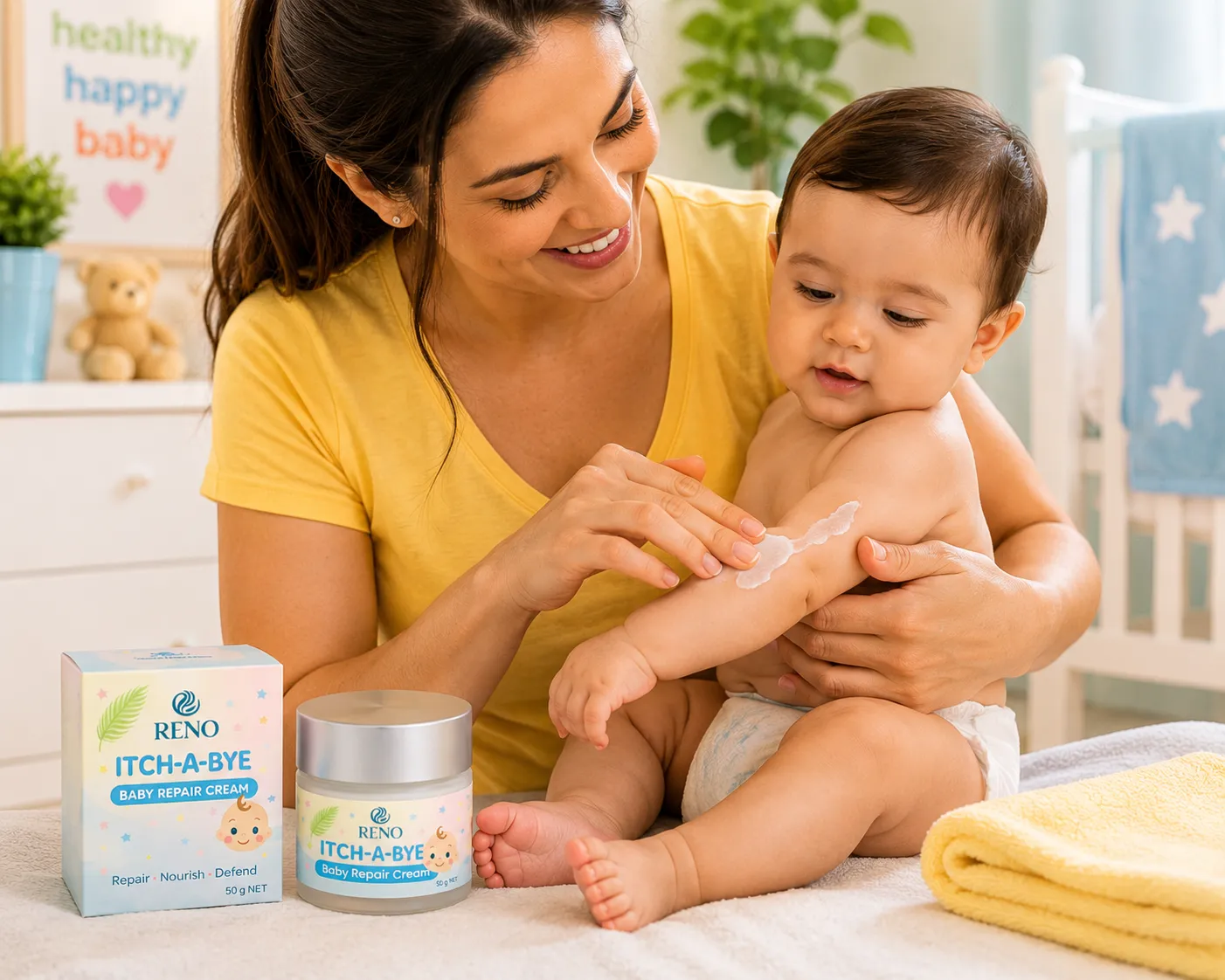
“Supports the skin barrier” has become one of the most common phrases on baby skincare packaging. You see it on creams, lotions, washes and balms, particularly products intended for dry, itchy or eczema-prone skin. It sounds reassuring, but it can also be frustratingly vague. What does a baby cream actually have to do before we can meaningfully describe it as barrier supporting?
A useful answer starts with understanding what the skin barrier does. It is not simply the dry outer layer we can see and touch, and barrier support is not synonymous with moisturising. A well-designed cream can support hydration, reduce excessive water loss, condition the skin and provide ingredients that complement the environment in which the barrier functions. The real question is not whether the words “barrier supporting” appear on the jar, but how the formulation is designed to support vulnerable skin.
First, What Is the Baby Skin Barrier?
The outermost part of the skin is called the stratum corneum. It is often described using a “bricks and mortar” analogy, with flattened skin cells representing the bricks and the lipids surrounding them acting like mortar. Together, these structures help create a physical boundary between the body and the outside world. One of their most important jobs is keeping water inside the skin.
But the barrier does much more than prevent dryness. It encounters friction, saliva, sweat, cleansers, environmental irritants and microorganisms every day. It is therefore both a water-retaining structure and an important protective interface. When we talk about supporting the barrier, we are talking about helping the skin perform several interconnected jobs. This broader role is why barrier care matters beyond surface softness alone.
A Baby’s Skin Is Not Simply Smaller Adult Skin
Infant skin is still developing. Its structure, water handling and relationship with the surrounding environment continue changing after birth, particularly during the early months and years of life. That is one reason babies can sometimes move surprisingly quickly from skin that looks perfectly comfortable to skin that appears dry, rough or irritated. Their skin deserves care designed with that developmental vulnerability in mind.
This does not mean every baby needs complicated skincare. Many babies do beautifully with simple routines and minimal products. But when skin is persistently dry, itchy or eczema-prone, the demands placed on the barrier can become much more noticeable. That is when understanding what a skincare formulation actually does becomes particularly useful.
Barrier Support Begins With Water
One of the clearest signs of a vulnerable barrier is increased difficulty retaining moisture. Water can escape from the skin into the surrounding environment through a process known as transepidermal water loss, usually abbreviated to TEWL. When water loss becomes excessive, the skin can become dry, rough and less comfortable. Supporting hydration is therefore an important part of barrier care.
Ingredients called humectants can help by attracting and retaining water within the outer skin. Glycerin is one of the best-known examples, while Hyaluronic Acid is valued for its ability to bind water. These ingredients can be extremely useful in a baby cream. But hydration is only the beginning of barrier support, not the complete definition.
The Cream Also Needs to Help Keep That Water There
Imagine continually pouring water into a bucket with small holes in the bottom. Adding more water helps temporarily, but unless you also slow the rate at which it escapes, you may find yourself repeatedly refilling the bucket. Vulnerable skin can behave in a similar way. Hydration matters, but retaining hydration matters too.
This is where emollient and more occlusive components become important. Oils and other lipid-rich ingredients can help soften and condition the surface while reducing excessive moisture loss to varying degrees. A richer formulation may remain on the skin longer than a lightweight lotion. Good barrier support therefore considers both putting water into the outer skin and helping prevent it from disappearing too quickly.
But “Barrier Supporting” Should Mean More Than Being Greasy
This is an important distinction. A very oily product may create substantial occlusion and reduce water loss, which can be genuinely useful for extremely dry skin. But greasiness itself is not proof that a formulation provides every form of support vulnerable skin might benefit from. Texture and function are related, but they are not identical.
A sophisticated cream can combine humectants, emollients, oils, skin-conditioning ingredients, antioxidants and other carefully selected components. Another product may intentionally remain extremely simple and focus primarily on occlusion. Both approaches can have value. The important question is whether the formulation matches the job the skin needs it to perform.
Look for Humectants
Humectants should be one of the first things you consider when examining a moisturising formulation. Glycerin is widely used because of its ability to support hydration within the outer layers of the skin. Hyaluronic Acid can also contribute to water retention because of its strong water-binding properties. Other formulations may use different humectant systems.
The presence of a humectant alone does not automatically make a product exceptional. Concentration, the surrounding formulation and the way ingredients interact all matter. But hydration is fundamental to comfortable barrier function, making humectants an important part of many barrier-supporting creams. Think of them as helping the skin hold onto the water it needs.
Look for Emollient Support
Dry skin is often rough as well as dehydrated. Emollient ingredients help soften and condition the skin surface, filling some of the spaces between dry surface cells and improving the way the skin feels. Oils can contribute strongly to this part of a formulation. Different oils also bring different fatty-acid and phytochemical profiles.
This is one reason oils should not automatically be dismissed as ingredients that merely make a product greasy. Their function depends on which oil is used and how it has been incorporated into the formulation. A carefully chosen oil can contribute conditioning while carrying naturally occurring compounds with additional properties. Barrier support is often strongest when ingredients perform complementary rather than identical jobs.
Look for Ingredients That Support Comfort
A baby with dry, eczema-prone skin is rarely experiencing dryness as an abstract cosmetic problem. The reason parents become concerned is often because the baby is uncomfortable, rubbing their face, scratching or waking during the night. Supporting the condition of the skin therefore also means thinking about comfort. This is where soothing and skin-conditioning ingredients can become valuable.
Allantoin, for example, has a long history of use in skincare for its soothing and skin-conditioning properties. It does not perform exactly the same job as Glycerin or Hyaluronic Acid, and that is precisely the point. A good formulation does not need every ingredient to do the same thing. Different ingredients can support different aspects of vulnerable skin simultaneously.
What About Skin Lipids?
Lipids are fundamental components of the outer skin barrier. Ceramides, cholesterol and fatty acids are frequently discussed because they form part of the lipid organisation within the stratum corneum. Some barrier-focused products therefore contain ingredients specifically intended to supplement skin lipids. This can be a perfectly reasonable formulation strategy.
But it is not the only possible barrier-supporting strategy. A cream does not automatically become useless because the word “ceramide” is absent from the ingredient list, just as the presence of ceramides does not automatically guarantee that every other aspect of the formulation is ideal. Humectants, oils, emollients, soothing ingredients and other supportive components can all contribute. Barrier support should be evaluated as a formulation rather than reduced to one fashionable ingredient.
Why We Think in Terms of Formulation Synergy
This principle sits at the centre of how we think about Itch-A-Bye Baby Repair Cream. We did not want to choose one ingredient and build the entire product story around it. Instead, we wanted different ingredients performing complementary roles within one formulation. That is how our broader Repair, Nourish and Defend philosophy developed.
Hyaluronic Acid and Glycerin contribute hydration, while oils provide additional conditioning. Allantoin brings soothing and skin-conditioning properties, and Black Seed Oil, MSM, vitamins and our botanical complex contribute their own different characteristics. The ingredients are not identical and they were never intended to be. The formulation becomes more interesting because each component can contribute something different.
REPAIR: What Barrier Support Means to Us
The first part of our approach is Repair. We use that word to describe supporting the condition and function of a vulnerable physical barrier rather than suggesting that a cosmetic cream medically reconstructs damaged skin. Hydration, conditioning and reducing the pressures associated with excessive dryness all contribute to that objective. The aim is to create a more supportive environment for the skin.
This matters particularly when scratching has entered the picture. Dryness can contribute to itching, scratching places additional physical pressure on the surface, and that disturbance can make already vulnerable skin more uncomfortable. Supporting the barrier can therefore become part of interrupting a much larger cycle. Repair begins with recognising that dry skin needs more than a temporary slippery feeling after application.
NOURISH: Barrier Support Is Not Hydration Alone
Our definition of Nourish is deliberately broader than moisturisation. Nourish means supplying vulnerable skin with a selected combination of topical ingredients that hydrate, condition, soothe and provide antioxidant and other supportive properties. Humectants are part of this, but so are oils, vitamins, skin-conditioning ingredients and botanicals. Hydration is one component of nourishment, not the entire concept.
This is particularly important because parents are often told simply to “moisturise more.” Sometimes that advice is useful, but it can also make families assume that every moisturiser is doing essentially the same job. Formulations can differ enormously. What matters is not simply how often you apply something, but what you are repeatedly applying to the skin.
Why Black Seed Oil Is Important to Our Approach
Black Seed Oil, Nigella sativa, occupies an important position within the Itch-A-Bye formulation. Its naturally occurring constituents, including thymoquinone, have been investigated for anti-inflammatory, antioxidant and antimicrobial properties. The oil itself also contributes emollient and conditioning characteristics. This gives it a broader role within our formulation philosophy than simply making the cream feel rich.
We do not suggest that Black Seed Oil single-handedly “repairs” the skin barrier or treats eczema. Its value is better understood as part of a multi-ingredient formulation in which different components provide complementary forms of topical support. It works alongside humectants, soothing ingredients, vitamins and botanicals. The formulation is the system; Black Seed Oil is one important part of that system.
Where MSM Fits
MSM, or methylsulfonylmethane, was included for another reason. Research has explored MSM in relation to inflammatory and oxidative processes, which made it relevant to our thinking about skin repeatedly exposed to irritation and environmental pressure. It therefore occupies a different position in the formulation from Glycerin or Hyaluronic Acid. That difference is useful.
A barrier-supporting formulation does not need ten versions of the same moisturising ingredient. It can instead bring together ingredients selected for hydration, conditioning, comfort, antioxidant support and other complementary properties. This is what makes formulation design more interesting than simply compiling a long ingredient list. The objective is purposeful synergy rather than ingredient quantity.
Allantoin and the Comfort of Vulnerable Skin
Allantoin provides another example of this complementary approach. It is widely used as a skin-conditioning and soothing ingredient, making it particularly interesting when skin feels rough or uncomfortable. It does not replace the hydrating role of Glycerin or the conditioning contribution of oils. It adds another dimension.
Parents understandably focus on visible dryness, but comfort can be equally important. A baby who constantly rubs or scratches the skin can create additional mechanical pressure regardless of how moisturised the surface looks. Supporting comfort can therefore complement hydration and conditioning. Barrier care works best when we remember the baby living inside the skin, not merely the appearance of the skin itself.
What Do Antioxidants Have to Do With Barrier Support?
Skin is continually exposed to environmental and biological processes that can generate oxidative stress. Antioxidants are compounds capable of interacting with these oxidative processes, which is why they are widely used in skincare formulations. Vitamin E and Vitamin C derivatives, for example, are commonly included for antioxidant support. Many botanical ingredients also contain naturally occurring antioxidant compounds.
This does not mean antioxidants physically replace missing parts of the skin barrier. Their role is different and should be described accurately. They form part of the wider supportive environment that a formulation can provide. Again, barrier support becomes more useful as a concept when we stop expecting every ingredient to perform the same job.
Our Botanical Complex Was Selected for Diversity
Itch-A-Bye contains a deliberately selected group of botanical extracts, including Centella asiatica, Chamomile, Licorice, Scutellaria baicalensis, Green Tea, Rosemary, Ginger and Polygonum cuspidatum. These plants have different phytochemical profiles and have been investigated across areas including soothing, antioxidant, anti-inflammatory and antimicrobial activity. We do not assume that every botanical provides every property. Their differences are part of their value.
Centella can bring a different profile from Chamomile, while Green Tea differs again from Licorice or Scutellaria. Those extracts sit within a formulation that also contains humectants, oils, Allantoin, MSM and vitamins. Nourish means bringing these different forms of topical support together rather than relying on one narrow mechanism. This is the formulation synergy behind our approach.
DEFEND: Because a Barrier Is Supposed to Defend
The word “barrier” itself tells us something important. A barrier is supposed to create a boundary between what is inside and what is outside. The skin continually interacts with bacteria, fungi and other microorganisms, including the communities that normally live on its surface. It also encounters environmental irritants, friction and physical contact.
Our Defend principle recognises this protective dimension. Black Seed Oil and several botanical ingredients contain constituents that have been investigated for antimicrobial properties, which contributed to our ingredient-selection strategy. The objective is not to sterilise the skin or suggest that Itch-A-Bye treats an established infection. Defend means supporting vulnerable skin in its everyday interaction with microbial and environmental pressures.
A Barrier Cream Should Not Have to Be a Paste
The phrase “barrier cream” sometimes makes parents imagine an extremely thick white paste sitting visibly on the skin. Those products can be useful in particular circumstances, especially when creating a strong physical shield is the objective. But a barrier-supporting everyday moisturiser can work differently. It can focus on hydration, conditioning, emollience and a wider ingredient system without needing to behave like nappy cream.
This distinction is particularly relevant when moisturising large areas of a baby’s body. A product that is technically protective but unpleasant to spread may become difficult to use consistently. Texture, absorption and comfort are therefore practical parts of formulation design. The best barrier-supporting cream is one whose function and usability make sense for the situation in which it will actually be used.
What About Petroleum Jelly?
Petrolatum is one of the most effective commonly used occlusive skincare ingredients. It can substantially reduce water loss from the skin and has a long history of use in dry-skin care. Its strength is precisely that powerful occlusive function. For some babies and some situations, that can be extremely useful.
But strong occlusion is still one function. A broader cream formulation may be designed to combine hydration, emollience, conditioning, soothing ingredients, antioxidants and botanicals within the same product. These are different formulation philosophies rather than a simple contest in which one must defeat the other. Sometimes the right question is not “Which is better?” but “Which function does my baby’s skin need right now?”
Does a Barrier-Supporting Cream Need Ceramides?
Not necessarily. Ceramides are important natural components of the skin barrier, and well-formulated ceramide products can certainly be useful. But skincare marketing has sometimes turned individual ingredients into shortcuts for judging entire formulations. Seeing “ceramides” on the label does not tell you everything else about the product.
Likewise, a formulation using a different combination of humectants, oils, emollients, soothing ingredients and botanicals should be judged according to that complete system. There are multiple ways to design supportive skincare. The formulation should be considered as a whole. The ingredient list needs to be understood as an architecture rather than a checklist containing one compulsory fashionable ingredient.
Does Thicker Mean More Barrier Supporting?
Not automatically. Thickness can often indicate a higher proportion of oils, waxes or occlusive components, and these can be useful for reducing water loss. But viscosity alone does not tell you whether a product contains effective humectants, soothing ingredients or other supportive components. A thick product can have a very simple purpose.
Similarly, a cream that spreads more easily can still provide meaningful barrier support. What matters is the balance between hydration, conditioning, occlusion, ingredient selection and how the formulation behaves on the skin. Texture is only one clue among several. Judge the function, not merely the thickness.
Why Application Timing Matters
Even an excellent formulation can be used more effectively when timing is considered. After bathing, the outer skin temporarily contains additional water. Applying a moisturiser relatively soon afterwards, while the skin remains slightly damp, can help retain some of that hydration. This is one reason post-bath moisturising is so commonly recommended.
You do not need to turn bath time into a race against a stopwatch. The useful principle is simply to avoid allowing vulnerable skin to become completely dry and tight before moisturising. Pat rather than aggressively rub the skin with a towel, dry folds appropriately, and apply skincare promptly. Barrier support comes from both the product and the way the routine surrounding it is managed.
The Environment Can Undo Some of Your Good Work
Imagine applying a carefully chosen barrier-supporting cream and then dressing your baby in several heavy layers on a warm evening. If the child becomes hot and sweaty, itching may increase even though the moisturiser itself is perfectly appropriate. The same can happen with rough clothing, saliva around the mouth and neck, chlorine after swimming or prolonged friction. Products operate within an environment.
This is why we encourage parents to look beyond the jar. Skincare can reduce some pressures while the environment adds others. The most effective routine often combines good topical support with small practical changes to the things repeatedly touching or affecting the skin. Barrier care is a system, not a single application.
The Skin Threshold Model Helps Explain Why
Our Skin Threshold Model offers a useful way to understand this. Imagine that vulnerable skin has a threshold representing the amount of combined pressure it can tolerate before dryness, redness, itching or a visible flare becomes more noticeable. Dryness may add some pressure, while heat, sweat, friction, saliva, scratching and environmental irritants add more. Microbial pressures can form another part of the picture.
A barrier-supporting cream may reduce some of these pressures by improving hydration, conditioning the skin and providing other forms of topical support. But it cannot remove every influence surrounding the child. That is why a cream can seem highly effective one week and less impressive during another week when several additional pressures have appeared. Sometimes the formulation has not stopped working; the total pressure has simply increased.
Why Scratching Matters So Much
Scratching is not merely a symptom that happens after the skin becomes uncomfortable. Once repeated scratching begins, it can become an additional source of physical pressure on the barrier. Fingernails repeatedly moving across vulnerable skin can disturb the surface and make the skin feel even more uncomfortable. That can encourage more scratching.
This creates the familiar itch-scratch cycle. Supporting hydration and comfort can help address some of the conditions contributing to that cycle, while keeping nails smooth and looking for patterns behind the itch can reduce additional pressure. Nighttime heat and sweating may also need attention. Supporting the barrier means thinking about what you put on the skin and what repeatedly happens to the skin afterwards.
What Should Parents Look for on a Baby Cream?
Start with the function rather than the marketing claims. Look for a formulation capable of supporting hydration, conditioning the skin and reducing excessive dryness, then consider whether it includes additional ingredients chosen for soothing or other supportive properties. Think about whether the texture is appropriate for your baby’s skin, the body area, the weather and how often you will realistically use it. A brilliant formulation that sits unused in the cupboard achieves nothing.
Then watch your baby’s skin over time. Does it remain comfortable for longer after application, or does dryness return almost immediately? Does the product spread easily enough for regular use, and does the skin appear to tolerate it well? A barrier-supporting claim becomes meaningful when the formulation and the real-world skin response support the idea behind the words. Those observations can help you decide whether the product suits your routine.
Where Itch-A-Bye Fits
Itch-A-Bye Baby Repair Cream was designed specifically around our broader view of vulnerable baby skin. Rather than making hydration the entire formulation story, we combine Black Seed Oil, MSM, Allantoin, Hyaluronic Acid, Glycerin, vitamins and a carefully selected botanical complex within our Repair, Nourish and Defend framework. Each group of ingredients contributes something different. The intention is complementary topical support rather than reliance on one hero ingredient.
That is what “barrier supporting” means within our formulation philosophy. Repair focuses on supporting the vulnerable physical barrier, Nourish provides hydration plus oils, humectants, vitamins, skin-conditioning ingredients and botanicals, and Defend considers the skin’s interaction with microbial and environmental pressures. You can explore Itch-A-Bye Baby Repair Cream here and see the complete approach behind the formulation. The cream was built as a system rather than around a single ingredient story.
Go Beyond the Words on the Jar
One of the reasons we wrote Beyond the Skin Barrier was that parents are constantly given simplified explanations for complicated skin problems. “Moisturise more.” “Find the trigger.” “Use something thicker.” Each statement can contain something useful while still leaving a parent wondering why their baby’s skin remains unpredictable.
The book looks beyond the surface to explore the developing barrier, environmental pressures, scratching, immune signalling, the microbiome, gut-skin interactions and our Skin Threshold Model. It provides a framework for understanding why multiple small pressures can sometimes matter more than one dramatic trigger. You can read Beyond the Skin Barrier here and explore that bigger picture. It is designed to help parents understand the patterns behind what they are seeing.
So, What Really Makes a Baby Cream Barrier Supporting?
A genuinely barrier-supporting baby cream should help the skin retain hydration, condition the outer surface and provide an environment that supports the barrier’s normal protective function. Depending on the formulation philosophy, it may achieve this through humectants, oils, emollients, occlusive components, soothing ingredients, antioxidants, skin-conditioning ingredients or combinations of these. There is no single ingredient that magically transforms an ordinary moisturiser into a complete barrier-supporting formulation. What matters is how the pieces work together.
For babies with persistently dry, itchy or eczema-prone skin, this distinction is worth understanding. Do not stop at the words “barrier supporting” on the front of the jar, and do not assume the thickest product must automatically provide the most complete support. Look at the formulation, think about what the skin needs and pay attention to how the baby responds. Because supporting the skin barrier is not simply about putting something over the skin; it is about giving vulnerable skin the right combination of support to Repair, Nourish and Defend.