
Why Baby Skin Can React to a Product You’ve Used for Weeks
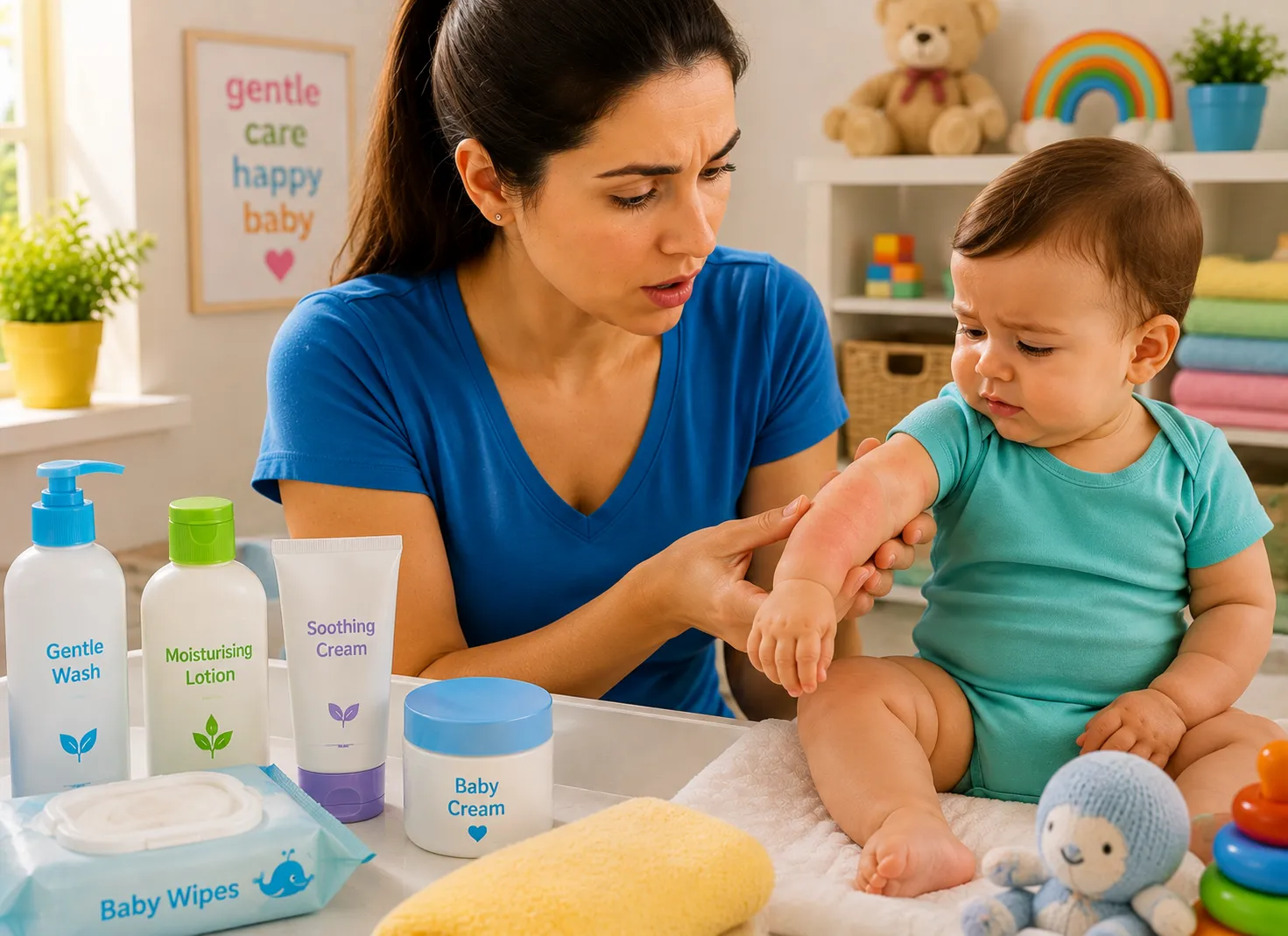
You have been using the same baby wash, moisturiser or skincare product for weeks. Everything seemed perfectly fine, and then one day your baby’s cheeks become red, their skin feels rough, or they suddenly start scratching more than usual. Naturally, the product may be the last thing you suspect because nothing about it has changed. But when it comes to a baby’s developing skin, previous tolerance does not always guarantee that the skin will respond exactly the same way forever.
This can be particularly confusing for parents because we tend to think of skincare reactions as immediate events. We imagine applying something new and seeing redness, itching or irritation within minutes or hours. Sometimes reactions do happen quickly, but skin responses can also develop gradually or appear after repeated exposure. Understanding why this happens can make it much easier to work out what has changed.
The Product Hasn’t Changed, But Your Baby’s Skin May Have
One of the most important things to understand is that baby skin is not static. During infancy and early childhood, the skin barrier is continuing to develop while constantly adapting to bathing, clothing, weather, saliva, sweat, friction and the surrounding environment. A product that seemed perfectly comfortable when the skin barrier was doing well may feel very different when that barrier is already dry or irritated.
Imagine using the same moisturiser throughout a mild week and then continuing to use it after several hot days, extra baths and a trip to the swimming pool. The bottle is exactly the same, but the condition of the skin receiving it may no longer be the same. That difference matters.
Why Can a Reaction Appear After Weeks of Use?
There is rarely one universal explanation. Sometimes repeated exposure to an ingredient can eventually become problematic for an individual child. In other situations, the product may simply become uncomfortable because dryness, inflammation or barrier disruption has made the skin more reactive than it was previously.
There may also be several pressures occurring at the same time. Heat, sweat, dribbling, swimming, frequent washing, friction from clothing and dry weather can all change how comfortable the skin feels. What appears to be a sudden reaction to one product may therefore be the point at which several smaller pressures have finally added up.
The Skin Barrier Changes the Equation
The outermost layer of skin acts as an important protective barrier. It helps hold water inside while reducing the penetration of substances from the outside environment. When this barrier becomes dry or disrupted, the skin can lose moisture more readily and substances applied to it may interact differently.
This helps explain something many parents have experienced: a product that never used to sting suddenly does. The formulation may not have become stronger overnight. The skin underneath it may simply have become more vulnerable.
Think of Baby Skin as Having a Threshold
In our book, Beyond the Skin Barrier, we explore what we call the Skin Threshold Model. Instead of assuming that every episode of dry, itchy or irritated skin must have one single cause, it can be more useful to imagine multiple pressures gradually filling a bucket. Your baby’s skin may cope comfortably while the total load remains below its individual threshold.
Then perhaps the weather becomes hotter, your baby sweats more, teething increases saliva around the face, bath frequency rises and the skin becomes slightly drier. The same skincare product is still being used, but it is now being applied to skin experiencing considerably more pressure. Eventually that cumulative load may cross the threshold and visible dryness, redness, discomfort or itching appears.
Repeated Exposure Can Matter Too
There is another possibility parents should understand. Some forms of contact dermatitis do not necessarily appear the first time a substance touches the skin. Allergic contact dermatitis involves the immune system becoming sensitised to a particular substance, which means a reaction can develop after previous exposures that appeared uneventful.
Fragrances, preservatives and various ingredients found in personal care products can sometimes be involved in contact allergy. That does not mean every ingredient with a complicated name is harmful, nor does it mean that every delayed reaction is an allergy. It simply explains why saying, “We’ve used this for weeks, so it can’t possibly be the product,” is not always a safe assumption.
Irritation and Allergy Are Not the Same Thing
This distinction is important. Irritant contact dermatitis occurs when something directly irritates or damages the skin barrier. Frequent washing, soaps, detergents, saliva and other repeated exposures can contribute, particularly when the skin is already vulnerable.
Allergic contact dermatitis, on the other hand, involves an immune response to a substance to which the person has become sensitised. The two can sometimes look similar to parents, which is why persistent or recurring reactions may require professional assessment. Trying to diagnose the difference simply by looking at a patch of irritated skin can be difficult.
Why Fragrance Deserves Particular Attention
Fragrance is one ingredient category worth checking when a baby suddenly becomes uncomfortable with a skincare product. Fragrance can contain numerous individual aromatic substances, and a beautifully scented baby product is not automatically gentler simply because it is marketed for babies. For children with very dry, irritated or eczema-prone skin, reducing unnecessary fragrance exposure can simplify the skincare environment.
This does not mean that every fragranced product will cause a problem for every baby. Many children tolerate them without obvious difficulty. But when you are trying to identify why previously comfortable skin has suddenly become itchy or irritated, fragrance is one of the things worth reviewing.
Natural Does Not Automatically Mean Reaction Proof
Parents understandably gravitate towards products described as natural, botanical or plant based. We use carefully selected natural ingredients and plant botanicals in Itch-A-Bye Baby Repair Cream, but we also believe parents deserve a more useful explanation than simply being told that natural equals safe. Any substance applied to skin has to interact with that child’s individual biology.
Plant derived ingredients can have valuable skincare properties, but individual sensitivities are still possible. What matters is thoughtful formulation, appropriate concentrations, the combination of ingredients and how the individual child’s skin responds. The best skincare routine is not the one with the most impressive label; it is the one the child’s skin actually tolerates.
Has Anything Else Changed?
Before blaming the moisturiser immediately, look at the previous few days. Has your baby been swimming? Has the weather suddenly become hotter or colder? Have you changed washing powder, fabric softener, sunscreen, shampoo, wipes, nappies, clothing or bedding?
Think about saliva as well, particularly around the cheeks, mouth, chin and neck during teething. Consider whether your baby has been sweating more at night or having longer baths. Sometimes the apparently unchanged skincare product receives the blame simply because another change was much easier to overlook.
Even the Way You Use a Product Can Change
Parents may use the same product differently without consciously noticing it. Perhaps you began applying more because the skin became dry. Maybe baths became more frequent, meaning the cleanser is now being used twice as often.
A product that was previously applied to intact skin might now be going onto areas that have been scratched. Something mild on healthy skin can feel uncomfortable on damaged skin. When investigating a reaction, therefore, ask not only “What are we using?” but also “How are we using it now?”
Don’t Change Five Things at Once
When a baby’s skin suddenly becomes irritated, the natural parental instinct is to fix everything immediately. The moisturiser changes, the body wash changes, the laundry detergent changes and three new products arrive in the bathroom. Unfortunately, that can make the mystery even harder to solve.
Unless there is a reason to stop a suspected product immediately, a methodical approach can provide much better information. Keep the routine simple and pay attention to timing, location and repeated patterns. If one change appears to improve or worsen the situation consistently, that observation can be extremely useful.
Look at Where the Reaction Appears
Location can sometimes provide clues. Irritation around the mouth and chin may point towards saliva or food contact, while irritation under clothing may make you think about heat, sweat, fabric or laundry products. Hands can be affected by frequent washing, while cheeks are constantly exposed to weather, saliva and rubbing.
If the problem appears mainly where one particular product is applied, that deserves attention. If the same product is applied everywhere but irritation consistently appears in only one small area, there may be additional local pressures involved. Patterns are often more informative than isolated episodes.
This Is Where Repair, Nourish and Defend Becomes Useful
At Itch-A-Bye, we approach dry, itchy and eczema-prone baby skin through three interconnected needs: Repair, Nourish and Defend. Repair means supporting a skin barrier that has become dry or compromised. Nourish means supplying hydration together with supportive ingredients the skin can use as it maintains and restores itself.
Defend means helping vulnerable skin maintain its protective role against everyday environmental and microbial pressures. When a baby’s skin suddenly begins reacting differently, this framework encourages us to look beyond the individual product. We ask what has happened to the barrier, what support the skin currently needs and what additional pressures may now be acting upon it.
Nourish Means More Than Moisturising
This is an important distinction in the Itch-A-Bye philosophy. Nourishing vulnerable skin is not simply about putting more water or oil onto it. Our formulation combines ingredients selected to provide complementary forms of skin support.
Black Seed Oil is valued for its anti-inflammatory and antimicrobial properties, while MSM provides additional soothing and anti-inflammatory support. Allantoin is widely used for its soothing and skin-supportive properties, while Hyaluronic Acid and Glycerin help attract and retain moisture. Vitamin C and Vitamin E derivatives, together with our specially selected botanical extracts, form part of the wider formulation designed around the synergy of Repair, Nourish and Defend.
Where Itch-A-Bye Baby Repair Cream Fits
Itch-A-Bye Baby Repair Cream was created specifically for dry, itchy and eczema-prone baby and young children’s skin. Rather than simply coating dry skin, its formulation brings together Black Seed Oil, MSM, Allantoin, Hyaluronic Acid, Glycerin, vitamins and specially selected plant botanicals within our Repair, Nourish and Defend approach. It is designed to provide practical everyday support for skin that needs more than a basic moisturising routine.
If you are introducing Itch-A-Bye or any other new skincare product to a baby whose skin has been particularly reactive, introduce it thoughtfully and observe how the skin responds. Individual skin can react differently even to carefully formulated products. What matters most is finding a simple routine that your child’s skin tolerates well and can use consistently.
Beyond the Skin Barrier
If you find yourself constantly asking, “Why did my baby’s skin suddenly react when nothing changed?”, that question is exactly why we wrote Beyond the Skin Barrier. The book explores the developing baby skin barrier, dryness, itching, environmental pressures, microbes and the many factors that can combine before symptoms finally become visible. It helps parents move away from endlessly searching for one mysterious trigger and towards understanding the bigger picture.
The central message is simple: what you see on the surface may be the final expression of several things happening underneath and around the skin. A product may be one piece of that puzzle, but it may not be the whole puzzle. Understanding the threshold can make recurring skin changes feel much less mysterious.
What Should You Do When a Familiar Product Suddenly Seems to Cause a Reaction?
Start by stopping and observing rather than immediately adding more products. Think about everything that has changed recently, including weather, swimming, bathing, laundry products, wipes, sunscreen, clothing, saliva, sweating and the frequency with which existing products are being used. If one product strongly appears to be associated with the reaction, discontinue it and see whether the pattern improves.
For mild dryness, returning to a simple, well tolerated routine can sometimes help you identify what the skin actually needs. If the reaction keeps returning, becomes widespread or is difficult to understand, professional assessment can help distinguish irritation from allergy and other skin conditions. Patch testing may sometimes be considered when allergic contact dermatitis is suspected.
When Should Parents Seek Medical Advice?
Seek professional advice when a baby’s skin reaction is persistent, severe, spreading or repeatedly returning despite removing suspected irritants. Medical assessment is also appropriate when itching significantly affects sleep or when you cannot identify why the skin continues deteriorating. Babies can develop several different skin conditions that may look surprisingly similar without proper assessment.
More urgent assessment is appropriate if there is significant swelling, difficulty breathing, widespread hives, rapidly worsening symptoms or the baby appears seriously unwell. Skin that becomes increasingly painful, hot, swollen, weeping, blistered or heavily crusted should also be assessed. Those situations should not be managed simply by experimenting with different skincare products.
Frequently Asked Questions
Can a baby suddenly become sensitive to a moisturiser they’ve used for months?
Yes, it is possible for previously tolerated products to become associated with irritation or an allergic contact reaction. The condition of the baby’s skin may also have changed, making previously comfortable ingredients feel irritating. Other environmental pressures can occur at exactly the same time, so the product is not automatically the cause. Look at the complete pattern rather than assuming previous tolerance rules the product out.
Why would a product suddenly sting my baby’s skin?
Damaged, scratched or extremely dry skin can respond differently from an intact skin barrier. A product that previously felt comfortable may sting when applied to compromised areas. That does not automatically prove an allergy. Persistent stinging or worsening irritation is nevertheless a reason to stop and reassess what is being applied.
Can babies develop an allergy after using something repeatedly?
Yes. Allergic contact dermatitis can occur after sensitisation to a substance, meaning previous exposure may have occurred without an obvious reaction. Fragrances and preservatives are among the substances that can sometimes be involved. Determining the responsible allergen can be difficult without professional assessment. Patch testing may be used in selected cases.
Should I throw away every product we’re using?
Usually, changing everything simultaneously makes it harder to identify what happened. Review the products and exposures most closely associated with the reaction and simplify the routine. Keep notes or photographs if reactions repeatedly appear and disappear. Patterns across several episodes can reveal much more than one isolated flare.
Could the weather make a familiar product suddenly feel irritating?
Yes. Cold dry air, heat, sweat, swimming and increased bathing can all alter the condition of the skin barrier. A product is therefore interacting with skin that may be in a very different condition from several weeks earlier. This is one reason the Skin Threshold Model can be so useful. The apparent trigger may simply be the final addition to several accumulating pressures.
Is fragrance-free better for very dry or irritated baby skin?
Removing unnecessary fragrance can simplify the routine when a baby’s skin is very dry, itchy or reactive. Fragrance ingredients can cause irritation or contact allergy in some individuals. This does not mean every fragranced product is harmful to every child. It simply removes another variable when you are trying to keep vulnerable skin care straightforward.
Can natural skincare products still cause reactions?
Yes. Natural origin does not guarantee that every ingredient will suit every person. Botanical ingredients contain biologically active compounds, and individual sensitivities can occur. A thoughtfully formulated natural product can provide valuable skin support while still requiring the same sensible observation you would give any skincare product. Your baby’s individual response remains important.
How does the Skin Threshold Model explain sudden reactions?
The model proposes that several smaller pressures can accumulate until the skin reaches a point where symptoms become visible. Dryness alone may not be enough, and sweat alone may not be enough, but dryness, heat, friction, swimming and another exposure together may cross the child’s threshold. This helps explain why the final event can look like the sole cause even when several factors contributed. Beyond the Skin Barrier explores this concept in much greater depth.
The Most Important Thing to Remember
When your baby’s skin suddenly reacts to something you have used comfortably for weeks, don’t dismiss the product simply because it was previously tolerated. But don’t automatically blame it either. Look at the skin barrier, the environment, repeated exposures and everything else that has changed around your baby.
Baby skin exists in a constantly changing environment, and its tolerance can change with it. Understanding that bigger picture is one of the reasons we developed the Repair, Nourish and Defend approach and explored the Skin Threshold Model in Beyond the Skin Barrier. Sometimes the question is not simply, “What product caused this?” but “What changed enough to push my baby’s skin beyond its comfortable threshold?”