
Why We Recommend Itch-A-Bye After Every Swim: The Science, Ingredients and Parent Experiences Behind Our After-Pool Routine
Swimming should be one of the uncomplicated pleasures of childhood. A child gets into the water, plays, learns, splashes around with friends and eventually comes out tired and happy. But for some families, particularly those caring for children with dry, itchy or eczema-prone skin, there can be another part of the experience waiting in the changing room. The skin that seemed comfortable before swimming may begin to feel dry, tight or itchy afterwards. Sometimes the scratching starts almost immediately, while for other children it becomes noticeable later that evening. After seeing the same pattern repeatedly, parents naturally begin asking whether there is something they could do differently.
At Itch-A-Bye, we have become particularly interested in that question because swimming has emerged as one of the situations in which families have told us they find the cream especially useful. Their experiences encouraged us to look more closely at what happens to vulnerable skin around swimming and why prompt moisturising afterwards makes sense. They also made us look again at the formulation itself, because Itch-A-Bye contains several ingredients selected for different aspects of dry, uncomfortable and easily irritated skin. None of this means every child will respond in exactly the same way, and customer experiences should never be confused with clinical evidence. But when established skincare principles, ingredient research and real-world experience begin pointing in a similar direction, the pattern is worth exploring carefully.
What Actually Happens to Skin During a Swim?
When we think about swimming pools and sensitive skin, chlorine usually receives most of the attention. Chlorine is there for an important reason: it helps control potentially harmful microorganisms and keeps swimming water safer for everyone using it. The problem is not that chlorine is inherently “bad” for children’s skin, nor does every child react badly to a chlorinated pool. Rather, repeated or prolonged exposure to treated water can contribute to dryness or discomfort in skin that is already vulnerable. A child who begins the swimming lesson with perfectly comfortable skin may notice very little, while another whose skin is already dry may feel the difference much more strongly afterwards.
There are other factors at work as well, and this is where the story becomes more interesting. A swimming lesson can mean forty-five minutes or an hour immersed in water, followed by evaporation as the child gets out, towel drying, tight wet swimwear and friction while changing clothes. Warm swimming centres can add sweat, while outdoor pools introduce sunshine and sunscreen into the equation. If the child starts scratching, that adds another source of physical stress to skin that may already feel uncomfortable. Seen this way, post-swim dryness is not necessarily about finding one culprit. It can be the result of several relatively ordinary things happening to the skin within a short period.
The Pool Is Not the Enemy
We think this distinction matters because parents of children with troublesome skin already have enough things to worry about. Swimming has enormous social, developmental and practical value, and learning to swim is particularly important for children growing up in countries such as Australia. We do not want parents reading about chlorine and concluding that their child should automatically stop swimming. Many children with dry or eczema-prone skin swim regularly and do very well. The more useful approach is to understand how your own child’s skin behaves and build a sensible routine around it.
That means observing rather than assuming. Does the skin become dry after every swim, or only after particularly long lessons? Does scratching begin while the child is still wearing wet swimwear, or several hours later? Are certain areas, such as behind the knees, around the elbows or underneath swimsuit edges, affected more than others? Small observations like these can tell parents far more than simply deciding that “chlorine causes the problem.” Once a pattern becomes clear, the after-swim routine can be adjusted accordingly.
Why Moisturising After Swimming Makes Sense
One of the most consistent pieces of advice in dermatological guidance for children with eczema-prone or very dry skin is remarkably simple: rinse after swimming and moisturise promptly. This is not an exotic intervention, and it does not require a complicated collection of skincare products. Fresh water helps remove residual pool or seawater from the skin, while gentle drying avoids adding unnecessary friction. Applying an appropriate moisturiser soon afterwards then helps address the dryness that may follow water exposure. For many families, this simple sequence is a far more practical starting point than abandoning swimming altogether.
Timing also matters because the easiest routine is usually the one performed while you are still thinking about swimming. If the moisturiser is at home, twenty or forty minutes may pass before anyone remembers it. By then the child may already be scratching, dinner may need preparing and the swimming bag may have been abandoned somewhere near the front door. Keeping the skincare product in the swimming bag removes one of those small obstacles. The routine becomes part of getting changed rather than another job waiting for the family at home.
Why We Started Recommending Itch-A-Bye After Swimming
Itch-A-Bye was not originally developed as a specialist swimming cream. It was created for babies and young children with dry, itchy and eczema-prone skin, using a formulation philosophy centred on supporting skin from several directions rather than relying on one fashionable ingredient. Over time, however, families began telling us about situations in which they found the cream particularly useful. Swimming was one of those situations, and those experiences caught our attention. They made us consider whether the formulation we had built for vulnerable skin happened to fit particularly well into the needs of an after-swim routine.
That is why we now believe Itch-A-Bye Baby Repair Cream can be a particularly useful product to keep in the swimming bag. We are not saying that it chemically neutralises chlorine, nor are we claiming that it prevents every possible reaction to swimming-pool water. Our reasoning is simpler and, we think, more defensible than that. Swimming can leave vulnerable skin needing moisture, conditioning and gentle support, and those were already central considerations behind the Itch-A-Bye formulation. The product and the situation therefore fit together naturally.
We Built the Formula Around a Team, Not a Star
Skincare marketing has become fascinated with hero ingredients. A company discovers one interesting botanical or active, puts its name in enormous lettering on the package and builds the entire product story around it. There is nothing inherently wrong with highlighting a good ingredient, but skin does not necessarily have only one need at a time. Dry skin may need hydration while also feeling itchy, rough or easily irritated. That led us towards a different formulation philosophy.
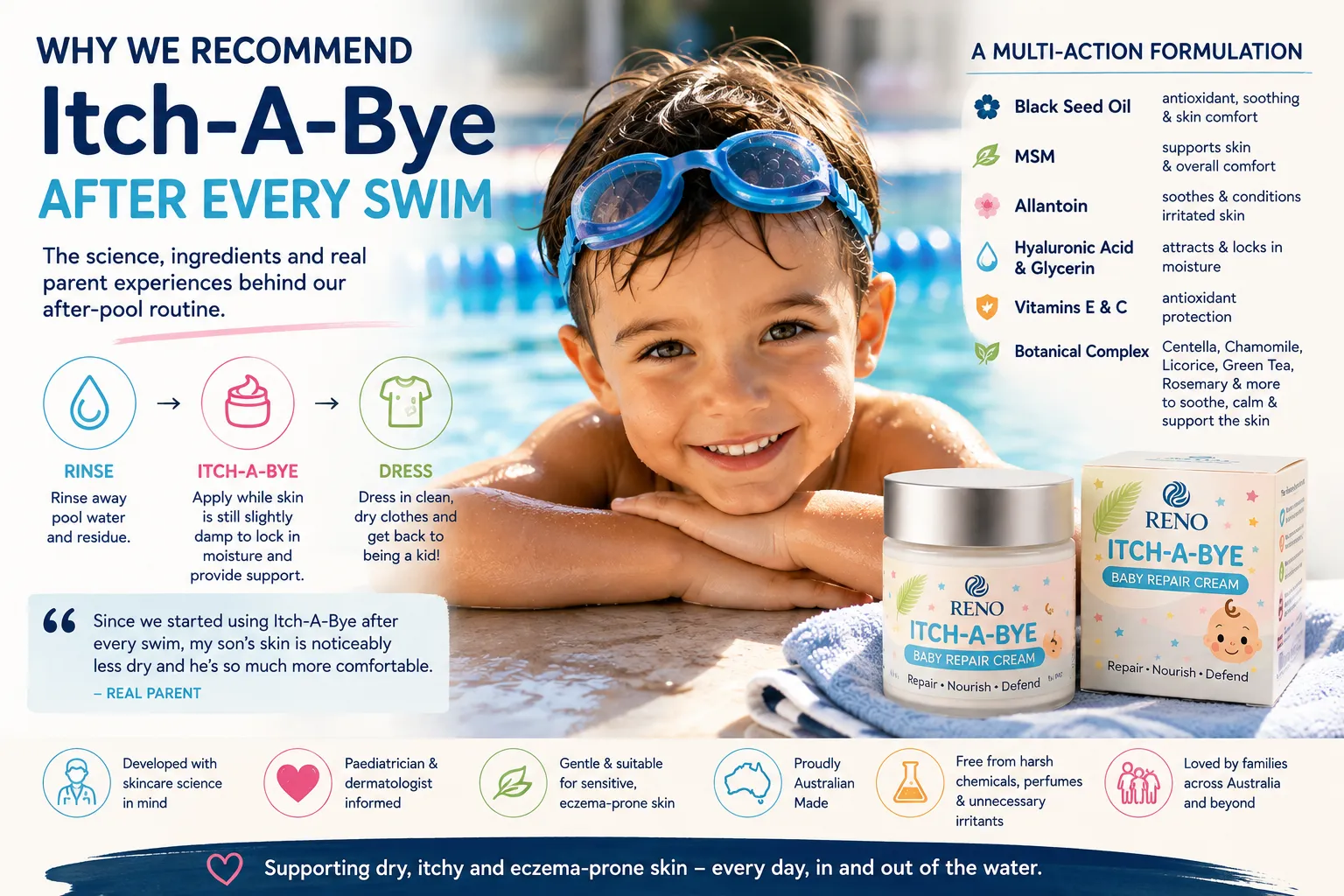
At the heart of Itch-A-Bye are Black Seed Oil, MSM and Allantoin, supported by Hyaluronic Acid, Glycerin, Tocopherol (Vitamin E), Ascorbyl Palmitate and Caprylic Acid. The formulation also incorporates a botanical complex containing Centella asiatica, Chamomile, Licorice, Scutellaria baicalensis, Rosemary, Polygonum cuspidatum, Green Tea and Ginger. We did not include all of these ingredients because a longer ingredient list automatically makes a better cream. We included different ingredients because they can contribute different properties to the overall formulation. For us, the interesting question has always been how those components work together.
Start With Something Very Ordinary: Moisture
It is easy to make skincare sound extraordinarily complicated, but sometimes the most important requirement is the most obvious one. Dry skin needs moisture support, and that becomes especially relevant when a child has just spent a considerable period in water. Itch-A-Bye therefore contains Glycerin and Hyaluronic Acid, two ingredients widely used in skincare because of their ability to support hydration. Glycerin acts as a humectant, helping attract and retain water within the outer layers of the skin. Hyaluronic Acid is also valued for its water-binding properties.
These ingredients are not included because they make dramatic advertising claims. They are included because hydration is one of the basic things dry skin needs. After swimming, when a child’s skin begins feeling tight or rough, that simple role becomes particularly easy to understand. But hydration alone does not explain everything parents tell us about uncomfortable skin. That is why the formulation continues beyond Glycerin and Hyaluronic Acid.
Why Allantoin Matters to Us
Allantoin is one of those ingredients that quietly appears in many well-considered skincare formulations without receiving much attention from consumers. It is widely used for its skin-conditioning and soothing properties and has a long history in products intended for dry, rough or easily irritated skin. Those qualities made it a natural fit for the type of formulation we were trying to create. They also make its presence particularly relevant when thinking about skin after swimming. A child may have experienced water exposure, friction from swimwear, towel drying and perhaps scratching within the space of an hour.
At that point, the last thing we want is a skincare routine that feels aggressive or unnecessarily complicated. We want the moisturising stage to be the gentle part of the experience. Allantoin contributes to that broader formulation philosophy rather than being expected to solve everything by itself. It works alongside humectants, oils and other conditioning ingredients. That is exactly how we prefer to formulate.
Black Seed Oil Is One of the Ingredients That Started the Story
Black Seed Oil, derived from Nigella sativa, is particularly important within Itch-A-Bye. The plant contains naturally occurring compounds including thymoquinone, and Nigella sativa has been extensively investigated in scientific literature for a range of biological properties. Research has explored antioxidant, anti-inflammatory and antimicrobial activity associated with Black Seed Oil and some of its constituents. That scientific interest was one of the reasons the ingredient became so compelling to us during formulation. It offered a very different contribution from ingredients whose primary job is simply hydration.
There is an important line we do not want to cross, however. Research involving Nigella sativa or thymoquinone does not automatically prove that a finished jar of Itch-A-Bye treats eczema, neutralises chlorine or prevents a swimming-related flare. Those would require evidence about the finished product itself, and individual ingredient studies should not be presented as though they provide that evidence. What the research does help explain is why we selected Black Seed Oil as part of a formulation for dry, itchy and easily irritated skin. Keeping those two ideas separate allows us to talk about interesting ingredient science without turning it into a medical promise.
MSM Adds Another Dimension
MSM, or methylsulfonylmethane, is another central component of the formulation. It has attracted scientific interest in several areas, including its potential anti-inflammatory and antioxidant properties, although the strength and relevance of evidence vary according to the application being studied. For us, MSM became interesting as part of a wider formulation rather than as a standalone treatment. We wanted ingredients that could complement one another rather than compete for attention on the front of the jar. That principle becomes especially relevant when skin is facing several pressures simultaneously.
Think again about the child leaving the swimming pool. The skin may be dry from water exposure, warm from activity, rubbed by clothing and irritated by scratching. There is no obvious reason to assume one ingredient should address every aspect of that experience. A formulation containing different complementary components makes more sense to us. MSM therefore sits within the team rather than being asked to become the entire team.
Then There Is the Botanical Complex
Itch-A-Bye also contains Centella asiatica, Chamomile, Licorice, Scutellaria baicalensis, Rosemary, Polygonum cuspidatum, Green Tea and Ginger. Many of these plants and their naturally occurring compounds have been studied for properties relevant to skincare, including antioxidant, soothing and conditioning effects. Again, we have to distinguish research into individual plants or extracts from clinical evidence about the complete Itch-A-Bye formulation. We think that distinction actually makes the ingredient story more credible, not less. Parents deserve to know what science can tell us and where its limits lie.
The reason for bringing these botanicals together was not to make the ingredient list look impressive. It was to create a broader formulation in which different components could contribute different properties. That idea of ingredient synergy is fundamental to the way we think about Itch-A-Bye. Rather than searching endlessly for the next miracle ingredient, we are more interested in how carefully selected ingredients behave as part of a complete formula. In our view, the formulation should be the hero.
Repair, Nourish and Defend
We eventually came to describe this way of thinking through three words: Repair, Nourish and Defend. Repair reflects our aim of supporting dry, stressed skin. Nourish represents the moisturising and conditioning components of the formulation. Defend reflects our approach to supporting vulnerable skin and its natural protective role against everyday environmental and microbial pressures. Together, these ideas form what we call our Skin Trifecta philosophy.
Swimming provides an unusually clear example of why this broader thinking appeals to us. The child is not experiencing only water, only chlorine or only friction. Several things may be happening at once, particularly if their skin was already dry before they entered the pool. It therefore makes sense to approach after-swim care with something more thoughtful than simply waiting until the child starts scratching. The Trifecta gives us a framework for thinking about that support without pretending that skincare can eliminate every trigger.
What Parents Have Taught Us
There is another kind of information that matters to product developers, even though it should never be confused with clinical research. It is what happens when real families take the product home and begin using it in situations we did not necessarily anticipate. Parents have shared positive experiences with Itch-A-Bye around swimming and after-pool dryness, itching and irritation. Those reports helped bring after-swim care much more clearly into our thinking. They are one of the reasons we now actively discuss swimming when explaining where Itch-A-Bye may fit into family life.
A parent experience is exactly that: one family’s experience. It cannot tell us that every child will respond identically, and we should never turn a testimonial into a universal scientific claim. But repeated feedback can still tell a company something valuable about how people actually use its product. In this case, families helped us see that Itch-A-Bye was becoming part of some children’s swimming routines. We thought that was worth listening to.
Our After-Swim Routine Is Deliberately Simple
After looking at all of this, we came back to a routine that could hardly be simpler. When the child finishes swimming, rinse their skin with clean fresh water and remove the wet swimming costume. Pat the skin gently rather than rubbing vigorously, leaving it slightly damp. Then apply an appropriate moisturiser and dress the child in clean, comfortable clothing. For families already using Itch-A-Bye, the routine becomes very easy to remember.
RINSE → ITCH-A-BYE → DRESS
We like this routine precisely because it does not require parents to become skincare experts. There are no seven stages and no collection of products that need to be applied in a particular order. The child swims, the pool water is rinsed away, the skin receives moisturising support and life continues. That is the kind of routine families can realistically repeat every week. Consistency often becomes easier when the process itself is uncomplicated.
What About Applying Cream Before Swimming?
For children whose skin tends to become particularly dry, parents may also encounter recommendations to moisturise before swimming. The idea is to prepare the skin before entering the water and then rinse and moisturise again afterwards. Whether that approach suits your child will depend on their skin, the product being used and any advice you have received from their healthcare professional. Some families may find the before-and-after approach useful, while others may only need the post-swim routine. There is no reason every child’s routine has to look identical.
What matters more is recognising predictable patterns. If you know that swimming almost always leaves your child’s skin uncomfortable, it makes sense to think about skincare before you arrive at the pool rather than waiting for the itching to begin. Pack the moisturiser with the goggles and towel. Make it part of the swimming routine rather than an emergency response. That small change in timing may be one of the most practical lessons in this entire discussion.
Salt Water Deserves Its Own Consideration
It is also worth remembering that swimming does not always mean chlorine. Some children spend more time at the beach than in swimming pools, particularly during an Australian summer. Salt water can feel perfectly comfortable on some skin, while it can sting areas that are scratched, cracked or already very dry. Sand, wind, sunscreen and wet clothing can add further sources of friction or irritation. The same child may even respond differently from one beach day to another depending on the condition of their skin beforehand.
The basic after-swim principles still make sense. Rinse away salt and sand with fresh water when possible, avoid aggressive towel rubbing and change out of wet clothing. Then moisturise the skin while it is still slightly damp. Itch-A-Bye can fit into that routine in exactly the same way it fits into a pool routine. The water may be different, but the skin still deserves some attention afterwards.
When a Cream Is Not the Answer
There are also times when we would not suggest simply reaching for the moisturiser and carrying on as usual. If your child’s skin is extensively broken, weeping, crusting, increasingly painful, swollen or showing other signs that concern you, swimming may need to wait. Skin that appears infected or is deteriorating rapidly deserves appropriate professional assessment. A cosmetic product should never be positioned as a substitute for that assessment. Itch-A-Bye is designed as skincare for dry, itchy and eczema-prone skin, not as a medicine for infection or another medical condition.
We think being clear about that boundary is especially important when discussing children’s skincare. Parents need useful information, not exaggerated promises. A good skincare routine can play an important role in everyday care, but it cannot answer every problem a child’s skin may develop. Knowing when ordinary care is appropriate and when to seek help is part of looking after vulnerable skin responsibly. That principle applies at the swimming pool just as much as it does at home.
The Bigger Lesson Goes Beyond Swimming
One of the ideas we explore in Beyond the Skin Barrier: Uncovering the Hidden Roots of Dry, Itchy and Eczema-Prone Skin is that parents can become trapped looking for a single cause. When the skin flares after swimming, chlorine becomes the obvious suspect. But perhaps the child entered the pool slightly dry, stayed in the water for an hour, remained in wet swimwear afterwards, became warm, was rubbed vigorously with a towel and then scratched. The final discomfort may reflect the accumulation of several small pressures rather than one dramatic event. Thinking in combinations can sometimes be much more useful than searching endlessly for one culprit.
That is also why our formulation philosophy developed the way it did. We do not believe every skin problem can be reduced to one missing ingredient, so we do not build Itch-A-Bye around one ingredient pretending to solve everything. Black Seed Oil, MSM, Allantoin, Glycerin, Hyaluronic Acid, vitamins and botanicals each bring something different to the formulation. The aim is to create complementary support rather than a single dramatic mechanism. Parents who want to explore this broader way of thinking can read the complete digital edition of Beyond the Skin Barrier free.
Why We Recommend Itch-A-Bye After Every Swim
After looking at the science, the ingredients, professional skincare principles and the experiences families have shared with us, our recommendation is straightforward. If your child has dry, itchy or eczema-prone skin and swimming regularly leaves them uncomfortable, consider making prompt after-swim moisturising part of every swimming session. Itch-A-Bye is particularly well suited to that routine because it was already formulated around the needs of dry, itchy and easily irritated skin. It combines hydration-supporting ingredients with skin-conditioning components and a broader botanical formulation rather than relying on a single hero ingredient. And, importantly for us, parents themselves helped draw our attention to how useful the cream could be around swimming.
That does not mean we promise that Itch-A-Bye will prevent every flare, neutralise chlorine or produce the same result for every child. It means we believe there is a sensible, evidence-informed reason for placing the cream in the swimming bag and using it as part of a consistent after-swim routine. Children should be able to enjoy swimming without parents spending the entire lesson worrying about what their skin might look like afterwards. Sometimes the best routines are not the complicated ones. They are the ones simple enough to become habits.
Next Time You Pack the Swimming Bag
Before the next lesson, look inside the swimming bag. There will probably be goggles, a towel, dry clothes and all the other little things your child needs. If their skin regularly becomes dry or itchy after swimming, add their skincare to that mental checklist too. For families who use Itch-A-Bye, keeping a jar in the swimming bag means it is there when the swimming finishes rather than sitting at home when you need it. Then the after-swim routine becomes something almost automatic.
Rinse the skin. Apply Itch-A-Bye. Put on the dry clothes. Then let your child get on with being a child. There is no need to turn every swimming lesson into a discussion about troublesome skin. Good skincare often works best when it quietly becomes part of ordinary family life. That is ultimately what we want Itch-A-Bye to become for families who find it useful after swimming. Not the centre of the swimming experience, but a simple part of taking care of the skin afterwards.
This article provides general educational information and does not replace medical advice. Itch-A-Bye is a cosmetic skincare product for dry, itchy and eczema-prone skin and is not presented as a medicine or treatment for eczema, infection, allergy or another medical condition. Individual experiences vary. Seek appropriate professional advice for severe, persistent, infected-looking, weeping, extensively broken or otherwise concerning skin.