
Baby Eczema vs Contact Dermatitis: What’s the Difference?
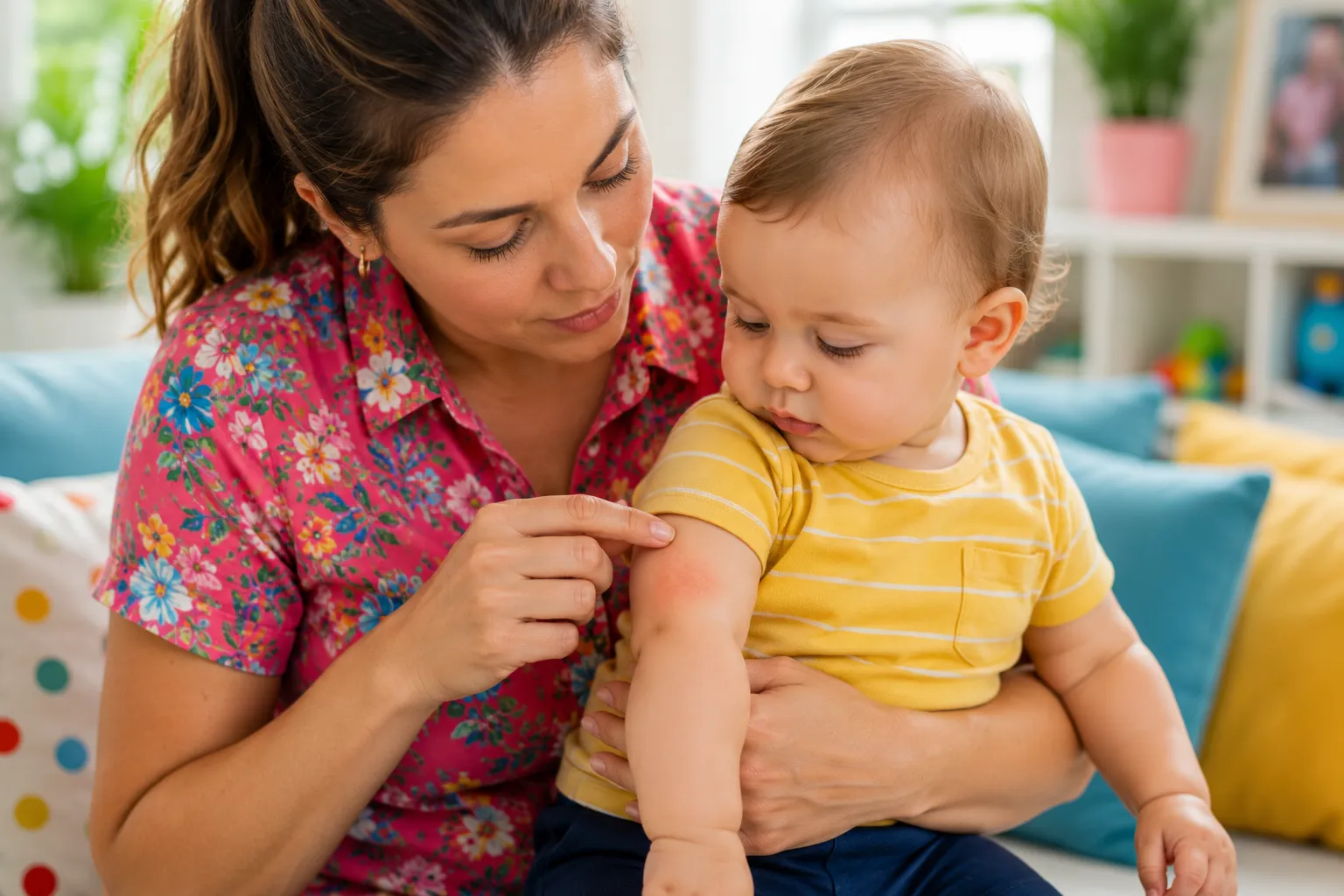
A baby’s red, itchy or irritated skin can be difficult to understand because several different skin problems can look surprisingly similar. Two that parents commonly confuse are baby eczema and contact dermatitis, particularly when the skin becomes dry, rough, red or uncomfortable. Both can itch, both can appear after exposure to everyday products or fabrics, and both can affect skin that is already vulnerable. Yet the pattern behind them can be quite different. Eczema usually behaves as a recurring inflammatory skin condition with dryness and itching at its centre, while contact dermatitis is more directly associated with something that has come into contact with the skin. Understanding that difference can help parents look for useful patterns rather than assuming every new patch is simply another eczema flare.
One of the most useful questions is “What touched this part of my baby’s skin before the irritation appeared?” Contact dermatitis can develop after exposure to things such as saliva, soaps, cleansers, wipes, fragrances, detergents, fabrics, adhesives or skincare products. Eczema can also become worse after contact with irritating substances, but it often has a longer history of dryness, itching and recurring flare ups. This means something touching the skin may aggravate existing eczema without necessarily being the reason the baby has eczema in the first place. Timing, location, previous skin history and what happens when the suspected exposure is removed can therefore provide valuable clues. Instead of concentrating only on what the rash looks like today, it helps to understand what the skin has been doing over several days or weeks.
The Quick Difference Between Baby Eczema and Contact Dermatitis
Baby eczema usually behaves as a recurring skin pattern rather than a single isolated reaction. Parents may notice dry and rough areas that become increasingly itchy or inflamed before improving and then returning again. Sometimes the same parts of the body repeatedly become troublesome, while other babies experience problems across several areas. Heat, sweat, dry air, friction, soaps and other everyday pressures may make the skin feel worse. There may not always be one obvious new exposure immediately before a flare. That repeating tendency towards dry, itchy and inflamed skin is an important part of the eczema picture.
Contact dermatitis is more directly associated with something contacting the skin and causing irritation or an allergic reaction. The affected area may correspond quite closely with where that exposure occurred. Saliva, for example, can repeatedly contact the mouth and chin, while a particular wipe may affect the areas where it is frequently used. Laundry products, creams, shampoos, adhesives, fabrics and other substances can create similar patterns in susceptible individuals. Removing the exposure may allow the irritated skin to settle, although improvement is not necessarily immediate. The relationship between contact, location and timing is therefore one of the most valuable clues.
Baby Eczema vs Contact Dermatitis at a Glance
| What you notice | Baby eczema | Contact dermatitis |
|---|---|---|
| Typical pattern | Recurring dry, itchy inflammation | Irritation associated with direct contact |
| Main clue | Repeated flare pattern | Exposure before irritation |
| Dryness | Very common | Can occur |
| Itching | Often prominent | Common |
| Location | May affect several characteristic areas | Often corresponds with contact area |
| Recurrence | Common | May return with repeat exposure |
| New product connection | Can aggravate eczema | Can be particularly relevant |
| Clear boundary | Not always | Sometimes more defined |
| Removing exposure | May help | Often particularly important |
| Underlying skin tendency | Often persistent | May be exposure specific |
This comparison is useful for organising observations, but it should not be treated as a home diagnostic test. Contact dermatitis itself can be divided into irritant contact dermatitis and allergic contact dermatitis, and those two processes are not identical. Eczema can also coexist with contact irritation, particularly when the skin barrier is already compromised. A baby with eczema may therefore develop contact dermatitis on top of their existing skin problem. Other childhood skin conditions can also resemble either one. The aim is to recognise useful clues while knowing when professional assessment is needed.
What Is Contact Dermatitis?
Contact dermatitis occurs when the skin reacts after direct contact with a substance or material. Irritant contact dermatitis happens when something physically or chemically irritates the skin, particularly after repeated exposure. Allergic contact dermatitis involves an immune response to a particular substance after sensitisation has occurred. Everyday exposures such as saliva, cleansers, soaps, wipes and friction can contribute to irritation around vulnerable baby skin. Allergic reactions are possible as well, although determining the exact cause may require professional evaluation. Simply seeing a red patch cannot tell parents which process is responsible.
The location can sometimes provide a valuable clue. Irritation occurring mainly around the mouth invites questions about saliva, food, frequent wiping and products applied to that area. Irritation beneath an adhesive, around the edge of clothing or exactly where a topical product was applied creates another useful pattern. The closer the affected area corresponds with a particular exposure, the more relevant that exposure becomes. However, location alone still does not prove causation. It should be considered alongside timing, recurrence and the baby’s previous skin history.
What Does Baby Eczema Usually Look and Feel Like?
Baby eczema tends to involve dryness, itching and recurring inflammation. The affected skin may feel rough even when it is not dramatically red, and babies may rub or scratch areas that look relatively mild to an adult. The cheeks and scalp can be troublesome during infancy, while other areas of the body may become involved as well. The skin may settle considerably and then flare again days or weeks later. Sometimes parents struggle to identify one particular event that explains why it returned. This repeating behaviour is one of the clues that separates eczema from a simple one off irritation.
If you are unsure whether you are seeing eczema or ordinary dryness, our cornerstone article Baby Dry Skin vs Eczema: How Can Parents Tell the Difference? explores that question in much greater detail. It examines itching, recurrence, texture, inflammation and the way skin changes over time. Those same observations become particularly useful when trying to distinguish eczema from contact dermatitis. The important question is whether your baby’s skin seems generally prone to becoming dry and itchy even when there has been no obvious new contact exposure. If the answer is yes, contact irritation may only be one piece of a larger picture.
Why Eczema and Contact Dermatitis Can Occur Together
A baby with eczema may already have a skin barrier that is struggling to retain moisture and protect the surface effectively. When that vulnerable skin encounters saliva, frequent wiping, harsh cleansing or another irritating substance, it may react more strongly than comfortable skin would. Something relatively ordinary can therefore add another layer of pressure to an existing eczema flare. Parents may understandably conclude that the latest product caused the entire problem. In some situations, however, it may simply have aggravated skin that was already vulnerable. Distinguishing between the underlying tendency and the latest aggravating factor can be extremely useful.
This overlap also explains why changing every product at once is rarely the best investigative strategy. Parents understandably become frustrated and replace the detergent, body wash, wipes, moisturiser and clothing all within a few days. If the baby’s skin subsequently improves, it becomes almost impossible to know which change actually mattered. Where appropriate, a simpler approach is to remove the most likely unnecessary exposure and observe what happens. One carefully observed change can sometimes provide more information than five simultaneous ones. The goal is to reduce guesswork rather than create a constantly changing skincare environment.
Look Carefully at Where the Irritation Starts
Location can tell parents a surprising amount. Contact dermatitis often develops where the skin repeatedly encounters something. Around the mouth and chin, saliva, food residue and wiping become obvious considerations. Around the neck, drool, milk, sweat and friction may interact. Beneath clothing, detergents, fabric friction, heat and trapped moisture may all need to be considered. On the hands, repeated cleansing or contact with products can create yet another pattern.
Eczema can affect some of these exact locations, which is why location cannot solve the puzzle by itself. However, eczema may also appear in several places without one obvious common contact exposure. If familiar areas become dry and itchy repeatedly, the baby’s wider skin history becomes increasingly important. If one sharply localised area changes after a very specific exposure, contact irritation deserves closer consideration. Think of location as one piece of evidence rather than the final answer.
Saliva Can Create a Classic Contact Pattern
Drool is one of the most common everyday exposures affecting baby skin. A teething baby’s chin and mouth may be repeatedly covered with saliva throughout the day. The skin gets wet, is wiped clean, becomes wet again and is repeatedly exposed to friction. Over time, that cycle can leave the area looking red, rough, dry and uncomfortable. It is easy to see why parents may assume they are looking at eczema. Sometimes repeated saliva contact is playing a much larger role.
The situation becomes more complicated when the baby already has eczema prone skin. Saliva may then aggravate an area that was already vulnerable, meaning eczema and contact irritation can overlap. Our guide to baby dry skin on the face examines some of these everyday facial pressures in more detail. Later in this series we will also explore Dry Skin Around Baby’s Mouth: Is Drool Making It Worse? and Baby’s Chin Is Red and Dry: Drool, Food or Irritation? Giving these specific parent questions their own articles allows us to investigate them much more carefully.
Wipes, Soaps and Cleansers Can Provide Another Clue
Baby wipes are convenient, but they also combine cleansing ingredients with repeated physical wiping. Most babies tolerate appropriate wipes perfectly well, but irritated or eczema prone skin may sometimes be less tolerant. If redness repeatedly develops in exactly the places where a particular product is being used, that observation deserves attention. The same principle applies to soaps, shampoos, body washes and other cleansers. Timing and location matter considerably more than simply declaring an ingredient universally good or bad. Every baby’s skin is different.
It is also important not to turn this into unnecessary fear of skincare ingredients. The presence of an ingredient does not automatically mean it caused a reaction. What matters is whether a consistent relationship exists between exposure and what happens to your baby’s skin. If irritation repeatedly follows the same exposure and improves after that exposure is removed, the pattern becomes more meaningful. If the baby appears to react to numerous unrelated products, underlying barrier vulnerability may deserve closer consideration. This is where a broader understanding of dry and eczema prone skin becomes valuable.
Fragrance Can Complicate the Picture
Fragrance is one ingredient parents frequently question when their baby’s skin becomes irritated. Fragranced products may irritate some vulnerable skin, while certain fragrance components can also be involved in allergic contact reactions in susceptible people. For babies with persistently dry or eczema prone skin, keeping the routine simple and reducing unnecessary fragrance exposure can remove one variable. That does not mean fragrance is responsible for every flare. It means it is one potential exposure worth considering when the pattern makes sense.
Later in this series we will explore Can Fragrance Make Baby’s Dry, Itchy Skin Feel Worse? and Fragrance Free vs Unscented Baby Cream: What’s the Difference? These questions matter because the language on baby skincare products can sometimes create more confidence than understanding. Parents need to know what labels actually mean rather than simply choosing whichever bottle sounds gentlest. This also applies to terms such as natural, hypoallergenic, dermatologically tested and paediatrician tested. Each deserves proper explanation rather than marketing shorthand.
Allergic Contact Dermatitis Is Different From Simple Irritation
Not every contact reaction happens because a product is simply too harsh. Allergic contact dermatitis involves an immune response to a particular substance after sensitisation has developed. One reason this can be confusing is that the reaction may not necessarily appear immediately after exposure. Hours or even longer may pass before the skin changes become obvious. This makes it easier to blame the wrong product. Determining whether a reaction is allergic may require professional assessment and, in some situations, specialist testing.
This delayed pattern also explains why previous tolerance does not always rule out a later problem. A baby may have encountered something many times before parents begin noticing a consistent reaction. At the same time, skin can become more vulnerable because of dryness, eczema, weather or repeated irritation. Several things may therefore change simultaneously. A carefully recorded history becomes much more valuable than trying to reconstruct events from memory weeks later. This is one reason we will eventually introduce a Baby Skin Trigger Tracker as part of this article series.
Does the Irritation Follow a Clear Boundary?
Sometimes contact dermatitis produces a remarkably useful visual clue. The affected skin may correspond with the exact area covered by an adhesive, clothing edge, bib or topical product. That kind of distribution makes direct contact more relevant. Eczema frequently has less precise boundaries and can involve broader areas of dry or inflamed skin. However, eczema can sometimes appear quite well defined too. No border should therefore be treated as a diagnostic fingerprint.
The combination of clues matters more. A sharply localised area plus a new exposure plus improvement after removing that exposure creates a stronger pattern than any one of those features alone. Conversely, widespread recurring dryness and itching without one obvious contact event creates a different picture. Taking photographs can help when the appearance changes rapidly. Try to photograph the skin in similar lighting so comparisons are meaningful.
What Happens When You Remove the Suspected Exposure?
Removing an unnecessary suspected irritant can sometimes provide useful information. If a particular wipe, cleanser, fragranced product or fabric seems associated with a localised reaction, stopping that exposure may allow the skin to recover. Improvement makes the exposure more relevant, although it still does not automatically prove the diagnosis. If the same problem repeatedly returns after the same exposure, the relationship becomes harder to ignore. This is particularly useful information to share with a healthcare professional.
Eczema can also improve when irritating exposures are removed. The difference is that the underlying tendency towards dry and itchy skin may remain. Parents can therefore remove an irritant, see substantial improvement and understandably believe they have found the entire cause of their baby’s eczema. Sometimes they have instead removed one pressure acting on already vulnerable skin. That distinction becomes important when symptoms return months later for an apparently unrelated reason.
Scratching Can Blur the Original Picture
Scratching makes almost every irritated skin condition harder to recognise. A small area of contact irritation can become larger, redder and more damaged after repeated rubbing. Eczema can become cracked, raw and increasingly uncomfortable for the same reason. Eventually the secondary damage may hide what the skin looked like at the beginning. This is why noticing early patterns can be so useful. Once the itch scratch cycle takes over, several different skin problems can begin looking much more alike.
Our guide Baby Scratching Until They Bleed: How the Itch Scratch Cycle Takes Over Sensitive Skin explores this cycle in greater detail. Itching leads to scratching, scratching can further disrupt vulnerable skin, and more disrupted skin may become increasingly uncomfortable. Whether the original irritation came from eczema, contact exposure or another cause, repeated scratching can become a problem in its own right. That is why understanding what is keeping the itch scratch cycle going matters. Simply identifying the original trigger may not always immediately undo the damage already created.
Laundry Products Can Be Surprisingly Difficult to Investigate
Laundry detergent does not touch the baby in the same obvious way as a cream, but washed fabrics can contact the skin for many hours each day. Clothing, bedding, towels, bibs and sleepwear all create repeated exposure. If irritation appears mainly beneath clothing, laundry products are one possible factor worth considering. Fragrance, residues and other ingredients may matter for some babies. Thorough rinsing and avoiding unnecessary complexity can sometimes simplify the picture.
However, detergent should not automatically become the villain. The same areas underneath clothing are also exposed to heat, sweating and friction. Rough fabrics can irritate dry skin, while eczema may worsen beneath clothing even when the detergent has nothing to do with the problem. The strongest evidence comes when several clues line up. A new detergent, matching timing, appropriate distribution and improvement after removing it create a much more convincing pattern than redness alone.
Fabric and Friction Can Mimic a Product Reaction
A rash around cuffs, necklines or waistband areas may not necessarily be caused by a chemical ingredient. Repeated friction can irritate vulnerable skin, particularly when the baby is hot or sweaty. Rough fibres may increase rubbing, while tight clothing can trap moisture and heat against the body. This combination can aggravate eczema and may also contribute to straightforward irritation. Parents therefore need to consider the physical environment touching the skin as well as the ingredient list.
That is why later articles in this series will examine cotton vs bamboo, polyester, wool, bedding and sleepwear individually. Rather than declaring one material universally safe and another harmful, we will look at breathability, friction, heat, moisture and individual response. A baby’s skin does not read fabric labels. It responds to the physical conditions created against its surface. Understanding those conditions is much more useful than following simplistic rules.
Could a Baby Cream Cause Contact Dermatitis?
Any topical skincare product can potentially irritate an individual baby’s skin, including products specifically marketed as gentle. That does not mean the product is unsafe for babies generally. It means individual responses vary and vulnerable skin may behave differently at different times. If redness or discomfort consistently develops after applying a particular product, stop using it and reassess the situation. Persistent or significant reactions should be discussed with an appropriate healthcare professional.
This is one reason our article map includes Should You Patch Test a New Baby Skincare Product?, How to Introduce a New Cream to Eczema Prone Baby Skin and Why Did a New Baby Cream Seem to Make the Skin Redder? These are practical questions parents frequently face after trying multiple products. Introducing products carefully can make reactions easier to identify. It also avoids creating unnecessary confusion by changing several parts of the routine simultaneously. A good skincare routine should become simpler as parents understand their baby’s skin better.
Why Can a Product Suddenly Become a Problem?
Parents sometimes tell us that a baby has used the same product for weeks or months before apparently reacting to it. This can seem impossible, but skin is not static. Repeated irritation can accumulate, eczema can alter the barrier, weather can change and allergic sensitisation can sometimes develop over time. A product that felt comfortable when the skin was healthy may feel very different when the barrier is already irritated. Several smaller pressures can also accumulate at the same time.
This is why the article Why Baby Skin Can React to a Product You’ve Used for Weeks has an important place later in this series. Instead of telling parents that the product definitely caused the problem or definitely could not have caused it, we need to look at changing circumstances. What else was happening to the skin? Had the weather changed? Was the baby already experiencing a flare? Good investigation considers the whole pattern rather than jumping immediately to one explanation.
Can Contact Dermatitis or Eczema Become Infected?
Any damaged skin can become more vulnerable to infection, particularly when scratching has broken the surface. Increasing pain, swelling, warmth, weeping, crusting or rapidly worsening redness deserve attention. These changes should not simply be dismissed as another eczema flare or contact reaction. If a baby appears generally unwell or develops fever, the overall condition of the child becomes more important than identifying the exact skin label. Professional medical assessment may be needed.
The same caution applies to eczema prone skin. Persistent scratching can create small breaks in the surface and change the environment of already vulnerable skin. Article #96 in this series, Signs Scratched Baby Skin May Be Infected, will examine these warning signs in greater depth. Parents do not need to become experts at diagnosing skin infections. They need to recognise when a changing skin problem has moved beyond routine home skincare.
When Does the Pattern Point More Towards Eczema?
Eczema becomes more plausible when the baby’s skin has a longer history of recurring dryness and itching. Familiar areas may repeatedly become troublesome even when no obvious new skincare product has been introduced. Heat, sweating, dry weather, friction and other exposures may aggravate the skin, but none seems capable of explaining the entire pattern. The skin may remain rough or dry between more obvious flare ups. Parents may also notice that scratching continues even when visible redness has improved.
Think of eczema less as one isolated rash and more as a repeating tendency of the skin. If your baby’s skin repeatedly becomes dry, itchy and inflamed over weeks or months, that history deserves appropriate professional discussion. Our Baby Dry Skin vs Eczema guide is an excellent companion article because it examines that recurring pattern from another angle. Together, these articles help parents move away from diagnosing by photographs alone. Skin behaviour over time often provides the more valuable information.
When Does the Pattern Point More Towards Contact Dermatitis?
Contact dermatitis becomes more plausible when there is a clear relationship between exposure and location. Perhaps a new wipe was introduced and irritation appeared primarily where it was used. Perhaps a particular cream was applied to one area and redness repeatedly followed. Perhaps the skin underneath an adhesive or clothing material developed a distinctive pattern while surrounding skin remained comfortable. These relationships are worth recording. They provide information that can be much more useful than a generic description such as “my baby’s skin became red.”
The timing may still be complicated. Irritant reactions can develop gradually after repeated contact, while allergic reactions can sometimes be delayed. This means the last thing applied to the skin is not automatically the culprit. Looking backwards over several days can be useful when the answer is not obvious. A simple diary can prevent parents from relying entirely on memory.
A Simple Way to Investigate Without Becoming Obsessed With Triggers
Start by recording four things: where the irritation appeared, when it appeared, what contacted that area and what the skin was like beforehand. Add any major changes such as new products, laundry detergent, clothing, heavy sweating, drooling or unusually frequent wiping. Then resist the temptation to replace everything at once. Where appropriate, simplify the most obvious unnecessary exposure and observe. This gives the skin time to tell you something.
Photographs can help document whether an area is spreading, fading or changing in character. Keep the routine otherwise reasonably consistent so that you can interpret what happens. This approach does not turn parents into dermatologists and should never delay appropriate medical care. It simply produces better observations. Those observations can also make conversations with your doctor or pharmacist much more productive.
What If You Cannot Find One Trigger?
This is where parents often become frustrated. You change the detergent and the skin improves, only for another flare to appear several weeks later. You remove one product, but the baby still scratches occasionally. Eventually it can feel as though everything touching the child must be causing eczema. That conclusion can lead families into increasingly restrictive and complicated routines.
Sometimes the more useful question is not “What single thing caused this?” but “What combination of pressures was affecting the skin at that particular time?” Dryness, heat, sweat, friction, scratching and an irritating exposure may sometimes occur together. One factor may matter greatly during one flare and very little during another. This broader way of thinking is central to our educational approach to recurring dry, itchy and eczema prone baby skin.
Go Deeper With Beyond the Skin Barrier
If your baby’s skin problems keep returning and you find yourself constantly searching for the next trigger, our book Beyond the Skin Barrier: Uncovering the Hidden Roots of Dry, Itchy and Eczema Prone Skin takes this discussion considerably further. It explores the developing skin barrier, itch scratch cycle, immune signalling, microbiome, gut skin relationships, food related questions and everyday environmental pressures. Importantly, it does not claim that every baby’s eczema has one hidden underlying cause. Instead, it explores how several different pressures may interact and why looking at the whole pattern can sometimes be more useful than endlessly searching for one culprit. That broader framework can help make sense of many of the individual questions explored throughout this 100 article series. The book is intended as an educational resource rather than a replacement for medical diagnosis or treatment.
You can get the complete digital edition of Beyond the Skin Barrier free at www.itchabye.com/free-book. This is the dedicated free book page where parents can access the book for further reading. It provides the deeper explanation behind many of the concepts introduced throughout the Itch A Bye article library. If you find yourself reading article after article trying to understand why your baby’s dry and itchy skin keeps returning, the book is a useful place to bring those individual pieces together. It is designed to help parents ask better questions and understand the wider context. Keep the address handy if you want to return to the book later.
Where Itch A Bye Fits
For babies with dry, itchy and eczema prone skin, supportive daily skincare can form one part of caring for vulnerable skin. The Itch A Bye approach is built around the Skin Trifecta philosophy: Repair, Nourish and Defend. Repair focuses on supporting the physical skin barrier and creating better conditions for recovery. Nourish focuses on moisturising and supporting skin struggling with dryness. Defend recognises that vulnerable skin continues interacting with bacteria, fungus and other microbes in its environment. The aim is to consider these functions together rather than building the entire skincare story around one fashionable ingredient.
Itch A Bye Baby Repair Cream was developed as a topical expression of this approach for dry, itchy and eczema prone baby skin. It is not intended to diagnose or treat contact dermatitis, and parents should stop using any topical product that appears to be causing a reaction. The cream supports the skin from the outside, while Beyond the Skin Barrier explores the wider educational framework behind recurring dry and itchy skin. That distinction matters because no cream should be presented as the answer to every rash. The right response depends on what is actually happening to the baby’s skin.
Baby Eczema or Contact Dermatitis? Watch the Pattern
The most useful difference often lies in the relationship between the skin and what has been happening around it. Contact dermatitis is more closely associated with direct exposure, particularly when the irritation corresponds with where something repeatedly touched the skin. Eczema behaves more like an underlying recurring tendency towards dryness, itching and inflammation. Irritating exposures can then aggravate that eczema, which means the two problems can overlap. Looking at timing, location, recurrence and previous skin history together provides far more information than simply comparing photographs.
If the same area repeatedly becomes irritated after contact with a particular substance, pay attention to that relationship. If dry and itchy skin repeatedly returns without one obvious contact exposure, look at the wider eczema pattern. If the skin becomes painful, weepy, rapidly worsening, infected looking or otherwise concerning, seek appropriate professional advice rather than continuing to experiment at home. And if you want to understand the broader picture behind recurring dry, itchy and eczema prone baby skin, continue with Beyond the Skin Barrier, available free at www.itchabye.com/free-book. The objective is not for parents to diagnose every rash themselves, but to understand their baby’s skin well enough to recognise patterns, ask better questions and know when professional help is needed.
This article provides general educational information only. It does not diagnose eczema, contact dermatitis or any other skin condition and does not replace advice from your child’s doctor, pharmacist or other qualified healthcare professional.