
How to Introduce a New Cream to Eczema-Prone Baby Skin
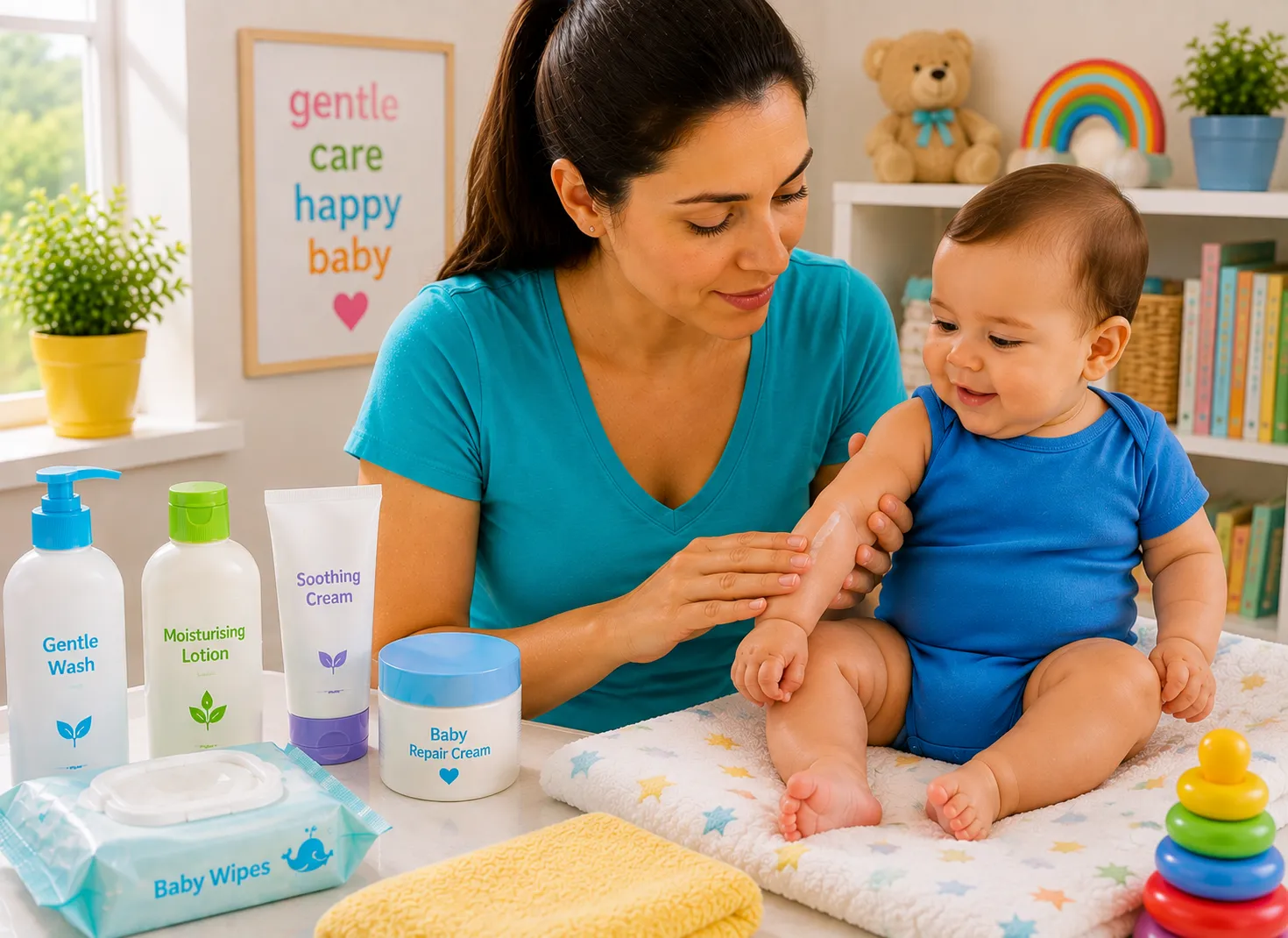
Buying a new cream for a baby with eczema-prone skin can come with more hesitation than excitement. You may have already tried several moisturisers, changed soaps, switched laundry products and spent far too much time wondering why something described as “gentle” did not seem gentle on your baby’s skin. When the skin is already dry, itchy or irritated, the last thing you want is to introduce another product and make matters worse.
The answer is not necessarily to avoid trying anything new. It is to introduce a new cream slowly, simply and observantly. By changing one thing at a time and paying attention to the condition of the skin before, during and after introduction, parents can get a much clearer idea of whether a new product belongs in their baby’s routine.
Start by Looking at the Skin Before You Look at the Cream
Before opening a new jar, take a moment to look at your baby’s skin as it is today. Is it simply dry and rough, or is it intensely red, scratched, cracked, weeping or crusted? Has your baby been unusually itchy during the last few days?
This matters because the condition of the skin barrier can influence how a product feels when it is applied. A cream that feels comfortable on relatively intact dry skin may sting when applied to skin that has been scratched raw. Starting with a clear picture of the skin gives you something to compare against later.
You may even find it useful to take a photograph for your own reference. When you are looking at the same skin several times every day, gradual changes can sometimes be difficult to notice.
Don’t Introduce Three New Things at Once
One of the easiest ways to make baby skincare confusing is to change everything at the same time. A new moisturiser arrives, so you also buy a new body wash, change the wipes and switch the laundry detergent. Three days later the baby’s skin becomes redder and nobody knows why.
When dealing with eczema-prone skin, simplicity gives you information. Introduce one new skincare product at a time wherever practical. Keep the rest of the routine reasonably consistent so that if the skin improves or becomes irritated, you have fewer variables to consider.
This approach can feel slower, but it may actually save time. Instead of repeatedly starting over, you gradually learn what your baby’s skin appears to tolerate.
Consider a Small-Area Introduction First
If your baby has previously reacted to skincare products, it can be sensible to begin with a small amount of the new cream on a limited area of intact skin. This is sometimes casually called a patch test, although it should not be confused with formal medical patch testing used by dermatologists to investigate allergic contact dermatitis. A home test cannot diagnose an allergy.
The purpose is much simpler. You are giving the skin a cautious introduction before applying the cream everywhere. Observe the area for redness, increased itching, swelling, bumps, blistering or obvious discomfort rather than assuming that one comfortable application proves lifelong tolerance.
If you want a more detailed explanation of this process, our guide on Should You Patch Test a New Baby Skincare Product? explains what a small-area trial can and cannot tell you.
Choose the Test Area Carefully
Do not deliberately choose the most inflamed, scratched or broken area of skin for the first application. When the barrier has been significantly disrupted, products may sting simply because substances can interact more readily with vulnerable tissue. That can make your observations difficult to interpret.
Instead, choose a small area where the skin is intact. Apply a modest amount rather than covering a large section immediately. Then watch not only what the skin looks like but how your baby behaves.
A baby cannot tell you, “That feels uncomfortable.” Increased rubbing, scratching, restlessness or trying to wipe the product away can therefore be worth noticing.
Don’t Assume Redness Means the Cream Is Working
There is a persistent idea in some areas of skincare that tingling, warmth or redness means an active ingredient is doing something useful. That is not a principle you need to apply to baby skincare. A cream designed for dry, itchy and eczema-prone baby skin should not need to make the skin uncomfortable to prove its value.
If the skin repeatedly becomes noticeably redder, itchier or more uncomfortable after application, stop and reassess. Look at the ingredients, the condition of the skin and anything else that changed at approximately the same time. If the reaction is substantial or persistent, seek appropriate professional advice.
The goal is comfortable skin, not a dramatic sensation after application.
Give the Skin Time Without Ignoring Warning Signs
Parents understandably want to know exactly how long they should trial a new cream. Unfortunately, there is no single number that can predict every baby’s response. Some irritation appears quickly, while other reactions may become noticeable after repeated exposure.
This is why gradual introduction can be useful. If the small area appears comfortable, the cream can be incorporated more broadly while you continue observing the skin. Avoid simultaneously introducing several other products during this period because doing so makes any subsequent change harder to interpret.
Observation does not mean persisting through an obvious adverse reaction. Significant swelling, blistering, widespread hives or substantial worsening should not be treated as an adjustment period.
Look Beyond the Word “Moisturiser”
When parents are choosing a cream for dry baby skin, it is easy to think that all moisturisers essentially perform the same job. They do not. Formulations can differ substantially in the types of oils, humectants, emollients, soothing ingredients, botanical extracts, fragrances and other components they contain.
For mildly dry skin, a straightforward moisturising formulation may be all that is required. But when skin is repeatedly dry, itchy and eczema-prone, we believe it is useful to think about the problem more broadly. The skin needs moisture, but it also depends on the integrity of its barrier and the wider environment surrounding that barrier.
That thinking is the foundation of our Repair, Nourish and Defend approach.
Repair: Start With the Barrier
The outer skin barrier helps keep water inside the skin while limiting penetration by irritants and other environmental substances. When that barrier is compromised, water can escape more readily and the skin may become dry, rough and increasingly uncomfortable. Scratching can then place even more mechanical pressure on an already vulnerable surface.
For this reason, our first question when developing Itch-A-Bye Baby Repair Cream was not simply, “How can we moisturise the skin?” It was, “How can the formulation support the conditions that a vulnerable skin barrier needs?” Moisture is an important part of that answer, but it is not the entire answer.
Repair therefore sits at the beginning of our framework. When the barrier is better supported, the skin is in a better position to retain moisture and perform its normal protective functions.
Nourish: More Than Adding Water
We use the word Nourish deliberately. Dry skin certainly needs hydration, but nourishment in the Itch-A-Bye formulation extends beyond adding water to the surface. We wanted ingredients that could complement one another through moisturising, conditioning, soothing, antioxidant and other skin-supportive properties.
That is why the formulation combines humectants with oils, soothing ingredients, vitamins and carefully selected botanical extracts. Instead of depending on one heavily promoted ingredient, we built a network of ingredients with different functions. The intention is for those functions to overlap and support one another.
This ingredient synergy is one of the most important differences between the philosophy behind Itch-A-Bye and simply choosing another basic moisturiser.
Defend: Supporting Skin’s Protective Role
Healthy skin is also a protective interface between the body and the outside world. The surface is continually exposed to sweat, saliva, dirt, environmental irritants and microorganisms. Bacteria and fungi naturally exist around us and on the skin, while damaged skin can be more vulnerable to unwanted microbial pressures.
Our Defend pillar recognises this protective role. It does not mean sterilising the skin or trying to remove every microorganism. Instead, we selected ingredients whose wider properties complement the barrier’s normal protective environment, including ingredients investigated for antimicrobial as well as soothing and antioxidant activity.
Repair, Nourish and Defend therefore work together. They are not three unrelated marketing claims but three ways of thinking about what vulnerable skin may need from a well-designed formulation.
Why Black Seed Oil Is So Important to Itch-A-Bye
One of the cornerstone ingredients in Itch-A-Bye Baby Repair Cream is Black Seed Oil from Nigella sativa. We selected it because its value extends beyond simply behaving as an oil. It contains biologically interesting compounds, particularly thymoquinone, that have been investigated for anti-inflammatory, antioxidant and antimicrobial properties.
For dry, itchy and irritated skin, that combination was particularly interesting to us. Black Seed Oil also contributes emollient properties, helping condition and soften the skin surface. It therefore fits naturally across more than one part of our formulation philosophy.
Within Nourish, it provides lipid-rich conditioning and additional supportive properties. Within Defend, its investigated antimicrobial activity makes it particularly relevant to the broader protective environment we are trying to support.
Why We Added MSM
MSM, or methylsulfonylmethane, contributes something different. MSM has been investigated for anti-inflammatory and antioxidant properties and is used in topical formulations for its skin-conditioning and soothing potential. This became important when we considered the relationship between dryness and itching.
A child scratches because the skin is uncomfortable. Scratching then physically damages the surface, which can make the skin feel even more uncomfortable and encourage more scratching. Simply placing water on the skin does not address every part of that cycle.
MSM was therefore chosen to work alongside rather than replace the moisturising components. It is another example of why we prefer a complementary formulation rather than asking one ingredient to carry the entire product.
Why Allantoin Earned Its Place
Allantoin is another ingredient we deliberately included for its soothing and skin-conditioning properties. It has a long history of use in cosmetic formulations designed for dry, rough or easily irritated skin. It can help soften the surface and support a more comfortable skin environment.
This makes Allantoin particularly useful within our Repair and Nourish thinking. When skin has been repeatedly scratched, comfort matters because anything that helps reduce the feeling of roughness and irritation can complement the wider barrier-support strategy. Again, its purpose is not to act alone.
It works alongside our humectants, oils and botanical ingredients as part of the finished formulation.
Why Hyaluronic Acid and Glycerin Work Together
Two of our important hydration ingredients are Hyaluronic Acid and Glycerin. Both are humectants, meaning they help attract and retain water within the outer layers of the skin. This can improve the feeling of softness, flexibility and hydration that very dry skin often lacks.
Glycerin is one of skincare’s most established humectants, while Hyaluronic Acid has a remarkable capacity to associate with water. Combining hydration-supporting ingredients gives us another layer of flexibility within the formulation rather than relying on one moisturising mechanism.
But hydration is still only part of Nourish. The water-binding system sits alongside the lipid, soothing, antioxidant and botanical components that give the formulation its broader character.
Why Vitamins C and E Are Included
We also included Vitamin C and Vitamin E derivatives for their antioxidant and skin-conditioning roles. Skin exists in an environment where oxidative pressures are part of everyday life, and antioxidant ingredients can complement a formulation designed to support the skin surface. Vitamin E also works particularly well within the oil phase of skincare formulations.
Vitamin C derivatives bring additional antioxidant and skin-supporting potential. Used alongside our other ingredients, the vitamins broaden the formulation rather than becoming its headline feature. This is a recurring principle behind Itch-A-Bye.
No single ingredient is expected to do everything.
Why We Chose Multiple Plant Extracts Instead of One Hero Botanical
The botanical portion of Itch-A-Bye was also designed around synergy. Our formulation incorporates specially selected extracts including Centella asiatica, Chamomile, Licorice, Scutellaria baicalensis, Green Tea, Rosemary, Polygonum cuspidatum and Ginger, alongside the wider botanical system. These plants contain different combinations of flavonoids, polyphenols and other phytochemicals that have attracted scientific interest for soothing, antioxidant, anti-inflammatory, conditioning and related properties.
Centella asiatica is widely valued in skincare for its skin-conditioning and recovery-supporting properties. Chamomile has a long history of use in soothing formulations, while Licorice contains compounds investigated for anti-inflammatory and calming activity. Green Tea contributes antioxidant polyphenols, while Scutellaria, Rosemary, Ginger and Polygonum broaden the phytochemical profile.
The point is not that adding more botanicals automatically makes a cream better. The point is that carefully chosen botanical components can contribute different functions within a thoughtfully designed formulation. We selected them because of how their properties complement the wider Repair, Nourish and Defend strategy.
Natural Still Doesn’t Mean Every Baby Will React the Same Way
We are proud that Itch-A-Bye is formulated around natural ingredients and plant botanicals, but responsible natural skincare requires honesty. A natural ingredient is still made of chemical compounds, and individual skin can respond differently to those compounds. “Natural” should never be interpreted as a guarantee that an individual reaction is biologically impossible.
This is precisely why introducing any new cream carefully makes sense when a baby’s skin has been particularly reactive. The quality of the formulation matters, but individual tolerance matters too. These ideas are not contradictory.
You can formulate thoughtfully and still respect the individuality of the child using the product.
Look at the Whole Formulation, Not Just the Famous Ingredients
Parents are becoming increasingly ingredient-aware, which is a positive development. But it can also create a new problem where people search an ingredient list for one familiar name and judge the entire product by whether that ingredient appears. A finished cream is much more complicated than that.
Concentration, compatibility, stability, texture, preservation and the interaction between ingredients all matter. Black Seed Oil on its own is not Itch-A-Bye. Neither is MSM, Hyaluronic Acid, Allantoin or Centella.
It is the synergy of the finished formulation that matters to us. Humectants support hydration, emollient ingredients condition the surface, soothing ingredients support comfort, antioxidants broaden protection from environmental pressures and botanical compounds provide additional complementary properties.
Don’t Forget What Is Happening Outside the Jar
Sometimes parents introduce a new cream during the exact week that something else changes. The weather becomes hotter. The baby starts swimming lessons. A new childcare centre uses a different soap, the child develops a cold and wipes their face constantly, or increased crawling introduces more heat and friction.
If the skin changes, the new cream immediately becomes the obvious suspect because it is the thing you remember changing. But correlation does not always establish cause. Look at what else has happened around the same time.
Heat, sweat, saliva, swimming pool water, frequent bathing, friction, clothing and environmental dryness can all affect vulnerable skin. Understanding this wider picture can prevent you from endlessly switching products while overlooking another source of pressure.
The Skin Threshold Model Can Help Make Sense of This
In Beyond the Skin Barrier, we describe what we call the Skin Threshold Model. Rather than assuming that every flare or episode of itching must have one single cause, the model asks parents to think about the total load acting on the skin. Several individually manageable pressures can sometimes accumulate until the skin’s capacity to cope is exceeded.
Imagine a bucket gradually filling. Dry weather adds some pressure. Heat and sweat add more. Frequent bathing, friction and scratching add more again. The new cream may arrive when the bucket is already close to overflowing.
That does not mean skincare products cannot cause reactions. They certainly can. It means that when evaluating a new cream, the wider condition of the skin and the other pressures surrounding it should also be considered.
How to Introduce Itch-A-Bye Baby Repair Cream
If you are introducing Itch-A-Bye Baby Repair Cream to a child whose skin has previously been highly reactive, begin simply. Avoid changing the entire skincare routine on the same day. Consider applying a small amount to an area of intact skin first and observe how your baby’s skin responds.
If it is comfortable, gradually incorporate the cream into the areas where your baby’s skin needs moisturising and barrier support. Pay attention to how the skin feels over the following days rather than repeatedly adding other new products. Itch-A-Bye can be used once daily or as needed according to the child’s skincare requirements.
The formulation was created specifically around the needs of dry, itchy and eczema-prone baby and young children’s skin, using our Repair, Nourish and Defend approach.
What If the Cream Seems to Make the Skin Redder?
Stop and look carefully at what is happening rather than immediately applying more. Ask whether the redness occurs consistently after application, whether the skin was already scratched or inflamed and whether another environmental or skincare change happened at the same time. Our previous guide, Why Did a New Baby Cream Seem to Make the Skin Redder?, explores this question in much greater detail.
If the product repeatedly causes obvious discomfort or worsening, discontinue it. If the reaction is significant, persistent or difficult to understand, professional assessment is appropriate. Continuing to challenge visibly unhappy skin rarely provides useful information.
A good skincare routine should ultimately make daily care simpler, not turn every application into an experiment.
What If the New Cream Seems to Be Helping?
Keep the rest of the routine reasonably stable for a while. Parents sometimes see improvement from a new routine and immediately begin adding several more products in the hope of accelerating the result. That can make it difficult to know what is actually helping.
Consistency is particularly valuable with dry and eczema-prone skin. Barrier support is not something that only matters on visibly bad days. Regular skincare can help maintain hydration and support the skin before it becomes extremely dry and uncomfortable.
Once you have found a simple routine your baby’s skin appears to tolerate well, there may be little advantage in constantly changing it.
When Should You Seek Professional Advice?
Seek medical advice when the skin is worsening despite appropriate care, when itching is substantially disrupting sleep or daily life, or when you repeatedly cannot identify why products seem to cause reactions. Skin that becomes increasingly painful, hot, swollen, blistered, weeping or crusted should also be assessed. These changes can indicate that something beyond straightforward dryness is occurring.
Urgent medical attention is appropriate if a child develops breathing difficulty, swelling around the face or mouth, widespread hives, collapse or appears seriously unwell. Do not deliberately reapply a suspected product to test whether a significant reaction happens again.
For persistent suspected contact allergy, a dermatologist can determine whether formal medical patch testing is appropriate.
Frequently Asked Questions
Should I patch test every new cream on my baby?
Not every baby requires an elaborate testing routine for every skincare product. However, a cautious small-area introduction can be sensible when a child has eczema-prone or highly reactive skin, particularly if previous products have caused problems. The purpose is to reduce unnecessary widespread exposure while you observe tolerance.
How many new products should I introduce at once?
Ideally, keep the number of simultaneous changes low. Introducing one new skincare product at a time makes it much easier to identify what may be helping or irritating the skin. If you change the cream, wash, shampoo, wipes and laundry detergent simultaneously, any subsequent reaction becomes much harder to interpret.
Should I put the new cream directly on the worst eczema-prone area?
Severely scratched, broken, weeping or highly inflamed skin is not an ideal place for an informal tolerance test. A compromised barrier can respond differently and products may sting. Begin on intact skin when assessing tolerance and seek appropriate professional advice for severe or persistent skin problems.
Why can a cream sting dry baby skin?
Very dry or scratched skin can have a compromised barrier, which may allow ingredients to interact more readily with vulnerable tissue. That can sometimes produce stinging even when a product is tolerated on intact skin. Persistent or significant discomfort should nevertheless be taken seriously.
How long should I give a new baby cream?
There is no universal number of days that applies to every product and every child. Immediate irritation can occur, while some responses emerge after repeated use. Introduce the product gradually, observe the skin and do not interpret substantial worsening as something that must simply be endured.
Is a natural cream automatically better for eczema-prone baby skin?
Natural ingredients can provide valuable properties, but natural origin alone does not determine whether a formulation is suitable for an individual child. Ingredient selection, concentration, formulation quality and individual tolerance all matter. We use natural ingredients in Itch-A-Bye because of the functions we selected them to perform within the formulation, not simply because the word “natural” sounds appealing.
Why does Itch-A-Bye contain so many different supportive ingredients?
Because dry, itchy and eczema-prone skin can have more than one need. We use ingredients with complementary moisturising, conditioning, soothing, antioxidant, anti-inflammatory and antimicrobial properties within our Repair, Nourish and Defend framework. The objective is synergy across the finished formulation rather than dependence on one hero ingredient.
What makes Black Seed Oil important in Itch-A-Bye?
Black Seed Oil contains compounds including thymoquinone that have been investigated for anti-inflammatory, antioxidant and antimicrobial properties. It also provides emollient conditioning to help soften dry skin. This combination makes it particularly relevant to our Nourish and Defend philosophy.
Why isn’t moisturising alone the whole answer?
Hydration is extremely important for dry skin, but the skin barrier also performs protective functions and can be affected by irritation, scratching and environmental pressures. Our Nourish pillar therefore includes hydration while extending into soothing, conditioning, antioxidant and other supportive functions. That broader perspective is one reason Itch-A-Bye combines several complementary ingredient groups.
Can my baby’s skin react to a cream even after initially tolerating it?
Yes. Skin condition changes over time, and repeated exposure can matter with some forms of irritation or allergy. Environmental pressures can also alter the barrier, meaning the skin receiving the product several weeks later may not be in the same condition as it was during the first application.
Make the Introduction Simple
Introducing a new cream to eczema-prone baby skin does not need to become complicated. Start with the skin in front of you, change one thing at a time, consider a small-area introduction when appropriate and pay attention to how the skin responds. Avoid judging a formulation entirely by its marketing language or by one fashionable ingredient.
Then ask a more useful question: What is this cream designed to contribute to my baby’s skin?
For us, that answer became Repair, Nourish and Defend. It is why Itch-A-Bye combines hydration from Glycerin and Hyaluronic Acid with the conditioning and wider properties of Black Seed Oil, the soothing support of MSM and Allantoin, antioxidant vitamins and a carefully selected network of plant botanicals. Each ingredient has a purpose, but the real intention lies in how they work together.
And if you want to understand why your baby’s skin can change from one week to the next, why apparently unrelated pressures can accumulate and why skincare is only one part of the picture, Beyond the Skin Barrier takes that conversation much further. Understanding the skin can make choosing what to put on it considerably easier.