
Should You Put Baby Cream Everywhere or Only on Dry Patches?
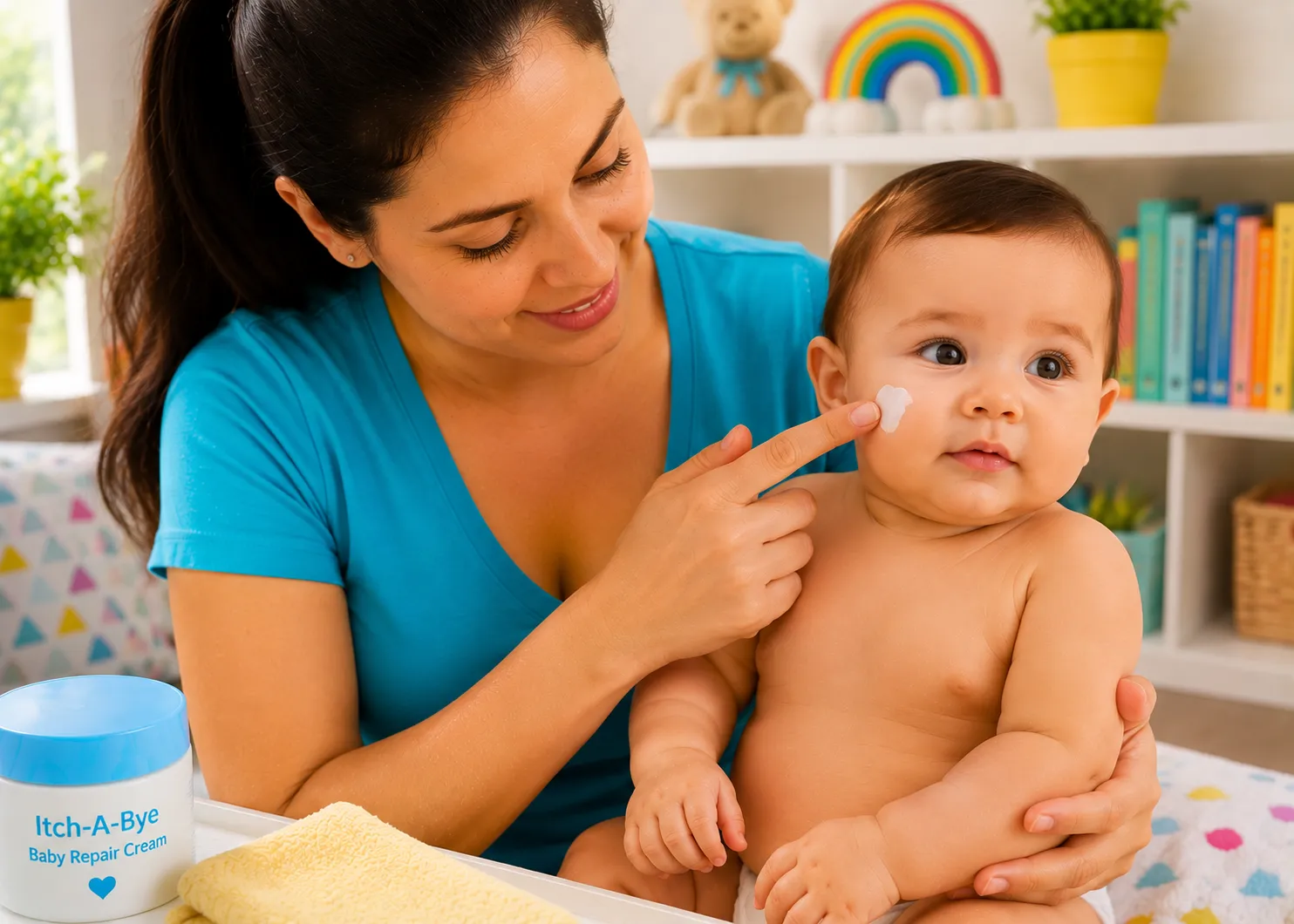
You notice a rough patch on your baby’s cheek, so you reach for the moisturiser. Then you run your hand over the other cheek and it feels perfectly soft. The arms look fine, the legs look fine, and the tummy does not appear dry at all. Suddenly a very ordinary skincare routine raises a surprisingly difficult question: should you put baby cream everywhere, or only on the dry patches?
There is no rule saying that every baby needs to be covered from head to toe in cream every day. At the same time, waiting until skin becomes visibly dry before giving it any support may not always be the best approach for a child whose skin repeatedly loses moisture. The most useful answer depends on what your baby’s skin normally does, not simply what it looks like at one particular moment. That distinction can make baby skincare much simpler.
The Short Answer
If your baby normally has comfortable skin and only develops an occasional small dry patch, applying cream to that area may be perfectly reasonable. There is usually little benefit in automatically coating every unaffected area simply because one cheek or one elbow has become dry. Targeted moisturising allows you to respond directly to the area that needs support.
But some babies have a broader tendency toward dry, itchy or eczema-prone skin. Their legs may become rough after bathing, their cheeks dry after being outside, and their skin may become uncomfortable after swimming or during colder weather. In that situation, moisturising more widely can become part of maintaining the skin rather than repeatedly chasing individual dry patches.
That is the important difference.
Visible Dryness Is Only Part of the Story
We naturally judge skin by what we can see. If it looks smooth, we assume everything underneath must be functioning perfectly. If it becomes flaky or rough, we decide that something has changed.
But dryness develops gradually. The outer skin barrier can begin losing water before obvious flaking appears, and the skin can feel slightly different before it looks dramatically different. By the time a parent notices a clearly rough patch, the process leading to that dryness may already have been happening for some time.
This does not mean that normal-looking skin should constantly be covered in product. It simply means that appearance should not be the only thing guiding the routine. How the skin usually behaves matters too.
Think About Your Baby’s Pattern
One of the most useful things a parent can do is stop looking at each dry patch as an isolated event. Instead, look for the pattern. Does the same area become dry again and again, or does dryness move around the body?
Perhaps your baby’s cheeks are almost always the problem while the rest of the body remains soft. Perhaps both legs become rough after every bath, even though they look normal beforehand. Another baby may develop widespread dryness whenever the weather becomes cooler.
Those are three different patterns, and they do not necessarily require exactly the same moisturising routine.
When Treating Only the Dry Patches Makes Sense
Targeted application can work very well when dryness is genuinely localised. A baby might develop a rough area where saliva repeatedly reaches the chin, where clothing rubs against the neck, or where one particular area is exposed to more friction. If everything else remains consistently comfortable, there may be no reason to apply the same amount of cream everywhere.
This approach can also make the routine easier. You use less product, application takes less time, and you can pay closer attention to whether the affected area is actually improving. If the patch settles and stays settled, the rest of the skin may never have needed additional support.
The key word is localised.
When Broader Moisturising May Make More Sense
The situation changes when dryness is not really confined to one place. Some babies repeatedly develop roughness across the arms and legs, or their skin generally feels dry even when there are no obvious flaky patches. Other children move through a cycle in which one patch improves while another appears somewhere else.
In those cases, moisturising only the most obvious patch can become a game of catch-up. You improve one area, then another dries out, then another starts itching. A broader moisturising routine may help support areas that are prone to dryness before they become noticeably uncomfortable.
This is particularly relevant when a baby’s skin has a well-established tendency to lose moisture easily.
There Is a Difference Between Prevention and Overuse
This distinction is important because preventative skincare does not mean applying enormous amounts of cream everywhere. A light, sensible layer across dryness-prone areas is very different from repeatedly smothering the entire body in thick layers whether they are needed or not. The objective is support, not excess.
As we discussed in our article on how much baby cream you should apply, the right amount is generally enough to provide comfortable, even coverage. More product does not automatically mean more benefit. The same principle applies when deciding how much of the body to moisturise.
Use the skin’s behaviour to decide where that support belongs.
The Face Often Needs a Different Approach
A baby’s face experiences pressures that the tummy or upper legs may rarely encounter. Saliva, food, dribbling, wiping, bedding and repeated touching can all affect facial skin. The cheeks and area around the mouth can therefore become dry even when the rest of the baby’s body remains beautifully soft.
If that is your baby’s pattern, targeted facial moisturising can make sense. You do not necessarily need to turn every cheek application into a full-body skincare routine. Instead, concentrate on the area repeatedly exposed to those pressures.
Then watch what happens over several days rather than judging one application.
Arms and Legs Can Tell a Different Story
Arms and legs are more likely to reveal broader dryness, particularly after bathing or during cool, dry weather. Run your hand gently over the skin rather than relying only on what you can see. Sometimes skin that looks perfectly normal feels slightly rough or dry to the touch.
If the arms and legs repeatedly develop that texture, applying moisturiser across those areas may be more useful than waiting for individual patches to become obvious. This is especially true when you already know that certain situations reliably trigger dryness. The routine becomes anticipatory rather than reactive.
You are supporting a known tendency.
What About the Tummy and Back?
The torso may remain relatively comfortable in babies whose exposed areas become dry easily. Clothing can provide some protection from wind and environmental exposure, although heat, sweat, detergents and friction can create their own problems. Again, there is no requirement to moisturise the tummy and back merely because you moisturised the legs.
But if your baby’s dryness tends to be widespread, the torso should not automatically be ignored either. After bathing, for example, you may notice that the whole body feels slightly drier than it did beforehand. In that situation, a broader application may be appropriate.
The decision should follow the skin rather than a rigid rule.
Skin Folds Need Particular Thought
The neck, armpits, behind the knees and other folds behave differently from exposed dry areas. These places can trap moisture, sweat and heat, so automatically applying thick layers of rich cream into every fold may not always be helpful. A baby’s dry shin and warm neck fold do not necessarily need identical treatment.
This is another reason the instruction to simply “moisturise everywhere” can be too simplistic. Different parts of the body experience different environments. What is helpful on a dry cheek may feel unnecessarily heavy in a warm, damp fold.
Skincare should respond to those differences.
What About After a Bath?
Bathing is one situation where broader moisturising can make particular sense for a dryness-prone baby. Water, cleansers and prolonged bathing can affect the oils and lipids at the skin’s surface. Some babies therefore feel dry across several areas after a bath rather than in one isolated location.
If you notice that pattern, gently pat the skin dry and moisturise the areas that normally become dry. For some babies that might mean the arms and legs. For others, it may mean most of the body.
You do not have to wait until obvious flakes appear before responding to a pattern you already recognise.
After Swimming Can Be Similar
Swimming creates another situation in which dryness may become more widespread. Prolonged water exposure, chlorine in swimming pools and salt water can leave some children’s skin feeling tight or uncomfortable. A child who normally has only a few troublesome areas may suddenly need broader moisturising after a swim.
That is why we often talk about the simple routine of rinse, moisturise and dress after swimming. Rinse away chlorine or salt, gently pat the skin dry and apply moisturiser to the areas that tend to become dry. If swimming affects most of your child’s skin, a broader application may be sensible.
The routine responds to the exposure.
Weather Can Change the Answer
A moisturising routine that works perfectly in humid summer weather may not be enough during winter. Cold air outside, heated indoor air and lower humidity can increase the challenge for skin that already loses moisture easily. Suddenly the dry patches that once appeared only on the cheeks may begin appearing on the legs and arms as well.
That does not necessarily mean something has gone wrong. The environment surrounding the skin has changed. Your moisturising routine may need to change with it.
Baby skincare does not have to remain identical every month of the year.
Heat Can Change the Answer Too
It is equally important not to assume that broader and thicker moisturising is always better. In hot weather, babies can sweat easily, particularly underneath clothing and in skin folds. Applying heavy layers everywhere and then wrapping the baby warmly can create an uncomfortable combination of cream, heat, sweat and friction.
During warmer conditions, you may find that a lighter application across dryness-prone areas is enough. Areas that remain naturally comfortable may not need additional product. Pay particular attention to how the skin behaves under clothing and around folds.
The goal is comfortable skin, not maximum product coverage.
Why Some Babies Need More Maintenance Than Others
No two babies begin with exactly the same skin. The infant skin barrier continues developing after birth, and individual differences can affect how easily the skin loses water and responds to the surrounding environment. Family tendencies, climate, bathing practices and everyday exposures can also influence what parents observe.
One baby may rarely need moisturiser outside the occasional dry cheek. Another may become rough and itchy within days of stopping a regular routine. Neither observation means that the parent is doing something wrong.
It means the babies’ skin is behaving differently.
Moisturising Normal-Looking Skin Does Not Make It “Dependent”
Some parents worry that applying cream to skin that is not visibly dry will somehow make the skin lazy. They fear that once they begin moisturising larger areas, the baby’s skin will forget how to moisturise itself. That is not a useful way to think about barrier skincare.
A moisturiser does not teach the skin to stop functioning. It temporarily helps support hydration, softness and the surface environment while it is present. If dryness returns after stopping, that generally tells you more about the skin’s underlying tendency and ongoing exposures than it does about “dependence.”
We explored this more fully in Why Does Baby Dry Skin Return When You Stop Moisturising?.
Maintenance Can Be Easier Than Recovery
Imagine that your baby’s legs repeatedly become very dry every four or five days. You wait until the roughness is obvious, begin moisturising intensively, get the skin comfortable again and then stop completely. Several days later, you repeat the same cycle.
For that particular baby, a lighter maintenance routine may be easier than repeatedly allowing the skin to become very dry. You might moisturise the legs regularly even when they look reasonably good because experience has shown that those areas repeatedly lose moisture. This is not about treating healthy skin as though something is wrong with it.
It is about learning from the pattern.
The Itch-Scratch Cycle Is Another Reason to Think Ahead
Dryness can contribute to itching, and itching can lead to scratching. Scratching then places additional mechanical pressure on the outer barrier, which can make the skin feel even more uncomfortable. Once that cycle begins, getting the skin comfortable again may take more effort than maintaining comfort in the first place.
For a child whose dry skin frequently progresses into scratching, supporting the dryness-prone areas before they become extremely rough can therefore make practical sense. That does not mean applying cream continuously throughout the day. It means recognising the areas where dryness tends to become a bigger problem.
Maintenance has a purpose.
Think in Zones Rather Than “Everywhere or Nowhere”
One of the easiest approaches is to divide your baby’s skin mentally into zones. There may be problem areas, such as cheeks or legs that repeatedly become dry. There may be occasionally dry areas that need support only after bathing, swimming or weather changes.
Then there may be areas that remain consistently soft and comfortable. Those areas may need little or no additional moisturiser in your baby’s everyday routine. This approach avoids the false choice between coating the whole body and treating only the single driest spot.
You can moisturise according to need.
The Skin Threshold Model Helps Explain Why
In Beyond the Skin Barrier, we describe the Skin Threshold Model. The basic idea is that what parents see on the surface can reflect the combined effect of several pressures rather than one isolated cause. Barrier weakness, heat, sweat, friction, chlorine, saliva, scratching, microbes and environmental conditions can all contribute.
When the combined pressure remains below the child’s individual threshold, the skin may look relatively calm. When enough pressures accumulate, dryness, itching, redness or irritation may become more noticeable. This helps explain why a patch can appear after swimming one week but not another, or why previously comfortable skin suddenly becomes dry during a weather change.
The visible patch may be the end result of several things happening together.
This Changes How You Think About Moisturising
If you only moisturise whatever looks driest at that exact moment, you are responding to the final visible sign. Sometimes that is all that is needed. But when a baby has recurring dry, itchy or eczema-prone skin, it can be useful to think about supporting the areas that repeatedly approach that threshold.
That might mean broader moisturising after swimming. It might mean moisturising both legs during winter even though only one currently has a rough patch. Or it might mean continuing to treat only the cheeks because the rest of the body has never shown any tendency toward dryness.
There is no contradiction between these approaches.
Repair, Nourish and Defend
This is also why our approach with Itch-A-Bye Baby Repair Cream is built around Repair, Nourish and Defend. We do not see dry baby skin simply as something that needs to be covered with more and more moisturiser. We look at the broader environment in which the skin barrier is trying to function.
Repair means supporting the barrier and helping reduce the conditions that encourage excessive moisture loss. Nourish means supplying hydration together with carefully selected ingredients that help support, condition and soothe the skin. Defend recognises the skin barrier’s important role in protecting vulnerable skin against bacteria, fungus and other environmental pressures.
That broader approach influences both what is in the cream and how we think it should be used.
Nourish Is Not Just About Hydration
Many baby moisturisers understandably focus heavily on water loss. Hydration matters enormously, and Itch-A-Bye contains Glycerin and Hyaluronic Acid to help attract and retain moisture within the outer layers of the skin. But we believe Nourish should go further than simply putting water back.
The formulation also brings together Black Seed Oil, MSM, Allantoin, Vitamin C, Vitamin E and specially selected plant extracts. These ingredients contribute different soothing, conditioning, antioxidant and skin-supportive properties. Rather than expecting one fashionable ingredient to solve every problem, they are intended to work as part of a complementary formulation.
The formulation matters just as much as the area being covered.
Black Seed Oil Brings More Than Moisture
Black Seed Oil from Nigella sativa is one of the cornerstone ingredients in Itch-A-Bye. It contains naturally occurring compounds, including thymoquinone, that have attracted scientific interest for their anti-inflammatory, antioxidant and antimicrobial properties. As an oil, it also contributes to conditioning and softening dry skin.
That makes Black Seed Oil particularly interesting within the Repair, Nourish and Defend framework. Its purpose is not simply to make the ingredient list look natural. It contributes properties that complement the hydration and conditioning provided by other parts of the formulation.
We want ingredients to earn their place.
MSM and Allantoin Add Their Own Support
MSM is included for its soothing and skin-supportive potential, including scientific interest around its anti-inflammatory and antioxidant properties. When dry skin becomes uncomfortable, reducing the pressures that encourage repeated rubbing and scratching can become particularly important. MSM therefore fits naturally within a formulation designed around more than surface hydration.
Allantoin is valued in skincare for its soothing, conditioning and skin-protective properties. It can help support the feel of rough or uncomfortable skin and complements the other ingredients within the formulation. Together, MSM and Allantoin help broaden what we mean by Nourish.
They are not there simply to make the ingredient list longer.
The Botanical Extracts Add Another Layer
Itch-A-Bye also contains a carefully selected botanical complex that includes extracts such as Centella asiatica, Chamomile, Licorice, Scutellaria baicalensis, Green Tea, Rosemary, Polygonum cuspidatum and Ginger. These plants contain naturally occurring phytochemicals associated with antioxidant, soothing, conditioning and anti-inflammatory properties. Their role is complementary rather than relying on one botanical as a miracle solution.
Centella, Chamomile, Licorice and Green Tea in particular have long histories of interest in skin-supportive preparations. When brought together with Black Seed Oil, MSM, Allantoin, Hyaluronic Acid and the rest of the formulation, they create a broader ingredient system. That is the kind of synergy we wanted from Itch-A-Bye.
It is a very different philosophy from simply applying the thickest possible layer of a basic moisturiser.
So Where Should You Apply Itch-A-Bye?
If your child has one or two isolated dry areas and everything else remains consistently comfortable, start with those areas. Apply enough Itch-A-Bye Baby Repair Cream to provide a light, even covering and gently spread it over the skin. There is no requirement to cover the entire body simply because one cheek is dry.
If your child has a broader tendency toward dry, itchy or eczema-prone skin, apply it more widely to the areas that repeatedly need support. That may include both arms and legs, the torso or most of the body depending on the child’s individual pattern. After swimming, bathing or other known triggers, you may temporarily broaden the application.
Let the child’s skin history guide you.
Do You Need to Apply It to Perfectly Normal Skin?
Not necessarily. If an area has always remained soft, comfortable and unaffected, there may be little reason to apply cream there merely for the sake of completeness. Baby skincare should have a purpose.
But “looks normal today” is slightly different from “never becomes dry.” If an area repeatedly becomes dry whenever moisturising stops, regular maintenance may be useful even during periods when it looks good. You already know something about that area’s behaviour.
That knowledge should influence your decision.
What If Only One Patch Keeps Coming Back?
A recurring patch deserves more attention than simply increasing the amount of cream indefinitely. Look at what repeatedly touches that particular area. Saliva, clothing seams, bedding, dribble, wiping, sweat and friction can all create very localised pressure.
If you moisturise the area successfully but the same patch keeps returning, ask what happens between applications. Sometimes changing the exposure makes as much difference as changing the moisturiser. This is exactly the kind of pattern that the Skin Threshold Model encourages parents to notice.
The location itself may be giving you a clue.
What If New Dry Patches Keep Appearing?
When new patches continually appear in different locations, the issue may be broader than one troublesome spot. That pattern can suggest that the skin generally has difficulty retaining moisture or that a wider environmental factor is affecting it. Bathing practices, weather, cleansers, clothing, swimming and heat are worth considering.
In this situation, treating each new patch separately may become unnecessarily reactive. Broader moisturising across the areas that tend to dry out can make the routine more consistent. You can then watch whether the frequency of new dry areas changes.
The objective is to learn from the response.
Should You Moisturise the Whole Body Every Day?
Some babies with widespread dry or eczema-prone skin may benefit from regular whole-body moisturising. Other babies simply do not need it. There is no prize for using the most cream, and there is no virtue in refusing to moisturise areas that repeatedly become dry.
If whole-body moisturising keeps your child’s generally dry skin comfortable, it can be a sensible maintenance routine. If only the cheeks ever become dry, targeted application may be all you need. And if the pattern changes with the seasons, the routine can change too.
The best routine is the one that fits the child.
Frequently Asked Questions
Should I put moisturiser all over my baby every day?
Not every baby needs whole-body moisturising every day. If your baby’s skin remains naturally soft and comfortable across most of the body, targeted moisturising may be sufficient. Babies with widespread or repeatedly recurring dryness may benefit from broader regular application.
Watch the skin over time rather than following a rule designed for every baby.
Should I only put cream where my baby’s skin looks dry?
You can do that when dryness is genuinely isolated. However, areas that repeatedly become dry may benefit from maintenance even when they temporarily look normal. Visible flaking is not the only indication that an area tends to lose moisture.
Your baby’s usual pattern can therefore be more informative than today’s appearance alone.
Can I put baby cream on normal-looking skin?
Yes, an appropriate moisturising cream can be used on normal-looking skin, particularly in areas known to become dry. But that does not mean you need to apply it everywhere without a reason. Use the cream where it provides useful support.
A light maintenance application is very different from unnecessarily heavy application.
Should I moisturise my baby’s whole body after a bath?
If bathing tends to leave most of your baby’s skin dry, whole-body or broad moisturising afterwards may make sense. If only certain areas become dry, you can concentrate on those. Keep the bath itself gentle, because very hot water, prolonged bathing and harsh cleansing can increase dryness.
A good moisturiser works best as part of a sensible overall routine.
Should I moisturise everywhere after swimming?
If swimming leaves your child’s skin generally dry, broader moisturising after rinsing can be useful. If only the legs or another specific area tends to react, focus there. Chlorine, prolonged water exposure and salt water can affect children differently.
The post-swim routine should reflect your child’s usual response.
Should I put cream into my baby’s skin folds?
Be more selective around folds because they can trap heat, sweat and moisture. Thick applications may not be necessary in areas that are already warm and moist. If a fold is dry or irritated, consider what may be causing it rather than automatically treating it exactly like a dry shin or cheek.
Different areas of the body can require different approaches.
If one cheek is dry, should I moisturise both cheeks?
You can, particularly if both cheeks commonly become dry, but you do not have to. If only one cheek is repeatedly affected, consider whether saliva, sleeping position, rubbing or another local exposure is contributing. Applying cream to the affected cheek while investigating the pattern is reasonable.
The repeated one-sided location may itself be useful information.
Can moisturising everywhere make my baby’s skin dependent on cream?
Moisturising does not make the skin “lazy” or teach it to stop producing its own protective components. If dryness returns when moisturising stops, that more often reflects the skin’s underlying tendency toward water loss or the pressures still acting on it. The cream was supporting the skin while it was being used.
That is maintenance, not addiction.
How should I use Itch-A-Bye if my baby has only a few dry patches?
Apply Itch-A-Bye Baby Repair Cream gently to the areas that need support, using enough to provide a light and even covering. If other areas remain consistently comfortable, you do not need to cover them merely because you are using the cream elsewhere. Observe how the patches respond and whether the same areas repeatedly become dry.
You can broaden the application if the child’s dryness becomes more widespread.
What if my baby’s whole body is dry?
When dryness is widespread, a broader moisturising routine can be more practical than treating dozens of individual patches. Work section by section so that you can apply an even amount without using unnecessary excess. Pay attention to bathing, cleansers, weather, clothing, heat and other factors that may be contributing.
If the skin is persistently very inflamed, cracked, weeping, painful or otherwise concerning, it deserves appropriate professional assessment rather than simply adding progressively larger amounts of moisturiser.
Stop Thinking “Everywhere or Nowhere”
The most useful baby skincare routines are rarely built around absolute rules. You do not have to choose between covering your baby from head to toe every day and waiting until the skin becomes extremely dry before applying anything. There is a sensible middle ground.
Moisturise the areas that are dry. Support the areas you already know repeatedly become dry. Broaden the routine after exposures such as bathing or swimming when your child’s skin tells you that it needs broader support.
And leave consistently comfortable areas alone when they do not need anything.
With Itch-A-Bye, this fits naturally with our Repair, Nourish and Defend philosophy. The objective is not to persuade parents to use more cream. It is to give dry, itchy and eczema-prone skin thoughtful support using a formulation that combines hydration with oils, skin-conditioning ingredients, antioxidants and carefully selected plant botanicals.
If your baby’s dryness keeps moving, returning or appearing after particular exposures, there may also be more to understand than where you put the moisturiser. Beyond the Skin Barrier explores the developing baby skin barrier, microbes, immune signalling, environmental pressures, the gut-skin relationship and our Skin Threshold Model to help parents understand the wider picture.
Because the better question is not simply, “Should I put cream everywhere?” It is: “Where does my baby’s skin actually need support?”